Why California’s Homeowners’ Insurance Market Collapsed—and How to Fix It
May 12, 2025
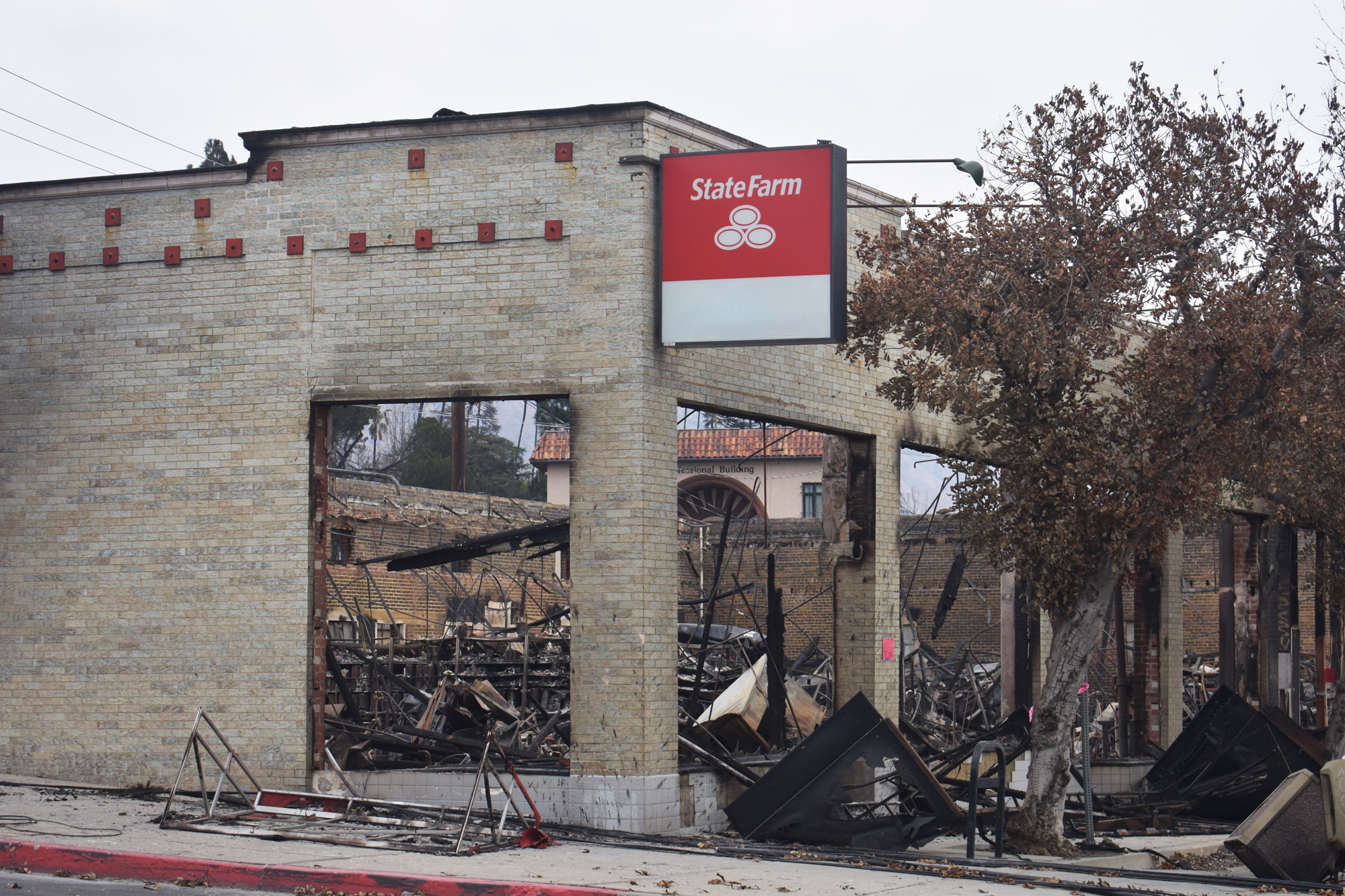
Burned out State Farm insurance office in Altadena, California after the January 2025 fires.
Policy Report

Contents
- Overview
- The Economics of a Well-Functioning Insurance Market
- California’s Proposition 103
- California Has the Worst Insurance Price Controls
- Loss Events in California Have Become More Devastating
- Prohibitions in California on Using Forward-Looking Catastrophe Models
and Factoring Reinsurance Costs into Rates - Delays in California Insurance Rate Decisions
- Insurers Have Been Leaving California and Restricting New Policies
- California’s FAIR Plan Is Overwhelmed
- Key Policy Recommendations
- Conclusion
Acknowledgments
I. Overview
California is facing a property insurance crisis. During the past several years, owing to devastating loss events, the inefficiency and burdens of California’s insurance regulations have become alarmingly evident. Since 2022, seven of the twelve largest insurance companies in California have limited new policies in the state. The state’s dire straits have been amplified by the recent devastating wildfires in Los Angeles, which destroyed billions of dollars in structures and took more than two dozen lives.
The root cause of California’s current crisis lies in a combination of increasingly destructive wildfires and a regulatory framework that is both inefficient and inadequate in addressing the growing risks. Proposition 103 requires that all rate changes on property and casualty insurance lines be approved by the California insurance commissioner before being implemented, a process that can take months, resulting in significant rate suppression. Furthermore, prohibitions on using forward-looking “catastrophe models” for assessing wildfire risks have further compounded the exposure faced by insurance companies.
The retreat by major insurers has left homeowners in many areas of California with limited options for obtaining coverage. Following the withdrawals of those insurance companies, the California Fair Access to Insurance Requirements (FAIR) Plan, the state’s “insurer of last resort,” is overwhelmed and faces a financial crisis. If the FAIR Plan cannot pay its claims, insurance companies are legally required to cover unpaid FAIR losses, exposing insurers to billions of dollars in additional liability exposure. The possible future burdens could be immense; as of March 2025, insurance companies have already been hit with a $1 billion assessment due to the FAIR Plan’s losses from the Los Angeles wildfires.
An unworkable and damaging regulatory framework for insurers has led the Independent Institute to award Harvey Rosenfield, Proposition 103, the California Department of Insurance, and California Insurance Commissioners with its sixteenth California Golden Fleece® Award. This report examines the regulatory failures that have driven the chaotic collapse of the state’s homeowners’ insurance markets and offers recommendations on the reforms necessary to create a functioning and sustainable market.
II. The Economics of a Well-Functioning Insurance Market
Insurance markets pool and spread policyholders’ risk exposures; the very purpose of insurance is to serve as a hedge against financial liability for low-probability events that carry substantial monetary costs if they occur. A well-functioning insurance market is one in which different risk classes pay “actuarially fair” premiums directly associated with their real liability risk. In other words, insurance markets function efficiently when each risk class pays its own way.
Risk classes are groups that have similar characteristics, and these groups are assessed premiums based on the level of risk associated with them. The standard insurance model operates on the principle that each risk class pays a premium that reflects its long-term expected average cost of claims, in addition to a normal risk-adjusted return on capital for insurance company owners. For the market to function efficiently, providers must be able to assess and incorporate all relevant information and variables associated with risk into their rates.
When regulations restrict the consideration of relevant information, some risk classes end up subsidizing others, distorting prices and creating inefficiencies and perverse incentives in the insurance market. In 2019, it became illegal in California to consider gender as a factor in auto insurance rates. This ban did not change the reality that, on average, men and women have different driving habits and expose insurers to different levels of risk.
According to the Insurance Information Institute, women get into fewer accidents, have fewer DUIs, and have fewer serious accidents than men. There is no such thing as a free lunch; the inability to charge men for their riskier driving habits means that women subsidize men’s auto insurance coverages. In a 2020 press release, the California Department of Insurance admitted that after the ban went into effect, drivers with comparable driving records pay an average annual premium of $1,608. In contrast, before, males with the same record would have paid $1,723 and females $1,555. Male drivers thus “save” $115 on average, while females pay an extra $53 in car insurance premiums. The two pre-ban premiums were not discriminatory but rather were based on empirical differences in accidents and claims.
If restrictions, whether they be explicit price controls or limits on the inclusion of relevant rating factors, become so egregious that they cause a risk of financial insolvency, an insurance provider may be forced to withdraw from specific areas of a market or the entire market, as has occurred in California. Well-intended regulations designed to “protect” consumers or prevent discrimination can lead to situations in which insurers can no longer afford to operate in a particular jurisdiction. Those regulations are precisely what has wreaked havoc in California.
III. California’s Proposition 103
The most consequential regulation of California’s insurance market is Proposition 103, the “Insurance Rate Reduction and Reform Act,” which voters approved in 1988. Before its passage, California was considered an “‘open competition’ state in which competition regulated the [insurance] marketplace,” as previously described by the California Department of Insurance. The proposition, found in Insurance Code Sections 1861.01–1861.16, rolled back the then-current insurance rates by 20 percent and established strict requirements on rate setting. Under Proposition 103, the rate-setting process is overseen by an elected state official, the California insurance commissioner, whose job is to ensure that “no rate shall be approved or remain in effect which is excessive, inadequate, unfairly discriminatory or otherwise in violation of this chapter” (CA Ins Code § 1861.05 [2024]). The proposition passed by a narrow margin, securing just 51 percent of the vote.
Proposition 103 created a “prior approval system,” in which insurance companies must receive permission from the commissioner before changing rates on property and casualty insurance lines (lines are simply products that provide insurance coverage). Rate change applications are not simple. According to a 2024 working paper from the National Bureau of Economic Research, rate change applications in California can “range from several hundred pages to more than 10,000 pages” and usually involve “several rounds of correspondence and objection letters from state rate specialists.”
The proposition also created the “consumer intervenor process,” whereby an entity that “actually represents the interests of consumers” is allowed to challenge insurance rate applications and recover costs, expenses, and attorney’s fees from insurers. The fees are allowed to be passed on to consumers. Recoveries can amount to hundreds of thousands of dollars per year. In fact, between 2003 and 2023, intervenors were paid more than $23 million, over $1 million per year on average. For the majority of Proposition 103’s history, consumer intervenors could only recover costs if a hearing occurred. This changed in 2006, however, when the regulation was modified to allow intervenors to recover fees prior to a hearing being conducted.
The consumer intervention process has come under scrutiny due to accusations that Consumer Watchdog, the most prolific “consumer advocate,” uses the intervention process for its own financial gain. Interestingly enough, Harvey Rosenfield, the founder of Consumer Watchdog, was also the author of Proposition 103.
After an insurance company applies for a rate change, the application is examined by the intake units of the California Department of Insurance (CDI) to verify that the application is complete and meets administrative requirements (“basic compliance”). Once an application has been deemed compliant, the intake unit will issue a public notice within ten days. From the date of the public notice, the rate change will be automatically approved after sixty days unless a rate hearing is requested. This provision, known as the “deemer” clause, is often rendered moot because the CDI frequently requests insurers to waive the deemer date. If they refuse, the CDI simply escalates the matter to a hearing. The commissioner cannot deny a rate change application without a hearing.
According to the California Insurance Code, hearings can be initiated under three circumstances:
- “A consumer or his or her representative requests a hearing within forty-five days of public notice and the commissioner grants the hearing.”
- “The commissioner on his or her own motion determines to hold a hearing.”
- “The proposed rate adjustment exceeds 7% of the then applicable rate for personal lines or 15% for commercial lines, in which case the commissioner must hold a hearing upon a timely request.”
Before a decision is made on a rate change application, the application is reviewed by the CDI’s Rate Regulation Branch, which is assisted by an actuarial unit and a rate specialist bureau to determine if rates comply with the law. CDI’s rate regulations are found in Title 10, Chapter 5 of the California Code of Regulations. The regulations outline extensive insurance rate rules, such as maximum permitted earned premiums and rate-of-return restrictions.
Unlike automobile insurance (10 CA Code of Regs 2632.5 [2024]), the permissible rating factors for homeowners’ insurance are largely not explicit in California regulations. Certain factors, such as those related to wildfire risk (10 CA Code of Regs 2644.9 [2024]), are stated explicitly, but generally the restrictions on rate setting are governed by Proposition 103, namely that they cannot be “excessive, inadequate, or unfairly discriminatory.” According to the R Street Institute, California is one of the few states in the nation to have “desk drawer rules,” or “rules that are not specified in statute or issued in a formal bulletin.” Those rules greatly complicate the rate-setting process and create ambiguity about what is permitted.
If a rate change intervention moves to a hearing, an “evidentiary hearing” is conducted by CDI’s Administrative Hearing Bureau. During an evidentiary hearing, the burden is on insurance companies to prove that their rates are “not excessive, inadequate, unfairly discriminatory,” or otherwise in violation of California insurance law (10 CA Code of Regs 2646.5 [2024]). After the hearing is held, the bureau submits a proposed decision to the commissioner, outlining the facts and legal conclusions pertinent to the application. The commissioner then must issue a final decision within 60 days of the hearing’s conclusion or 180 days from the date the application was received, whichever comes first (CA Ins Code § 1861.05 [2024]).
IV. California Has the Worst Insurance Price Controls
Insurance companies typically provide their services for profit. If the profit motive is eliminated, insurers may cease doing business in a state. As the current California Insurance Commissioner Ricardo Lara said in March 2024, “By law, they don’t have to be here, and when we try to overregulate, we’ll see what happened after the Northridge earthquake, when the legislature came in and tried to overregulate, and they no longer write earthquake insurance in California.” Even mutual insurance companies, which are owned by policyholders instead of shareholders, must generate a profit in order to cover losses.
Price controls have handicapped insurance providers and constrained their ability to be properly compensated for the risks that they are incurring. Regulatory rate suppression is the difference between actuarially sound insurance rates and the rates that regulators approve. Research by the International Center for Law & Economics, based on data from S&P Capital, revealed that California ranks the worst in the nation in terms of regulatory rate suppression for both home and auto insurance. Despite the fact that California is a disaster-prone state, the average cost of homeowners’ insurance in the state, $1,250 per year, is well below the national average of $1,915.
The R Street Institute publishes a biennial report card ranking insurance regulatory environments throughout the United States. The organization’s 2024 report rated California as the worst state in the nation for “underwriting freedom.” Mark Sektnan, vice president for state government regulations for the western region of the American Property Casualty Insurance Association, an insurance industry trade group, stated that “the California regulatory environment is certainly the most challenging of all the 50 states, both in the complexity of the regulatory system and the amount of time it takes to get a rate increase.”
Not only do insurance companies have to receive prior approval for rate changes, but the profit they are allowed to generate is capped. In California, the binding limit is “the risk-free rate … plus 6%” (10 CA Code of Regs 2644.16 [2024]). The risk-free rate refers to the “average of the short, intermediate and long-term US government bonds” (10 CA Code of Regs 2644.20 [2024]). As of January 2025, the permissible rate of profit was slightly below 10.5 percent, based on US Treasury yields. If Treasury yields were to decrease, this limit would be even lower. This formulation does not correspond to the actual needs of companies or the actual risks assumed in the market; it is arbitrary.
The limit on potential profit hinders insurance companies and prevents them from amassing a healthy policyholder surplus, which is especially important in states like California, where catastrophic loss events, such as wildfires, are not uncommon. Policyholder surplus, a company’s assets minus its liabilities, provides insurance companies with a source of funds that can be used to pay higher-than-expected claims. The surplus is built up steadily through years of profitability.
By capping profits during “good years,” California regulations prevent insurers from strengthening their financial reserves, weakening their ability to withstand significant losses in disaster years. The policyholder surplus of State Farm General, the largest homeowners’ insurance company in California, has dropped from $4 billion in 2016 to $1.04 billion at the end of 2024. Moreover, the situation has become so dire for State Farm that in early 2025, the company requested an emergency rate increase of 22 percent, which was later lowered to 17 percent in April.
Even the FAIR Plan is victim to the prior-approval system and price controls. In March 2024, Victoria Roach, president of the FAIR Plan, stated that in 2021 FAIR had requested a rate increase of 48.8 percent but was approved for only 15.7 percent. Moreover, even the 48.8 percent rate that was denied was still less than the 70 percent rate increase needed at the time actuarially. The FAIR Plan’s eventual $1 billion bailout is unsurprising considering the level of rate suppression that the plan was subject to.
Restricted insurance rates also distort homeowners’ incentives to make their homes more fire-resistant (“home hardening”) in high-risk areas. In 2022, California Insurance Commissioner Ricardo Lara mandated that homeowners be given discounts if they engage in certain risk-mitigation practices (10 CA Code of Regs 2644.9 [2025]). The discounts vary based on each insurer and are itemized in company rate filings.
State Farm policyholders, for example, can reduce their premiums by roughly 10 percent if they implement all twelve mitigation steps outlined in the regulation and are certified compliant by a nonprofit. While 10 percent may sound substantial, these discounts are minimal compared with the cost of fire mitigation measures. For example, the State Farm discount for fire-resistant windows, which can cost more than $700 per window, is a mere 0.1 percent discount, or a $14 reduction to a $13,800 annual insurance premium. To retrofit a house with the highest levels of fire protection can cost upwards of $100,000.
Table 1. Wildfire Prevalence and Severity in California

Sources: Cal Fire, 2019 Wildfire Activity Statistics; Cal Fire, California Wildfires and Acres for all Jurisdictions, 2020; Cal Fire, 2020 Wildfire Activity Statistics; Cal Fire, 2021 Wildfire Activity Statistics; Cal Fire, 2022 Wildfire Activity Statistics; Cal Fire, 2023 Wildfire Activity Statistics.
Fire mitigation discounts have been undermined by the fact that rates in California are not actuarially sound to begin with, meaning that homeowners in high-risk areas have not had a real financial incentive to engage in good practices because they were not bearing the full financial brunt of the risk that they expose insurance providers to. Under actuarially sound rates, insurance companies would be able to consider the true value of mitigation efforts and offer steeper discounts to those who implement them. For more on this topic, see my op-ed “Why California’s Plan to Harden Homes Against Wildfires Is Broken,” published in the San Francisco Chronicle.
V. Loss Events in California Have Become More Devastating
Catastrophic events, such as wildfires, devastate communities and lead to tragic losses of both life and personal property. These events are also particularly challenging for insurance companies because they involve correlated losses. Insurers typically rely on uncorrelated losses to sustain their business models. If one home is destroyed, the cost of replacement can be recouped by the premiums of policyholders whose homes were not destroyed. When entire neighborhoods burn, losses are correlated and the financial impact to insurance companies is much more harmful.
In California, wildfires have become an increasingly serious issue for both homeowners and insurance providers (Table 1). The most recent wildfires in Los Angeles were among the most destructive in California history, with an estimated $135 billion to $150 billion worth of economic damages and $28 billion to $35 billion in insured losses. State Farm General has stated that the effects of the Los Angeles wildfires will further deplete its capital and that further capital deterioration may cause its financial strength ratings to be downgraded by rating agencies.
As seen in the data from the California Department of Forestry and Fire Protection (Cal Fire) above, the average number of acres burned per year in California has increased significantly during the past two decades. Moreover, while the total number of fires per decade has decreased, the average number of acres burned in each fire has increased significantly, nearly doubling from 2004–2013 to 2014–2023. In fact, even excluding the recent Los Angeles fires, 9 of the top 10 biggest fires in California history, in terms of acres burned, have occurred since 2017.
Wildfires have also become increasingly costly. The average annual loss due to wildfires in California from 1999 to 2008 was $400 million (in 2018 dollars), but from 2009 to 2018, the average figure was almost $1 billion per year. In recent years, wildfire losses have been more staggering. A report from the Gordon and Betty Moore Foundation estimates that from 2017 to 2021, the value of property losses alone was almost $10 billion. In early 2024, Moody’s estimated that wildfires in California have caused more than $70 billion in insured losses during the past decade when adjusted for inflation.
Table 2. Historical Percentage Loss Ratios for Homeowners’ Multi-Peril Insurance, Top Insurance Providers in California, 2014–2023 (Top 12 Companies by 2023 Market Share)

Note: Data for one company was unavailable for 2014–2020. For 2014–2020, count = 11; for 2021–2023, count = 12. Sources: California Department of Insurance (CDI), 2014 California Property and Casualty Market Share Report; CDI, 2015 California Property and Casualty Market Share Report; CDI, 2016 California Property and Casualty Market Share Report; CDI, 2017 California Property and Casualty Market Share Report; CDI, 2018 California Property and Casualty Market Share Report; CDI, 2019 California Property and Casualty Market Share Report; CDI, 2020 California Property and Casualty Market Share Report; CDI, 2021 California Property and Casualty Market Share Report; CDI, 2022 California Property and Casualty Market Share Report; CDI, 2023 California Property and Casualty Market Share Report.
California insurance companies have suffered large financial losses in the past decade compared with their national counterparts. Between 2012 and 2021, the average direct underwriting profit for homeowners’ insurance companies in California was -13.1 percent, compared with a national average of 3.6 percent. In January 2025, the Wall Street Journal reported that California “insurers are paying out $1.09 in expenses and claims for every $1 they collect in premiums.”
Furthermore, the insurer loss ratio is the ratio of incurred losses to earned premiums. The ratios do not include operational costs and other expenses. As seen in Table 2, 2017 and 2018 were particularly devastating for insurance providers due to wildfire losses, with loss ratios well over 100 percent. Select data analyzed by the US Department of the Treasury reveals that from 2018 to 2022, the average national loss ratio for homeowners’ insurance companies was 57.5.
The recent events in Los Angeles have reinforced that wildfires have become a recurring feature of life in the Golden State. As loss events intensify, they will become an increasingly important issue for both property owners and insurance companies.
VI. Prohibitions in California on Using Forward-Looking Catastrophe Models and Factoring Reinsurance Costs into Rates
Two major issues plaguing California’s homeowners’ insurance market are prohibitions on the use of forward-looking “catastrophe models” in rate setting and the inability to incorporate reinsurance costs into rates. Reinsurance is essentially insurance for insurance companies, and it allows insurers to “remain solvent by recovering some or all amounts paid out to claimants” when large loss events occur. Both factors are crucial in a disaster-prone state such as California.
For “catastrophe adjustment,” California has historically restricted insurance providers’ rate making to the use of twenty years of historical loss data. The regulation stated that catastrophe models must be based on the “multi-year, long-term average of catastrophe claims” for “at least 20 years for homeowners multiple peril fire” (10 CA Code of Regs 2644.5 [2023]). The policy wreaked havoc on the California market, exposing insurance companies to considerable risk without adequate compensation.
California Governor Gavin Newsom has stressed the importance of “climate action” in California and has implemented extensive measures in accordance with this worldview. It is ironic, therefore, that a state so focused on the notion of climate change restricted insurers to using only historical data in their models, rather than forward-looking models that allow for the consideration of changing circumstances.
In 2023, one of California’s largest insurance providers, USAA, classified different counties in the state on a scale from 1 to 32 based on its “wildfire risk score threshold” and announced that in the following year, it would accept new policies only in counties with a risk threshold of 1. Not a single California county had a score below 12. That situation perfectly encapsulates the problem of restricting catastrophe modeling. If companies are not allowed to incorporate relevant risk variables into their rates, they will simply opt out of the market altogether, just like USAA effectively did.
Until recently, reinsurance costs were not allowed to be incorporated into insurance rates (10 CA Code of Regs 2644.25 [2024]). In the past couple of years, insurance companies have been particularly vocal about allowing the incorporation of those costs. In a state plagued with wildfires, the potential losses that insurance companies can be exposed to in a worst-case scenario can be monumental, making reinsurance especially critical in such situations. For example, State Farm has estimated that its total payouts from the Los Angeles wildfires will amount to $7.9 billion, with net losses of approximately $600 million after reinsurance payments.
Following an exodus of insurance companies from the state, Insurance Commissioner Lara released new regulations in December 2024 to permit the use of forward-looking catastrophe models and the factoring of reinsurance costs into rates. The catastrophe models must also be approved by the CDI through a pre-application process and are subject to extensive requirements. Both reforms come at a heavy cost for insurance companies though, requiring that “major insurance companies must increase the writing of comprehensive policies in wildfire distressed areas equivalent to no less than 85% of their statewide market share.” This means that if an insurance company’s total statewide market share is 20 percent, their market share in wildfire-distressed areas must be 17 percent. These areas are determined by the CDI. While these reforms are important steps in the right direction, the requirement that insurers must write policies in certain areas undermines the allowances, especially in a system with rampant, significant rate suppression.
VII. Delays in California Insurance Rate Decisions
If premiums are unable to keep up with changing risk profiles, the discrepancy between actuarially sound rates and earned premiums widens. According to the Insurance Information Institute, in 2021, property claim replacement costs increased far more rapidly than both inflation and homeowners’ insurance premiums. Since the beginning of the pandemic in 2020, the price of construction inputs has increased by almost 40 percent. In an inflationary environment with increasing costs and ever-changing conditions, delays in rate approvals, on top of price controls, make the situation even more challenging—a perfect storm created by the CDI and regulations.
According to data from the CDI, the average time that it took to issue a rate-filing decision between January 2017 and September 2020 was 160 days for non-intervened filings and 337 days for intervened filings. Data from S&P Capital reveals that from 2018 to 2022, the five-year average delay for rate-change decisions was 236 days in California, the second longest in the country. Those delays have gotten significantly worse over the years. In 2012, the average approval time for a homeowners’ insurance rate filing in California was just over 100 days; in 2023, it was more than a year.
Not only do rate change applications require considerable processing time and limit insurance companies’ ability to plan adequately and respond to changing market conditions, but insurers also cannot submit a new request on the same line of insurance while another is pending, which further increases market inefficiency. As mentioned previously, under Proposition 103, if a rate change exceeds 7 percent for personal lines, a hearing must be held. Companies will purposely avoid exceeding 7 percent when applying for rate increases to avoid this lengthy process. A 2024 working paper from the National Bureau of Economic Research reveals that for 636 requested rate increases in California between 2008 and 2023, the “rate increase requests are bunched at 6.9 percent … (which) suggests that pricing regulations have been a limiting factor in California.” According to the CDI, from 2017 to 2020, more than 60 percent of rate increase filings were between 0 and 7 percent. One company even filed six separate 6.9 percent rate increases in a 23-month period.
Proposition 103 was intended to guarantee that the CDI and the commissioner process rate applications in a timely manner. Rate change applications, unless challenged, are supposed to be approved within sixty days of the application’s public notice, but the reality of the rate change process is much different. According to the International Center for Law & Economics, the “deemer” clause has essentially been rendered moot because the CDI often requests that insurance companies waive this sixty-day timeline, a request for which it has significant leverage. If the CDI cannot complete rate applications in a timely manner, it can elect to move to a rate hearing, rather than allowing automatic rate approval to occur. If companies do not comply with CDI’s request to waive the sixty-day deadline, they will face a rate hearing, which will delay the process significantly.
In August 2024, the Insurance Commissioner issued a bulletin “to increase the transparency and speed of rate change application review and approval times in ways that are beneficial to consumers, the Department, and the insurance market.” The bulletin reiterates the timeline established in the law, requiring the department to review applications within sixty days. Whether that bulletin will make a substantial difference in rate decision delays remains to be seen.
VIII. Insurers Have Been Leaving California and Restricting New Policies
Wildfires, the increasing costs of claims, and price controls have led many of the largest insurance companies in California to refuse to issue new homeowners’ insurance policies or to renew existing policies. The current problem that many homeowners are facing, therefore, is not pricing but availability. Two residents of Tujunga, a suburb of Los Angeles, told ABC7 News in July 2024 that “we have shopped around. It’s not for the best rate, it’s for anyone who will insure us.”
The full extent of the specific actions California’s top insurance companies have taken in response to the state’s harsh regulatory environment is shown in Table 3.
The actions taken by California’s insurance companies signal that the market is broken. Unless the root causes of the homeowners’ insurance crisis are addressed, insurers will keep restricting coverage. This scarcity has also pushed many homeowners onto the FAIR Plan, straining its financial stability.
IX. California’s FAIR Plan Is Overwhelmed
According to the California Department of Insurance, the FAIR Plan is intended for “California residents and businesses in urban and rural areas who cannot obtain insurance through a regular insurance company.” The plan was established by statute in 1968 in response to the brush fires and riots of the 1960s. The FAIR Plan is not taxpayer-funded and is not a public agency. Insurance companies are required to participate in the FAIR Plan “as a condition of its authority to transact those kinds of insurance in this state” (CA Ins Code § 10094 [2024]). Despite being a syndicated insurance pool, the FAIR Plan is not subject to Proposition 103, but its rates are still approved by the California insurance commissioner.
Table 3. Major Action by California’s Top Homeowners’ Insurance Companies in Recent Years

Sources: CDI, 2023 California Property and Casualty Market Share Report; State Farm, “State Farm General Insurance Company: California New Business Update,” May 26, 2023; Iman Palm, “State Farm to Non-Renew 72,000 Policies in California: These Zip Codes Will Be Impacted the Most,” KTLA5, April 8, 2024; Susan Wood, “State Farm Zigzags on California Home Policy Non-Renewals,” North Bay Business Journal, June 7, 2024; State Farm, “State Farm General Insurance Company: Update on California,” March 12, 2025; Carolyn Said and Danielle Echeverria, “Farmers Insurance to Limit California Home Policies after Departures of Allstate, State Farm,” San Francisco Chronicle, July 7, 2023; Megan Fan Munce, “California’s Second-Largest Home Insurer to Begin Accepting New Customers,” San Francisco Chronicle, December 11, 2024; Ramishah Maruf, “Another Major Insurance Company Limits New Homeowners Insurance in California,” CNN, July 10, 2023; California Department of Insurance, California’s Sustainable Insurance Strategy; Matthew Kupfer, “Insurance Crisis: Another Major Home Insurer to Limit Business in California,” San Francisco Standard, August 21, 2023; Iman Palm, “Allstate Stops Accepting New Property Insurance Applications in California,” KTLA5, June 2, 2023; Claire Hao, “Yet Another Home Insurance Giant Quietly Stops Writing New Policies in California,” San Francisco Chronicle, June 2, 2023; Bloomberg, “Allstate Will Insure California Homes Again, under One Condition,” Mercury News, April 28, 2024; Tom Jacobs, “Chubb Pulling Back Sharply in California; CEO Blames Price Inadequacy,” S&P Global, October 27, 2021.
Because of the insurance shortage in California, the FAIR Plan is currently overwhelmed. The number of FAIR policies for residential property has grown from 202,987 policies in 2020 to 451,799 in 2024, more than doubling. As of September 2024, the percentage of FAIR Plan policies relative to total residential insurance policies has grown steadily year over year, especially in the top ten counties with homes at high wildfire risk: The share has grown from 12.3 percent of policies in 2019 to 26.7 percent in 2022. Insurance Commissioner Lara has even admitted that for many homeowners, the FAIR Plan is quickly becoming “the insurer of first resort, not last resort.”
In early 2024, the president of the FAIR Plan warned that one event could cause the plan to become insolvent, stating, “There’s no other way to say it, because we don’t have the money on hand [to pay every claim] and we have a lot of exposure.” As of September 2024, the FAIR Plan’s total exposure was a staggering $458 billion, whereas their written premium for those structures is less than $1.4 billion per year. In January 2025, the FAIR Plan had only $377 million available to pay out claims and $5.78 billion in reinsurance.
If the FAIR Plan cannot pay its claims, licensed insurance companies operating in California are liable. In December 2023, the Commissioner stated that “if the FAIR Plan experiences a massive loss and cannot pay its claims, by law, insurance companies are on the hook for the unpaid FAIR Plan losses.” The Commissioner reiterated in July 2024 that in an “extreme worst-case scenario,” the FAIR Plan’s losses would be “recouped by surcharges on residential and commercial insurance policies statewide.” Insurance companies, therefore, not only have their own policies to worry about but also potential exposure to an insurance scheme that is quite literally on the brink of financial insolvency with a total level of liability in the hundreds of billions of dollars.
Neither the FAIR Plan’s cash on hand nor reinsurance is enough to cover its liabilities from the recent Los Angeles wildfires, and private insurance companies are legally obligated to pick up the tab. The FAIR Plan has indicated that its losses from the Los Angeles wildfires will be roughly $4 billion, and the Commissioner has already approved a FAIR Plan assessment on insurance companies for $1 billion. According to a rule change made in 2024, 50 percent of the first $1 billion of a FAIR Plan assessment and 100 percent of any amount beyond that threshold can be passed on to consumers. This liability will ultimately result in higher premiums for policyholders across the state and further deepen the financial problems faced by California insurers.
X. Key Policy Recommendations
1. Eliminate Restrictions on Rate Setting and Repeal Proposition 103
The most important lesson from California’s insurance crisis is that price controls, even when well-intentioned, have unintended but predictable consequences that prevent the market from functioning efficiently. Insurance providers must be able to charge premiums in accordance with risk to remain financially solvent and provide coverage.
The new regulations that the current Insurance Commissioner has issued, allowing for catastrophe modeling and reinsurance costs to be factored into insurance rates, are important steps in the right direction, but the prior-approval process still hinders the efficient pricing mechanisms of free markets to operate. Moreover, the new mandate that insurers must write a certain percentage of their policies in wildfire-distressed areas to utilize catastrophe models and factor reinsurance costs into their rates risks significant unintended consequences, once again. This requirement should be abolished.
The delays in rate setting caused by the prior-approval system make it virtually impossible for insurers to respond quickly and efficiently to ever-changing conditions (such as inflation and rising costs). As stated in a letter to the governor and members of the California legislature from the Little Hoover Commission, a public state government oversight agency, rate-setting delays leave companies in a “‘pricing limbo’ for months on end.”
The CDI has previously claimed that the rate-making process is “not an obstacle for insurers requesting rate increases,” providing data showing that the vast majority of premium increases between 2017 and 2020, by dollar amount, were approved. That evidence misrepresents reality in California. It takes months for insurance companies to receive approval of rates that are not actuarially sound. Moreover, if the system was truly not an obstacle, companies would not feel the need to file six separate 6.9 percent rate increases in twenty-three months just to avoid the risk of a rate hearing. Finally, if the process truly does not prevent rate increases, it naturally raises the question: Why have prior approval at all?
The fundamental law of free market economics is that competitive markets regulate themselves and lead to efficient outcomes. Property insurance is a relatively homogeneous good. In a competitive market, if an insurance company tries to overcharge people beyond their level of actual risk, its competitors will see this as an opportunity to offer customers more favorable rates, eliminating the need for rate regulations. In other words, the California insurance commissioner is a supposed solution to a problem that would not exist in a free and competitive insurance market.
The prior-approval system should be abolished, and premiums should be set according to the dynamics and principles of a well-functioning insurance market (see Section II). Because Proposition 103 states that the act cannot be amended except to “further its purposes,” Proposition 103 should be placed on a future ballot to be repealed.
Insurance companies should be able to raise and lower their prices freely, in accordance with changing market conditions, and they should also be free to incorporate any variables associated with risk in their actuarial assessments. Those reforms will help keep insurance companies from fleeing California and allow the insurance market to recalibrate and rebuild. They would also eliminate the need to request emergency rate increases. The abolition of Proposition 103 would also benefit the auto insurance market, allowing companies to price their policies freely and reincorporate relevant factors, such as gender, into their rate setting.
2. Wildfire Policy Reforms
Many of the issues surrounding risk management for property insurance companies and their heavy losses in recent years stem from California’s wildfire crisis. If wildfires, especially megafires, could be better prevented and mitigated through policy reforms, the potential losses for individuals, businesses, and insurance companies would decline dramatically.
The management of wildfires in California has historically been so poor that the Independent Institute awarded two separate California Golden Fleece® Awards to Cal Fire and other agencies, once in 2017 and again in 2019. The reports, California Burning: CAL FIRE Wins Dishonor of the California Golden Fleece® Award, by Lawrence J. McQuillan, and California Wildfires: Key Recommendations to Prevent Future Disasters, by Lawrence J. McQuillan, Hayeon Carol Park, Adam B. Summers, and Katherine Dwyer, offer a comprehensive array of policy solutions to mitigate California’s severe and recurring wildfire problems.
One of the most critical errors made by Cal Fire and other agencies was to focus on fire suppression rather than prevention. That approach, reactive rather than proactive, is one of the factors that have led to devastating wildfires in recent years. Fire prevention primarily occurs by conducting thinning operations, including prescribed burns, in which controlled fires eliminate deadwood accumulation and burn through other hazardous vegetation. The burns are carried out with the goal of preventing far more devastating, uncontrollable fires down the line. As the US Forest Service has finally admitted, “more prescribed fires mean fewer extreme wildfires.”
Experts agree that California should “treat” at least one million acres of forest and wildlands per year through controlled burns and other fuel reduction activities in order to reduce the risk to public safety. In 2020, the State of California and the US Forest Service signed a memorandum of understanding in which each agency agreed to treat 500,000 acres of forest land per year, but neither party has met that goal. Since then, the state has treated only roughly 100,000 acres of land annually. One estimate claims that at the state’s current rate, it is facing approximately a ten-year backlog. The US Forest Service has kept to its commitment more closely and claims to be treating approximately 200,000 acres of land per year. Both the state and federal governments should honor the agreement and prioritize wildfire prevention over suppression.
While the causes of the horrific wildfires in Los Angeles are still unknown, speculations are rife that the Eaton Fire in Altadena was caused by electrical equipment. That is also how the Lahaina wildfire in Hawaii started: Strong winds caused utility equipment to ignite dry and overgrown vegetation. In November 2024, Independent Institute Senior Fellow Lawrence J. McQuillan published an article outlining the lessons for other states from the Lahaina wildfire. McQuillan highlights strategies that could have been adopted to avert the tragedy in Lahaina, including implementing public safety power shutoffs, leveraging synchrophasor-based controls (technology that can “automatically de-energize broken lines two to three times faster than gravity can pull them down”), and insulating power lines or relocating them underground.
Public Safety Power Shutoffs (PSPSs) are measures taken by utility companies to temporarily cut power in specific areas to reduce wildfire risk. The tragedy in Lahaina, and potentially Altadena, highlights the danger posed by strong winds. Utility companies should utilize PSPSs in conjunction with Red Flag Warnings to enhance wildfire prevention. While PSPSs may inconvenience residents, the inconvenience pales in comparison to the potential devastation caused by the loss of lives and homes. Long term, mitigating power line vulnerabilities through insulation or moving them underground would significantly reduce wildfire risk and eliminate the need for PSPSs in most cases.
As mentioned previously, a well-functioning insurance market would also minimize wildfire risk by properly incentivizing home hardening and fire mitigation practices. In the current regulatory framework, the financial incentive for homeowners to engage in these practices is weak because they are not financially liable for all of the risk to which they are exposing insurance companies. In a free market, however, property owners would have stronger incentives to “harden” their homes and lower their insurance rates substantially. A free market would likely mean higher premiums initially, but larger discounts for those who responsibly implement mitigation measures.
3. Housing Reforms
California is particularly susceptible to wildfire risk because of the number of homes in the wildland-urban interface (WUI). According to the Federal Emergency Management Agency, the WUI is the “zone of transition between unoccupied land and human development.” Those areas, where “human development meets or intermingles with undeveloped wildland or vegetative fuels … that are both fire-dependent and fire-prone,” can have catastrophic environmental and economic consequences. It is perhaps no surprise, considering California’s housing crisis and overall topography, that California has the largest number of houses in WUIs in the country. From 1985 to 2013, more than 80 percent of the total destruction caused by wildfires in California was in WUIs.
The Los Angeles wildfires illustrate how dangerous it can be to live in this zone. The areas that have been devastated by the fires, Altadena, Pacific Palisades, and Malibu, are all part of California’s WUI. The lack of housing in metropolitan city centers has pushed people from the peripheries of urban centers into WUIs, placing both their lives and their property at greater peril. University of California, Santa Cruz researchers argue that the rapid population and structure growth in WUIs across the United States since the 1990s, especially in California, has been driven by an affordable housing crisis.
California’s housing crisis is the result of a housing shortage that is entirely self-inflicted by poor policies that artificially constrain housing supply. Eliminating the restrictions that prevent housing development would alleviate the pressure that people from all socioeconomic backgrounds, but especially those of lower incomes, experience that push them into fire-prone WUIs. Examples of burdensome regulations include zoning laws and other land-use controls, permitting policies, urban growth boundaries, rent control, the California Environmental Quality Act, development fees, and excessive building standards.
More details on the necessary solutions to solve California’s housing crisis can be found in the 2020 California Golden Fleece® Award report How to Restore the California Dream: Removing Obstacles to Fast and Affordable Housing Development by Lawrence J. McQuillan.
XI. Conclusion
When California Insurance Commissioner Ricardo Lara stated in 2024 that “they [the insurance companies] don’t have to be here,” he captured the essence of one of the most famous quotes in economic science. Adam Smith famously observed in The Wealth of Nations that “it is not from the benevolence of the butcher, the brewer, or the baker, that we expect our dinner, but from their regard to their own interest.”
The failure of California’s homeowners’ insurance market is a cautionary tale for the rest of the nation. Regulation, even when well-intended, has the potential to devastate markets by setting into motion harmful consequences, often hidden. If regulatory authorities subvert the motive of self-interest, they undermine the incentives and price signals that enable a well-functioning insurance market to thrive. California undermined the fundamental workings and incentives of its homeowners’ insurance market, and its residents are suffering the consequences. For those reasons, the Independent Institute has awarded Harvey Rosenfield, Proposition 103, the California Department of Insurance, and California Insurance Commissioners with the California Golden Fleece® Award.
Acknowledgments
I thank Alan A. Smith Jr., Christopher J. Calton, Ian Adams, Jerry Theodorou, Jonathan Hofer, Lawrence J. McQuillan, Richard Maher, and William F. Shughart II for their contributions to the refinement of this report.