The Myth of the One-Time Defense Buildup
Expanding the defense budget may strengthen contractors and bureaucracy more than national security.
November 16, 2026

News Article
Expanding the defense budget may strengthen contractors and bureaucracy more than national security.
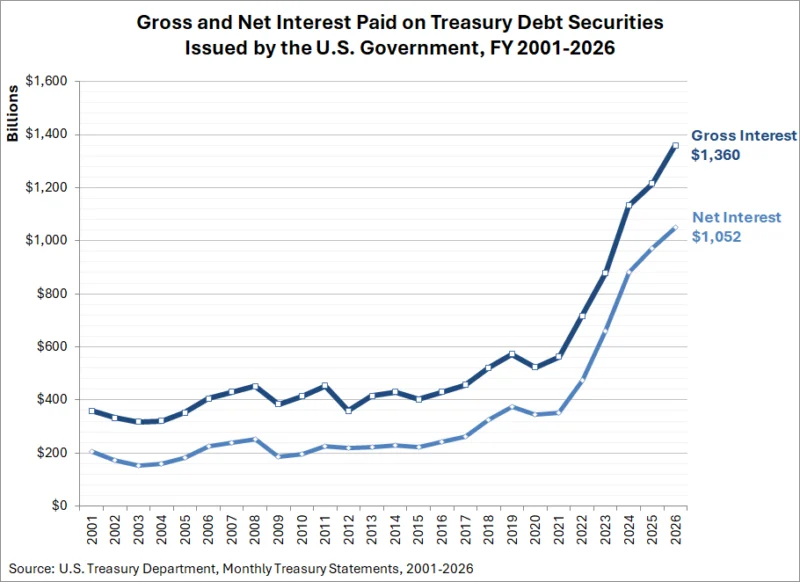
Congress is being asked to increase Pentagon spending to roughly $1.5 trillion despite the Defense Department’s continued inability to pass a comprehensive audit. Proponents such as Owen West, a senior Pentagon official overseeing its push into drones, imply this buildup is a temporary investment in modernization. In a LinkedIn post promoting his Wall Street Journal op-ed, he calls it “a one-time budget that is 2/3rds of that Reagan wielded to win the Cold War.” Similar promises have been made before, but history suggests otherwise.

Owen West’s LinkedIn post promoting his Wall Street Journal op-ed.
Mr. West’s post calls it “a modest 4.5%” budget. In dollars, the request is a 42 percent jump over fiscal 2026’s $1.058 trillion.

Source: Congressional Budget Office, Office of Management and Budget
Look no further than Mr. West’s own example: Ronald Reagan. Mr. West cites the Reagan buildup as a success story to emulate. Reagan’s defense spending helped triple the national debt, and his supposed “one-time investment” roped the American taxpayer into multi-year programs for defense contractors. Have we forgotten the consequences of Reagan’s defense buildup? Iran-Contra, expanded Cold War interventions, and support for anti-Soviet forces in Afghanistan whose aftermath would reverberate for decades in the form of radical Islamic groups.
Policies sold as short-term strategic investments often created new liabilities and new conflicts. Defense spending, in this regard, is a self-licking ice cream cone: the larger it grows, the more interests emerge to justify its continued expansion.
Mr. West, having recently taken a leave of absence from the Defense Innovation Unit, is the new CEO of Project Agincourt. That program is the Pentagon’s new Autonomous Warfare Command, which presumably needs funding to acquire the next generation of autonomous weapons.
Mr. West also claims the Drone Dominance program is buying drones for a tenth of what they cost in 2024, and he offers that as proof this time is different. He doesn’t explain the details, and presumably he is leaving out two essential factors: how the Pentagon was buying drones in 2024, and which drones it was buying.
In 2024, the military was buying in a hurry. In the fallout from Israel’s Operation Swords of Iron against Hamas, Iranian-backed militias hit American bases in Iraq and Syria with waves of drones and rockets. In January 2024, an Iranian-made Shahed killed three American soldiers at Tower 22 in Jordan. Units filed urgent operational needs, and the Pentagon filled them through its urgent acquisition pathway and its rapid capabilities offices.
Those channels exist to deliver equipment to troops in months rather than years. They get that speed by skipping most of the formalized acquisition process designed to ensure competitive pricing. Contracts are often awarded to a single vendor because there’s no time to compete with multiple systems. I’ve personally seen many Coyote Block 2 interceptors fired in Syria—a system that came through the Rapid Capabilities Office. And while I’m certainly thankful I had them, I understand the American taxpayer paid an inflated price, reportedly around $100,000 per interceptor.

Source: U.S. Department of Defense. Some examples shown have since been retired.
The second problem is the word “drone.” It covers everything from an MQ-9 Reaper, which costs tens of millions of dollars and flies thousands of missions, to a disposable quadcopter. For the past 20 years, drones like the MQ-9 were used primarily for high-altitude surveillance or as delivery platforms for Hellfire missile strikes. Constant air superiority during the global war on terror meant these platforms operated with impunity. As the U.S. prepares for conflicts without the advantage of constant air superiority, there has been a push for cheaper disposable or “one-way” systems.
The Defense Department officially uses the Group Classification system shown in the table above. The closest 2024 comparison to what Drone Dominance buys is the Switchblade 300 and 600 (Group 1/2), a guided loitering munition the Army has bought through urgent-need channels for Special Forces for more than a decade, at roughly $60,000 to $80,000 per round. Drone Dominance buys small first-person-view attack drones, starting at about $5,000 each. Those are different weapons with different capabilities and payloads. Comparing their prices is misleading because these are different technologies.
Mr. West is right that personnel costs are squeezing out modernization. He is referring to the money spent to sustain our military through the maintenance of current systems and soldiers’ salaries. These personnel costs are a product of the “more is better” mindset that has plagued the American military for years, driving the recruiting of unfit soldiers, a problem that further bleeds money. Donald Trump prides himself on his accomplishments with DOGE and “running our government like a Trump enterprise.” Any reasonable company in the same position would cut headcount and invest in our best soldiers and most elite units. A smaller Army with better pay and training, backed by a strong reserve, could modernize within the current budget. The Pentagon should innovate by streamlining our outdated force structure, which is still designed to combat Soviet tanks rolling across the Fulda Gap.
My next disagreement with Mr. West is over his sense of urgency. Ukraine built cheap, effective drones because its survival depended on it. Instead of procuring through the top rungs of government, Ukraine built an innovative direct purchasing pathway for commanders on the front line. The American military-industrial complex faces no such pressure to adapt. Its incentive is profit, and without the threat of an existential war forcing results, the defense industry will continue to produce cost overruns and programs that never end.
In World War II, America’s last time of need, the government did more than sign checks. It built and owned factories, rationed materials, taxed excess profits, and ordered Detroit to stop making cars. American industry outproduced every other country in the war. The Defense Production Act keeps much of that authority on the books. We don’t need to waste money in peacetime; we know that the country can innovate when it has to.
In 1953, Dwight Eisenhower, a five-star general and a Republican, warned that “every gun that is made, every warship launched, every rocket fired signifies, in the final sense, a theft from those who hunger and are not fed, those who are cold and are not clothed.” Mr. West doesn’t mention what his budget would displace. Every dollar borrowed for the Pentagon is a dollar not spent on schools or hospitals, and another dollar of debt.
The founders distrusted large standing armies for this very reason. The Constitution bars Army appropriations for more than two years, so Congress has to keep deciding whether to fund it. The large permanent military we have now dates from after World War II. The founders knew that if a country maintains a standing force, it will find reasons to use it.
The health and security of our nation depend on bridges, ports, schools, and healthcare outcomes. Mr. West says insurance is cheaper before the storm, and I agree. Congress should buy a policy that invests in the country, not one that gives the Pentagon $1.5 trillion.