The Money the U.S. Government Owes Itself
Uncle Sam’s net interest bill topped $1 trillion for the first time in fiscal 2026.
November 12, 2026
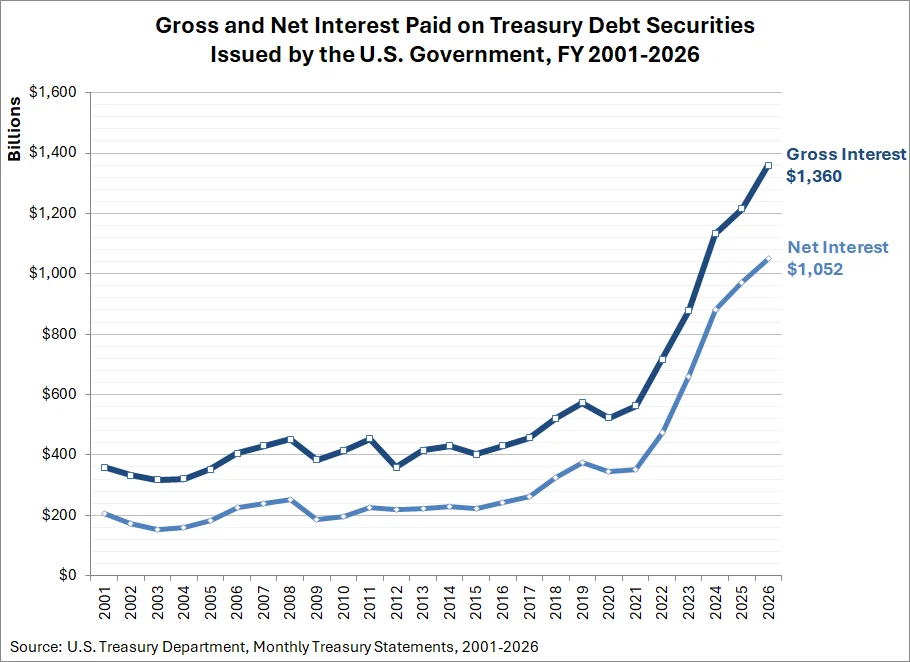
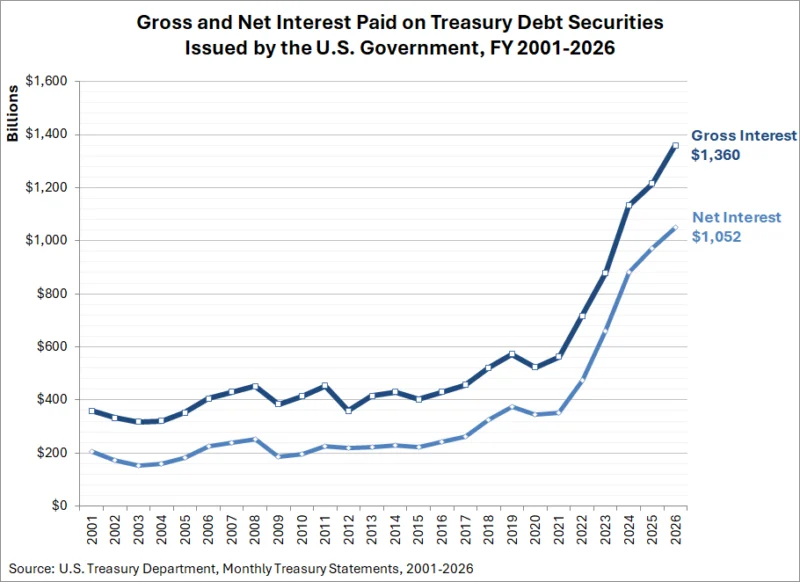
The U.S. government paid just under $1.36 trillion of interest on the national debt during its 2026 fiscal year. That makes 2026 the third year in a row the federal government paid out more than a trillion dollars of gross interest to all its creditors.
The government’s net interest payments came in a little over $1.05 trillion. That’s the first time Uncle Sam’s net interest payments have ever exceeded $1 trillion.
The chart below shows how much gross and net interest the U.S. government paid to the people and institutions it borrowed money from in each fiscal year from 2001 through 2026.
According to the Congressional Budget Office, most of the $308 billion difference between its gross and net interest payments represents money Uncle Sam “owes” to itself. The net interest the government pays goes to people and institutions outside the U.S. government.
How does the government owing money to itself work?
A good example of how the government owing money to itself works is provided by Social Security’s Old-Age and Survivors Insurance (OASI) trust fund. From 1982 through 2008, Social Security collected more in employee and employer payroll taxes than it needed to pay out in retirement benefits. The extra billions it collected each year were put into the OASI trust fund account.
None of that money stayed there. Under federal law, Social Security trust fund managers must invest any surplus they have in special-issue debt securities issued by the U.S. Treasury Department. Every time Social Security runs a surplus, it lends all of it to the federal government, enabling much of Uncle Sam’s chronic excessive spending.
Since 2009, when Social Security started paying out more in benefits than it collects in payroll taxes, the interest Social Security’s trust fund receives has increasingly been used to pay retirement benefits. Because it’s running deeply in the red, it is also cashing in those securities to pay benefits.
Near the end of 2032, the OASI trust fund will have burned through all those special-issue securities and the U.S. government will no longer owe it money. When that happens, Social Security trustees forecast retirement benefits will be cut by around 22%.
Who are the other “intragovernmental” lenders to the U.S. government?
The OASI trust fund is one of several big trust funds the U.S. government operates. Other examples include the trust funds that provide military and civilian government employees with their retirement benefits. The military retirement trust fund invests only in U.S. Treasury debt securities, and the Civil Service Retirement and Disability Fund likewise invests in special-issue Treasury securities, much like Social Security’s trust fund. (Federal workers’ separate Thrift Savings Plan operates more like a private-sector 401(k)-type plan.)
Other U.S. government-operated trust funds also lend money to the U.S. government, but in much smaller amounts. Social Security’s OASI trust fund and the military and civilian government employee retirement trust funds are the big three.
For now, anyway. After 2032, the government’s “free” source of borrowed money will dry up and taxpayers will be left with the full bill. The only responsible answer is for Washington to stop spending money it doesn’t have, starting now.