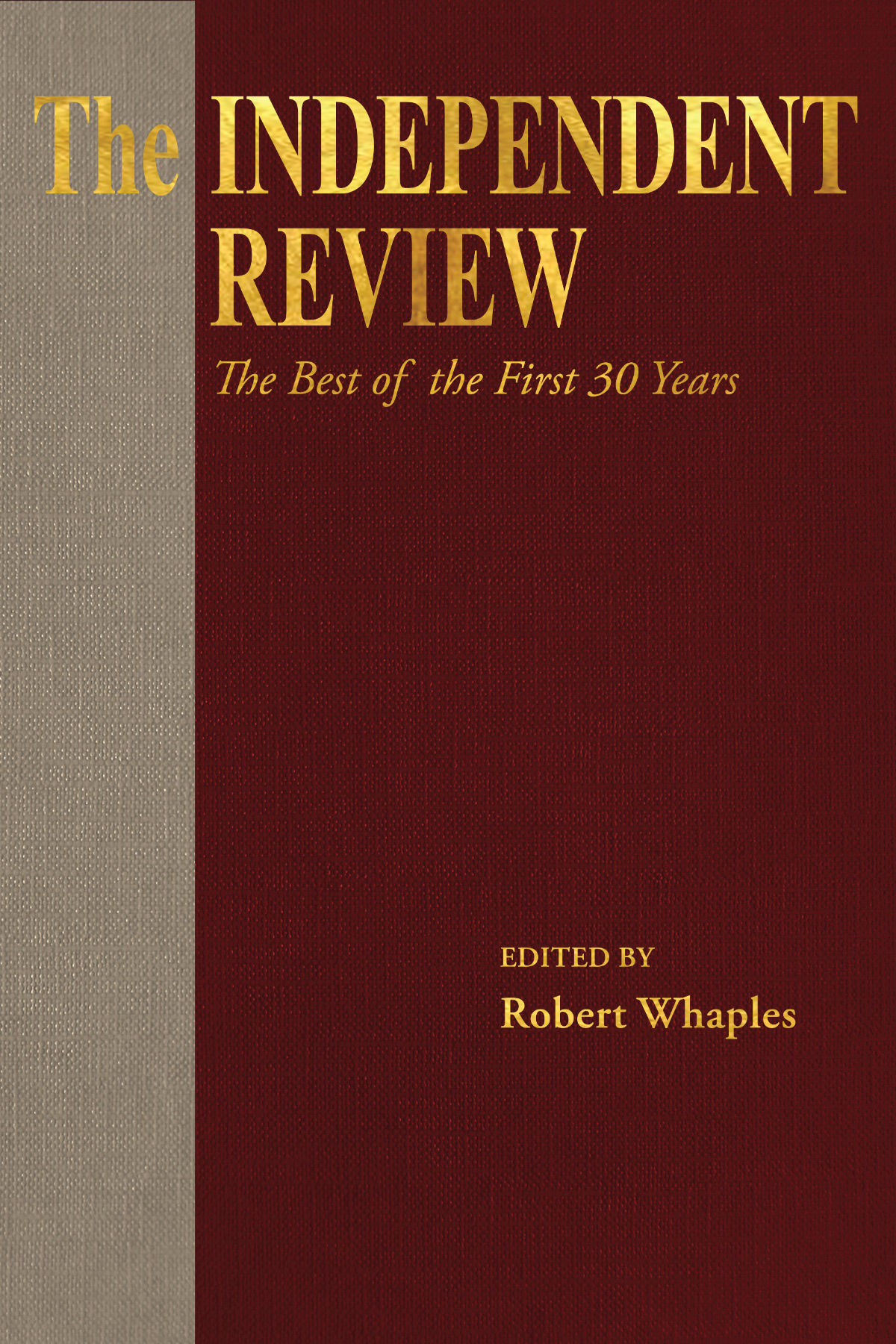
The Independent Review
The Best of the First 30 Years
Format: Hardcover
Publication Date: August 18, 2026
Publisher: Independent Institute
List Price:
Price:
Discount:
Free Shipping On Orders Over $60! (Within U.S.A)
Bulk Discounts Available: Learn More
Overview
Celebrate 30 years of The Independent Review: A Journal of Political Economy with the acclaimed magazine’s highest caliber scholarship by some of the world’s leading experts.
For over thirty years, The Independent Review has been a beacon of clear, fearless, and wide-ranging scholarship—bringing together some of the sharpest minds in economics, history, law, philosophy, and political thought. Now, for the first time, the most influential and enduring essays from the first 30 years are collected in one volume, offering readers a guided tour of the ideas that continue to shape debates on liberty, markets, and the role of government.
Edited by Robert Whaples (Wake Forest University) with contributions from a distinguished team of co-editors, this anthology highlights groundbreaking works from Nobel laureates, renowned scholars, and unorthodox, trailblazing thinkers. From Robert Higgs’s seminal essay on “Regime Uncertainty” to James Buchanan’s “The Soul of Classical Liberalism,” this book boldly tackles timeless questions about human flourishing, political economy, and the struggle between state power and civil society.
Whether you are a student discovering these ideas for the first time, a teacher seeking to inspire your classroom, or a lifelong reader of The Independent Review, this collection provides a front-row seat to three decades of intellectual innovation.
Table of Contents
Introduction
Robert M. Whaples
Editor’s Welcome
Robert Higgs—1996
Preface to the First Issue of The Independent Review
David J. Theroux—1996
Etceteras . . .
Robert Higgs—1996
Regime Uncertainty: Why the Great Depression Lasted So Long and Why Prosperity Resumed after the War
Robert Higgs—1997
Does “Existence Value” Exist?: Environmental Economics
Encroaches on Religion
Robert H. Nelson—1997
Reflections: Population Growth: Disaster or Blessing?
Peter T. Bauer—1998
Is Microsoft a Monopolist?
Richard B. McKenzie and William F. Shughart II—1998
Watching You: Systematic Federal Surveillance of Ordinary Americans
Charlotte Twight—1999
Reflections: The Soul of Classical Liberalism
James M. Buchanan—2000
From Smith to Menger to Hayek: Liberalism in the
Spontaneous-Order Tradition
Steven Horwitz—2001
To Drill or Not to Drill: Let the Environmentalists Decide
Dwight R. Lee—2001
What Is Systemic Risk, and Do Bank Regulators Retard or Contribute to It?
George G. Kaufman and Kenneth E. Scott—2003
Environmental Turning Points, Institutions, and the Race to the Top
Bruce Yandle—2004
Government: Unnecessary but Inevitable
Randall G. Holcombe—2004
Controversy: Is Government Inevitable? Comment on Holcombe’s Analysis
Peter T. Leeson and Edward P. Stringham—2005
Controversy: Is Government Inevitable? Reply to Leeson and Stringham
Randall G. Holcombe—2005
Reflections: Nineteen Public Bads of Empire, Nation Building, and the Like
Christopher J. Coyne and Steve Davies—2007
Isabel Paterson, Rose Wilder Lane, and Zora Neale Hurston on War, Race, the State, and Liberty
David T. Beito and Linda Royster Beito—2008
Wal-Mart to the Rescue: Private Enterprise’s Response to Hurricane Katrina
Steven Horwitz—2009
Central Banks as Sources of Financial Instability
George Selgin—2010
Crony Capitalism: By-Product of Big Government
Randall G. Holcombe—2013
Fearing Freedom: The Intellectual and Spiritual Challenge to Liberalism
Peter Boettke—2014
Are All Commons Tragedies? The Case of Bison in the Nineteenth Century
Peter J. Hill—2014
Property Rights, Coercion, and the Welfare State: The Libertarian Case for a Basic Income for All
Matt Zwolinski—2015
The New Egalitarianism
Adam Martin—2017
On the Origins and Goals of Public Choice: Constitutional Conspiracy?
Michael C. Munger—2018
Opting Out: A Defense of Social Justice
James R. Otteson—2019
Classical Economics: Lost and Found
Sabiou M. Inoua and Vernon L. Smith—2020
A Theory of Justice with Claims of Desert
Alexander Rawls—2021
The Wisdom of David J. Theroux (1949–2022)
Robert M. Whaples—2022
How to Run Wars: A Confidential Playbook for the National Security Elite
Christopher J. Coyne and Abigail R. Hall—2023
Christianizing Nozick
Gregory Robson—2024
My Dinner with Nozick
David J. Schmidtz—2024
Robert Nozick and the Moral High Ground
Jason Brennan—2024
Credits
References
Notes
Index
Highlights
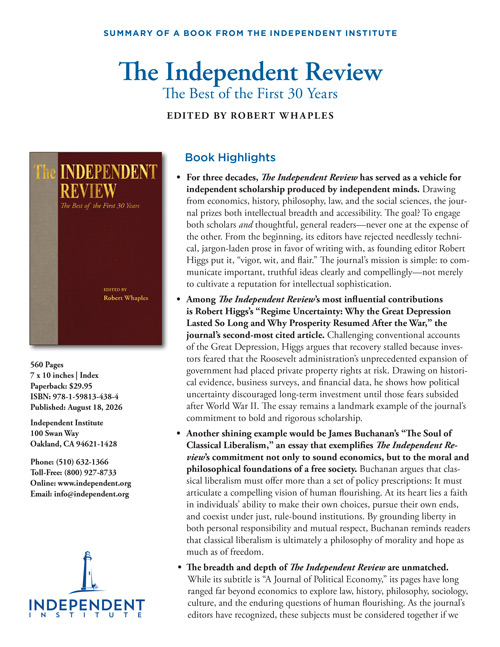
For three decades, The Independent Review has served as a vehicle for independent scholarship produced by independent minds. Drawing from economics, history, philosophy, law, and the social sciences, the journal prizes both intellectual breadth and accessibility. The goal? To engage both scholars and thoughtful, general readers—never one at the expense of the other. From the beginning, its editors have rejected needlessly technical, jargon-laden prose in favor of writing with, as founding editor Robert Higgs put it, “vigor, wit, and flair.” The journal’s mission is simple: to communicate important, truthful ideas clearly and compellingly—not merely to cultivate a reputation for intellectual sophistication.
Among The Independent Review’s most influential contributions is Robert Higgs’s “Regime Uncertainty: Why the Great Depression Lasted So Long and Why Prosperity Resumed After the War,” the journal’s second-most cited article. Challenging conventional accounts of the Great Depression, Higgs argues that recovery stalled because investors feared that the Roosevelt administration’s unprecedented expansion of government had placed private property rights at risk. Drawing on historical evidence, business surveys, and financial data, he shows how political uncertainty discouraged long-term investment until those fears subsided after World War II. The essay remains a landmark example of the journal’s commitment to bold and rigorous scholarship.
Another shining example would be James Buchanan’s “The Soul of Classical Liberalism,” an essay that exemplifies The Independent Review’s commitment not only to sound economics, but to the moral and philosophical foundations of a free society. Buchanan argues that classical liberalism must offer more than a set of policy prescriptions: It must articulate a compelling vision of human flourishing. At its heart lies a faith in individuals’ ability to make their own choices, pursue their own ends, and coexist under just, rule-bound institutions. By grounding liberty in both personal responsibility and mutual respect, Buchanan reminds readers that classical liberalism is ultimately a philosophy of morality and hope as much as of freedom.
The breadth and depth of The Independent Review are unmatched. While its subtitle is “A Journal of Political Economy,” its pages have long ranged far beyond economics to explore law, history, philosophy, sociology, culture, and the enduring questions of human flourishing. As the journal’s editors have recognized, these subjects must be considered together if we are to understand the world and improve it. To keep this volume both substantial and readable, Robert Whaples and his team limited themselves to five hundred pages drawn from the journal’s first three decades. But many outstanding essays—including recent symposiums on liberty and literature, Pope Francis and economics, underappreciated economists, and corporate America’s ideological drift—could not be included within these space constraints. The omission is regrettable, but readers will be pleased to find every essay freely available on the journal’s website!
Synopsis
Most academic journals are only for academics. But The Independent Review has spent more than thirty years proving that serious scholarship can also be engaging, accessible, and deeply relevant to the world beyond the academy. Bringing together historians, economists, philosophers, legal scholars, and political scientists, the journal has earned a reputation for challenging conventional wisdom with rigorous research, lucid prose, and provocative, original ideas.
Now, for the first time, the journal’s most influential and enduring essays have been collected in a single volume.
The Independent Review: The Best of the First 30 Years offers a guided tour through the ideas that continue to shape debates over liberty, markets, government, and human flourishing. Featuring landmark essays such as Robert Higgs’s “Regime Uncertainty” and James Buchanan’s “The Soul of Classical Liberalism,” this anthology showcases some of the finest writing in economics, history, law, philosophy, and political thought.
Edited by Robert Whaples, Senior Fellow and managing editor of The Independent Review, with contributions from a distinguished team of co-editors, this collection celebrates three decades of fearless scholarship that refuses to sacrifice clarity for complexity. Whether you are discovering these ideas for the first time or returning to revisit old favorites, this volume offers a rare combination of intellectual rigor, literary quality, and enduring insight—a treasury of essays that rewards reading and rereading.
Scholarship That Speaks Beyond the Academy
From its founding, The Independent Review set out to prove that rigorous scholarship need not be written in a language only specialists can understand. The journal was created for “students as well as teachers, generalists as well as specialists, lay persons as well as professionals.” Its editors rejected arcane and ponderous prose in favor of writing that combines scholarly rigor with literary clarity. As Robert Higgs put it in his Editor’s Welcome, while economists often remind us that “mathematics is a language,” we have equal reason to insist that “English is a language, too.”
The essays collected in this volume exemplify that ideal. They tackle some of the most important questions in economics, history, law, philosophy, and public policy without ever losing sight of the reader. After all, what is the point of great writing if no one can understand it?
Why Did the Great Depression Last So Long?
Few essays better capture the spirit of The Independent Review than Robert Higgs’s “Regime Uncertainty: Why the Great Depression Lasted So Long and Why Prosperity Resumed After the War.” It asks a deceptively simple question: If the economy began recovering in the early 1930s, why did the Great Depression linger for so many years?
Higgs argues that the answer lay not simply in economics, but in politics. Investors, he contends, delayed long-term commitments because they feared the Roosevelt administration’s sweeping expansion of federal power threatened the security of private property rights. Drawing on business surveys, financial markets, and contemporary accounts, Higgs assembles a compelling case that uncertainty about the future of the legal and political order—not merely weak demand or insufficient spending—held back private investment until after World War II.
Whether one ultimately accepts or disputes his conclusions, the essay is a stunning example of what The Independent Review has sought to cultivate for three decades: careful scholarship that challenges conventional wisdom, draws insights from multiple disciplines, and invites readers to reconsider even the most familiar chapters of history. Rather than reinforcing academic consensus, this journal has consistently provided a forum for original ideas backed by rigorous evidence, thoughtful argument, and a willingness to ask questions others overlook. That commitment has clearly paid off. Fortune favors the bold.
Can Liberty Have a Soul?
James Buchanan’s essay, “Reflections: The Soul of Classical Liberalism,” opens with a striking admission of failure: Even as mid-century classical liberals succeeded in preserving their foundational texts and sharpening their ideas, they never managed to cultivate what he calls the movement’s “soul”—an animating vision capable of inspiring genuine devotion rather than mere intellectual assent. He distinguishes between advocates who rely on economic science and self-interest alone and those who offer something more aspirational, arguing that the former can never generate lasting public support on their own.
For Buchanan, a soul must be actively created, not simply defended, and its absence leaves classical liberalism vulnerable to the vicissitudes and nastiness of politics and faction, where competing groups treat the public sphere as a commons to be raided rather than a space governed by shared, rule-bound respect for individual choice.
The essay exemplifies what The Independent Review does best: It refuses to treat liberty as a purely technical or economic matter, insisting instead that free societies rest on a moral imagination as much as on sound policy. Buchanan closes not with data or models but with an appeal to obligation—those who have glimpsed Ronald Reagan’s “shining city” of a truly free order, he suggests, owe it to that vision to act as though its realization remains possible. That fusion of rigorous argument with moral aspiration is exactly the sensibility the journal has long championed.
Ideas That Challenge Conventional Wisdom
Higher education today is in a sorry state. For too long, academia has rewarded ideological conformity, and tenure committees, hiring panels, and peer reviewers all tend toward the same unspoken rule: No one wants to be the first to blink. Scholars who question prevailing orthodoxies risk more than criticism; they risk their livelihoods. The result is a kind of institutionalized self-consciousness, in which caution masquerades as rigor, and genuinely original thinking becomes a professional liability.
But The Independent Review has long offered scholars a way around this bind: a respectable, peer-reviewed venue where controversial but legitimate arguments can still find a hearing. Adam Martin’s “The New Egalitarianism” shows why that matters. In his essay, Martin traces how modern egalitarian thought has redefined racism—from individual antipathy or belief in racial inferiority to invisible, socially constructed “systems conferring dominance.” Diagnosing this new racism, he argues, requires specialized expertise inaccessible to ordinary people, effectively demanding rule by self-appointed “moral experts.” Martin’s willingness to name this dynamic rather than simply defer to it is precisely the kind of courageous, rigorous thinking The Independent Review exists to publish.
Bold, Witty, Provocative, Rigorous
And these three essays are only the beginning. Flip further into the volume and you’ll find Peter Boettke’s “Fearing Freedom: The Intellectual and Spiritual Challenge to Liberalism,” which picks up Buchanan’s challenge directly: Classical liberalism, Boettke argues, needs a vision that is romantically, aesthetically, and morally satisfying, not just one that happens to deliver liberty, prosperity, and peace. Steven Horwitz’s “From Smith to Menger to Hayek: Liberalism in the Spontaneous-Order Tradition” is a primer on classical liberal market thinking so lucid that it might make you fall in love with the tradition all over again. In “My Dinner with Nozick,” David Schmidtz recounts how Anarchy, State, and Utopia made Robert Nozick “notorious” for rejecting John Rawls’s theory of justice—and tells the story of Nozick offering to sit incognito, cap pulled low, at the back of one of Schmidtz’s talks so as not to steal the show. David Beito and Linda Royster Beito’s “Isabel Paterson, Rose Wilder Lane, and Zora Neale Hurston on War, Race, the State, and Liberty” is a reminder that economists and philosophers have never held a monopoly on defending liberty, individualism, and self-reliance. And Horwitz returns with “Wal-Mart to the Rescue: Private Enterprise’s Response to Hurricane Katrina,” which tells you more about how markets actually work than any antitrust brief ever could—chronicling how private enterprise, often working around government relief efforts rather than with them, saved lives in Katrina’s aftermath.
Taken together, these essays are why The Independent Review has earned its reputation: bold enough to defend unfashionable truths, witty enough to make the defense a pleasure, provocative enough to unsettle a comfortable consensus, and rigorous enough to earn a hearing regardless. That’s why this collection is more than an anthology. It is a testament to what scholarship can be when it refuses to trade courage for comfort. For anyone who believes that ideas still matter, and that the best of them deserve a wider audience than the seminar room, The Independent Review: The Best of the First 30 Years belongs on their shelf.
Praise
“Most academic journals talk only to themselves. The Independent Review talks to everyone. For thirty years, historians, economists, philosophers, and political scientists have shared these pages—writing in clear prose, challenging conventional wisdom, and presenting truly original thought on history, political philosophy, and the unintended consequences of public policy. This collection highlights the best of the best from three decades of great scholarship. A real treasure.”
—Jonathan Bean, author of Race and Liberty in America: The Essential Reader
“The Independent Review consistently publishes high-quality scholarship that supports a free society. I always learn something from reading it. This volume offers readers a good introduction to the Review’s content. I consider it a good outlet for my own work and am happy to have been a part of the Review’s first thirty years.”
—Randall Holcombe, DeVoe Moore Professor of Economics, Florida State University
“This collection of the best of the first thirty years of The Independent Review is an instant classic of the literature of liberty. Full of broad and deep scholarship, original thought, and wisdom, these thirty-two articles represent a wonderful tribute to the journal’s brilliant founder, David Theroux, and to its founding editor, Robert Higgs. These essays speak profoundly, and not only to the practice and thought of classical liberalism but to its soul as well. As Robert Whaples invites us in his superb introduction: ‘Bon appétit!’ The volume is delectable indeed.”
—T. Hunt Tooley, A.M. Pate Jr. Professor of History, Austin College
“Over the past thirty years The Independent Review has consistently published top-quality research articles on the importance of markets and human dignity. The Independent Review draws top scholars from different disciplines and advances our understanding of fundamental topics. It advances knowledge in many areas and is the leading source of insight on the economics of war and peace. This current volume provides a nice selection of articles from this very important journal.”
—Edward Peter Stringham, Ph.D., Shelby Cullom Davis Professor of American Business and Economic Enterprise, Trinity College
“There are so many outstanding articles in this collection. Here are my favorite six: Robert Higgs’s classic article on how regime uncertainty put the ‘great’ in Great Depression; Bruce Yandle’s showing how a Brit named John Eastwood used private action to clean up England’s rivers; Peter Leeson and Edward Stringham’s insightful critique of the idea that government is inevitable; David Beito’s thrilling story about Rose Wilder Lane’s risky activism; Steven Horwitz’s showing how Wal-Mart helped rescue people from Hurricane Katrina; and Michael Munger’s scathing but fair review of his colleague Nancy MacLean’s book Democracy in Chains. I learned a great deal and so will you.”
—David R. Henderson, research fellow, Hoover Institution, Stanford University; editor of The Concise Encyclopedia of Economics
“Four decades ago, the Independent Institute was founded to combine rigorous, consequential policy research and effective communication. Ten years later, plans for a unique—and important—journal came to fruition. Since 1996, first under founding editor Robert Higgs and then editor Robert Whaples, The Independent Review has published peer-reviewed, authoritative academic research and commentary, while also communicating clear and accessible information about policy and current events. This book is a selection of thirty-two of the best articles and commentaries from that first thirty years, but it is clear that the book would have been almost equally good if the ‘next best’ thirty-two had been selected instead. As an academic outlet, the Review is sui generis; as a source of policy insight, it is indispensable. On to the next thirty years!”
—Michael C. Munger, professor, political science and economics, Duke University
“Robert M. Whaples has performed a valuable service. He has brought informed readers a book which features a star-studded cast of top-rate scholars and examples of some of their best work. The chapters include Robert Higgs’s pathbreaking historical analysis of the 1930s depression decade, Steven Horwitz’s insightful history of the spontaneous order tradition, George Selgin’s carefully researched critique of central banks, James Buchanan’s thoughtful piece on the soul of classical liberalism, and a recent game-changing contribution by Christopher J. Coyne and Abigail R. Hall on war and the national security elite. This book is a most fitting memorial to the great and late David Theroux, who made it all possible.”
—David Beito, author of The New Deal’s War on the Bill of Rights: The Untold Story of FDR’s Concentration Camps, Censorship, and Mass Surveillance
Product Details
Course Adoption
The Independent Institute is pleased to offer both extended PDF excerpts and print exam copies to college instructors for course adoption consideration.
All orders are subject to a manual review and approval process and subject to inventory availability. We endeavor to verify submissions and process requests within three business days. For print copies, please allow an additional 5–10 days for delivery.
Extended PDF Excerpts of roughly the first 25% or first 50 pages of each book are offered free of charge.
Print Copies are offered at significantly reduced rates compared to the normal sale price:
- Print Copies with a list price under $30 are $8.00.
- Print Copies with a list price above $30 are $15.00.
Print copies will only be shipped to institution, university, or organization addresses. Shipping within the United States has no extra cost. For international orders, add $30 for shipping.
Bulk discounts for print copies are also available to all buyers. Learn more.
We reserve the right to refuse approval for fraudulent requests.
The Indispensable Robert Higgs
Unsung Heroes of the Market

Depression, War, and Cold War


In All Fairness


Future

The Challenge of Liberty