


When Rents Can’t Rise, Apartments Fall
New York’s rent freeze will cost tenants heat, hot water, and safety, just as the 2019 rules did.
November 27, 2026
News Article
New York’s rent freeze will cost tenants heat, hot water, and safety, just as the 2019 rules did.
New York City recently froze the rents of about a million rent-stabilized apartments. Tenants cheered, but they will jeer when they lose heat, hot water, safety, and other aspects of apartment quality.
That is what happened after New York tightened rent stabilization in 2019. In the stabilized buildings, violations the city categorizes as “immediately hazardous,” such as failures of heat and hot water, lead paint, mold, and pests, rose 25 percent, a Yale study found, measured against the trend in the unregulated buildings. Filings to renovate apartments fell by almost half.
Those results did not surprise anyone versed in price theory. The usual case against rent control draws supply-and-demand curves with a ceiling below their crossing to indicate a shortage. In 15 minutes, any undergraduate can see that it makes a strong case against government meddling. But it leaves out the problem that existing tenants discover first: the leaking roof. Quality needs a different picture.
Finance supplies one, called the security market line, which plots asset risk against expected return. An asset above the line offers more return than its risk warrants, so investors bid up its price (and so bid down its return) until it sits on the line. An asset below the line offers too little for the risk, so investors sell it until its return rises to the line.
Apartments obey a close cousin, which I call the quality market line. Put quality on the horizontal axis: safe hallways, temperature control, no leaks, and a super who fixes problems promptly. Put monthly rent on the vertical axis. Better apartments rent for more, so the line slopes up (see the figure, left panel). An apartment above the line asks more than it is worth, so it sits empty until its owner cuts the rent or fixes it up. An apartment below the line is a bargain. Tenants bid up the rent until the bargain dissipates. Either way, competition pulls apartments to the line.
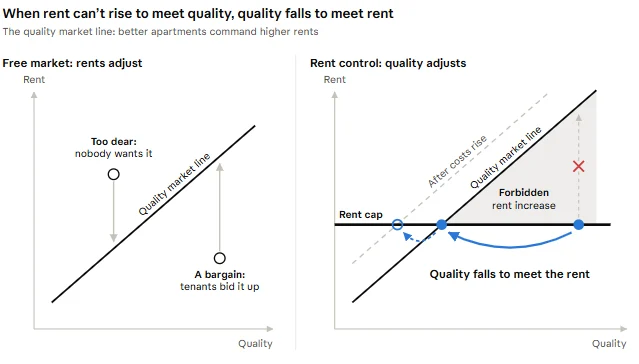
Rent control draws a horizontal ceiling across the chart (right panel). Any apartment good enough to command more than the ceiling now sits below the line, a bargain whose price may not rise. Yet the gap between price and value must still close. If rent cannot rise to meet quality, quality falls to meet rent. The apartment slides left along the ceiling as the owner puts off maintenance.
Rising costs speed the slide. Higher taxes, insurance, wages, and materials push the whole quality market line up every year, so a frozen ceiling buys less quality every year. If rent stays put, apartment quality must slip.
You do not need the geometry, though. You need only what Adam Smith called sympathy (what we now call empathy) in The Theory of Moral Sentiments (1759). Smith observed that we can know what another person feels only “by conceiving what we ourselves should feel in the like situation.” Advocates of rent control sympathize only with tenants, leaving owners with no good options.
Imagine that you own a six-story walk-up built in the 1920s. Its boiler is older than you are. Your taxes, insurance, and wages rise every year, lately faster than inflation. The city has just told you that you may not increase the rents. A new boiler would keep your tenants warm, but at frozen rents it will never pay for itself. What would you do?
You have two choices. You can get out by selling to someone who can turn the building into condominiums or commercial space, or by leaving apartments empty when tenants move out rather than renovating them at a loss. Or you can spend as little on upkeep as the housing code and inspectors allow.
Greed does not feed this process. A saintly owner who kept pouring money into a frozen building would soon be a saint without a building, and its next owner would make the cheaper choice, which in the Bronx in the 1970s meant delaying maintenance until fires consumed the problem.
In 2019, New York State tightened rent stabilization. Among other things, the new law capped how much an owner could add to the rent after improving an apartment, at $15,000 of spending spread over 15 years, and closed the routes by which apartments left regulation.
Beau Bressler, a postdoctoral associate at Yale’s Institution for Social and Policy Studies, compared about 30,000 stabilized buildings with 10,000 unregulated buildings of similar age, size, and neighborhood, before and after the law (“Does Tightening Rent Regulation Reduce Housing Quality? Evidence from New York City,” working paper, November 2026). He used the city’s own inspection records to reach those findings. Rents were held down, and quality slid to meet them, just as the quality market line predicts.
The decline Bressler documents happened even though the 2019 law still allowed modest annual rent increases. The current freeze allows none. Put yourself in the owner’s shoes, and you can predict the result: “affordability” forced upon landlords and renters at the cost of livability.