Deconstructing the Council of Economic Advisers’ Balance of Payments Report
August 27, 2026

Working Paper
Summary
A July 2026 report by the Council of Economic Advisers (CEA) built a legal argument for tariffs by redefining a 1970s-era economic metric, portraying contentious economic metrics as consensus, and misrepresenting the sources it cites. The Court of International Trade (CIT) ruled that Section 122’s “balance-of-payments deficit” means what Congress intended in 1974, not simply “the U.S. runs a current-account deficit.”
To satisfy this requirement, the Council of Economic Advisers claims the current account is a universally accepted proxy for balance-of-payments deficits and presents a reconstructed “basic balance”—a Bretton Woods-era metric abandoned in 1976. However, their report misrepresents the literature it cites. The report’s two lead sources are 1975 papers by the Federal Reserve Banks of New York and St. Louis.
Both papers explicitly warn against fixating on any single metric, including the current account. The St. Louis Fed paper says such fixation feeds “undue concern on the part of policymakers, inducing costly recommendations for trade restrictions, controls on capital movements, and export promotion in order to solve balance-of-payments and exchange rate ‘problems’ which simply do not exist.”
We write to give a detailed critique of the Council of Economic Advisers’ report. Ultimately it works backward from a predetermined legal conclusion. Rather than providing sound economic analysis, it serves as litigation advocacy, distorting historical research to justify trade restrictions.
1. Introduction
The President’s Council of Economic Advisers (CEA) released an unsigned report, dated July 2026, advancing the argument that a Balance of Payments (BOP) deficit can be reasonably and reliably measured by the current account, or by the CEA’s own reconstruction of the discontinued measure from the 1970s known as the “basic balance.” In the report, the CEA attempts to capture what the “basic balance” would have shown for today’s BOP.
In doing so, the report attempts to lend credence to a similar argument being advanced by the Administration’s legal team in the pending case of Burlap & Barrel v. Trump, which challenges the legality of tariffs imposed under Section 122 of the Trade Act of 1974. Earlier this year, the U.S. Court of International Trade ruled against these tariff measures on the grounds that they did not meet the statutory condition of a “Balance of Payments deficit,” which does not currently exist under the conventional economic definition of the term. In its pending appeal of this ruling, the Administration’s lawyers have adopted a new argument: they attempt to redefine the BOP as a current account deficit, and argue that a reconstructed version of the discontinued “basic balance” measure fulfills the statute’s requirements.
The July CEA report attempts to add scholarly heft behind the claims of the Administration’s attorneys in their appellate filings. It claims that these new definitions of BOP are consistent with how economists applied this concept at the time the Trade Act was written, thereby ratifying the Section 122 tariffs. In reality, the CEA report engages in egregious misrepresentations of the relevant economic literature on how BOP is measured. We write to document these transgressions in detail.
The report states, “CEA staff have concluded that the current-account balance remains the most reasonable and reliable approach for determining a BOP deficit today” (p. 4). To this point, Figure 1 of the report, shown below, presents a line chart of the current account balance for 1960–2025, concluding that it “has been in a persistent deficit since the 1990s” and “was larger at the end of 2024 … than at its trough in the early 1970s” (p. 5).

The report compares the current account balance with one historical and two modern alternative measures of BOP.
Figure 2 shows a line chart for 1950–1973 of the current account alongside the Bureau of Economic Analysis (BEA) vintage measure of the basic balance as calculated in 1974. The BEA basic balance is usually defined as the current account plus long-term capital flows but excluding volatile short-term financial flows. The report provides no source for Figure 2, nor does it explain or discuss Figure 2, but the most plausible reading is: Figure 2 renders what the basic balance actually showed for the years 1950 to 1973, using the data and methodology in use when Congress wrote the Trade Act of 1974.
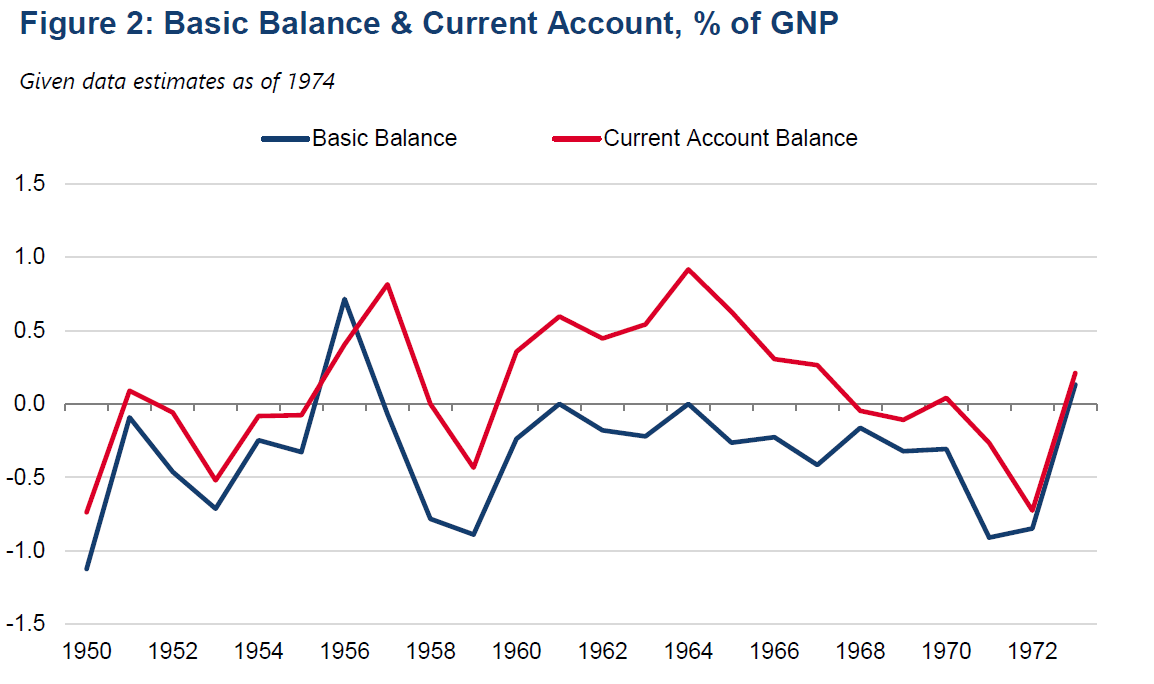
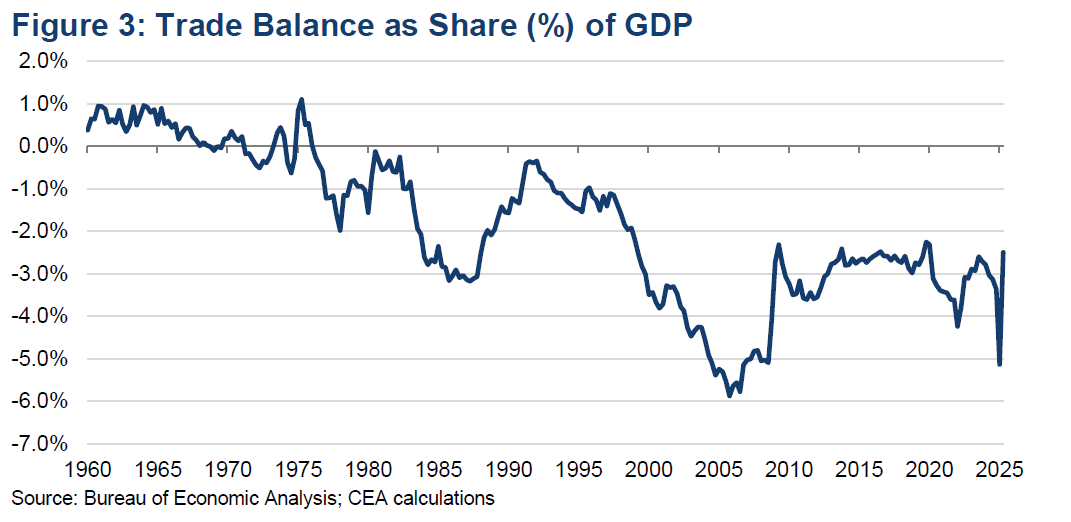
Figure 3 of the report shows the U.S. trade balance, which equals the current account minus net primary income and net secondary income. Noting that Figure 3 closely tracks the fluctuations in Figure 1, the report again concludes that the trade balance “has been in persistent deficit since the 1970s” (p. 6).
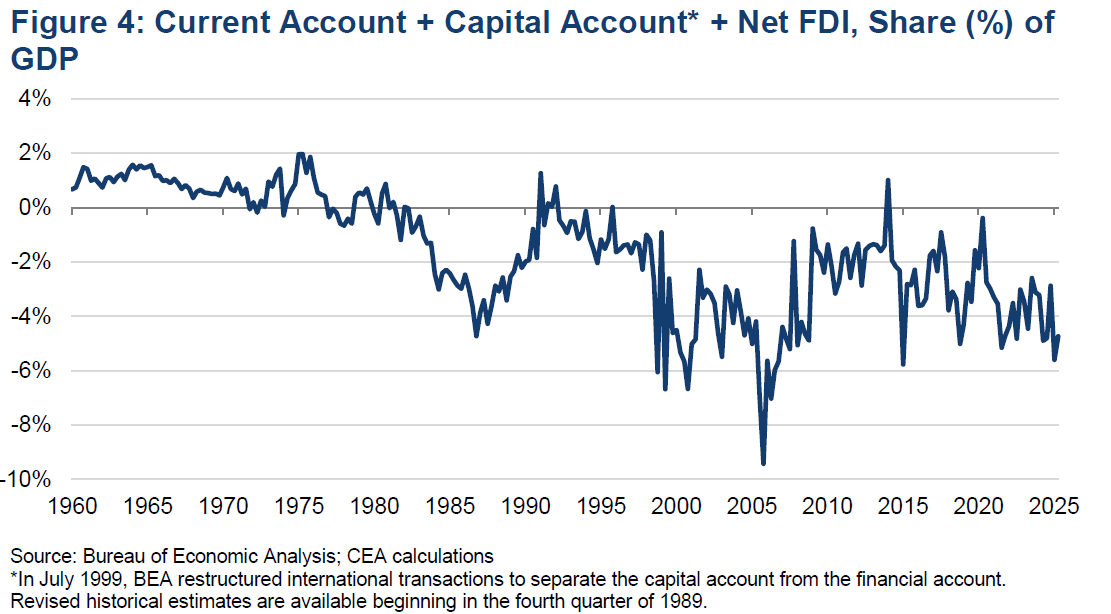
Finally, Figure 4 presents a reconstructed series described as “CEA’s most expansive candidate BOP deficit measure” (p. 7), for 1960–2025. It is a reconstructed series attempting to show what the BEA’s vintage basic balance methodology would have shown had the BEA not discontinued it. The BEA discontinued tracking the basic balance in response to evolving financial markets rendering obsolete this manner of distinguishing long-term, low-volatility assets from short-term, higher-volatility ones. This problem has, as admitted by the CEA, “grown immeasurably worse” (p. 3) since the change from fixed exchange rates under Bretton Woods to floating exchange rates. The reconstruction approach in Figure 4 begins with the current account, adds the capital account, and—to isolate long-term, low-volatility assets—also adds a single component of the financial account, namely net foreign direct investment (FDI). CEA interprets the capital account as “certainly consist[ing] of long-term capital” and assumes that net FDI is a close enough proxy as today’s counterpart to the BEA’s 1974 concept of long-term capital. Thus, Figure 4 is labeled “Current Account + Capital Account + Net FDI” as a share of GDP. The report concludes yet again that Figure 4 “presents the same qualitative story: a prolonged period in deficit” (p. 7). Figure 4’s attempt to reconstruct a series the CEA’s citations regard as obsolete seems odd. It doesn’t provide much insight and seems more like a case to wedge a new legal justification into the mix.
2. The Report’s Policy Implications
The report is very timely. It comes soon after the Trump Administration lost at the Supreme Court on its first round of universal tariffs that claimed IEEPA authority[1], after which the Administration immediately pivoted, re-imposing many of those same tariffs under authority granted by Section 122 of the Trade Act of 1974. This Act authorizes the President to impose tariffs up to 15% ad valorem to address “large and serious United States balance-of-payments deficits” for 150 days.
Earlier in 2026, the U.S. Court of International Trade (CIT) struck down those tariffs[2]. The Court’s reasoning[3] is that Section 122 can only be invoked when certain conditions exist, namely those explicitly stated in the Act. The exact wording of the statute authorizes the President to act “[w]henever fundamental international payments problems require special import measures to restrict imports (1) to deal with large and serious United States balance-of-payments deficits, (2) to prevent an imminent and significant depreciation of the dollar in foreign exchange markets, or (3) to cooperate with other countries in correcting an international balance-of-payments disequilibrium.” The Administration appealed to the U.S. Court of Appeals for the Federal Circuit (CAFC) and secured a temporary stay of the judgment that continued to impose the 122 tariffs on importers who were not parties to the case. The 150-day window expired on July 24, 2026. While the tariff window has passed, the court challenge to these tariffs still carries significant implications: if the CIT ruling is upheld, the government would have to refund the tariffs collected during those 150 days. The Administration has since transitioned its tariff justification to Section 301’s unfair trade practices provisions, citing inadequate protection against forced labor.
Importantly, the CIT ruled that Section 122 was written specifically with reference to BOP deficits as measured by government statistics in use at the time of its adoption in 1974. These measures included the basic balance, liquidity balance, or official settlements balance. The U.S. government discontinued these measures in 1976, after it officially terminated the fixed exchange rate obligations under the Bretton Woods system. Because those Bretton Woods era metrics no longer exist, the Administration must now attempt to legally establish reconstructed versions of them as close proxies. Therefore, the report is timely as an instrument for the Administration’s ongoing Section 122 and other tariff litigation.
3. Evaluating the Report
The BOP is an accounting concept that is somewhat controversial when viewed through the lens of economics. It is a record of all exchanges of goods, services, and assets between residents of one country and residents of another country. Since every exchange has two sides, the transaction must, by definition, balance. The balance-of-payments is a “balance” as in “balance sheet.”
If the BOP necessarily must balance, then what is a BOP deficit? That is where the controversy lies. While the balance-of-payments must balance, its individual subaccounts need not. The Administration’s argument essentially holds that an imbalance in one of these subaccounts constitutes a “balance-of-payments deficit” under Section 122.
Under the Bretton Woods regime, it was possible to have a BOP deficit due to draw-downs of official reserve holdings of a country’s central bank. According to the Joint Economic Committee: “A country’s balance-of-payments surplus was its accumulation of officially held international reserves, while its deficit is its loss of reserves.”[4]
This was not an accounting deficit, but rather referred to the fact a central bank would have to exchange official currency holdings with other banks to maintain the currency pegs required by the Bretton Woods Agreement. The U.S. dollar was the reserve currency and was redeemable for gold at a fixed rate of $35/ounce. In Bretton Woods terminology, a “BOP deficit” referred to sustained draw-downs of U.S. gold reserves. During the 1960s, the U.S. had persistent BOP deficits (under this definition), leading to Richard Nixon ultimately ending the convertibility of dollars into gold in August 1971.
Under the BOP accounting system, the main subaccounts are (1) the current account and (2) the capital and financial accounts. The current account tracks transactions in goods, services, income flows, and unilateral transfers; things that are usually consumed in the current period. This balance is sometimes referred to as the “trade balance.” While that is not strictly speaking correct, it suffices here as trade in goods and services makes up the majority of the transactions in this account and movement in the trade balance tends to dominate the current account. The capital and financial accounts record all international exchanges of non-good and non-service assets (stocks, bonds, investment flows, and the like). Either one of these subaccounts may be in deficit, but that must mean that the other is in surplus.
There is no particular reason to favor one subaccount over the other as the measure of a BOP deficit. The CEA’s main justification is historical: it argues that the current account is a universally accepted measure of a BOP deficit (p. 4). However, the citations listed in the report provide no such support.
The first two citations, both from 1975 Federal Reserve Reviews, one in New York and one in St. Louis, discuss the current account as a component of the BOP but nothing more. Both are analytical papers that actually caution against using the current account as a measure of the BOP. In the first citation,[5] for instance, author Patricia Kuwayama states: “No attempt is made to identify a single statistic which can be regarded as ‘the’ appropriate balance-of-payments measure for the United States,” but rather that different policy questions will require different measures. The second citation’s[6] author, Donald Kemp, states there is controversy about how to report the BOP and focusing on trade balances “has led to undue concern on the part of policymakers, inducing costly recommendations for trade restrictions, controls on capital movements, and export promotion in order to solve balance-of-payments and exchange rate ‘problems’ which simply do not exist,” and that “implications drawn from the current account regarding the domestic impact of foreign transactions can be highly misleading.” A year later, in 1976, Janice M. Westerfield of the Federal Reserve Bank of Philadelphia reached a similar conclusion: the fixed-exchange rate measures were obsolete for a floating exchange rate world: “Under the fixed-rate system, stability required the avoidance of payments deficits; but with floating exchange rates, the relative values of currencies constantly readjust to changing international conditions. Therefore, deficit and surplus measures don’t mean what they used to mean and so they are being deemphasized. Indeed it would be inconsistent with present developments to tie domestic and foreign economic policy decisions to these figures in the same way as before, ignoring the flexibility of exchange rates and the complexity of international capital movements.”[7] In short, as we elaborate with more specifics below, the CEA’s main historical justification is not consistent with a careful reading of these citations. In fact, these reports suggest the CEA’s reconstruction is meaningless in modern context.
Within the context of the Court’s ruling, a current account deficit is not necessarily an inappropriate component to evaluate for Section 122. Section 122 can be read to imply it is the executive’s duty to prevent rapid changes in the exchange rate. It is theoretically possible that a current account deficit is indicative of imminent rapid currency depreciation. If the current account is in deficit, that means imports exceed exports. To purchase imports, Americans must sell dollars to purchase foreign currencies.[8] In this case, such a deficit implies that foreigners are not buying as many dollars relative to the people selling. Supply of dollars rises, demand stays the same, and thus the price of the dollar falls (depreciates) relative to other currencies. It is theoretically possible, but not a given. A rapid devaluation would require evaluation of other data as well.
Rapid dollar depreciation is only one of many possible outcomes indicated by a current account deficit. Another possible outcome, which the CEA’s report alludes to, is a “sudden stop” of capital flows into the country (p. 4). While theoretically possible, it doesn’t appear to be the case for the U.S. Indeed, the U.S. has long been the top global destination for foreign investment. In 2025, the U.S. had approximately $400.5 billion from foreigners, about 2.5 times the next closest country (Singapore).[9] Furthermore, net inflow of capital into the U.S. has grown since 1970. In 1970, the U.S. had $1.2 billion.[10] U.S. net FDI inflow has grown by 32,727.9%. No “sudden stop” from the current account deficit is apparent in these data – indeed the opposite is true.
We see that foreigners want dollars to invest in the U.S. and buy our goods (exports are still rising[11]). Additionally, the U.S. dollar is used both as a reserve currency and as an invoice currency for international transactions around the world. In other words, foreigners demand dollars to facilitate their own international trade transactions. Demand for the dollar remains high, which is why the U.S.’s current account deficit hasn’t triggered a BOP problem despite persisting for almost 50 years.
The CEA’s concerns of a current account deficit implying a balance of payments deficit rely on a false assumption: that the demand for the dollar is not changing. While theoretically plausible, the CEA makes a foundational error: never reason the cause from the effect. Although a current account deficit could be an effect of either a sudden stop or imminent rapid dollar depreciation, it is not necessarily so. More evidence would be needed to support such a claim.
Such a laser focus on the current account is a mistake noted by Adam Smith in 1776: the wealth of a nation is not the amount of money it has, but rather the resources at its people’s command.[12] A current account deficit implies there is a net inflow of resources into the country. Domestic people are buying goods and services from overseas for their consumption and in return sending just pieces of paper rather than real goods and services. In a sense, the obsession with the current account deficit makes the same mistake as King Midas: that gold is the goal. Only after he turned his daughter to gold did he realize his terrible mistake. If money were the source of wealth, we’d expect to see American households poorer. But, despite 50 years of current account deficits, real median personal income has risen 57.2%, from $28,720 per year in 1974 to $45,140 in 2024.[13]
A second mistake is that the BOP accounts only look at a subset of the economy: only transactions between individuals in their respective countries. While the size of the international sector will vary from country to country, in the U.S. it is fairly small; only about 25% of GDP is tied to international trade (globally, it’s closer to 60%).[14] In the U.S., we import many inputs and then consume those products domestically. According to Dartmouth College economist Douglas Irwin, consumer goods make up just 25% of U.S. imports; the rest are intermediate and other non-consumer goods.[15] The U.S. imports, manufactures, and then consumes domestically. That will show up as a current account deficit but does not imply any threat to people in the United States economy. Indeed, tariffs used here would substantially weaken U.S. manufacturing and the economy in general as they would raise the cost of manufacturing in the U.S.
4. Specific Critiques
In addition to the general critiques, there are numerous discrepancies, ambiguities, misstatements, and inconsistencies in the CEA report that weaken its credibility:
In its discussion of Figure 3, for example, the report states that “Figure 3 shows the U.S. trade balance (goods and services)” as a percentage of GDP (p. 6). Yet, just three lines down in the same paragraph it pivots to a dollar figure and silently drops services from the discussion, saying that the “goods trade deficit has grown by over 40 percent in the past 5 years alone, reaching $1.2 trillion in 2024 and remaining at approximately $1.2 trillion in 2025” (p.6, emphasis added). Because the U.S. runs surpluses in services, this overstates the deficit by exactly the size of the services surplus. Looking at the BEA’s own release for 2025, the goods and services deficit was $901.5 billion in 2025 and $903.5 billion in 2024. So, the CEA’s reported $1.2 trillion claim for both years exaggerates the trade deficit, portraying it as being $298.5 billion larger in 2025 and $296.5 billion higher than what it actually is in 2024.[16] Nowhere is this discrepancy acknowledged or explained in the report.
In several places throughout the report, it states that CEA staff have assessed, considered, or analyzed important aspects of the BOP and reached conclusions. Most prominently, as described above, is the CEA staff’s preference for the current account. For example: “CEA staff reiterates its assessment that the most reasonable approach for determining BOP deficits using modern BOP reporting is the balance of the current account” (p. 5). None of these instances are substantiated with reasons. The report only lists conclusions and does not address the contradictions its own sources have with its conclusions.
Figure 2 is nowhere explained or discussed in the report. It also lacks a source line, never stating whether the 1950–1973 series is a reproduction of an earlier release by BEA/Commerce, or the CEA’s own recreation applying the 1974 methodology. The chart, unlike others in the report, is labeled “Given data estimates as of 1974,” furthering the ambiguity.
The report cites previous literature in erroneous ways. The table below lists eight specific instances of erroneous citation. These are cases where the CEA implies comments the authors did not make, mischaracterizes what a cite says, or, in two egregious cases, shown in the table below, claim a report reaches a conclusion opposite of what the report says.
| Citation / Claim | Discrepancies |
|---|---|
| Fn. 2 — Current account has long been a “widely accepted measure of a BOP deficit” | Poorly supported / misleading. The cited sources establish that economists and institutions have discussed current-account deficits and sometimes used phrases such as “BOP deficit on current account.” That does not establish that the current account was widely accepted as a measure of the BOP deficit. More seriously, Kemp explicitly argues that focusing on the current account can be highly misleading and can induce costly policies aimed at BOP ‘problems’ that do not exist. Thus, Kemp is contrary evidence to the stronger characterization for which he is cited. The report later escalates “widely accepted” to “universally accepted,” which the cited literature plainly does not establish. |
| Fn. 13 — Kuwayama supposedly recommends “current account + capital account” | Substantively incorrect / misleading. Kuwayama actually proposes considering the current account plus “United States Government capital items.” CEA converts this into the modern “capital account,” which is a different accounting concept. This is particularly important because CEA subsequently includes the modern capital account in its proposed reconstruction of the basic balance. |
The two most egregious errors the CEA’s report makes occur in Footnote 2 (page 1) and Footnote 13 (page 4). Footnote 2 follows the CEA’s claim that “[a] deficit in the current account has long been a widely accepted measure of a BOP deficit.” Footnote 2 cites several academic sources as justification for this remark: an IMF report from 1952, Patricia Kuwayama’s 1975 Federal Reserve Report “Measuring the United States Balance of Payments,” and Donald S. Kemp’s 1975 Federal Reserve report “Balance-of-Payments Concepts—What Do They Really Mean?” Kuwayama and Kemp both discuss current accounts, but only as a group of various subaccounts. In the cited report, Kuwayama identifies at least seven different measures of a balance of payments in use at her time, qualifying: “Indeed, the number is larger than seven if all balance-of-payments measures which are commonly used by professional economists for various tuples of analysis are included.”[17] She continues: “No attempt is made to identify a single statistic which can be regarded as ‘the’ appropriate balance-of-payments measure for the United States,” but rather that different policy questions will require different measures.[18] Kuwayama discusses the current account, but explicitly stops short of what the CEA says she says: that the current account is an accepted measure of a balance of payments deficit. What Kuwayama actually says is: “But it is misleading to focus attention on any one balance of part of these transactions and attempt to conclude from that balance whether the external sector of the economy has become better or worse in a given period” (p. 193).
We see a similar misrepresentation with Kemp’s article. Kemp does discuss the current account (or, more precisely, the trade balance) as a conventional measure, but he explicitly questions this convention, writing: “If one views international transactions within this monetary framework, the currently employed balance-of-payments [which include the current account] have little meaning.”[19] Indeed, the entire point of the article the CEA cites to justify using the current account is to ignore the current account: focusing on trade balances “has led to undue concern on the part of policymakers, inducing costly recommendations for trade restrictions, controls on capital movements, and export promotion in order to solve balance-of-payments and exchange rate ‘problems’ which simply do not exist,”[20] and that “implications drawn from the current account regarding the domestic impact of foreign transactions can be highly misleading.”[21] Kemp even refers to the fixed-exchange rate balance-of-payments measures, such as the ones the CEA is trying to recreate in this report, as “completely obsolete as a result of the switch.”[22]
The citations in Footnote 2 do not support the argument that the current account was “widely accepted.” In fact, both reports are criticizing the current account approach.[23] Even at the time the Trade Act of 1974 was written, the current account approach to balance of payments was controversial. Its cited sources say that the CEA should not do what it is trying to do. Indeed, both reports reference the surrounding controversy of current accounts and the basic balance.[24] Further, these citations show that the CEA’s rhetorical move to claiming the current account was “universally accepted” on page 4 is flat-out false: it was hardly used and questioned by both government and private economists.[25]
The other material misrepresentation occurs in footnote 13. Footnote 13 follows the claim: “Instead, the New York Fed posited that balance-of-payments flows might best be measured by the sum of the current account and the capital account, as these are ‘the only measured flow categories that can be regarded as largely interest insensitive’” (p. 4). This statement is incorrect. What Kuwayama actually says is much less enthusiastic. First, she states that the basic balance can be approximated by adding “the current-account and United States Government capital items together,”[26] not the capital account as the CEA claims. U.S. Government capital items in this paper are essentially government lending/credit transactions with foreigners, principal repayments on those loans, and U.S. government financial claims on foreigners. Intentionally or not, the CEA materially misrepresents the cited report.[27]
Furthermore, the wording the CEA uses in its claim is more enthusiastic than what Kuwayama says. Here is the entire paragraph its quote comes from:
“In applications whose object is to separate ‘stable’ from ‘volatile’ payments, or to distinguish flows that are exogenous to short-run policy decisions from those that are not, the basic balance concept still represents the ideal that is sought. The available statistics are so flawed by measurement problems, however, that none of the usual approximations of this balance can be recommended with any enthusiasm. Perhaps all that should be attempted is to add the current-account and United States Government capital items together, since they are the only measured flow categories that can be regarded as largely interest insensitive. The information gained from examining this balance by itself will be slight, though. Some estimate (or guess) about underlying trends in private direct investment must certainly be added by the user in order to interpret the basic payments situation. The empirical basis for such an estimate must be a careful examination of past and current trends in a number of the gross private capital flows, and probably other information as well. The search in our present statistics for a reliable net basic balance that will consistently illuminate the underlying balance-of-payments situation of the United States is doomed to disappointment.”[28] (Emphasis added)
This basic balance is what the CEA is attempting to reconstruct, but its workhorse citation found the method would not provide much insight. And she worries the whole project the CEA is attempting to undertake is “doomed to disappointment.” Rather than following some established “widely accepted/universally accepted” measure, the CEA is undertaking a project its own citation said doesn’t provide much insight. Furthermore, her conclusion further undermines the CEA’s contention that the current account was “widely accepted.”
5. Conclusion
The CEA’s report on BOP is an attempt to reconstruct an empirical rationale from non-existent data to retroactively satisfy the Section 122 tariff requirements surrounding the existence of a “balance of payments deficit.” It contains numerous unexplained discrepancies and misrepresents a novel and heterodox rendering of the BOP literature as a consensus viewpoint among professional economists. It is not.
The CEA cites literature that, when read carefully, does not support the report’s claims and, in most instances, says the opposite. It adopts a laser focus on current account deficits based on shaky historical precedent and a misreading of the historical record, rather than sound economic fundamentals. It is an example of motivated reasoning—starting with a desired outcome and attempting to wedge its way to that result. While professionally written in some respects, the report is little more than a thinly-veiled attempt to justify a pre-determined rationale in support of the Administration’s legal argument before courts. The resulting report is a political document intended to support a political claim that is at odds with the mainstream consensus among professional economists who study the balance of payments.
Notes
[1] Learning Resources, Inc. v. Trump
[2] Burlap and Barrel, Inc. and Basic Fun, Inc. v. Trump
[3] https://libertyjusticecenter.org/wp-content/uploads/CIT-Opinion.pdf
[4] Hearings Before the Subcommittee on International Exchange and Payments of the Joint Economic Committee, Part 2: Supplement. Eighty-Ninth Congress. 1985. p. 455
[5] “Measuring the United States Balance of Payments” by Patricia Hagan Kuwayama. Federal Reserve Bank of New York, Monthly Review, August 1975.
[6] “Balance-of-Payments Concepts—What Do They Really Mean?” by Donald S. Kemp. Federal Reserve Bank of St. Louis Review, July 1975. Available at: https://fedinprint.org/item/fedlrv/24801.
[7] “A Lower Profile for the U.S. Balance of Payments” by Janice M. Westerfield. Federal Reserve Bank of Philadelphia Business Review. November/December 1976. pp. 16–17.
[8] Typically, it is the importer/exporter who is buying and selling currencies. As consumers, we do not. But such technicalities do not matter here. What matters is that somebody is selling dollars.
[9] https://data.worldbank.org/indicator/BX.KLT.DINV.CD.WD?locations=US&most_recent_value_desc=true
[10] Ibid.
[11] U.S. Bureau of Economic Analysis, Exports of Goods and Services [EXPGS], retrieved from FRED, Federal Reserve Bank of St. Louis; https://fred.stlouisfed.org/series/EXPGS, August 26, 2026.
[12] An Inquiry into the Nature and Causes of the Wealth of Nations, Book IV, Chapter 1, p. 438
[13] U.S. Census Bureau, Real Median Personal Income in the United States [MEPAINUSA672N], retrieved from FRED, Federal Reserve Bank of St. Louis; https://fred.stlouisfed.org/series/MEPAINUSA672N, August 25, 2026.
[14] World Bank: https://data.worldbank.org/indicator/NE.TRD.GNFS.ZS
[15] Free Trade Under Fire, p. 14
[16] https://www.bea.gov/news/2026/us-international-trade-goods-and-services-december-and-annual-2025
[17] “Measuring the United States Balance of Payments” by Patricia Hagan Kuwayama. Federal Reserve Bank of New York, Monthly Review, August 1975. p. 183
[18] Ibid., p. 183
[19] “Balance-of-Payments Concepts—What Do They Really Mean?” by Donald S. Kemp. Federal Reserve Bank of St. Louis Review, July 1975. Available at: https://fedinprint.org/item/fedlrv/24801. p. 14
[20] Ibid., p. 14
[21] Ibid., p. 19
[22] Ibid., p. 15
[23] See also “A Lower Profile for the U.S. Balance of Payments” by Janice M. Westerfield. Federal Reserve Bank of Philadelphia Business Review. November/December 1976. pp. 16–17.
[24] Kuwayama: “Currently, another review committee of academic, Government, and business economists is considering the questions of whether the official tables should be revised again and even whether publication of traditional balance-of-payments measures should be continued at all.” (p. 183). Kemp: “The Advisory Committee on Balance-of-Payments Statistics Presentation of the Office of Management and Budget is currently holding meetings on the usefulness of current balance-of-payments concepts.” (p. 14).
[25] As a historical matter, the statement is false too. The usefulness of the balance of trade has been hotly debated since the 1700s. Adam Smith and David Hume argued forcefully against it as a concept. Adam Smith calls it “absurd” (The Wealth of Nations, Book IV, Chapter 3, Part 2.). In short: the issue has been contested for centuries.
[26] Kuwayama, p. 194
[27] It is a mistake that should have been caught, too. By definition, the current account plus the capital account equals zero. That would mean the CEA’s understanding of the alternative measure mentioned by Kuwayama would always and everywhere equal 0.
[28] Kuwayama, p. 194