Why Is the Milei Economy Struggling?
Inflation, debt dynamics, and incomplete liberalization
May 25, 2026
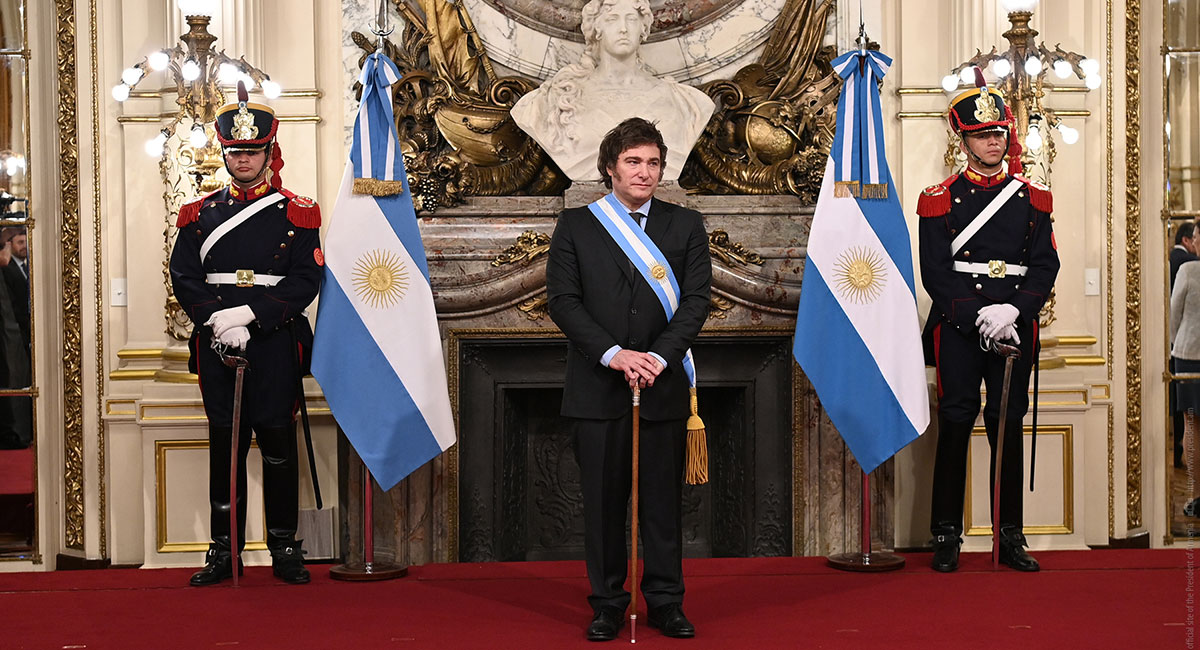
One problem with raising expectations, as a government such as Javier Milei’s did in Argentina, is that when things don’t look as bright as one would like, people begin to lose faith in the ideas. Much emphasis was placed at the beginning on the superiority of the libertarian ideas the president professes, and they were proclaimed with such forceful, aggressive assertiveness that, even though he himself made clear it would take time and sacrifices to clean up the disaster he inherited, people became convinced of the inevitability of progress. Such faith inevitably carried with it high expectations and impatience. Now, almost two and a half years into his administration, many Argentines are losing sight of the legacy of so many years of failed policies he had to confront when he came into office and beginning to associate what is happening today—persistent inflation, high interest rates, scant investment and job creation, high rates of poverty, ethical scandals and excessive politicking—with the present administration rather than past ones.
To be sure, even though many areas of social and economic activity have been deregulated in large part thanks to Federico Sturzenegger, the minister of deregulation and state transformation, some government-owned or controlled companies have been privatized. Certain markets have been liberalized, but several problems continue to impede Argentina’s takeoff. One of them is inflation. Yes, government spending has been dramatically reined in. Still, inflation persists because a lot of money has been and continues to be printed by a central bank that Milei had promised to liquidate, and because a large part of the government’s obligations that were previously on the central bank’s balance sheet have become the treasury’s debt.
After coming down from the astronomical levels reached under the Kirchnerista government, inflation steadily increased month after month from May of last year until March of this year. Monthly inflation went back down to 2.6 percent in April after having hovered above 3 percent for almost a year, but we will have to see whether it is the beginning of a trend, a passing relief, or a more permanent situation (which is nothing to brag about if we consider that it translates into an annualized rate of more than 30 percent). Since the government reneged on its promise to replace the peso with the dollar and to get rid of the central bank, the monetary base has quadrupled. The debt, in turn, has increased by US$71 billion. Part of the debt is in pesos, which means that the peso’s strong devaluation since Milei took office should have significantly reduced its dollar value. Instead, it keeps piling on even in dollars. If all of the interest the government pays on its debt were included in the government’s expenses, its finances would be in the red.
In terms of market liberalization, there has been significant improvement in several areas, but not in others, because key parts of the economy, considered indispensable social services, are still in state hands. The government has stopped funding them, but since they have not been privatized, the result is the collapse of certain services altogether rather than the survival of the fittest. The decline feeds the perception that the administration is keeping people in poverty. Healthcare is one such sector.
Because things continue to look shaky, investment money is not pouring in as the optimists thought it would (except in mining and energy, to some extent). A lot of money has gone into government bonds, increasing the administration’s obligations and interest payments, thereby forcing it to print pesos rather than invest in productive projects. This is one reason why, in the last couple of years, industrial production has suffered the second worst drop after Hungary. Not to speak, of course, of the fact that there are still restrictions on lending and capital controls, and of the difficulty many manufacturing companies face with such weak demand. Some of the 2,400 manufacturing companies that have closed have been the victims of their own inefficiency, as one would expect in a transition from a closed to an open, competitive economy. Still, a lot of what is happening has to do with high inflation and, therefore, high costs, even though taxation has come down. Labor reforms have made it easier to hire and fire workers (one consequence of the former has been a drop in tax revenues, which fell 4 percent in real terms in April).
It is important that Milei’s government addresses these issues rather than rely on gross domestic product statistics to try to persuade people that things are going as planned. Yes, GDP growth is expected to surpass 3 percent and perhaps come close to 4 percent this year, but this is due to just a couple of sectors, such as mining and agriculture, not an overall increase in economic activity. Of course, any radical free-market transformation requires a period of tough sacrifices, but there are factors that offset them and bring relief to people, such as reducing inflation and creating an environment where investors prefer to invest in the economy rather than government bonds.
Let’s hope, for the sake of Argentina and the libertarian cause, that Buenos Aires takes a good look at its own policies and decides to be as bold as its rhetoric in those areas that are still shackling the economy and hindering its definitive takeoff.