Autopilot Deficits
Mandatory spending and surging debt interest drove federal outlays to record levels in fiscal year 2026.
October 26, 2026

News Article
Mandatory spending and surging debt interest drove federal outlays to record levels in fiscal year 2026.
In its 2026 fiscal year that ended on September 30, the U.S. government collected $5.403 trillion in taxes but spent $7.396 trillion. That excessive spending resulted in an annual budget deficit of $1.992 trillion.
All these figures come from the Treasury Department’s Monthly Treasury Statement that covers both September 2026 and the entire 2026 fiscal year. Compared to the previous fiscal year, the federal government’s tax revenues increased by 3.2% from $5.235 trillion, while spending increased by 5.5% from $7.010 trillion. The U.S. government’s budget deficit therefore increased by 12.2% to $1.775 trillion, driven by the big year-over-year increase in spending.
How did the U.S. government’s spending change in 2026?
The chart below shows how the major categories of federal government spending changed from fiscal year 2025 to 2026. The major categories are ranked from highest to lowest in Fiscal Year 2026 from left to right in the chart.
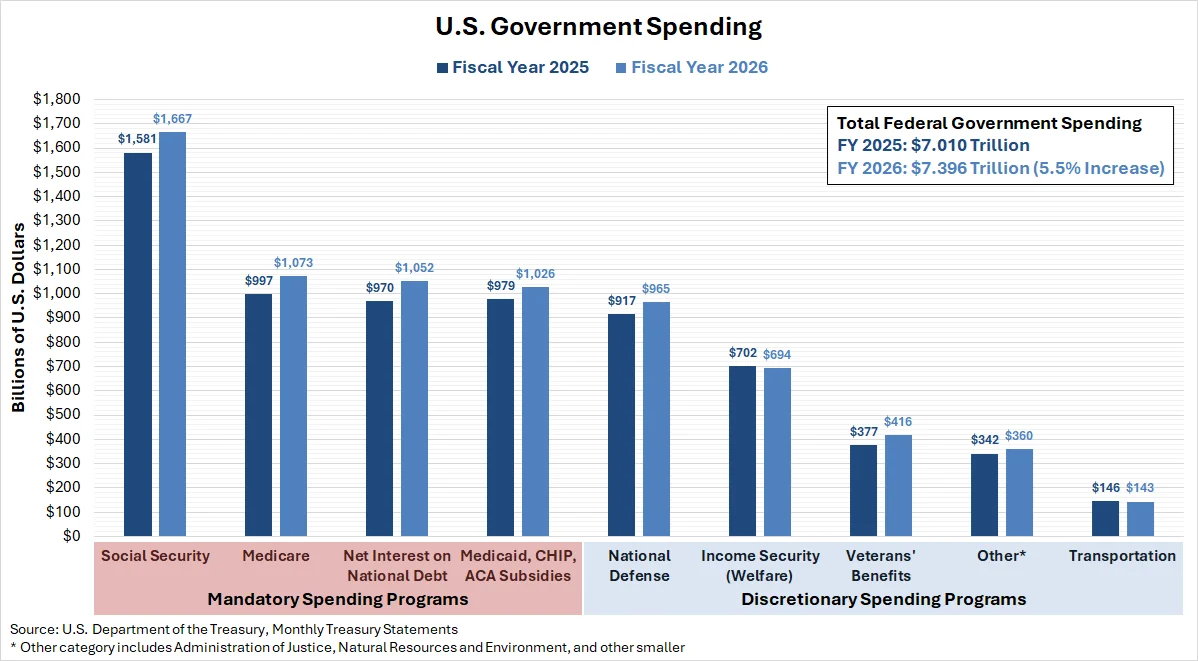
The four most expensive categories of government spending in 2025 and 2026 share a unique characteristic. They consist predominantly of mandatory spending programs. Spending on these programs is on autopilot. Their spending increases each year without any action by the U.S. Congress. Mandatory spending accounts for 65% of all U.S. government spending. From the 2025 to 2026 fiscal year, it increased by $291 billion, or 6.4%.
The remaining 35% of the federal government’s outlays fall in the discretionary spending category, which Congress votes on each year. Discretionary spending increased by 3.8% year-over-year in 2026.
Within the mandatory expenditure category, net interest on the national debt had the biggest percentage increase from the 2025 fiscal year. It jumped by 8.5% from $970 billion to $1.052 trillion in the 2026 fiscal year. That increased expenditure continues an adverse trend for the U.S. government’s fiscal situation as increasing interest rates combine with its $40 trillion and rapidly growing national debt.