

The Legend vs. the Reality of Tariffs in Early American History
Mythbusters: Debunking the New Mercantilists, Part 4
May 26, 2025

News Article
Mythbusters: Debunking the New Mercantilists, Part 4
Note: This is the fourth article in a multi-part series on teaching economics through today’s ongoing trade war. You can read Part 1 here, Part 2 here, Part 3 here, Part 5 here, and Part 6 here. Stay tuned for more.
In our last article in this series, we debunked the idea put forward by some Trump administration officials that the federal government could eventually replace the income tax with tariff revenues.
But what of the second related objection that tariff proponents often raise: if tariffs are such a drag on the economy, why did the U.S. enjoy such strong economic growth throughout the first 150 years of its history when tariffs were the Treasury’s primary funding source?
The Tariff Legend: Tariffs Did Not Cause America’s Economic Growth in the 19th century
Here, the simple answer is one that any economist worth their salt can attest to: correlation is not causation. The claim that tariffs were in any way responsible for America’s prosperity in the 19th century is a prime example of the causal fallacy – the notion that since Y followed X, then X must’ve caused Y (“post hoc ergo propter hoc” in Latin). Contrary to today’s mercantilists, both theory and evidence suggest that the U.S. economy grew in the 19th century despite tariffs, not because of them.
To see why, it’s worth taking a deeper dive into America’s complicated and messy history with tariffs.
Controversy over tariffs in American history dates back to the Navigation Acts in the early colonial era and the Townshend Act of 1767. The American Revolution was in no small way sparked by a rebellion against trade restrictions imposed by executive fiat, as the Boston Tea Party vividly illustrated. Thomas Jefferson explicitly indicted King George III “For cutting off our Trade with all parts of the world” in the Declaration of Independence in 1776. Although Alexander Hamilton was an ardent supporter of tariffs on the grounds that they were necessary to protect infant industries and promote economic self-sufficiency, the majority of the Founders saw them as, at best, a necessary evil and, at worst, a slippery slope to the sort of arbitrary power they had just fought to overthrow.
In 1787, James Madison included tariffs in Article I, Section 8 of the Constitution, which granted Congress the power to “lay and collect Taxes, Duties, Imposts, and Excises.” Although Madison and others had hoped to establish a low and uniform tariff rate of 5 percent, the tariff power soon became a magnet for abuse from protectionist factions and special interest groups.
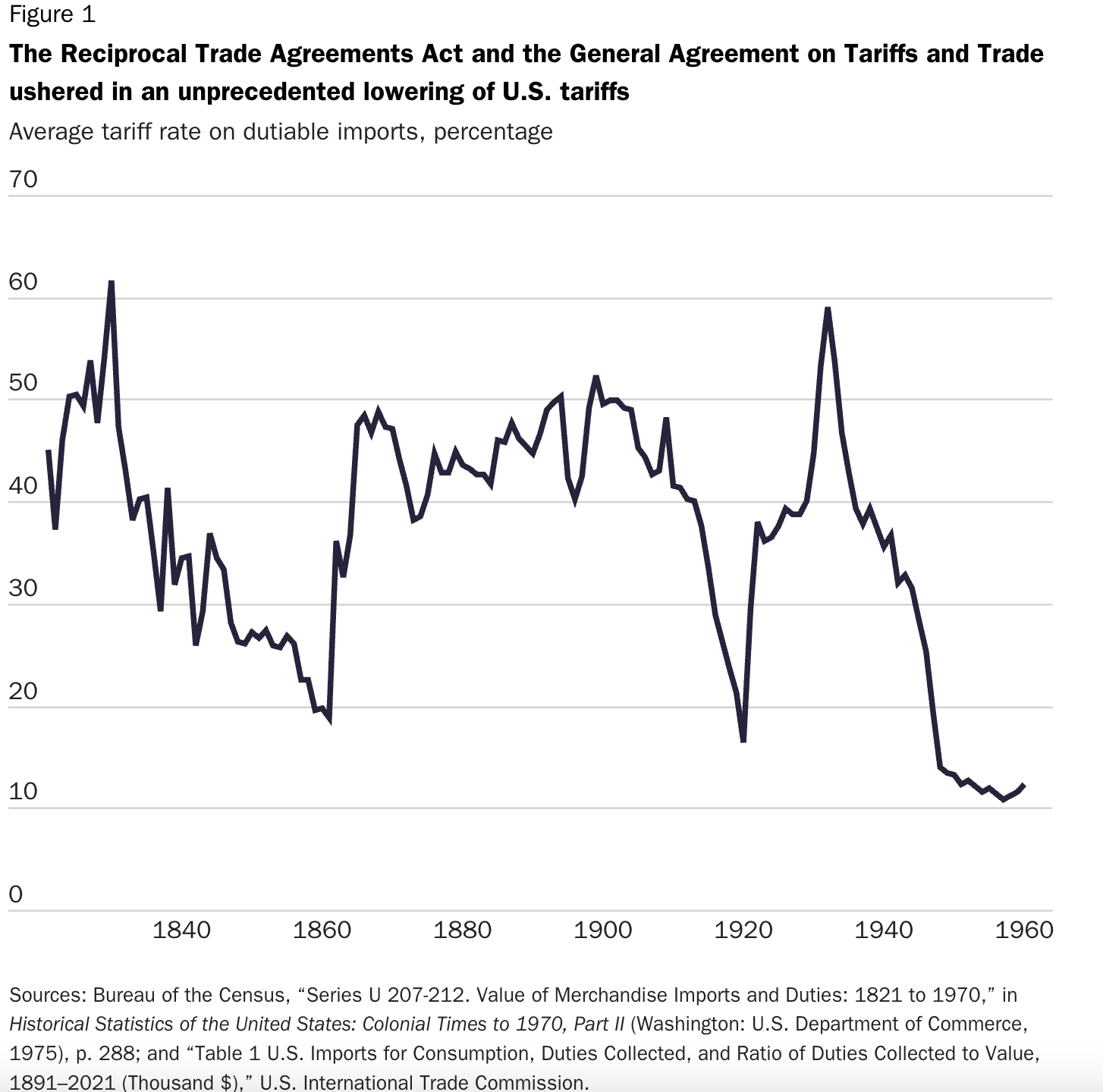
The case for protectionist tariffs lay dormant until the next generation, when Kentucky Senator Henry Clay revived many of Hamilton’s arguments in an 1824 speech outlining the tenets of the “American System.” The speech marked a watershed moment in American trade policy, as it helped usher in a short-lived era of high tariffs. The Tariff of 1828 (colloquially known as the “Tariff of Abominations”), which was passed to protect northern industries from foreign competition, raised America’s average tariff rates to more than 60 percent.
This startling escalation of tariffs riled the southern states, which depended heavily on foreign trade for their agricultural exports. Jefferson and Madison penned the Virginia and Kentucky Resolutions, arguing for the nullification of the tariffs.
These tariffs were so unpopular that they led to the ouster of President John Quincy Adams, who signed the bill into law, and the election of populist President Andrew Jackson in 1828. (Ironically, although Trump likens his populism and anti-establishmentism to Jackson’s, much of Jackson’s populist support came from his voters’ opposition to protectionist tariffs.)
Despite moving in fits and starts each time Congress changed hands, U.S. trade policy generally moved in the direction of freer trade in the ensuing decades. In the 30 years leading up to the Civil War, tariff rates fell by roughly two-thirds, and the U.S. economy grew by a whopping 4.5 percent per year. By the time the Civil War started, America had some of the lowest tariff rates in the world.
After the Southern states seceded, protectionist factions in the North were able to pass the Morrill Tariff Act of 1861. Higher protectionist tariffs remained in place for much of the postbellum period. The U.S. economy did, indeed, experience robust growth during this era. However, this period is a case study in the lesson that correlation doesn’t equal causation. If anything, evidence suggests that these late 19th century tariffs put a damper on America’s economic growth. As Douglas Irwin notes, nontradable sectors experienced faster growth than tradable sectors during this era, implying that tariffs didn’t do much to stimulate domestic production or kickstart industrialization.
Many of the manufacturing industries that protectionists often claim arose in this era actually arose in the relatively free trade antebellum era rather than the more protectionist postbellum era. The main industry that tariffs stimulated during this period was lobbying and rent-seeking in Washington, D.C., as special interest groups flocked to the nation’s capital to lobby for tariffs on foreign competitors.
It’s worth noting that even with tariffs in place throughout the 19th century, the U.S. ran persistent trade deficits for its first 100 years from its Founding era through the 1870s. The U.S. didn’t start running trade surpluses until the 1880s. Today’s protectionists conveniently omit this fact when they clamor for a return to the “American System” as a way to restore trade surpluses.
Lately, President Trump has embraced President William McKinley as his economic role model. He often touts McKinley’s expansive tariffs at the turn of the 20th century as a blueprint for his 21st-century protectionist agenda. However, President Trump’s history is pure fiction. The sweeping McKinley Tariffs of 1890 that McKinley passed while in Congress were hardly popular or successful. In fact, their immense unpopularity led to McKinley losing his seat the next election, along with seventy-two other Republicans who voted for it, preempting a wholesale overhaul of tariff policy.
When McKinley was later elected president, he softened his protectionist stance considerably, shifting his views on the ultimate goal of trade policy toward expanding trade, not circumscribing it. McKinley did enact tariffs as president. However, contrary to President Trump’s claims, even McKinley’s more limited tariffs weren’t a smashing success. They were a colossal failure. McKinley’s patchwork of tariffs didn’t create a Golden Age of American prosperity. They primarily served to centralize power in Washington, D.C. This provided kindling for even more rent-seeking efforts, sparking a wildfire of bribery and dispensing favors to politically well-connected interest groups. Phil Magness aptly summarizes the results of this protectionist racket: “The sheer extravagance of the public corruption around tariff schedule revisions came to a head in the late 19th century, eventually leading reformers to call for the abandonment of the tariff-based revenue system.”
The blatantly corrupt nature of these tariff regimes prompted the passage of the 16th Amendment, which replaced tariffs with the income tax as the federal government’s primary revenue source. Tariffs, however, did not disappear entirely, nor did the spoils system that it spawned. Freed from the constraint of relying on tariffs to raise revenue, politicians shifted to using tariffs solely for protection. The Fordney-McCumber Tariff of 1922 was passed on purely protectionist grounds.
The interwar era of tariffs culminated in the 1930s with the passage of the (Anyone? Bueller?) disastrous Smoot-Hawley tariffs, which raised average tariff rates to nearly 60 percent, their highest levels since the Tariff of Abominations almost exactly a century earlier. Given their well-documented role in exacerbating the Great Depression, even the most dyed-in-the-wool protectionists would chafe at invoking them to justify today’s tariffs. Infamously, the Smoot-Hawley tariffs triggered a cascade of “beggar-thy-neighbor” policies from dozens of nations, who ratcheted up their tariffs in retaliation. The results were disastrous for the global economy. The total volume of global trade fell by two-thirds in the four years after the Smoot-Hawley Act, plunging the American and global economy even deeper into depression. Today’s policymakers would be wise to heed these lessons before they decide to treat tariffs like an innocent threat or simple bargaining chip. Those who don’t know history…
The tariff era finally came to an end with the Reciprocal Trade Agreements Act of 1934 (RTAA), which delegated trade policy to the executive branch by granting the President the power to negotiate bilateral trade agreements. On the plus side, this made it possible for the President to escape the trench warfare that Congress had created with its bad trade policies (for game theory and public choice reasons, it was incredibly difficult for members of Congress to pass sweeping tariff reductions because no individual industry in their district wanted to see tariff rates reduced on its foreign competitors). Indeed, the RTAA ushered in an unprecedented era of trade liberalization in the U.S. and around the world. Tariff rates fell in half after World War II, and they continued to decline throughout the postwar era of globalization. All the while, economic growth has exploded, with GDP per capita skyrocketing from $15,000 to $70,000 between 1950 and 2023.
To be sure, many Presidents – even those who support free trade – have used this authority to raise specific tariffs at the behest of politically favored groups. That said, they’ve generally made these concessions to protect the greater good of freer trade. President Ronald Reagan aptly described this unfortunate political reality as “kissing the pig.” Kissing a pig isn’t ideal, but it is better than throwing the baby out with the bathwater by allowing protectionist factions to get sweeping tariffs passed.
Ironically, the very RTAA that was intended to give Presidents the power to negotiate lower tariffs now gives President Trump near-absolute power to set higher tariff rates by executive fiat. This brings us to the conundrum that Congress now faces, where the authority that it delegated to promote free trade is now being used to suppress it. Congress, meet the consequence of your own inaction.
Chasing the White Whale of Protectionism
Today’s tariff defenders should be credited for looking to history to justify their proposals. Wise men should try to learn from history. Alas, their interpretation of the historical record is dead wrong.
Tariffs did, in fact, play a critical role in financing the early American Republic. But given the exponential growth in the size of the federal government and its spending, they cannot possibly fund today’s leviathan. The math simply doesn’t math. In Melvillan terms, the government that tariffs funded in the 18th and 19th centuries was a veritable minnow compared to today’s Moby-Dick.
Furthermore, tariffs did not make America into an economic powerhouse. They were simply the least bad way to finance a nascent nation. Because tariff rates were fairly low and uniform for much of early American history, they imposed minimal damage on or distortions to the economy. That said, nothing from history implies that they were popular or advantageous. Far from being a popular and effective policy tool, tariffs were a lightning rod of controversy throughout the 19th and early 20th centuries, exacerbating economic tensions and paving the way for rampant corruption in our politics.
Fast forward to the 21st century, and the picture is quite different. In the early 1800s, foreign trade comprised less than 10% of our GDP, and the production of most goods was fairly concentrated in only a few nations. Today, trade accounts for more than one-third of GDP, and most supply chains are dispersed across dozens of nations. The global economy today is more entangled than the British monarchy’s family tree. Economies are inextricably linked. The international division of labor is remarkably intricate and advanced (see I, Pencil). Given these seismic changes, President Trump can’t justify returning to an antiquated fiscal model, much less moving us to a brave new world of autarky.
At the end of the day, the administration’s deep affinity for tariffs betrays an even deeper misunderstanding of U.S. history, not any enlightened policy or a return to the halcyon days of American manufacturing supremacy. Those who don’t learn from history are doomed to repeat it. President Trump might fancy himself a “Tariff Man” in the ilk of Alexander Hamilton or William McKinley. But unless he learns from the mistakes of these earlier tariff men, history will view him as Captain Ahab from Moby-Dick, chasing the white whale of tariffs until it inevitably drags him off to sea.