Japan: Where High-Speed Rail Works
The Shinkansen system is efficient and being exported to other countries. Will something similar work in the U.S.?
January 8, 2024

News Article
The Shinkansen system is efficient and being exported to other countries. Will something similar work in the U.S.?
There’s a longstanding debate over building high-speed rail (HSR)—defined as railroads with trains traveling at least 124 MPH—in the U.S. The concept is back in the news, with the Biden administration allocating millions in infrastructure funds to two HSR projects: Brightline West, connecting Las Vegas with the Los Angeles suburbs, and phase one of California’s beleaguered high-speed line. The debate over whether HSR is a good investment is nuanced, factoring not only costs, but density, distance and demand. Arguably, the best example of a country that got HSR right is Japan, with its line of “Shinkansen” trains.In 2021, they carried 195 million riders between Japan’s major cities, and travel up to 200 MPH. I recently rode it during the Tokyo stop of my 1.5 year Global South trip, and can offer thoughts on how the line informs HSR’s suitability in the U.S.The first Shinkansen line opened in 1964, coinciding with the Tokyo Olympics, connecting Tokyo and Osaka. It was built by Japanese National Railways for $9.9 billion in today’s dollars. That’s reasonable by modern standards, and even then, was made higher because the line carved through mountains. But JNR faced a severe debt crisis, in part from political pressure to keep unprofitable lines open. In 1987, JNR was privatized and split into multiple companies. (The government subsidizes construction in some cases, and regulates fares.) Today, there are nine Shinkansen lines.Last December, while staying in Tokyo, I took the Shinkansen to Osaka on a crowded Friday. I watched it fly by farms, through hills and past sizable cities, way faster than the Amtrak trains I’m used to.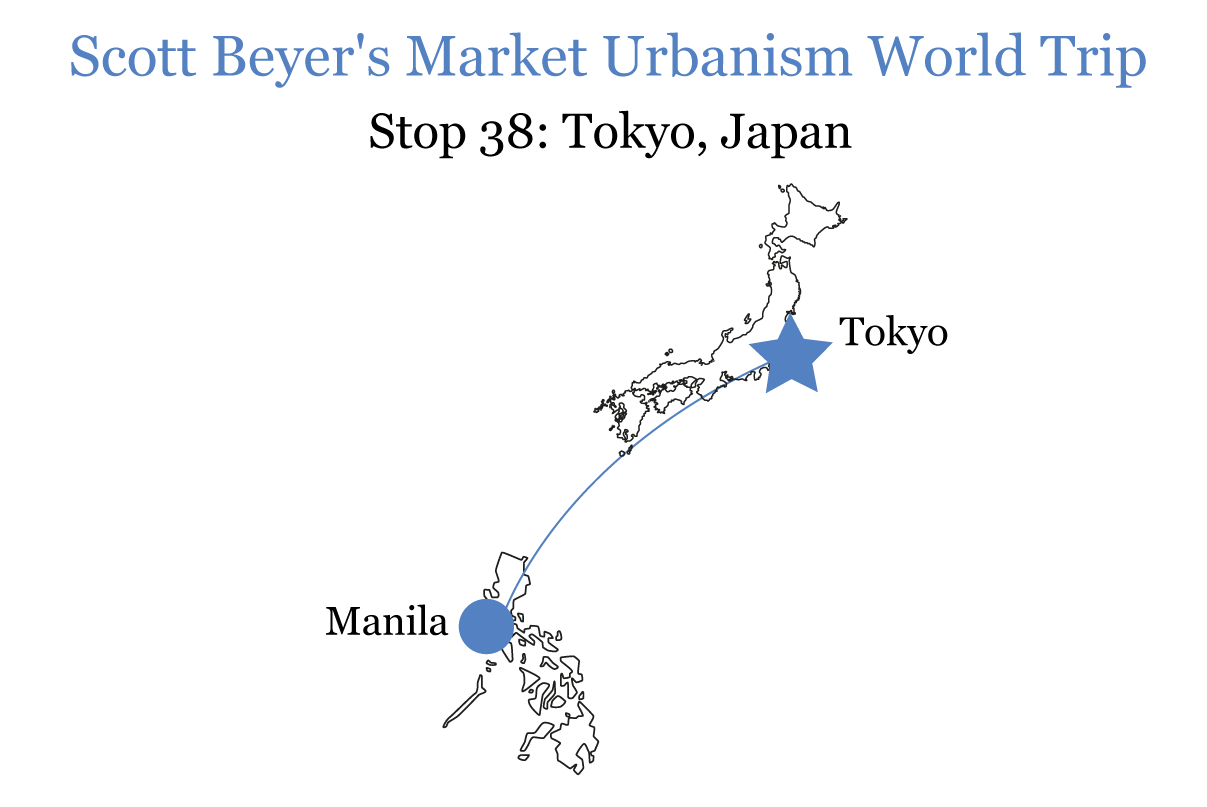 Two takeaways jumped out regarding the debate about how practical HSR would be for the U.S. The first issue is whether it’s really faster. Sure, a train traveling 200 mph covers ground. But in terms of raw vehicle speed, flying is faster. Depending on one’s travel distance, flying could be the better choice even accounting for the extra time spent reaching the airport and checking in. Driving could also be faster: you can go directly from point A to B without having to change vehicles. But this depends on factors such as accessibility level at the end point.In Japan, the train is clearly the most convenient choice. Driving between Tokyo and Osaka takes 6-8 hours depending on traffic. Once arriving at either city, drivers deal with congestion and scarce parking. Flying takes 1 hour, but often costs much more, and the airports in both cities are so far from the center that the trip would likely also take 6-8 hours. Shinkansen takes 2.75 hours, serving centrally-located stations. Once the trip ends on either end, the rider has access to lots of cabs, buses and subways that quickly take them around. In the U.S, origins and destinations tend to be more dispersed, and transit networks aren’t as comprehensive. Flying or driving often works out faster. Still, auto-centric cities have severe congestion, and high speed trains occasionally make outlying stops, meaning HSR could be competitive for some trips. The second, and more important, debate is whether HSR spurs development. Japan was already dense before the first Shinkansen was completed, and smartly, the train was built along the country’s urbanized Pacific Coast. But HSR has spurred yet more development there, with railroads building major housing, office, and retail developments at and around stations. The city of Nagoya, for example, grew thanks to serving as a Shinkansen stop.
*
The Shinkansen demonstrates that, with high density and strong intracity transit, HSR is the most convenient choice. It also proves that passenger rail can be profitable under these conditions—the companies running it are publicly listed on the Japanese stock market and pay dividends.As a result, other countries want it. JR companies are actively involved in HSR projects worldwide. JR East has been part of a group of companies bidding to build and operate a planned HSR line between Singapore and Kuala Lumpur (that plan was canceled, but negotiations resumed in 2024). India is also working with Japanese engineers on a high-speed train connecting Mumbai and Ahmedabad. Elsewhere in the Global South, countries such as Morocco (which has already opened one line) and the United Arab Emirates are building HSR networks.So would it work in the U.S.?Unlike Japan, much of America is spread out, with low density land use common even in major urban centers. This makes a coast-to-coast “national high-speed rail plan” unrealistic. But there are places where it would be practical. Brightline completed a higher-speed rail between Miami and Orlando, mostly with private funds, which is proving successful. The private Texas Central consortium plans to build an HSR line using Shinkansen trains between Dallas and Houston, partnering with Amtrak. Private interests have expressed desire to build a maglev along the Northeast Corridor. Amtrak has long intended to upgrade the Northeast Corridor to allow for higher speeds.The main challenge is that new rights-of-way are necessary, a problem that, particularly in the Northeast, ties to entrenched players like Amtrak as well as lack of undeveloped land. Environmental regulations add to red tape; California’s CEQA, for instance, has been invoked in litigation around that state’s HSR project. More broadly, America’s infrastructure construction costs are high, including CAHSR, with its outrageous overruns.The Biden administration’s tossing of $3 billion to Brightline West could be more of the same. But done well, it could mirror the best of Japan’s strategy, by helping lay right-of-way while allowing private operator use. In Florida, Brightline already uses a similar model, developing land near stations to build a ridership base and using these land assets to generate revenue.The key is to let market demand guide decisions about HSR, informing the entire procurement, construction and management process. Operators should be responsible for the full financial viability of lines, even if construction subsidies are inevitable (and providing them by loans requires they be paid back). Key to success, also, is allowing the development around stations to be as intensive as possible, like in Japan. But that too would require significant land-use deregulation in U.S. cities.HSR can succeed in America, but it’s an expensive undertaking, and to justify the costs, would require larger liberalization to occur around it. The California HSR shows that likely won’t happen, but hopefully the new Brightline train proves different.Graphic Credit: The Market Urbanist.Cover photo is in the public domain under the Creative Commons 1.0 Universal Public Domain Dedication.