The unrelenting expansion in the scale and scope of government involvement in science receives too little attention. Today in the United States and around the world, government funding and direction of science are presumed to be essential, if not constitutional, prerogatives of the state. The rise of state-run science did not commence in earnest in the United States until World War II and its aftermath, although a substantial amount of the bureaucratic groundwork was put in place by Franklin D. Roosevelt before the war. During the 1930s, Great Britain barely escaped full central planning of science; it was pulled back from that precipice in large part because of the heroic efforts of Michael Polanyi, John Baker, and their Society for Freedom in Science. In the Soviet Union, in contrast, the central planning of science exacted an enormous human cost, with Stalin’s embrace of Lysenkoism and the resulting destruction of the country’s agricultural sector and its suppression of Western genetics and biological sciences. Today, although central planning in science is rarely mentioned, the United States is at a tipping point: an alliance of government, business, and academia threatens the autonomy and knowledge-generating capacity of science. Only a fiscal constraint seems to hold this revolution in science at bay.
This situation is a relatively modern development. At one time, science was thought to be an undertaking that should be principally financed by private sources and largely removed from the government’s oversight and its political aims, which most often involved using science for military purposes. That government’s insinuation into science parallels the growth of the modern interventionist state is not a coincidence.
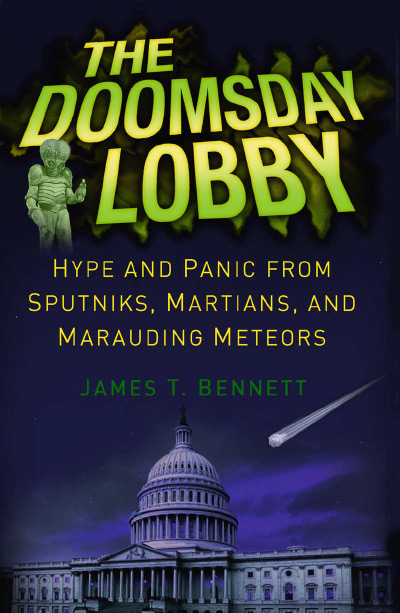
James T. Bennett’s most recent book, The Doomsday Lobby, is an excellent antidote to the thinking that has promoted science as an arm of the government during the past seventy-five years. The explanation of how the present situation developed is a complex, intertwined story of the growth of government itself, on the one hand, and political opportunism by government and its clients—scientists, business, and academic institutions—on the other. Bennett wisely carves out a single theme in this story by concentrating on the U.S. space program’s development. The bulk of the book concentrates on the U.S. response to the USSR’s orbiting of Sputnik in 1957, the National Aeronautics and Space Administration’s ensuing programs for moon landings and planetary exploration, and the more recent speculations about life-ending doomsday asteroids. Bennett’s narrative lays bare, often in overwhelming detail, the crass political exploitation of fears manufactured by government and the scientific establishment to justify enormous expenditures for projects of dubious value ostensibly to protect against highly unlikely catastrophes from outer space. Bennett’s main conclusion is that the science establishment has frittered away its independence to a power-hungry government, with government funding of science serving as the enabling juice. Whatever public benefits might be ascribed to such endeavors, the argument of The Doomsday Lobby is that this game is rigged and entails substantial costs to taxpayers.
Several notable studies that have examined the actual process of government funding of science have reached similar conclusions: for example, Joseph P. Martino’s Science Funding (New Brunswick, N.J.: Transaction, 1992); James D. Savage’s Funding Science in America (New York: Cambridge University Press, 1999); and Michael Grough’s Politicizing Science (Stanford, Calif.: Hoover Institution, 2003). Bennett, however, also performs a singularly important service by demonstrating that basic scientific research can do fine in the absence of government funding. His case in point is the emergence and rise to world-class prominence of astronomical research and observatories in the United States during the latter part of the nineteenth century, all financed privately by benefactors, donations, and scientists themselves. This case study is important because simply highlighting the inefficiencies of government funding of science, the politicization of science, and the purposes to which such science is put are not sufficient to seal the case against government funding of science. Bennett stakes out this position in the book’s first sentence: “Federal patronage of science was never contemplated by the men who wrote the U.S. Constitution” (p. 1). Thus reorienting the terms of the debate, he demonstrates that private science not only occurred but also outperformed government science.
Bennett’s approach is not geared to technical economics. Readers will certainly acquire a deep appreciation of the historical narrative he presents, but they are not presented with a critical analysis of the economic arguments commonly used to justify government funding of science. These arguments, dating from the 1950s, claim that privately funded basic science would suffer persistent underfunding because of the nonappropriability of scientific knowledge and the “free riding” that would ensue. The resulting market failure, it is argued, implies that securing the optimal “quantity” of such knowledge requires government subsidization. One might plausibly argue that such matters are really fodder for another book, yet this market-failure claim remains as a kind of “presence” left hanging for the reader. Although the absence of discussion of this issue does not diminish the force of Bennett’s overall argument, tackling the issue probably would have made that argument more persuasive. Implicit throughout the book, Bennett’s argument against government funding of science surfaces again in the final chapter as being “grounded on a healthy skepticism of state power,” power geared to redistributing wealth “to the most politically potent actors” (p. 187), among whom academic institutions and scientists figure prominently. Whether those actors are motivated by visions of human habitation of Mars, as discussed in chapter 5, or anthropogenic global warming (pp. 189–92), Bennett correctly hones in on government funding as the key ingredient in the politicization of science and the concomitant government control of science. Government policy generally precedes the science underpinning it, giving rise to increased funding for the “right” science and dissuading funding for “critics,” as amply illustrated in recent funding of climatological science. The problem, however, is not that government policymakers and bureaucrats have their own biases; instead, the problem is that because government by a wide margin is the Big Player in science funding relative to private sources, it has the capacity to dominate the kind of research that is funded and then to implement policy based on that science. That the government alone can tax private citizens to fund such science gives it an advantage that no private entity can match. These conditions give us reason to suspect that with increasing government funding of science, policymaking will increasingly reflect government science. This tendency, of course, presents difficulties because dislodging incorrect science will become more challenging. Government policies that are partially defended on scientific grounds (for example, carbon taxation) will become increasingly self-referential.
Economists have tried with little effect to design incentive schemes to reform the politicization of science and the kind of cronyism that appears to permeate the funding agencies. Even Michael Polanyi, who argued so eloquently and persuasively for scientists’ autonomy to pursue their inquiries free of political pressures, favored government funding of science. In contrast, Bennett expresses deep skepticism of government funding of science, maintaining that “piecemeal reforms of the system are bound to fail” (p. 188) and “seem truly quixotic” (p. 194). To his credit, he advocates a return to a funding system based on the pursuit of knowledge “under private, corporate, philanthropic, and cooperative patronage” (p. 194) and urges that it is time “for another look at the virtues of private science” (p. 194).
Bennett’s book will appeal to a large swath of readers with a bent toward the history of science and who are concerned about the increasing role science has come to play in justifying the government’s policy choices. His account of the government’s takeover of the space program is both a compelling and an unsettling story because of the ease with which this takeover was accomplished. Once past the book’s catchy title, the reader will see that it is a thoughtful, serious (though disarmingly witty), and well-researched work.
| Other Independent Review articles by William N. Butos | |
| Spring 2020 | The Keynes Perplex |
| Fall 2015 | Causes and Consequences of the Climate Science Boom |
| Fall 2006 | Government and Science: A Dangerous Liaison? |