

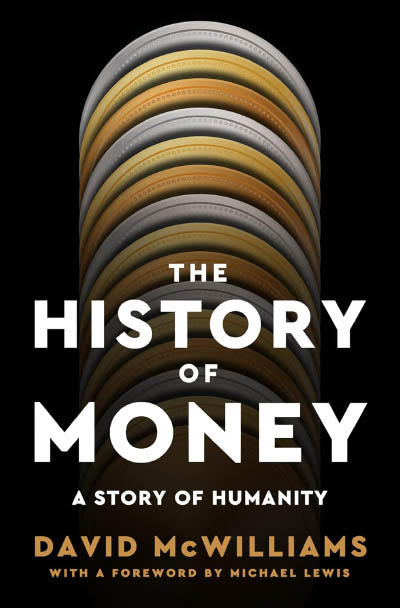
The History of Money
Book Review
Reviewed by
This book review is a web exclusive for the Spring 2026 issue of The Independent Review.
In the acknowledgements at the end of The History of Money, David McWilliams writes, “Opinions and errors are my own, but if there are any real howlers, you can blame the following people. I’m only messing . . . ” (p. 369). The passage captures the nature of the book surprisingly well. It is fun to read and bubbling with ideas but goes overboard in places and there are a few genuine howlers, as well.
McWilliams begins boldly. “A highly emotional substance, money can be transgressive, sexy, dangerous, mind-altering. Money is power, it is domination, but it can also be liberation. . . . Money defines the relationship between worker and employer, buyer and seller, merchant and producer. But not only that: it also defines the bond between the governed and the governor, the state and the citizen. . . . Each of us has heard the mantra that money is the root of all evil, yet money is also an instrument of peace. . . . We have coevolved with money: we have shaped money, but money has also shaped us. . . . [T]he contention of this book is that the crucial technology shaping humanity in the last 5,000 years has been money. . . . This book is about the relationship between a curious ape and a wondrous technology,” hence the book’s subtitle A Story of Humanity (emphasis added, as well as the caveat that St. Paul’s quote from 1 Timothy 6:10 actually says that “love of money,” not money itself, “is the root of all evil,” pp. 5–9).
The book’s introduction presents McWilliams at his best—big ideas and daring insights conveyed by a practiced storyteller. Then the hard work begins—tracing the history of money to flesh out the full story. The narrative effectively begins in Mesopotamia about five thousand years ago. McWilliams reports that grain was the first unit of monetary measure used in trading and contracts—and that granaries served as banks. As soon as this proto-money came on the scene, the Mesopotamians began using contracts with interest payments—compound interest, no less. Money “was the first thing we wrote about” (p. 26) and allowed states to tax and therefore to arise—“a state without statistics isn’t a state” (p. 29).
The next breakthrough came when money was transformed from contracts to coins around 700 BC in Asia Minor. McWilliams sees this new form of standardized money as almost magical. He argues that the introduction of money by itself could and did make societies wealthy, beginning with the ancient Lydians. He largely sees the invention of money as a top-down affair. Nowhere in the story is the spontaneous emergence of precious metals as money, as conceived by thinkers like Carl Menger (for example in “On the Origins of Money” Economic Journal 2 [1892]: 239–55). Menger isn’t mentioned in the index. Nor, oddly, is the term seigniorage. And virtually nowhere to be seen are events in China. The development of money in China is fleetingly mentioned on about a dozen pages, despite the fact that commodity money emerged there as early as it did in Asia Minor, and that commodity-backed money and fiat money were invented in China.
From this point onward it becomes increasingly clear that the volume’s title is a bit misleading, as it is not so much the “The History of Money,” as “Episodes in the History of Money, Markets, and Finance.” Topics include “The Empire of Credit” (the rise and fall of Rome), the feudal European economy, Johannes Gutenberg, the conquest of the Aztecs, “The Father of Monetary Economics” (surprisingly, this crown is given to John Law of Mississippi Bubble fame), “The Bishop of Money” (a chapter on Talleyrand and monetary affairs in the era of the French Revolution), money in the early history of the American Republic (Alexander Hamilton is credited with doing almost everything accomplished by both Congress and the President), the monetary allegory of the Wizard of Oz (oddly Hugh Rockoff’s “The ‘Wizard of Oz’ as a Monetary Allegory,” Journal of Political Economy 98 [1990]: 739–76 isn’t cited—but sources and citations aren’t a priority in most of the chapters), the Klondike gold rush, James Joyce (the author is Irish, so Joyce’s side gig as an entrepreneur is worthy of note), hyperinflation in Weimar Germany, the 2008 financial crash, cryptocurrency—and much more! There are numerous asides—fascinating and distracting by turns—and plenty of scandals, which seem to be catnip to McWilliams.
Throughout these interesting chapters McWilliams sees money as a far more important driver of historical events than traditional historians do. As is well known, Roman emperors’ debasement of coinage caused rampant inflation. “Did money kill the Roman Empire? We’ll never know, but of the 210 different reasons cited by historians, the death of Roman money is surely up there” (p. 78). “Surely”? I doubt it. (Inflation didn’t kill the eastern part of the empire, which had the majority of the population—nor did money die there.) The verdict is rendered but supporting arguments are few. The “dark ages” were dark in his telling because they stopped using money, rather than the more obvious story that the use of money declined because of deeper problems in Western Europe. More strikingly, “Historians put the relative underdevelopment of the Meso-American civilization down to a variety of structural causes, such as the Europeans being settled farmers for a much longer period. . . . Rarely mentioned, however, is the fact that the Aztecs had only a very rudimentary form of money” (p. 154). The implication seems to be that if the Aztecs had simply developed money before Spaniards arrived, the fate of the hemisphere would have been far different. One subheading is “Money’s magic” (p. 38), and later McWilliams says, “Give people money and, in economic terms, magic happens” (p. 321).
McWilliams is especially hard on the gold standard, arguing that it created a deflationary bias because economic growth was faster than the expansion in the money supply, which was very slow because the amount of gold out there is virtually fixed. The facts say otherwise. As Lawrence White (Better Money: Gold, Fiat or Bitcoin? [Cambridge University Press, 2023], chap. 2) shows, between 1807 and 1869 the world’s monetary gold stock grew by 1.95 percent per year, while real GDP that traded against gold grew by 2.05 percent per year. From 1870 to World War I, the growth rates were 2.52 percent for the monetary gold stock and 2.67 percent per year for real GDP in the (Western) countries on the gold standard. Accordingly, because growth in the money supply and real GDP growth were approximately equal, the long-term inflation rate was approximately zero—rather than there being chronic deflation—during this era. In addition, it is not clear that deflation harms economies. Andrew Atkeson and Patrick Kehoe conclude that deflation and depression do seem to have been linked during the 1930s. “But in the rest of the data”—for seventeen countries and more than one hundred years—“there is virtually no evidence of such a link” (“Deflation and Depression: Is There an Empirical Link? American Economic Review 94 [2]: 99–103). In contrast, McWilliams rehearses the arguments about deflation wrecking farmers that gave rise to the Populist Party in the late 1800s. Here he adds errors, such as suggesting the United States “had no known natural sources” of gold before the California gold rush (p. 266). We had a gold rush in North Carolina that began in 1799 and there was one in Georgia, as well. And he mentions that the Populists wanted to cut the income tax for ordinary workers (p. 275), in an era in which there was no income tax.
Some of the errors that McWilliams introduces seem to be caused by his desire to tell a good story. For example, he links the end of the nineteenth century’s “deflation” to the heroic efforts of a single person from a mistreated group: “Deflation was slain by the intrepid prospecting of a First Nations woman, Shaaw Tláa” (also known as Kate Carmack). Her efforts kicked off the Klondike gold rush and are responsible for prices in the U.S. rising nearly “50 percent” from 1897 to 1914 (p. 276). The biggest problem with this story is that the Klondike’s production added about 13 to 20 million ounces of gold to the world’s stock, but this is dwarfed by output of about 32 million ounces in South Africa and 55 million ounces in Australia in the same period (these estimates are from Google AI). And prices in the U.S. rose only about 20 percent during this era. Another interesting faux pas is when McWilliams states, “Today, currency . . . amounts to around 10 percent of all the money supply; finance in all its various manifestations—your mortgage for example—makes up the rest” (emphasis on the peculiar error added, p. 331).
A final broad point of The History of Money is that fiat money means progress: “Average global growth during the Gold Standard was about 1.0–1.5 percent per year, while during the past fifty odd years of fiat, the global GDP growth rate averaged around 2–3 percent per year. . . . In a growing economy, limiting the money supply to something fixed such as gold has an automatically deflationary effect” (p. 321). Yes, economic growth has accelerated but hasn’t this been due to moribund economies (like China or India) adopting pro-growth, market-friendly institutions, rather than the spread of fiat money? I think fiat money does have some advantages over commodity-backed money, but it is important to weigh these against the disadvantages and to stop pretending that the money supply curve is vertical under gold. In all of human history, about 212 to 216 million tons of gold have been mined. Approximately one-third of this—70 to 80 million tons—has been produced since the turn of the millennium (Google AI)!
Despite all these caveats, McWilliams’s contention that money has been the most important technology of the past five thousand years is an intriguing idea. If it isn’t the most important, it surely deserves to be prominent on any list. Yet it is not. It is clearly a key social technology that has “helped organize us in pursuit of common goals by enhancing cooperation” (p. 7).
Comments
Related Book Reviews
The Political Economy of War, Peace, and the Military-Industrial Complex

The Call of the Tribe


Maverick


Medicare’s Midlife Crisis


Independent Review Issues
Articles by Issue