

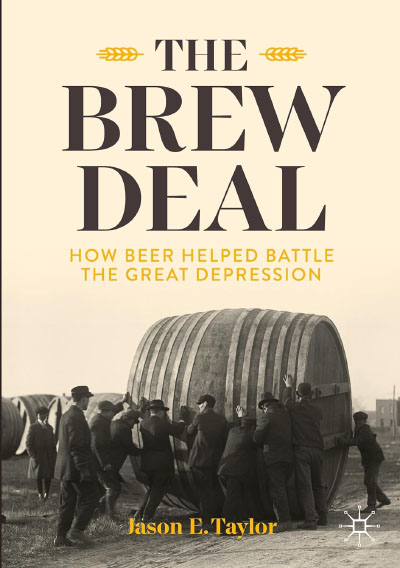
The Brew Deal
Book Review
Reviewed by
This book review is a web exclusive for the Spring 2026 issue of The Independent Review.
Prohibition in the United States lasted just thirteen years, but it left an enduring legacy. The mob cut its teeth running alcohol to speakeasies across the country and would go on to dominate numerous criminal enterprises over the coming decades. Moonshiners in their hot rods evading government agents in the hills of Appalachia eventually morphed into today’s NASCAR. And Prohibition gave us that most American product of all: 3.2 beer. “Roosevelt beer,” as it came to be known, was the country’s way to save face after those long, dry years. Ultimately, the end of Prohibition and the creation of low-alcohol beer (3.2% by weight or about 4% by volume) was both a result of the Great Depression and one of the few potential paths out of the Great Depression. Jason E. Taylor’s The Brew Deal: How Beer Helped Battle the Great Depression tells the story.
The best thing I can say about this book, really any book, is that I learned a lot. Despite imbibing more than my fair share of alcoholic beverages and watching every mob show available on Netflix, I knew very few details about the history leading up to, the reality during, or the end of Prohibition. I had a vague notion only that Prohibition ended because of the Great Depression, but that’s about it.
I learned that Prohibition was not the discrete 0-1 policy light switch that I had previously imagined. Before the passage of the Eighteenth Amendment to the U.S. Constitution in 1919, which banned “the manufacture, sale, or transportation of intoxicating liquors” in the country, and the Volstead Act, the Congressional law that was passed to enforce the Amendment, fully half of the United States were already completely dry states. Likewise, after the Twenty-First Amendment was passed in 1933 thus ending national Prohibition, state-level Prohibition continued in those same states until those state legislatures began to re-legalize.
As Congress debated the Volstead Act’s provisions, it was forced to decide what was to be considered an “intoxicating liquor” under the Eighteenth Amendment. Did that mean only distilled spirits leaving beer and wine still legal? If wine and beer were to be prohibited too, could non-intoxicating versions be allowed? And if so, what exactly was non-intoxicating? Interestingly, Congress seriously debated declaring that beer brewed to the wartime maximum of 2.75% alcohol by weight (abw) was non-intoxicating and therefore would remain legal. But in the end, any alcoholic beverage above 0.5% abw, which truly is non-intoxicating, was banned by the Volstead Act. The debate about how much alcohol was “intoxicating” would be a central issue in all the federal elections of the 1920s, but the “Wets” could not beat the “Dries” and the 0.5% standard stuck.
Taken literally, Prohibition decimated by a factor of nine the brewing industry in the United States as over 90% of the nation’s breweries disappeared. The few that survived eked by as shells of their former selves by selling near beer, soda pop, seltzer waters, ice, or other related products. The Brew Deal describes the grim details as brewery after brewery after brewery went belly up in the first year or two of Prohibition. This section of the book may be tedious for some readers, but as a native of Cincinnati, reading about the closure of old breweries with names like Bellevue Brewing and Christian Moerlein, which was one of the nation’s largest national beer brands, was of special interest to me. I remember well when Cincinnati’s Hudepohl-Schoenling Brewing Co., incidentally one of the few breweries to survive Prohibition, brought back Christian Moerlein beer in 1981 to great local fanfare.
With the onset of the Great Depression and the 1932 election of Franklin Roosevelt, himself a well-known drinker and a “Wet” politically, it seemed Prohibition was in trouble. Within weeks of his inauguration, Roosevelt got Congress to modify the Volstead Act to allow “non-intoxicating” 3.2 beer, and April 7, 1933, became a day, not of infamy, but to be celebrated as New Beer’s Day or Brew Year’s Day.
As is typically the case in politics, the end of the ban on beer was less about the Dries seeing the ideological light or their embrace of economic liberalism, but rather it was about the jobs:
Make no mistake. Beer legalization in the spring of 1933 was instituted as an economic measure. While calls for Congressional modification of the Volstead Act to allow beer were made within days of Prohibition’s start, they always stalled for lack of political support. The Great Depression changed that. With the economy in its fourth year of downward spiral, and a quarter of the U.S. workforce unemployed, it was time for something new. Or perhaps something brew. (p. 112)
In a testament to the wonders of the always-underrated elasticity of supply, the 133 surviving breweries (out of the 1400 from 1919) sprang into action, and by the end of the year had produced over 40% of the pre-war output of beer.
Coincident with the change in the definition of non-intoxicating beer, Congress began to move fast to repeal the Eighteenth Amendment entirely and did just that with the Twenty-First Amendment. This amendment was ratified by the necessary states by early fall of 1933. Thus wine, hard liquor, and real beer (not just 3.2 beer) became legal again—at least in those states where it was legal before Prohibition.
In what may be the most economically questionable chapter of the book, Taylor speculates on the power of legalization to revitalize an economy that was then at its lowest point of the entire Great Depression. The fact is that 1933 was a very good year economically. Industrial output surged and employment grew right alongside. It is all but impossible to isolate the impact of beer (and eventually all) legalization from the general positive change in expectations associated with Roosevelt’s election. Taylor argues that beer was causally linked to the 1933 recovery. I want to believe the thesis, but I am not sure we will ever know for sure how much the end of Prohibition contributed to the economy.
Taylor does explain why the boom didn’t last and why a second wave of malaise took over the American economy by the end of 1933 through 1935. Here he is on firmer ground citing the policy uncertainty and downright kooky (to use a technical term) economics of Roosevelt’s National Industrial Recovery Administration (NIRA). Taylor thinks, and I would agree, that the NIRA quickly undid whatever gains had been earned by ending Prohibition.
The last chapters catalog the boom years as investment, and the accompanying questionable financing practices, reestablished old breweries that had failed during Prohibition and led to the creation of hundreds of new brewing companies. He quickly dismisses claims that the post-Prohibition brewing boom was a bubble:
At the beginning of 1933, fewer than 150 breweries were manufacturing near beer. By the end of the year more than 600 were selling real beer. If there was too much entry during these nine months, massive brewery failures would have followed when the beer bubble popped, as bubbles always do. In fact, no such exodus occurred. (p. 173)
Indeed, the number of breweries continued to rise, hitting 696 by the end of 1936 and producing a volume greater than in 1919.
The Brew Deal doesn’t really engage with the entire Prohibition scene. The focus of Taylor’s book is beer, and in particular 3.2 beer. After Prohibition ended, many states regulated beer sales in ways that helped keep 3.2 beer in the market. Some dry states and those that banned Sunday sales still allowed the sale of 3.2 beer. Many states allowed 18-year-olds to drink 3.2 beer but reserved the harder stuff for ages 21 and up. Some states had easier licensing rules for bars serving 3.2 beer only. The military also favored 3.2 beer. But over the decades and with the explosion of interest in craft brewing, 3.2 beer as a legal category has all but disappeared. Only Minnesota still has a legal place for 3.2 beer. Of course, most of the top selling American lagers, as well as quite a few craft beers, are right about or only slightly above 3.2 abw (4% abv). Thus, Roosevelt beer is ironically still alive and well in America, but it survives because of consumer sovereignty not government diktat.
I have few complaints about this book and heartily recommend it. The only caution is that I found the focus on beer, and 3.2 beer at that, interesting and informative as it was, a bit too narrow. By most accounts, distilled liquor took center stage during Prohibition as its higher value by volume and easier concealment and transportation relative to beer gave it the edge. Readers looking for a complete history of Prohibition that includes the story of distilled spirits, moonshine, smuggling, and organized crime will need to look elsewhere.
Comments
Related Book Reviews

Liberalisme


The Poverty of Nations


Religious Liberty in America

Libertarianism


Independent Review Issues
Articles by Issue