

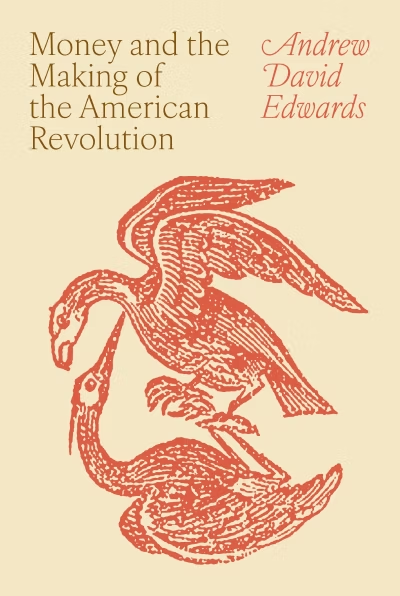
Money and the Making of the American Revolution
Book Review
Reviewed by
This book review is a web exclusive for the Spring 2026 issue of The Independent Review.
A single open-access encyclopedia article, written by Ron Michener and commissioned by Robert Whaples for EH.Net Encyclopedia some twenty years ago (“Money in the American Colonies”), demolishes this book’s puerile, Chartalist understanding of colonial money and its oversimplified thesis “to understand the American Revolution, we need to understand American money” (p. 1). Actually, we need to understand macroeconomics to understand the Imperial Crisis that led to independence. Colonial agitation found root in the simultaneous contraction of both full-bodied gold and silver coins and paper bills of credit following the French and Indian War. That spiked interest rates and tanked land prices, initiating a rash of sheriff’s sales, bankruptcies, and imprisonment for debt just as news of the Stamp Act arrived in the colonies.
For twenty years, Michener and I worked on a book explaining how British monetary, trade, and tax policies created the post–French and Indian War macroeconomic crisis undergirding the Imperial Crisis. Unfortunately, we routinely found ourselves sidetracked by what we saw as Farley Grubb’s flawed forays into the field of colonial money. (We abandoned the book during the pandemic, but my summaries are available in “Consequences Unintended: The Bubble Act and American Independence,” in The Bubble Act: New Perspectives from Passage to Repeal and Beyond, edited by Helen Paul and D’Maris Coffman [Palgrave, 2023], 131–61 and “Cruel Bedlam: Bankruptcies and the Break with Britain,” Journal of the American Revolution [2024]). Author Andrew Edwards somehow discovered Grubb’s papers but not our rebuttals, the number of which alone should have alerted him to the depth of colonial currency controversies. (Most importantly, Ron Michener and Robert E. Wright, “State ‘Currencies’ and the Transition to the U.S. Dollar: Clarifying Some Confusions,” American Economic Review [June 2005]: 682–703).
Contrary to the claims of generations of historians, the Imperial Crisis indeed rested on a material basis, but one far more complex and nuanced than Edwards elucidates in his chronological narrative, which begins with the development of bills of credit in Massachusetts in the 1690s and ends with the Constitutional Convention. Smitten by the fact that colonists burned their paper money and unaware that early banks burned or macerated retired notes and that the Federal Reserve still incinerates or composts its old notes, Edwards repeatedly insists that “after the [Revolutionary] war, Americans stopped burning their money” (pp. 6, 16, 273). That might sound like a minor factual mistake, but Edwards builds his entire interpretation of colonial money on the incredible claim that because retired colonial bills of credit were destroyed, they constituted a “temporary” (pp. 5, 79) money “at odds” (p. 68) with the “in theory” (pp. 4, 81) permanent money foisted upon Britain by John Locke and other self-interested financiers. When British authorities finally figured this out, the virtual ban on colonial bills of credit imposed by the Currency Act of 1764 resulted and Americans rebelled to regain the right to issue their “anticapitalist” temporary money (pp. 14, 277). The Revolution and its aftermath, however, forced Americans to adopt the bad British model of money, burdening them with banks, permanent money, and other accoutrements of capitalism thereafter.
Like many other members of the upstart “History of Capitalism” group that arose in response to the 2007–2009 financial crisis, Edwards remains at heart an intellectual historian more interested in ideas than in economic realities and in bashing capitalism than in developing a plausible thesis. Undoubtedly due to his intellectual history perspective, Edwards fails to grasp the severity of the postwar depression that gripped the colonies and hence downplays it by underestimating its geographical extent, length, and depth. “The Northern Colonies [sic],” he writes, “were just [in 1765] emerging [sic] from what, from their perspective [sic, emphasis added], had been a brutal postwar depression” (p. 114). The reality was that the postwar monetary contraction deeply cut output in all of Britain’s mainland colonies into the late 1760s. Americans were not merely “frustrated when the Stamp Act arrived,” (p. 118) many struggled to stay out of debtors’ prison due to a dearth of final means of settlement—paper, metallic, or otherwise. Due to the dramatic jump in interest rates, the downturn affected everyone, but especially the many colonists who had borrowed during the wartime boom, not just “propertyless men” as Edwards claims (p. 119).
To his credit, Edwards does a fine job describing the monetary effects of Britain’s increased enforcement of trade regulations beginning in the early 1760s. By blocking colonists’ trade with the Spanish, the British diminished their ability to replenish their supply of silver dollars, which were constantly being remitted to Britain or elsewhere abroad to pay for imported goods. Edwards, however, never makes clear that greatly increased trade enforcement, along with higher sugar taxes, had combined with vanishing paper money and silver supplies to depress the postwar colonial economies to the point of ruin. He also misses the balance of trade implications of the colonists’ sundry nonimportation agreements.
Like other intellectual historians, Edwards quotes primary source materials copiously but the connection between what colonial and imperial authors wrote and what Edwards asserts they meant often remains doubtful. When John Wright wrote that the colonies “varied greatly in the way of Reckoning their Monies, or Currencies,” for example, he meant that they defined the gold and silver content of their respective “pound” units of account differently, not that they had formed “distinctly different meanings” of money as Edwards claims (p. 111). Such misunderstandings create much mischief throughout the book, including the bizarre claim that the colonies formed a “monetary bloc” (p. 119).
Edwards rightly eschews the use of economic “jargon” but seems not to understand important concepts like substitutability, derived demand, or even the major characteristics of money. He claims, for example, that Qing China allowed silver to pass “as money, by weight” (p. 55). Money, qua money, passes by tale (count), not weight. That fundamental misunderstanding suggests that other mistakes, like confusing bills of credit with “bills of exchange” (p. 60), were not, like “a bridge to [sic] far,” (p. 227), mere typos.
The book’s publication serves as another example of elite university presses favoring works based on ideological fit rather than scholarly merit. By assiduously avoiding peer referees likely to find fault with preferred manuscript proposals—like those that Nobel Prize–winning economic historian Joel Mokyr likely would have chosen before including the book in his excellent Princeton University Press “Economic History of the Western World” series—such presses lend their imprimatur to vague accusations against an undefined “capitalism.” Others, including Columbia University Press, purposely seek out ideologically biased peer referees instead of bona fide experts to suppress scholarship that challenges woke or progressive shibboleths.
Readers, but especially authors, suffer dearly due to such editorial mismanagement. Formerly a journalist, Edwards is a skilled storyteller who smartly relies upon narratives featuring the unexpected policy effects of clogged water closets, failed monsoons, and insulting the King’s mother. With expert guidance, his stories could have landed with effect instead of being reduced to irrelevant or misguided monetary history anecdotes. If I ever attempt to write a history of art, music, or another subject of which I know naught, I pray publishers will get me expert help, or send me away, especially if they find my interpretation ideologically pleasing. If humans are to retain an edge over artificial intelligence, intellectual rigor must once again trump ideological virtue signaling, at least in university presses and other academic publishers.
Comments
Related Book Reviews

The Bottomless Well

The Resilient Society


Charter Schools and Their Enemies

Independent Review Issues
Articles by Issue