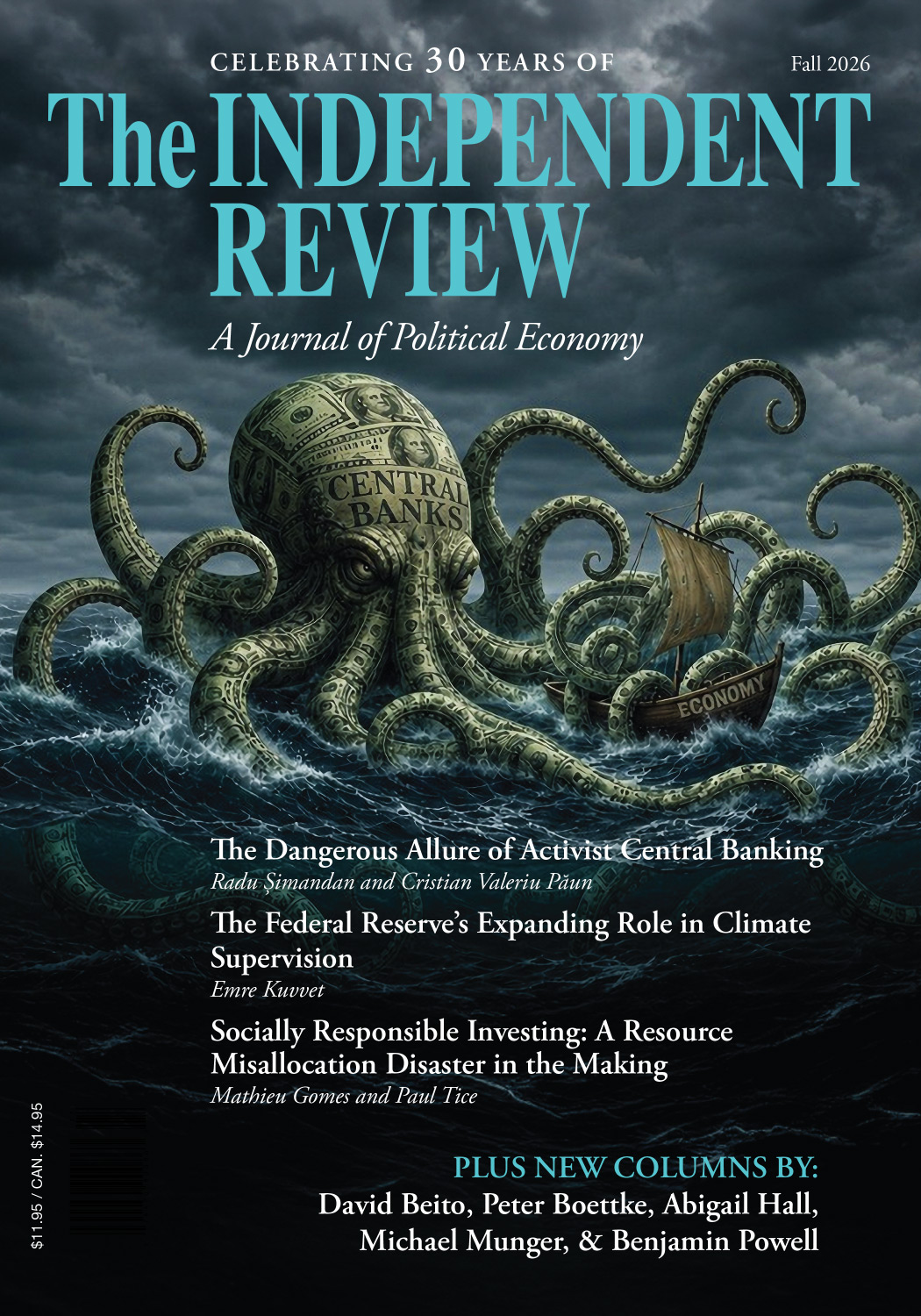

The Dangerous Allure of Activist Central Banking

Activist central banking—with its turn toward broad social objectives including environmental sustainability and inequality reduction—carries serious risks: It erodes the rule-of-law foundations of monetary governance, weakens credibility and independence, increases inflationary bias, and ultimately exposes central banks to political contestation they are ill equipped to manage.
Article
Over the past decade, central banks have undergone a marked transformation in how they conceive of their role in the economy. Institutions once defined primarily by their commitment to price stability and monetary restraint increasingly present themselves as contributors to broader social objectives, ranging from environmental sustainability to inequality reduction and inclusion. This reorientation is visible not only in public communication but also in changes to policy frameworks, operational tools, and supervisory practices. What was once treated as peripheral to monetary policy is now increasingly described as central to it. This transformation marks a departure from traditional monetary governance toward a distinctly activist model of central banking.
These developments raise a fundamental institutional problem. Central banks are expanding their objectives—often without corresponding changes to their legal mandates—into domains characterized by normative disagreement and distributive conflict. In doing so, they move beyond the technocratic rationale that once justified their insulation from democratic politics. This article argues that the turn toward what can aptly be described as social justice–oriented central banking carries serious risks: It erodes the rule-of-law foundations of monetary governance, weakens credibility and independence, increases inflationary bias, and ultimately exposes central banks to political contestation they are ill equipped to manage. The analysis proceeds by examining how activist objectives reshape the logic of monetary policy and by making the case for a renewed commitment to rule-based central banking.
The Ideological Capture of Central Banking
A growing strand of the academic literature on central banking now urges monetary authorities to assume an active role in advancing a set of socially and politically salient objectives, most notably decarbonization, the reduction of inequality, and the promotion of gender and racial justice (Șimandan and Păun 2026). Within this perspective, the traditional objectives of central banks—such as price stability and, in some cases, external monetary stability—are not rejected but reinterpreted as insufficient on their own. Instead, they are to be complemented by a broadened portfolio of aims that explicitly includes environmental sustainability and various forms of social equality. The aim is not to abandon the conventional mandate of price stability and maximum employment, but to widen it by adding new objectives. While some of these new goals are already being implemented by central banks in practice, others are being actively promoted in academic and policy-oriented debates, contributing to a redefinition of what central banking is expected to accomplish.
Prominent among the newly proposed objectives is a role in supporting the decarbonization of the economy. This position typically starts from the premise that humanity confronts an acute and unprecedented environmental crisis, in which carbon-intensive production methods generate systemic risks and thus warrant a far-reaching low-carbon transformation of the financial system (Gunningham 2020). Central banks, as independent agencies entrusted with safeguarding macroeconomic and financial stability, are therefore increasingly called upon to support this transition through their monetary and prudential instruments. Proponents further argue that the absence of an explicit environmental mandate should not preclude such action when moral urgency and economic prudence are seen to converge.
This reasoning is commonly grounded in the broad statutory objectives of many central banks, which link the pursuit of price stability to the promotion of the sound development of the national economy. On this basis, environmental sustainability is reinterpreted as an integral component of “sound development.” Measures such as climate-linked lending facilities or the encouragement—and, in some cases, effective pressure—placed on financial institutions to adopt climate-risk disclosure standards are thus portrayed not as extensions of central bank mandates, but as legitimate applications of an increasingly elastic understanding of their legal and moral responsibilities. The argument appears even more compelling in the case of central banks, such as the European Central Bank (ECB), whose statutory mandates explicitly instruct them to support the broader policy objectives of their respective governments (Dikau and Volz 2021).
Since the global financial crisis of 2008–9, financial stability has ascended to near-universal status as a core objective of central banks. It is now increasingly argued that the “greening” of the economy constitutes a necessary condition for the preservation of that stability, and that environmental engagement therefore falls squarely within the proper remit of monetary authorities. On this view, climate policy is recast as a natural—indeed, almost unavoidable—extension of central banks’ traditional responsibilities. Framed in this way, earlier concerns about the limits of central bank mandates and the dangers of institutional overreach appear not merely outdated, but largely beside the point.
In the wake of the extraordinary post-2008 interventions, income and wealth inequality has become a leading candidate for inclusion among central bank objectives. The case rests on the observation that quantitative easing (QE)—a form of unconventional monetary policy that departs from the traditional tool kit of central banking, yet precedes the more recent turn toward explicitly activist objectives—has generated substantial distributional effects by boosting asset prices and disproportionately benefiting wealthier, well-connected asset holders, thereby intensifying concerns about inequality (Dietsch et al. 2018). Recent scholarship increasingly calls for a more assertive central bank role in addressing inequality, including its formal incorporation into monetary policy objectives. The earlier orthodoxy—skeptical of central banks engaging in explicit redistribution—has largely receded. It is now argued that, under certain conditions, monetary authorities should deliberately pursue policies with distributional consequences, and that their legitimacy can be strengthened if affected groups are granted participatory channels in decision-making (Hassoun forthcoming).
As in the case of decarbonization, the turn toward inequality is often justified as instrumental to the achievement of central banks’ primary objectives. High wealth concentration is said to weaken monetary transmission, since affluent households exhibit lower marginal propensities to consume and are therefore less responsive to interest rate changes (Carstens 2021). A more equal income distribution would, on this view, enhance the effectiveness of monetary policy. Beyond such functional arguments, proponents also maintain that central banks, as public institutions, should align their priorities with evolving societal concerns and engage more explicitly with inequality as a value in its own right (Fontan et al. 2016).
The environment and inequality are not the only new points of interest for central banks. A recent academic focus is developing on the allocative effects of monetary policy on racial and gender disparities. The starting point here is also the observation that the effects of monetary policy on people differ according to their gender and race. A recent review of this emerging literature by Rafael Caminha Pahim and Sylvio Antonio Kappes (2025) finds that monetary policy operating through interest rate shocks generates asymmetric distributional effects: It disproportionately affects racial minorities, contributes to wealth distributions that disadvantage women, and produces far less consistent impacts on labor market outcomes. These findings have gained renewed prominence amid political efforts in the United States to mandate reductions in racial disparities, most notably through the reintroduction of the Federal Reserve Racial and Economic Equity Act (U.S. House Committee on Financial Services 2023), which proposes revising the Federal Reserve’s statutory objectives. Against this backdrop, academic and policy debates increasingly revolve around whether such distributional effects warrant embedding gender and racial equity objectives directly into mandate-driven monetary policy—an inference that has also prompted explicit skepticism (Dorn 2022).
In the realm of gender equality, a growing strand of the literature argues that, as organizations that promote the public interest, central banks should internalize widely endorsed affirmative action principles, for instance, through the composition of their governing bodies (Kern et al. 2025). Some contributions go further, recommending that central bank mandates be explicitly revised to include gender equality as a policy objective. In the United States, the Fed has become a leading source of research on the relation between monetary policy and inequality (Bartscher et al. 2022), with special attention given to the racial dimension of inequality. With this development, the path toward what some authors have termed “inclusive monetary policy” appears increasingly open (Bergman et al. 2022).
Concrete policy developments confirm that this shift toward activist central banking is no longer confined to academic debate but has been operationalized in practice. As documented in the Green Central Banking Scorecard (Positive Money 2024) and its more recent extension to East and Southeast Asia (Positive Money 2025), major central banks have begun to incorporate climate-related criteria directly into their policy frameworks. The ECB, for instance, has adjusted its corporate bond purchases and collateral policies to account for climate considerations, thereby influencing the allocation of capital across sectors. The Bank of England has embedded climate scenarios into its supervisory stress-testing exercises, affecting the risk assessment and lending behavior of financial institutions. Similarly, the Bank of Japan has introduced targeted lending facilities that provide preferential funding for environmentally oriented investments, which by January 2025 accounted for approximately 14 percent of the central bank’s total loan portfolio. These measures go beyond acknowledging financial risks; they entail the use of monetary and prudential tools to steer economic outcomes in line with broader social objectives, highlighting how central banks increasingly deploy their instruments to advance wider policy agendas.
In sum, there is now a coherent and increasingly explicit form of activist central banking (Skinner 2021). Monetary authorities are no longer confined to stabilizing the monetary framework but are expected to advance substantive social objectives. Once central banks move from neutral rule enforcement to the pursuit of contested social goals, a series of institutional risks inevitably follows—risks that bear directly on the rule of law, independence, legitimacy, and monetary stability. It is to these perils that we now turn.
The Perils
The Dilution of the Rule of Law
Although central banking has long been a fixture of modern economies, its traditional framework has often been criticized for failing to impose sufficiently strong constraints on policy discretion, thereby allowing departures from the rule of law. With its long record of bending the spirit of the established framework to accommodate political priorities, traditional central banking, some argue, has already replaced the rule of law with the rule of technocrats (White 2010). The emerging model of social justice–oriented, activist central banking only heightens these concerns. Far from mitigating earlier flaws, it accelerates the drift away from legal and institutional restraint, pushing monetary authorities ever deeper into the domain of political discretion and ideological judgment.
The manner in which this activist turn has been initiated is revealing in terms of its uneasy relationship with the rule of law. Parliamentary debate has largely been absent, as central banks have invoked existing statutory provisions—such as mandates to promote sustainable economic growth or to support government economic policy—as justification for their new social justice–oriented framework (Dikau and Volz 2021). Intended to bolster legitimacy, the vigorous public communication campaigns launched by many central banks as they began embracing these new objectives (Feldkircher and Teliha 2024; Șimandan et al. 2023) instead reveal both their willingness and their growing necessity to venture into policy domains far beyond their traditional remit. In proclaiming their intent to steer the economy onto a socially and politically prescribed path, central banks have begun to publicize a normative vision of economic life, signaling that other actors, commercial banks foremost among them, are expected to align their behavior with this agenda.
As Boettke, Salter, and Smith (2021) argue, the rule of law requires institutions to embody generality, predictability, and robustness. In the monetary domain, any institution or practice that claims fidelity to the rule of law must adhere to these principles. As we show below, each of these dimensions is weakened—often significantly—under the new social justice–oriented monetary policy framework, eroding the rule-of-law foundations of contemporary central banking.
In the rule-of-law framework articulated by Boettke, Salter, and Smith (2021), generality requires that monetary rules be neutral in form and equal in application, rather than tailored to particular actors, sectors, or objectives. Social justice–oriented central banking violates this principle by compelling monetary authorities to operationalize policy through classification and discrimination. To promote environmental sustainability or equity, central banks must distinguish between favored and disfavored activities or borrowers—green versus brown, inclusive versus non-inclusive—and then treat them differently through collateral frameworks, asset purchases, refinancing conditions, supervisory expectations, or credit guidance. Such practices stand in direct opposition to general rules applied equally.
Once monetary instruments are used to channel credit and capital toward preferred ends, central banking ceases to function in a neutral institutional framework and instead becomes a selective steering mechanism with predictable winners and losers. This shift invites precisely the “rule by authorities” problem that the rule-of-law ideal is meant to preclude. Moreover, by importing politically contested concepts such as sustainability and equity—none of which possess stable or widely accepted operational meanings—the new framework further erodes generality. Policy application becomes increasingly contingent on administrative judgment rather than bound by general rules.
Predictability, the second pillar of the rule-of-law framework, is likewise undermined by activist central banking. Recent practice demonstrates that the fundamental objectives of monetary policy can shift abruptly: Central banks move from prioritizing price stability and resource employment to promoting environmental sustainability and addressing income and wealth inequality—either economy-wide or along gender and racial lines. Whether this reorientation occurs with or without formal changes to legal mandates is ultimately beside the point; uncertainty arises in either case.
In the United States, this tension is particularly evident when contrasted with the Federal Reserve’s statutory mandate, which is formally limited to promoting maximum employment, stable prices, and moderate long-term interest rates. Despite this relatively limited framework, Federal Reserve officials have increasingly engaged with broader social objectives. Jerome Powell, for instance, has emphasized that climate change poses “significant challenges for the global economy and the financial system” (Board of Governors of the Federal Reserve System 2021) and that the Fed has “narrow, but important responsibilities” in ensuring resilience to climate-related financial risks, framing such engagement as consistent with its supervisory and stability mandate (Board of Governors of the Federal Reserve System 2023a), a position articulated in connection with the Financial Stability Oversight Council’s (2021) Report on Climate-Related Financial Risk and subsequently operationalized in the Fed’s Principles for Climate-Related Financial Risk Management for Large Financial Institutions (Board of Governors of the Federal Reserve System 2023b), where climate risk is incorporated into supervisory expectations. Similarly, Lael Brainard (Board of Governors of the Federal Reserve System 2019) has argued that the Fed must “analyze and adapt” to climate-related risks in order to fulfill its core responsibilities. At the same time, recent discussions in the U.S. Congress indicate a renewed willingness to revisit the scope and hierarchy of the Fed’s mandate, including whether its dual objectives remain appropriate in their current form and whether legislative changes are needed (Schneider 2025). These developments suggest that the boundary between the existing mandate and a more expansive, socially oriented role is increasingly fluid, shaped as much by formal statutory constraints as by evolving political expectations. Within this evolving framework, what remains unclear is how these objectives are to be prioritized. Pursuing price stability, environmental goals, or distributive objectives places the economy on markedly different trajectories. A de facto hierarchy of objectives may emerge through practice, but such a hierarchy immediately raises questions of legality and, more fundamentally, democratic legitimacy. Navigating among competing goals invites precisely the kind of “elitist tinkering” (Boettke et al. 2021, 149) that undermines predictability by replacing rule-guided policy with discretionary judgment.
Robustness, in Boettke, Salter, and Smith’s (2021) framework, requires monetary institutions to remain resilient to real-world stressors, such as ignorance, economic shocks, and especially political pressure, so that governance does not quietly slide from rules into exceptions and from law into opportunistic administration. The pursuit of social justice–oriented objectives directly weakens this resilience by expanding administrative complexity and discretion. Implementing contested social goals necessitates elaborate metrics, classifications, exemptions, and continual reinterpretation.
The more monetary governance relies on such administrative judgment, the less resistant it becomes to opportunism and ad hoc adjustment under pressure—precisely the circumstances a rule-of-law monetary constitution is designed to withstand. Under the activist framework, robustness fails because monetary governance becomes politically valuable, administratively pliable, and therefore easily bent when the next “exigent circumstance” arises.
The Distributional Nature of Activist Central Banking
Activist central banking is structured around the introduction of multiple criteria intended to guide the implementation of monetary policy beyond its traditional remit. By design, these criteria require monetary authorities to differentiate among economic activities, firms, and sectors according to normative benchmarks associated with social justice objectives. As a result, monetary policy no longer operates solely through general and neutral mechanisms but acquires an explicitly distributional character. Access to liquidity, eligibility for asset purchases, or regulatory treatment becomes conditional on conformity with these criteria, ensuring that some activities are favored while others are disadvantaged. In this sense, activist central banking unavoidably entails the selection of winners and losers, embedding distributive judgments directly into the conduct of monetary policy.
To be sure, traditional central banking has never been distributionally neutral. Steven Horwitz (2015) argues that the monetary policy implemented under Ben Bernanke—particularly through quantitative easing and prolonged low interest rates—functioned as a de facto mechanism of redistribution. By raising the prices of financial assets and reducing returns to savers, these policies disproportionately benefited wealthier households while disadvantaging others, including retirees and middle-income savers. More fundamentally, Horwitz emphasizes that such redistributive effects are not incidental but inherent to discretionary monetary policy, which necessarily alters relative prices and income flows across the economy.
This interpretation is reinforced by the observation that large-scale asset purchase programs have tended to operate through existing financial markets rather than by channeling resources toward new productive investment, as initially envisioned. By elevating the prices of financial assets, QE has disproportionately benefited those who already hold such assets—typically households in higher income and wealth brackets. Moreover, the composition of assets acquired under QE programs has often reflected institutional and political convenience, favoring large, well-connected market participants, while largely neglecting broader economic and social considerations, including the environmental footprint of the supported industries (Dietsch et al. 2018). Activist central banking does not introduce distributional effects; it amplifies, rebrands, and politicizes them. When monetary operations are deliberately designed to penalize “brown” assets or privilege “green” ones, central banks are no longer merely stabilizing macroeconomic aggregates; they are intentionally accelerating structural transformation. Capital costs rise in some industries and fall in others, generating predictable distributional effects across workers, regions, and local tax bases tied to those sectors. Similarly, policies justified under the banner of employment or inclusion are crafted to influence which labor markets tighten, for whom, and under what conditions. Although any broad monetary stimulus entails distributional consequences, activist frameworks explicitly elevate particular groups or outcomes, thereby embedding prioritization and trade-offs across demographic and regional labor markets. In this way, distribution ceases to be an incidental by-product of monetary policy and becomes an explicit feature of its design.
By framing distributional outcomes as matters of social justice, monetary authorities transform what were previously contested side effects into proclaimed policy objectives. This shift raises the political salience of monetary decisions, invites contestation over who benefits and who bears the costs, and weakens the boundary between monetary governance and distributive politics. In doing so, activist central banking not only magnifies distributional consequences but also embeds them within a moralized and politicized policy framework—further complicating claims of neutrality, independence, and adherence to the rule of law.
The distributional consequences discussed above are not merely a secondary feature of activist central banking; they have direct implications for institutional legitimacy. As monetary policy increasingly shapes the allocation of resources across sectors, regions, and social groups, its effects become more visible and more questionable. What were once framed as technical adjustments to aggregate conditions are now more readily perceived as choices among competing interests and normative priorities. In this context, distributional outcomes are no longer incidental by-products but become focal points of political scrutiny, raising the question whether unelected monetary authorities can legitimately exercise such influence. It is this shift—from implicit to explicit distributional politics—that gives rise to the legitimacy challenge examined in the following section.
The Legitimacy Challenge
The increasing visibility, intentionality, and politicization of distributional effects pose a direct challenge to the legitimacy of contemporary central banking. As monetary authorities move beyond rule-based stabilization and into the explicit pursuit of social justice objectives, they exercise discretionary power with clear winners and losers—often without corresponding changes to their legal mandates or democratic oversight. Legitimacy, however, cannot be sustained by technocratic expertise alone when policy choices carry overt distributive and normative implications. Once central banks assume responsibilities that properly belong to the political sphere, their authority comes to rest on increasingly fragile claims of economic efficiency (Tucker 2019), thereby exposing a growing tension between expanded mandates and the constitutional principles that originally underpinned central bank independence.
Public perceptions are vital to sustaining the legitimacy of central banking, particularly during periods of heightened stress, such as when unconventional measures like QE are deployed (Braun 2016). When monetary authorities are widely seen as acting beyond their formal mandates—or as rhetorically stretching those mandates to justify new objectives—public trust in the institution is weakened. Even if such actions can be defended through creative statutory interpretation, the appearance of mandate overreach undermines the implicit social contract that underpins central bank authority. As this perception spreads, central banks risk being viewed not as neutral guardians of monetary stability, but as discretionary political actors—opening the door to challenges against their legitimacy and, ultimately, their independence.
Legitimacy is not merely a normative attribute of central banking; it is a functional prerequisite for credibility (Dietsch 2020), and credibility, in turn, is essential for the effective conduct of monetary policy (Blinder 2000). Central banks rely on public trust to anchor expectations and to ensure that policy signals are taken seriously by markets and households alike. When monetary authorities assume responsibility for advancing social justice objectives that lie beyond their traditional remit, they expose themselves to the risk of visible underperformance on dimensions over which they have limited control. A failure to deliver on these objectives can erode public confidence, with consequences that extend well beyond the activist agenda itself. Once credibility is weakened, even the pursuit of core objectives—such as price stability—becomes more difficult, if not impossible, as expectations lose their anchor and monetary policy loses traction.
This expansion of central bank mandates into overtly social and distributive domains places legitimacy, credibility, and independence in mutual tension. As activist objectives multiply and expectations rise, central banks are increasingly judged on outcomes they neither control nor are institutionally equipped to deliver. The result is a fragile equilibrium in which technocratic authority is asked to perform political functions without electoral authorization—an arrangement that invites contestation, weakens trust, and ultimately undermines the very institutional foundations upon which effective monetary governance depends.
Multiple Objectives, Politicization, and the Erosion of Central Bank Independence
The multi-objective framework characteristic of social justice–oriented central banking places increasing strain on central bank independence and accelerates politicization. Unlike a regime organized around a single, clearly defined objective, a plural and heterogeneous set of goals requires continual prioritization among competing ends. This necessity alone exposes central banks to political contestation, as different political forces emphasize different objectives and evaluate performance accordingly. In response, central banks may seek to clarify their mission through enhanced communication or even solicit guidance from elected officials—moves that further entangle monetary authorities in the political process.
Under a single, relatively well-specified objective such as price stability, external observers can readily identify when a central bank departs from its mandate. Adding a secondary objective such as full employment inevitably reduces clarity and expands the central bank’s room for maneuver, but the overall framework remains comparatively intelligible and bounded. By contrast, a multi-objective framework—especially one incorporating elastic and contested concepts such as sustainability or equity—dramatically expands the interpretive space of the mandate. Almost any political priority can be framed as consistent with some dimension of the central bank’s objectives. This ambiguity lowers the threshold for political pressure, allowing elected officials and organized private interests to intervene while plausibly claiming that they are merely enforcing the mandate rather than undermining independence. Moreover, because some objectives will inevitably remain unmet, a broad agenda requires continuous moral and political justification. Central banks are thus drawn into public relations efforts and coalition-building activities, an environment in which independence becomes contingent on political approval rather than grounded in legal restraint.
Central bank independence is typically justified as a technical mechanism for insulating monetary policy from short-term political temptations—a justification that, as discussed below, captures only part of its institutional role. Yet when central banks are tasked with pursuing a portfolio of social and economic goals, effective implementation often requires coordination with fiscal authorities, industrial policy agencies, and regulatory bodies that control complementary instruments. Although such coordination may be presented as a technocratic necessity, in practice it creates channels for influence, bargaining, and blame-shifting. The more deeply central banks are embedded in broader policy networks, the less plausible their claim to institutional insulation becomes. When objectives conflict—as they frequently do—any policy choice can be portrayed as neglecting some part of the mandate. This provides politicians with ready-made justifications for hearings, statutory threats, conditional appointments, or informal pressure. Even absent formal legal changes, the anticipation of such sanctions induces preemptive compliance, resulting in a practical loss of independence.
As we have shown above, activist central banking substantially increases the frequency and visibility of distributive choices. Independence is most defensible when an institution does not openly allocate gains and losses. By contrast, navigating among multiple objectives necessarily involves trade-offs—determining who bears costs, who receives benefits, which sectors expand, and which contract. Once central banks routinely make such distributive judgments, it becomes politically unrealistic to expect insulation from political control. Legislatures, ministries, and organized coalitions have strong incentives to influence decisions that generate identifiable winners and losers. In this environment, independence ceases to function as a credible institutional constraint and instead becomes a contested political prize.
Finally, once central bank independence is no longer treated as a purely technical solution to the credibility problem of monetary policy but instead as a contingent institutional construction, its incompatibility with activist mandates becomes clear. A substantial strand of the literature has shown that the neutrality and independence of central banks function not only as technical arrangements but also as symbolic devices of legitimation. In Kathleen McNamara’s (2002) influential analysis, central bank neutrality appears as a rational fiction: an institutional construct that enables the delegation of inherently contestable decisions to experts under the guise of rationality and apoliticism. This fiction is not merely illusory—it performs a real function by dampening open political conflict and stabilizing expectations—but it rests on an artificial separation between the technical and the political. Even within narrow mandates, monetary policy involves choices among risks, distributions, and intertemporal priorities, all of which carry normative content. Contemporary central bank activism does not introduce this tension; it makes it explicit. By extending mandates toward objectives such as climate policy, inequality, or social justice, the activist framework dissolves the very conditions under which the fiction of neutrality can be sustained. Independence, in this context, is no longer merely contested or weakened—it becomes conceptually incoherent, as monetary authorities are openly tasked with pursuing political ends while simultaneously claiming insulation from politics. What was once a tacit and disputable institutional convention thus gives way to an explicit contradiction, with profound implications for constitutional legitimacy and for the standing of central banks as independent public authorities.
The “Tyranny of the Urgent” in Monetary Policy
The growing tendency of elected officials to rely on monetary policy as a substitute for political and regulatory action has been captured by the expression “the only game in town” (El-Erian 2016). In the presence of political fragmentation, institutional gridlock, or distributive conflict, monetary policy emerges as the path of least resistance, allowing governments to defer difficult choices while transferring responsibility to ostensibly independent central banks. As Raghuram Rajan (2012) observes, such stalemates lead central banks to “venture farther into uncharted territory,” expanding their role well beyond stabilization. Yet this delegation by default is inherently unstable. Once interest rates approach the lower bound and unconventional instruments become the primary tools, central banks face diminishing returns, rising side effects, and mounting pressure to pursue objectives for which monetary policy is ill-suited. The source of the “only game in town” inclination can be found not in a monetary necessity, but in a deeper failure of the broader policy mix—one that sets the stage for mission creep, overextension, and institutional strain.
This broader policy limitation is further reinforced by what Daniel Nohrstedt (2022) describes as the “tyranny of the urgent,” under which central banks have increasingly found themselves responding to problems framed as requiring immediate and extraordinary action. In Nohrstedt’s account, crises elevate particular issues to overriding priority, compress decision horizons, and weaken normal constraints on policymaking. This dynamic dovetails closely with the perception of monetary policy as “the only game in town.” As political systems struggle to deliver timely fiscal, regulatory, or structural responses, the most salient problem of the moment is funneled toward central banks as the only institutions perceived as capable of acting quickly and decisively. Urgency thus substitutes for institutional fit.
Problems framed as acute—once inflationary pressures, later financial instability, and more recently environmental risks and inequality—are treated as demanding immediate intervention, and monetary authorities are pressured to intervene regardless of whether their instruments are well suited to the task. In this way, the “only game in town” narrative reflects not the inherent capacity of monetary policy, but rather the exhaustion of political alternatives under conditions of a crisis-driven agenda.
The tyranny of the urgent also renders monetary policy vulnerable to time inconsistency at the level of objectives. As public attention shifts and new causes gain political salience, additional ends are layered onto the monetary policy agenda, possibly without abandoning earlier ones. What is framed as an exceptional response to an urgent problem thus becomes a precedent for future interventions in the service of newly popular goals. Over time, monetary policy loses its temporal coherence: Commitments made under one priority are revised or diluted as another rises to prominence. In this environment, central banking becomes reactive to shifting agendas rather than anchored in stable rules, undermining both predictability and credibility.
Deepening the Mission Creep
As recent work by Louis Rouanet and Alexander William Salter (2025) demonstrates in the context of the Federal Reserve, mission creep is not an accidental by-product of crisis management but a cumulative and self-reinforcing institutional process. Once central banks respond to urgent, politically salient problems beyond their traditional remit, the scope of acceptable intervention expands incrementally and persistently. Temporary measures justified as exceptional gradually become normalized, and discretionary actions set precedents that lower the barriers to future expansions of responsibility. Under the combined pressures of urgency, salience, and the perception of monetary policy as the “only game in town,” central banks increasingly internalize a broader conception of their role—one defined less by statutory constraint and more by evolving policy expectations. In this way, mission creep deepens not through explicit mandate revision but through repeated practice, rhetorical accommodation, and the gradual redefinition of what central banking is understood to entail.
The expansion of central bank responsibilities is not a recent practice but builds on earlier precedents in which monetary authorities moved beyond general liquidity provision into targeted credit allocation. As Lawrence White (2015) documents in his analysis of post-crisis Fed policy, interventions such as large-scale asset purchases and emergency lending facilities increasingly favored specific assets, markets, and institutions, thereby departing from rule-like monetary operations and entering the domain of discretionary allocation. What began as crisis management introduced a new template for action: Once central banks demonstrated both the capacity and willingness to direct credit toward selected sectors, the boundary between monetary policy and broader economic management became less clear.
The danger inherent in this process can be further understood through the lens of the slippery slope mechanisms analyzed by Eugene Volokh (2002). As Volokh emphasizes, institutional change often proceeds not through abrupt breaks but through incremental steps that individually appear modest, defensible, or unique, yet collectively produce substantial transformation. Applied to monetary policy, each newly adopted objective—frequently rhetorically justified as narrowly tailored or crisis-specific—reduces resistance to subsequent expansions of scope.
Precedent-setting plays an important role in this process: Once central banks accept responsibility for addressing one nontraditional concern, arguments against incorporating additional objectives become progressively weaker. Over time, the accumulation of such steps alters baseline expectations about what central banks may and should do. What begins as discretionary accommodation under extraordinary circumstances thus evolves into a ratcheting process, in which the menu of legitimate monetary objectives expands asymmetrically while reversals become politically and institutionally costly. The result is a slippery slope in which the boundaries of monetary policy are gradually redefined without explicit mandate revision or democratic authorization.
The dynamics of urgency, precedent, and incremental expansion reveal how mission creep in central banking can deepen over time without a deliberate institutional decision to overhaul monetary policy. Pragmatic responses to exceptional circumstances accumulate over time, reshaping expectations, practices, and ultimately the perceived boundaries of legitimate monetary action. In the absence of clear stopping rules or effective mechanisms for reversal, temporary accommodations harden into permanent responsibilities. The cumulative result is an expanded and elastic conception of central banking—one increasingly detached from its original, narrow mandate and progressively less constrained by law, predictability, and democratic accountability.
The Inflationary Bias of Multi-Objective Monetary Policy
A further—and often understated—peril of activist central banking lies in the heightened risk of sustained inflation once price stability ceases to function as the dominant organizing principle of monetary policy (Șimandan and Păun 2021). While price stability continues to be affirmed as the primary objective in central bank statutes and public communication, the operationalization of multiple additional objectives increasingly risks reducing it to one goal among many. It now competes, traditionally, with employment and debt sustainability concerns and, more recently, with objectives related to climate and inclusion, a development aptly described as an overstretching of the mandate (Volz 2017). When these objectives conflict, inflation is no longer treated as a hard constraint but increasingly as a residual outcome to be managed, tolerated, or temporarily accommodated in the pursuit of more politically salient ends. This does not require overt abandonment of inflation targets or irresponsible policymaking. Rather, it follows from the logic of prioritization under pressure: As new objectives are layered onto the mandate, the political and institutional costs of missing inflation targets are weighed against the perceived urgency of alternative goals. Over time, this shifts the policy calculus away from strict price discipline toward discretionary trade-offs, introducing a systematic inflationary bias even when formal commitments to price stability remain unchanged.
To be sure, central banks—and the ECB in particular—consistently stress in their public communication that price stability remains the primary objective and that climate-related measures are pursued strictly “within the mandate” and in support of price and financial stability (Șimandan et al. 2023). In this framing, environmental factors are presented as potential sources of macroeconomic and financial risk, implying that central banks are compelled to act on climate issues precisely in order to fulfill, rather than expand, their existing mandates (Aguila and Wullweber 2024). Yet this rhetorical reassurance does not resolve the underlying problem of expectations formation. Once multiple objectives are operationalized simultaneously, economic agents must infer how conflicts among them will be resolved in practice. The effective reaction function becomes less transparent: It is no longer clear how much inflation will be tolerated in pursuit of climate goals, employment support, or debt sustainability. As a result, credibility is weakened not through explicit abandonment of price stability but through ambiguity about its priority when trade-offs arise. In this sense, activist monetary policy increases inflation risk primarily through the expectations channel, well before any formal deviation from stated targets becomes observable.
Finally, the inflationary bias of activist central banking is reinforced by its political economy. Multi-objective monetary policy aligns naturally with environments of high public spending, large public debts, and ambitious transition agendas that rely on sustained monetary accommodation. In such settings, inflation becomes a politically expedient adjustment mechanism: Its costs are diffuse, delayed, and less visible than explicit taxation or spending cuts. Although central banks formally retain their independence, the pressure to support fiscal sustainability, green investment, or social justice–inspired objectives weakens resistance to prolonged accommodation. Inflation thus emerges not as an accident of policy failure, but as a foreseeable by-product of a regime in which monetary authorities are increasingly tasked with advancing objectives that extend well beyond price stability.
The heightened inflation risk associated with activist, multi-objective monetary policy reinforces the case for a rule-based framework, in which price stability functions as a binding constraint rather than a discretionary outcome contingent on shifting political priorities.
Toward a Rules-Based Monetary Regime
As noted earlier, the standard account in the literature presents the delegation of monetary policy to independent technocratic agencies as a technical solution to the problem of short-term political incentives, aimed at insulating monetary decision-making from the time horizons of both the public and elected officials. Politicians operating under electoral pressure are widely understood to have incentives to prioritize near-term economic conditions, even when doing so entails significant long-term costs or trade-offs. Independent central bankers, by contrast, are expected to operate under longer time horizons, allowing them to weigh future consequences more prudently and to pursue policies oriented toward sustained monetary stability rather than immediate political gain (Tucker 2018, 2020). At the same time, as noted in the preceding discussion, this technical justification has been complemented by a symbolic dimension: Independence has also functioned as a rational fiction that legitimizes the delegation of inherently contestable decisions by framing them as apolitical and expert-driven.
Yet the environment in which this insulation is meant to operate has changed markedly; the public’s sense of urgency has intensified in recent years, bringing with it heightened demands that elected officials take visible and immediate action. Communication scholars point to an “inflation of crisis coverage,” in which labeling issues as crises becomes a powerful device for mobilizing attention and compressing decision horizons (Geiß et al. 2025). Climate change is increasingly framed in crisis terms (Alimonti and Mariani 2025), as is inequality (Behar 2023), contributing to a political environment in which a succession of problems is perceived as requiring exceptional and rapid intervention. Research on European Union governance similarly shows that repeated crises tend to elevate urgency as the dominant organizing principle of policymaking, narrowing participation and expanding the role of executive and technocratic actors (Rhinard 2025). At the same time, citizens place a high value on governmental responsiveness to public input, while trust remains fragile, particularly in the face of complex and high-salience challenges. The cross-national trust survey of the Organisation for Economic Co-operation and Development (OECD) underscores that public confidence depends in part on whether authorities are seen as acting decisively and reliably under pressure, helping to explain why demands for swift and visible policy action have become so pronounced (OECD 2024).
In this context, the social justice orientation of contemporary central banking can be interpreted as a response to politically transmitted public pressure. As urgent demands for action accumulate and elected officials face constraints in deploying fiscal or regulatory instruments, expectations are increasingly redirected toward monetary authorities. Central banks, in turn, adapt their rhetoric and policy frameworks to accommodate these expectations, expanding their remit in ways that reflect prevailing social and political priorities rather than narrowly defined monetary objectives. It is therefore not surprising that central banks are increasingly encouraged to move beyond a narrow “culture of expertise” toward a more expansive engagement with the public and lay audiences (Bowman and Keller 2025, 305). In this view, it is no longer sufficient for central banks merely to implement the new policy agenda advocated in the name of social justice; they are also expected to articulate, justify, and actively promote the normative values and societal visions that now inform their expanded role. The result is a conception of central banking whose scope is shaped by evolving social priorities rather than by stable institutional constraints.
These dynamics strengthen the case for anchoring central banking in a rule-based framework. When urgency, salience, and politically mediated public pressure threaten to pull monetary authorities into ever-expanding and shifting objectives, only clear, general, and pre-committed rules can provide a credible stopping point. Rules limit discretion, discipline expectations, and protect central banks from being continually repurposed as all-encompassing instruments of crisis management or social reform. By constraining the scope of permissible action, a more rules-oriented regime helps ensure predictability, shields monetary policy from the tyranny of the urgent, and reasserts the constitutional logic that independence is meant to serve.
A shift in this direction does not require a return to a historically pure or fully depoliticized model of central banking, nor does it depend on the adoption of a single, universally accepted policy rule. Rather, it implies a set of feasible institutional constraints designed to limit discretionary intervention under contemporary conditions. These may include a clearer prioritization of price stability within central bank legal mandates; the use of systematic policy guidelines—such as Taylor-type rules or nominal income targeting—as reference points for decision-making; stricter limits on balance sheet policies that allocate credit across sectors; and a more clearly defined boundary between monetary policy and broader social or industrial objectives, potentially reinforced through legislative clarification. The common element among these alternatives is their orientation toward generality, pre-commitment, and constraint. From this perspective, the argument advanced here is not that central banking can be entirely rule-bound in practice, but that institutional reforms can significantly steer it in that direction, counteracting the open-ended expansion of objectives associated with the activist turn. This more modest and guiding approach reflects the view that diagnosing and resisting institutional drift of the kind we are witnessing is a necessary first step before more fully specified reform proposals can be developed.
Rules-based central banking therefore reflects a deeper constitutional principle, emphasized by James Buchanan (2010): A monetary regime should define the rules within which economic activity unfolds, not serve as a counter in the strategic pursuit of evolving social and political goals. Activist central banking inverts this logic by transforming the monetary unit itself into an instrument of policy discretion, thereby destabilizing its role as a firm coordinating framework.
Concluding Thoughts
A recent article that surveys the literature on central bank involvement in environmental policy by Iegor Vyshnevskyi and Wook Sohn (2026) is representative of the broader pattern in academic work advocating new objectives for monetary authorities. Such contributions typically proceed in a standardized sequence. First, a problem is identified—environmental degradation in this instance, but elsewhere inequality or gender and racial justice—together with a clear articulation of the problem’s social significance and a sketch of its macroeconomic and financial implications. The issue is then framed in terms of crisis and urgency, often accompanied by moralized language, thereby establishing a sense that immediate action is required. Against this backdrop, central bank intervention is presented as the natural and almost self-evident next step. The discussion subsequently turns to the formal mandate, arguing—often through elastic interpretation—that existing statutory provisions already encompass the new objective or should be revised so as to do so. Finally, the focus shifts to the operational level: Specific instruments are evaluated, new tools are proposed, and policy recommendations are advanced in a decidedly optimistic and forward-looking tone (see, e.g., Braun 2016; Fontan et al. 2016; Gunningham 2020; Volz 2017).
The proliferation of new objectives for central banks raises a prior set of questions that much of this literature leaves unexamined: Why have these particular concerns risen to prominence, and why are they treated as especially deserving of central bank attention? Why environmental degradation, inequality, or gender and racial justice—and not deglobalization, national security issues, political fragmentation, or geopolitical instability, all of which plausibly carry macroeconomic and financial implications? The answers are often implicit rather than argued, resting on the salience of the “issue of the day” and on the perception of monetary policy as the “only game in town” when other policy instruments appear politically constrained. What is strikingly absent, however, is a comparative analysis explaining why certain socially desirable objectives should be elevated into the monetary domain ahead of others. Without such comparison, the selection of objectives appears contingent on urgency and visibility rather than grounded in principled criteria or institutional fit.
These unanswered questions point to a deeper issue about the direction of contemporary central banking. As the analysis in this article has shown, today’s activist turn erodes the long-standing claim of neutrality, but it also yields a cognitive and political clarification: It reveals that the central bank is an integral part of the state, not an actor standing outside politics. Neutrality has always been problematic, since even a seemingly “purely monetary” policy carries distributive consequences and requires choices among competing risks and priorities. What has changed is that these choices can no longer be plausibly camouflaged as mere technical adjustments. Activism therefore does not simply dilute the mandate; it exposes the fragility of the narrative according to which central banks operate in an apolitical domain. In this context, the case for moving toward more constrained and rule-oriented monetary arrangements does not rest on the feasibility of a fully neutral or purely rule-bound regime, but on the need to counterbalance this expansion by strengthening generality, predictability, and institutional limits. Once the narrative of apolitical technocracy weakens, pressures for politicization, oversight, and democratic contestation cease to be anomalies and instead emerge as institutionally predictable responses.
References
Aguila, Nicolás, and Joscha Wullweber. 2024. Legitimising Green Monetary Policies: Market Liberalism, Layered Central Banking, and the ECB’s Ongoing Discursive Shift from Environmental Risks to Price Stability. Journal of European Public Policy 32 (3): 665–96.
Alimonti, Gianluca, and Luigi Mariani. 2025. Quantifying the Climate Crisis: A Data-Driven Framework Using Response Indicators for Evidence-Based Adaptation Policies. Environmental Hazards (October): 1–30.
Bartscher, Alina K., Moritz Schularick, Moritz Kuhn, and Paul Wachtel. 2022. Monetary Policy and Racial Inequality. Brookings Papers on Economic Activity No. 1.
Behar, Amitabh. 2023. 3 Key Actions to Help Bridge the Inequality Gap. #SDIM23. World Economic Forum, September 12. https://www.weforum.org/stories/2023/09/3-key-actions-to-help-bridge-the-inequality-gap/.
Bergman, Nittai, Benjamin Born, David A. Matsa, and Michael Weber. 2022. Inclusive Monetary Policy: How Tight Labor Markets Facilitate Broad-Based Employment Growth. National Bureau of Economic Research Working Paper 29651.
Blinder, Alan S. 2000. Central-Bank Credibility: Why Do We Care? How Do We Build It? American Economic Review 90 (5): 1421–31.
Boettke, Peter J., Alexander William Salter, and Daniel J. Smith. 2021. Money and the Rule of Law: Generality and Predictability in Monetary Institutions. Cambridge University Press.
Board of Governors of the Federal Reserve System. 2019. Why Climate Change Matters for Monetary Policy and Financial Stability. Speech by Governor Lael Brainard, November 8. https://www.federalreserve.gov/newsevents/speech/brainard20191108a.htm.
———. 2021. Statement of Chair Jerome H. Powell on the Financial Stability Oversight Council’s (FSOC) Report on Climate-Related Financial Risk. Press release, October 21. https://www.federalreserve.gov/newsevents/pressreleases/other20211021c.htm.
———. 2023a. Statement by Chair Jerome H. Powell on Principles for Climate-Related Financial Risk Management for Large Financial Institutions. Press release, October 24. https://www.federalreserve.gov/newsevents/pressreleases/powell-statement20231024b.htm.
———. 2023b. Risk Management: Principles for Climate-Related Financial Risk Management for Large Financial Institutions. https://www.federalreserve.gov/frrs/guidance/principles-for-climate-related-financial-risk-management-for-large-financial-institutions.htm.
Bowman, Megan, and Anat Keller. 2025. Through the Lens of Legal Mandate: Central Bank Capital in a Time of Climate Crisis. In Central Bank Capital in Turbulent Times, edited by Dirk Broeders, Aerdt Houben, and Matteo Bonetti. Springer.
Braun, Benjamin. 2016. Speaking to the People? Money, Trust, and Central Bank Legitimacy in the Age of Quantitative Easing. Review of International Political Economy 23 (6): 1064–92.
Buchanan, James M. 2010. The Constitutionalization of Money. Cato Journal 30 (2): 251–58.
Carstens, Agustín. 2021. Central Banks and Inequality. Remarks at the Markus’ Academy, Princeton University’s Bendheim Center for Finance, May 6. https://www.bis.org/speeches/sp210506.htm.
Dietsch, Peter. 2020. Independent Agencies, Distribution, and Legitimacy: The Case of Central Banks. American Political Science Review 114 (2): 591–95.
Dietsch, Peter, François Claveau, and Clément Fontan. 2018. Do Central Banks Serve the People? Polity Press.
Dikau, Simon, and Ulrich Volz. 2021. Central Bank Mandates, Sustainability Objectives and the Promotion of Green Finance. Ecological Economics 184:107022.
Dorn, James A. 2022. Racial Equity Is Beyond the Fed’s Scope. Cato at Liberty Blog, July 6. https://www.cato.org/blog/racial-equity-beyond-feds-scope.
El-Erian, Mohamed A. 2016. The Only Game in Town: Central Banks, Instability and Avoiding the Next Collapse. Yale University Press.
Feldkircher, Martin, and Viktoriya Teliha. 2024. Speeches in the Green: The Political Discourse of Green Central Banking. Energy Economics 135:107646.
Financial Stability Oversight Council. 2021. Report on Climate-Related Financial Risk. https://home.treasury.gov/system/files/261/FSOC-Climate-Report.pdf.
Fontan, Clément, François Claveau, and Peter Dietsch. 2016. Central Banking and Inequalities: Taking Off the Blinders. Politics, Philosophy and Economics 15 (4): 319–357.
Geiß, Stefan, Christina Viehmann, and Conor A. Kelly. 2025. Inflation of Crisis Coverage? Tracking and Explaining the Changes in Crisis Labeling and Crisis News Wave Salience 1785–2020. Journal of Communication 75 (1): 27–41.
Gunningham, Neil. 2020. A Quiet Revolution: Central Banks, Financial Regulators, and Climate Finance. Sustainability 12 (22): 9596.
Hassoun, Nicole. Forthcoming. Legitimate Distribution Without Legislation. Critical Review of International Social and Political Philosophy 1–29.
Horwitz, Steven. 2015. Monetary Policy Under Bernanke: A Variation on a Redistributionist Theme. Journal of Private Enterprise 30 (4): 31–41.
Kern, Andreas, Bernhard Reinsberg, and Davide Romelli. 2025. Empowering Women in Central Banking. Journal of European Public Policy 32 (7): 1746–79.
McNamara, Kathleen. 2002. Rational Fictions: Central Bank Independence and the Social Logic of Delegation. West European Politics 25 (1): 47–76.
Nohrstedt, Daniel. 2022. When Do Disasters Spark Transformative Policy Change and Why? Policy and Politics 50 (3): 425–41.
OECD. 2024. OECD Survey on Drivers of Trust in Public Institutions—2024 Results: Building Trust in a Complex Policy Environment. OECD Publishing.
Pahim, Rafael Caminha, and Sylvio Antonio Kappes. 2025. Monetary Policy Effects on Gender and Racial Inequality: A Survey of the Empirical Literature. Cadernos CEPEC 14 (3): 254–89.
Positive Money. 2024. The Green Central Banking Scorecard: 2024 Edition. September 25.
———. 2025. The East and Southeast Asia Green Central Banking Scorecard. September 9.
Rajan, Raghuram G. 2012. The Only Game in Town. Project Syndicate, October 19. https://www.project-syndicate.org/commentary/the-limits-of-unconventional-monetary-policy-by-raghuram-rajan.
Rhinard, Mark. 2025. Permanent Crisis Governance in the European Union. In Handbook of European Union Governance, edited by S. Lucarelli and J. Sperling. Edward Elgar Publishing.
Rouanet, Louis, and Alexander William Salter. 2025. Mission Creep at the Federal Reserve. Southern Economic Journal 91 (4): 1323–46.
Șimandan, Radu, and Cristian Valeriu Păun. 2021. The Costs and Trade-Offs of Green Central Banking: A Framework for Analysis. Energies 14 (16): 5168.
———. 2026. Central Banking Research Is Increasingly Directed to Environment, Inequality, Gender, and Race. Econ Journal Watch 23 (1): 211–31.
Șimandan, Radu, Cristian Valeriu Păun, and Bogdan Glăvan. 2023. Post-Pandemic Greenness? How Central Banks Use Narratives to Become Green. Sustainability 15 (2): 1630.
Schneider, Howard. 2025. Exclusive: Head of Fed-Watchdog Task Force in Congress Plans Broad US Central Bank Review. Reuters, February 25.
Skinner, Christina Parajon. 2021. Central Bank Activism. Duke Law Journal 71 (2): 247–328.
Tucker, Paul. 2018. Unelected Power: The Quest for Legitimacy in Central Banking and the Regulatory State. Princeton University Press.
———. 2019. How the ECB and Other Independent Agencies Reveal a Gap in Constitutionalism: A Spectrum of Institutions for Commitment. Paper delivered at the Carl Friedrich von Siemens Stiftung, Munich, February 11. https://bit.ly/37pGEes.
———. 2020. Central Banking and the Rule of Law. Cato Journal 40 (2): 431–46.
U.S. House Committee on Financial Services. 2023. Ranking Member Waters, Senator Warren Reintroduce Bill Requiring the Fed to Close Racial Employment and Wage Gaps. Press release, June 22. https://democrats-financialservices.house.gov/news/documentsingle.aspx?DocumentID=410585.
Volokh, Eugene. 2002. The Mechanisms of the Slippery Slope. Harvard Law Review, no. 116: 1026–137.
Volz, Ulrich. 2017. On the Role of Central Banks in Enhancing Green Finance. UN Environment Programme, Inquiry Working Paper 17/01. https://wedocs.unep.org/handle/20.500.11822/16803.
Vyshnevskyi, Iegor, and Wook Sohn. 2026. Central Banks’ Support for Climate Action: A Literature Review and Key Issues. Journal of Economic Surveys 40:182–98.
White, Lawrence H. 2010. The Rule of Law or the Rule of Central Bankers. Cato Journal 30 (3): 451–63.
———. 2015. The Federal Reserve System’s Overreach into Credit Allocation. Journal of Private Enterprise 30 (4): 17–29.
Acknowledgments
The authors thank the three referees for their careful reading and helpful comments, which have improved the clarity and structure of the paper.
Comments



Independent Review Issues
Articles by Issue