

Controlling Contagion
Book Review
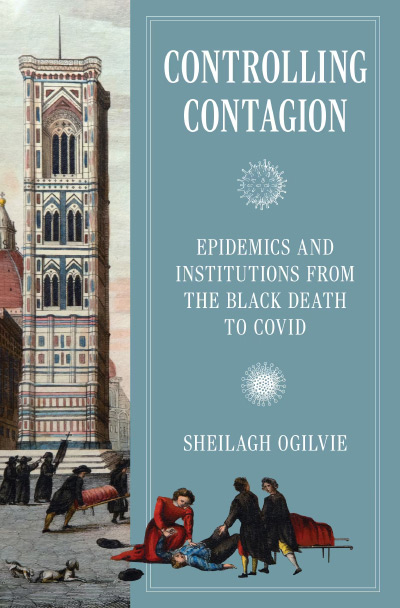
Reviewed by
This book review appeared in the Winter 2025/26 issue of The Independent Review.
Sheilagh Ogilvie’s Controlling Contagion: Epidemics and Institutions from the Black Death to Covid examines how different institutions have affected societies’ ability to address disease. The book comprises eight chapters and spans a substantial 460 pages while examining societies from across the globe and public health crises dating back to the mid-1300s.
The introductory chapter presents a compelling argument that every society experiences epidemics, but their approaches vary considerably due to different institutional structures. Thus, Ogilvie adopts a comparative institutional analysis framework to understand historical and contemporary epidemic responses better. The book examines six institutions: the market, the state, the local community, religion, medical guilds and associations, and the family. Each chapter presents the theoretical strengths and weaknesses of each institution, accompanied by ample historical examples of when they succeeded and failed.
Ogilvie explores the tremendous benefits and potential harms that functioning markets provide during epidemics in Chapter 2. Historically, markets have provided the most consistent and pervasive avenue for reducing poverty and promoting human flourishing. As the author notes, wealth creation provides the financial means to develop public health initiatives and prevent diseases associated with low living standards from spreading. Markets are also the primary mechanism for developing and distributing medical goods and treatments for communicable diseases.
Markets alone cannot address epidemics, however. Some goods—such as vaccinations and medical information— have a public goods component, which markets struggle to provide. Some actions taken during epidemics have external effects. Markets can also amplify disease spread by promoting urbanization, transporting goods (and with them germs) across vast geographical distances, and sometimes creating unhygienic conditions.
Remarkably, incentives within markets can also work to avoid contagion. As the author notes, market withdrawals to prevent the spread of disease occurred in major cities as early as 1575. Many of these withdrawals occurred without government mandates and centuries before germ theory became accepted medical
practice. These findings largely reflect those made by Byron Carson (2021, “Automatons or Individuals? Voluntary Responses to COVID-19 Related Epidemic Externalities,” The Independent Review 25 [Spring]: 551–67) regarding the COVID-19 pandemic. Ogilvie also provides a detailed history of the market discovery, development, and distribution of variolation and vaccination efforts even when governments and other institutions were hostile.
Chapter 3 chronicles dozens of historical efforts by governments to mitigate and control epidemics. Through coercion, governments are theoretically well-suited to regulate markets, restrict behavior, provide public health infrastructure, and institute regulations to help abate the spread of disease. However, any government’s ability to do so depends heavily on its actual state capacity, as well as the incentives it provides.
A consistent lack of state capacity and pervasively poor incentives repeatedly demonstrate a much grimmer reality. Across a hundred pages, Ogilvie
highlights that governments have routinely squandered fiscal resources, created outbreaks from wartime activities, enacted ineffective hygiene boards, failed to create sanitary conditions, enacted overzealous lockdown and social distancing efforts, and relied on harmful internment systems to quarantine the (sometimes) ill. Surprisingly, states with parliaments (as opposed to more centralized monarchs) have performed similarly poorly.
While the chapter provides noticeably few success stories of centralized state efforts to thwart disease spread, the author provides several examples of local governments devising and enforcing effective epidemic response policies. As Ogilvie summarizes,
Local governments pioneered sanitary measures as early as the tenth century, social distancing by the Black Death, variolation and vaccination long before central states mandated or even permitted it, and public information about epidemics for local citizens long before central states were willing or able to allocate resources for that purpose. (p. 187)
Localized responses often vary, however, and have been limited in controlling spillover effects on other populations, suggesting that centralization may still play an important role.
The author then bridges the highly formal institutions of markets and informal institutions of states by examining the role of local (defined as spatially close) communities in Chapter 4. Unlike states, local communities engage in governance through the building of social capital, which helps overcome collective action problems by adhering to informal norms. Local communities can also effectively monitor and punish their members (primarily through ostracism). Early communal norms helped create systems of monitoring unclean behavior, administering shame to deter specific behaviors, and facilitating philanthropic efforts.
Unfortunately, as the author acknowledges, it is challenging to determine the extent to which local norms help govern behavior, because adherence or disregard is rarely documented. Local communities may also hold norms that are counterproductive to preventing disease spread. For example, local communities may be inimical to foreign groups (including minorities and those belonging to other religions) and to foreign norms. Local norms are also maintained from personal relationships, making them less effective in governing foreign entities. In many historical cases, these limitations have failed to address externalities. These institutional limitations are sometimes overcome when local norms overlap or complement institutions with larger scalability— including governments and religion.
Chapter 5 examines the role of religion in disease transmission. Organized religions often have their own sets of practices, rituals, and rules, which are reflected in social traditions. Some of these impact public health. For example, the author notes that Judaism’s traditions related to preparing food and bathing helped Jews avoid illness during many epidemics. Other religious views on drinking, burial practices, breastfeeding, and spring cleaning may have also influenced transmission.
Religions have varied considerably in their theological views on disease. Some faiths considered it a duty to care for the ill. During the fifteenth and sixteenth centuries, the Catholic Church built and staffed numerous hospitals specifically to care for the sick. This tradition began before the Black Death. As Ogilvie notes, “Between 1000 and 1250, only 8 percent of Florence hospitals [often Catholic]
were aimed mainly at sick people, rising to 21 percent between 1250 and 1349” (p. 240). Other practices likely promoted transmission. Many Catholic and Protestant worship gatherings continued to take place during epidemics despite leaders’ and other participants’ awareness of the risk.
Theological differences in the moral implications of variolation and vaccination also impacted when these treatments were administered in religious hospitals or by religious caretakers. Despite variolation’s widespread use in China, India, and regions of Africa, it was not accepted in Europe until 1720. Before that time, the treatment method was seen by many Christian sects as “primitive pagan practice” or, worse, “the offspring of atheism” (p. 260). Early vaccination efforts were initially welcomed by some Christians but met with heavy skepticism by others.
The next chapter examines the complex and controversial history of how medical guilds and similar associations influenced epidemics. Medical guilds’ ability to treat patients, establish and communicate medical expertise, and serve in advisory roles for governments made them a vital aspect of responding to epidemics. Throughout history, their role was rarely a positive one. Reaching conclusions similar to Peter T. Leeson, M. Scott King, and Tate J. Fegley (2020, “Regulating Quack Medicine,” Public Choice 182:273–86), Ogilvie finds medical guilds more often aligned their expertise and social capital to pursue their own interests than to help an ill and fearful public. Shockingly, medical guilds (mostly examined between 1300 and 1700) spent considerable resources restricting entrance while accumulating political protections and building personal wealth. When epidemics occurred, it was common for members to refuse to treat ill patients and provide no guidance on preventing the spread of contagion. However, members continued to fight against permitting nonmembers to practice “medicine” (I use that term loosely).
One of the more surprising aspects of this chapter is that medical guilds, which typically determined the effectiveness and quality of treatments, were often against incorporating scientific discoveries when it weakened their advantageous position. French medical guilds successfully banned variolation as late as 1760. Other medical associations lobbied for governments to grant medical guild members exclusive rights to variolate patients. Afterward, they restricted access and raised their fees.
In the penultimate chapter, Ogilvie examines how family structure and tradition impacted disease spread. Much of this chapter contrasts the European marriage pattern (characterized by living with only the nuclear family, marrying later, and forming a separate household) with other cultural practices, where the extended family often lives with the nuclear family. These considerations significantly impact the rate of transmission within the household, especially in familial arrangements in which older relatives live with other family members. Intuitively, these arrangements also reduce the effectiveness of social distancing in public settings.
The chapter then turns to examine the role of women in the household and how their status affects disease. Historically and contemporarily, women make the majority of the decisions on how to care for other members of the family. Those decisions include when and whether to vaccinate children.
The book concludes by reiterating that none of the institutions examined can fully address epidemics. Instead, the author calls for institutional diversity, in which the limitations of some institutions are matched with the strengths of others. While each of the six institutions plays a necessary role in mitigating disease spread, Ogilvie specifically notes that functioning markets, coupled with strong state capacity and restraint on political interests, provide the strongest institutional framework for combating epidemics.
Unsurprisingly, given the recent pandemic, many economists have taken an interest in medical history, public health policy, and the impact of institutions on these areas. Controlling Contagion ranks among the most significant and well-researched works in this area. Although the book is written for an academic audience, the author’s lucid prose and captivating portrayal of medical history make her work accessible to a broader audience.
While I found this work fascinating and engaging, I do have some criticisms. First, the author frequently references separate institutions and their impacts within specific areas during particular epidemics. But these references are often dozens or even hundreds of pages apart, making comparative institutional insights challenging for the reader.
Second, and perhaps most important, I found the analysis of the family’s institutional role lacking. Much of the discussion centers on demographic factors, labor migration, and the role of women in childcare. However, these factors are highly dependent on other institutional structures, making the chapter’s contribution unclear and somewhat unconvincing. That is disappointing because, as the author points out, the family provides the least formal institutional structure but is arguably the most likely to elicit compliance.
Criticisms aside, I believe Ogilvie’s work will become a must-read for medical historians and health economists interested in the overlap between policy, institutions, and public health. Any reader willing to invest the time to read it will be well rewarded.
Comments
Related Book Reviews




Independent Review Issues
Articles by Issue