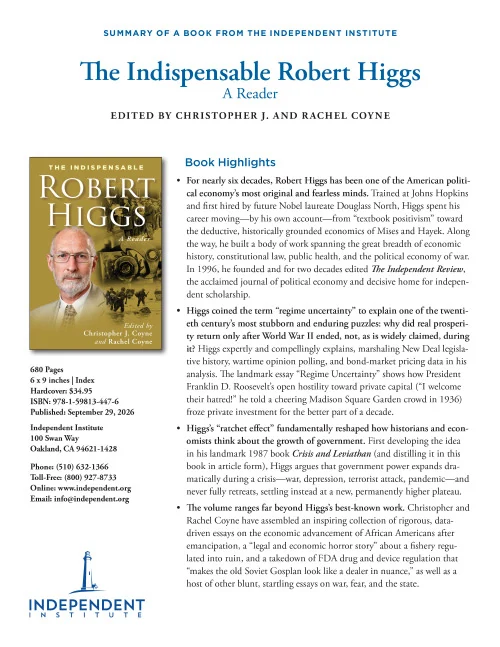
The Indispensable Robert Higgs
A Reader (The Essential Robert Higgs)
Format: eBook
Publication Date: September 29, 2026
Publisher: Independent Institute
List Price:
Price:
Discount:
Free Shipping On Orders Over $60! (Within U.S.A)
Bulk Discounts Available: Learn More
Overview
A sweeping celebration of one of the most original and fearless voices in modern political thought.
Best known for his landmark work Crisis and Leviathan: Critical Episodes in the Growth of American Government, Robert Higgs has repeatedly reshaped how scholars and citizens understand the relationship among government expansion, economic crises, and individual liberty. This carefully curated volume brings together his most influential writings, offering readers an unparalleled look at a career that spans civil rights, wartime political economy, the military-industrial complex, the regulatory state, the Food and Drug Administration, and the long-run growth of government power.
Higgs’s scholarship stands out not only for its range, but for its intellectual craftsmanship. He boldly challenged conventional economic analysis by probing the reliability of official data—questioning how statistics are gathered, what they omit, and how they shape public understanding. Refusing to treat numbers as inherently authoritative, Higgs incorporated historical evidence, institutional analysis, and human experience to illuminate the complex forces shaping political and economic life.
At its core, Higgs’s work centers on the human stakes of political economy: freedom, coercion, and the conditions necessary for human flourishing. The Indispensable Robert Higgs introduces new readers to his groundbreaking insights while providing longtime admirers with a powerful reminder of his lasting influence.
Timely, provocative, and deeply insightful, this collection showcases a scholar whose work continues to shape debates about power, policy, and liberty today.
Table of Contents
Introduction
Part 1: The Science of Economics and the Art of Political Economy
- The Dangers of Samuelson’s Economic Method
- Austrian Economics—the Queen of the Experimental Sciences
- Extreme Aggregation Misleads Macroeconomists and the Fed
- Social Science 101: Three Ways to Relate to Other People
- Ten Fallacious Conclusions in the Dominant Ideology’s Political Economy
- Ten Rules for Understanding Economic Development
- Politics and Markets: A Highly Misleading Analogy
- Where Should the Burden of Proof Rest?
- Diagnostics and Therapeutics in Political Economy
Part 2 : American Economic History
- Progress and Poverty
- Making Sense of the Facts
- A Digression: How Growth Began
- American Inventiveness, 1870–1920
- Preface from Competition and Coercion: Blacks in the American Economy,
1865–1914 - “Race” and “Racial Discrimination”: A Prefatory Note on Usage
- Approaching the Facts
- Overview and Interpretation
- Firm-Specific Evidence on Racial Wage Differentials and Workforce Segregation
- Accumulation of Property by Southern Blacks Before World War I
- Landless by Law: Japanese Immigrants in California Agriculture to 1941 121
- Legally Induced Technical Regress in the Washington Salmon Fishery
- Coasian Contracts in the Coeur d’Alene Mining District
Part 3 : Crisis and the Growth of Government
- Eighteen Problematic Propositions in the Analysis of the Growth of Government
- The Sources of Big Government: A Critical Survey of Hypotheses
- Crisis, Bigger Government, and Ideological Change: Toward an Understanding of the Ratchet
- The Complex Course of Ideological Change
- Can the Constitution Protect Private Rights During National Emergencies?
- National Emergency and Private Property Rights: Historical Relations and Present Conditions
Part 4 : The Great Depression and the World War II Economy
- Wartime Prosperity? A Reassessment of the US Economy in the 1940s
- Wartime Socialization of Investment: A Reassessment of US Capital Formation in the 1940s
- Regime Uncertainty: Why the Great Depression Lasted So Long and Why Prosperity Resumed after the War
Part 5 : The Political Economy of Warmaking
- War Is Horrible, But . . .
- Government Protects Us?
- Benefits and Costs of the US Government’s War Making
- On “Winning the War”
- Caging the Dogs of War: How Major US Neoimperialist Wars End Military-Economic Fascism: How Business Corrupts Government, andVice Versa
- The Cold War Is Over, but US Preparation for It Continues
Part 6 : The Political Economy of Health
- Introduction from Hazardous to Our Health?
- FDA Regulation of Medical Devices
- Diminishing the Harm
- Banning a Risky Product Cannot Improve Any Consumer’s Welfare (Properly Understood), with Applications to FDA Testing Requirements
Part 7 : The Political Economy of the State and Democracy
- If Men Were Angels: The Basic Analytics of the State Versus Self-Government
- Public Choice and Political Leadership
- Consent of the Governed?
- Legitimacy
- Fear: The Foundation of Every Government’s Power
- The Song That Is Irresistible: How the State Leads People to Their Own Destruction
- Democracy and Faits Accomplis
Part 8 : The Post–9/11 Warfare State
- Glory Days for Government: An Economic Historian Talks About
National-Security Crises and the Growth of Government - Wartime Curbs on Liberty Are Costless? (It Just Ain’t So!)
- US National Security: Illusions Versus Realities
- If We’re Really in Danger, Why Doesn’t the Government Act as If We’re
in Danger? - Free Enterprise and War, a Dangerous Liaison
- Suppose You Wanted to Have a Permanent War
- How Does the War Party Get Away with It?
- On Crackpot Realism: An Homage to C. Wright Mills
- To Make War, Presidents Lie
- Collateral Damage: Two Venues, One Logic
- Military Precision Versus Moral Precision
- Can Bullets and Bombs Establish Justice in Iraq?
Part 9 : Conclusion
Credits
Appendix: Selected Writings
References
Notes
Index
Highlights
- For nearly six decades, Robert Higgs has been one of the American political economy’s most original and fearless minds. Trained at Johns Hopkins and first hired by future Nobel laureate Douglass North, Higgs spent his career moving—by his own account—from “textbook positivism” toward the deductive, historically grounded economics of Mises and Hayek. Along the way, he built a body of work spanning the great breadth of economic history, constitutional law, public health, and the political economy of war. In 1996, he founded and for two decades edited The Independent Review, the acclaimed journal of political economy and decisive home for independent scholarship.
- Higgs coined the term “regime uncertainty” to explain one of the twentieth century’s most stubborn and enduring puzzles: why did real prosperity return only after World War II ended, not, as is widely claimed, during it? Higgs expertly and compellingly explains, marshaling New Deal legislative history, wartime opinion polling, and bond-market pricing data in his analysis. The landmark essay “Regime Uncertainty” shows how President Franklin D. Roosevelt’s open hostility toward private capital (“I welcome their hatred!” he told a cheering Madison Square Garden crowd in 1936) froze private investment for the better part of a decade.
- Higgs’s “ratchet effect” fundamentally reshaped how historians and economists think about the growth of government. First developing the idea in his landmark 1987 book Crisis and Leviathan (and distilling it in this book in article form), Higgs argues that government power expands dramatically during a crisis—war, depression, terrorist attack, pandemic—and never fully retreats, settling instead at a new, permanently higher plateau.
- The volume ranges far beyond Higgs’s best-known work. Christopher and Rachel Coyne have assembled an inspiring collection of rigorous, data-driven essays on the economic advancement of African Americans after emancipation, a “legal and economic horror story” about a fishery regulated into ruin, and a takedown of FDA drug and device regulation that “makes the old Soviet Gosplan look like a dealer in nuance,” as well as a host of other blunt, startling essays on war, fear, and the state.
Synopsis
Best known for his landmark work Crisis and Leviathan: Critical Episodes in the Growth of American Government, Robert Higgs has repeatedly reshaped how scholars and citizens understand the relationship among government expansion, economic crises, and individual liberty. This carefully curated volume brings together his most influential writings, offering readers an unparalleled look at a career that spans civil rights, wartime political economy, the
military-industrial complex, the regulatory state, the Food and Drug Administration, and the long-run growth of government power.
Why did the Great Depression last so long? Why does government keep growing, crisis after crisis, and never quite shrink back down? And can markets and private property do more to lift up the disadvantaged than the laws written in their name?
Higgs’s scholarship raises and answers all these questions—and more. Remarkable not only for its range, but for its intellectual craftsmanship, his legacy boldly challenges conventional economic analysis by probing the reliability of official data. Higgs was never one to shy away from questioning how, exactly, statistics are gathered, what they omit, and how they shape public understanding. At the same time, he refused to treat numbers as inherently authoritative. With courage and clarity, he incorporated historical evidence, institutional analysis, and human experience to illuminate the complex forces shaping political and economic life.
Indeed, at its core, Higgs’s work centers on the human stakes of political economy: freedom, coercion, and the conditions necessary for human flourishing. The Indispensable Robert Higgs introduces new readers to his groundbreaking insights while providing longtime admirers with a powerful reminder of his lasting influence.
Why Did the Great
Depression Last So Long?
No essay in this collection has done more to shape how economists and historians think about the 1930s than “Regime Uncertainty: Why the Great Depression Lasted So Long and Why Prosperity Resumed after the War.” It is the second-most-cited article in the thirty-year history of The Independent Review, and it asks a question no conventional account of the Depression has ever answered well: If recovery began in 1933, why did the economy not return to its long-run growth trend until 1946?
Higgs’s answer is as striking as it is compelling: A lack of confidence—not spending—was the true cause. The term he coined for the malady is “regime uncertainty,” and it described business leaders’ fear of Roosevelt’s hostility toward private capital (in 1926, Roosevelt told a roaring Madison Square Garden crowd that he “welcomed” the hatred of “organized money,” vowing these forces would “meet their master”). They feared he had put their property rights permanently at risk. Indeed, Higgs writes, on the eve of Pearl Harbor, nearly 93 percent of business executives told Fortune magazine they expected the postwar government to erode private property rights further, with more than 40 percent of those bracing for outright “semi-socialism.” In short, investors simply stopped building for a future they no longer trusted. They started again only after Roosevelt was gone. “For investors,” Higgs writes, “the nightmare was over. For the economy, once more, prosperity was possible.”
The Ratchet Effect: How Crises Build the State
If “regime uncertainty” is Higgs’s best-known contribution to economic history, the “ratchet effect” is his best-known contribution to political economy. The thesis at the heart of his 1987 classic, Crisis and Leviathan, is included and distilled into a compact essay for this collection, titled “Crisis, Bigger Government, and Ideological Change.” In it, Higgs claims that in a genuine crisis—war, depression, a terrorist attack, a pandemic, etc.—government sharply expands its authority, and when the crisis passes, that authority never fully retreats. It settles onto a new, permanently higher plateau.
Bureaucratic inertia explains part of the pattern, Higgs argues, but the phenomenon is also ideological. Crises teach citizens that command-and-control measures are “less obnoxious” than feared, and they create new constituencies who come to defend the expanded state. A companion essay, titled “Can the Constitution Protect Private Rights During National Emergencies?,” pushes the argument into constitutional law. Higgs answers his own title question with a flat no, arguing the United States effectively operates under two constitutions at once: a “Normal Constitution,” which protects private rights, and an unwritten “Crisis Constitution,” built up through a century of Supreme Court deference, which suspends those protections whenever officials declare an emergency—and rarely gives them back in full.
Markets, Competition, and the Undoing of Discrimination
Before he became the legend he is today, Higgs was a young cliometrician turning archival tax rolls, wage ledgers, and court records into evidence for an argument that cut against the political grain of both the left and right: that market competition, more than legislation, has historically done the heavy lifting of undoing discrimination. “Progress and Poverty” opens Part 2 with real letters from Gilded Age farm widows starving on the Great Plains, set against Andrew Carnegie’s rise from a $1.20-a-week mill hand to a $225 million steel baron. This shows how decades of explosive growth produced radically different fortunes for different people.
Drawing on his 1977 book Competition and Coercion, Higgs shows how the wealth of African Americans in Georgia grew nearly eightfold between 1875 and 1915. He also notes that literacy among African Americans rose from roughly 5–10 percent to more than 70 percent in just fifty short years—“an accomplishment,” he writes, “seldom witnessed in human history.”
A parallel essay, “Landless by Law,” tells the story of Japanese immigrant farmers in California who out-competed white growers so decisively that legislatures moved to ban them from owning land outright. They fought back with legal workarounds until wartime internment wiped out their gains. This is why, Higgs writes, “[c]ompetition is the salvation of oppressed people.”
Fear, War, and the State
The latter parts of the volume turn from economic history to some of the most pointed political writing Higgs has published, much of it coming after September 11, 2001.
“Fear: The Foundation of Every Government’s Power” argues that no government, ancient or modern, can survive without a continuous supply of public fear to manage, and, when necessary, manufacture. Its companion essay, “The Song That Is Irresistible”—which was Higgs’s acceptance speech for the Mises Institute’s lifetime-achievement prize—takes its title from Margaret Atwood’s poem “Siren Song.” It pivots on a real interview Hermann Göring, one of the most powerful figures in the Nazi Party, gave from his Nuremberg prison cell: “The people can always be brought to the bidding of the leaders,” Göring said. “All you have to do is tell them they are being attacked. … It works the same way in any country.”
In “To Make War, Presidents Lie,” Higgs traces a century of manufactured pretexts for war, from McKinley’s Philippines to LBJ’s Gulf of Tonkin to George W. Bush’s case for invading Iraq (published, tellingly, five months before that invasion began). In “On Crackpot Realism,” he lambastes the elite foreign-policy set of “serious people” who reflexively conclude that dropping bombs is the only realistic response to a complicated world. And his essays on the FDA argue that federal drug and device regulation amounts to central planning for a quarter of the consumer economy: “The FDA,” he writes, “makes the old Soviet Gosplan look like a dealer in nuance.”
Across nine parts and six decades, Higgs’s throughline never wavers: skepticism of official statistics, an eye for the gap between what a law claims to do and what it actually does, and an abiding concern for what editors Christopher J. Coyne and Rachel Coyne call “the human element”—that is, real people’s suffering, agency, and flourishing under coercive power.
For anyone who wants to know why Robert Higgs matters, The Indispensable Robert Higgs belongs on their shelf.
Praise
“Robert Higgs is one of the most original political economists of our time—a meticulous economic historian, a penetrating analyst of the state, an unrepentant radical, and a glorious curmudgeon. Expertly edited by Christopher and Rachel Coyne, this reader is the ideal entry into an important body of work—and a reminder of why Higgs remains, in every sense, indispensable.”
—Alex Tabarrok, Director, Center for Study of Public Choice, Mercatus Center, George Mason University
“For many years Robert Higgs has offered penetrating insight, founded upon the combination of careful empirical study and a firm commitment to principle. Above all he has been the great analyst of how political power grows through war and crises and how this growth threatens liberty and makes almost any social problem you care to mention worse and more difficult to resolve. In this comprehensive collection of work from his long career, the editors have assembled gems of insight and argument across the whole wide range of topics Higgs has looked at, from the relationship between the state and war and the threats posed by the latter, to healthcare, the nature of economics and economic history, and the history of the New Deal and the economic impact of World War II. Myths are dismantled and facts are brought to light on every page. This is a treasure trove that readers will both read through and repeatedly dip into.”
—Stephen Davies, senior education fellow, Institute of Economic Affairs
“This volume is appropriately named. It provides an excellent selection of Higgs’s writing on a wide variety of subjects. Readers cannot fail to be impressed with his insight and scholarship, and will come away with a deeper understanding of economics, politics, and history.”
—Randall Holcombe, DeVoe Moore Professor of Economics, Florida State University
Product Details
Curriculum Resources
Course Adoption
The Independent Institute is pleased to offer both extended PDF excerpts and print exam copies to college instructors for course adoption consideration.
All orders are subject to a manual review and approval process and subject to inventory availability. We endeavor to verify submissions and process requests within three business days. For print copies, please allow an additional 5–10 days for delivery.
Extended PDF Excerpts of roughly the first 25% or first 50 pages of each book are offered free of charge.
Print copies will only be shipped to institution, university, or organization addresses. Shipping within the United States has no extra cost. For international orders, add $30 for shipping.
Bulk discounts for print copies are also available to all buyers. Learn more.
We reserve the right to refuse approval for unverifiable or fraudulent requests.
Neither Liberty nor Safety
Resurgence of the Warfare State

Crisis and Leviathan

Against Leviathan

Depression, War, and Cold War
Taking a Stand
Delusions of Power

Opposing the Crusader State