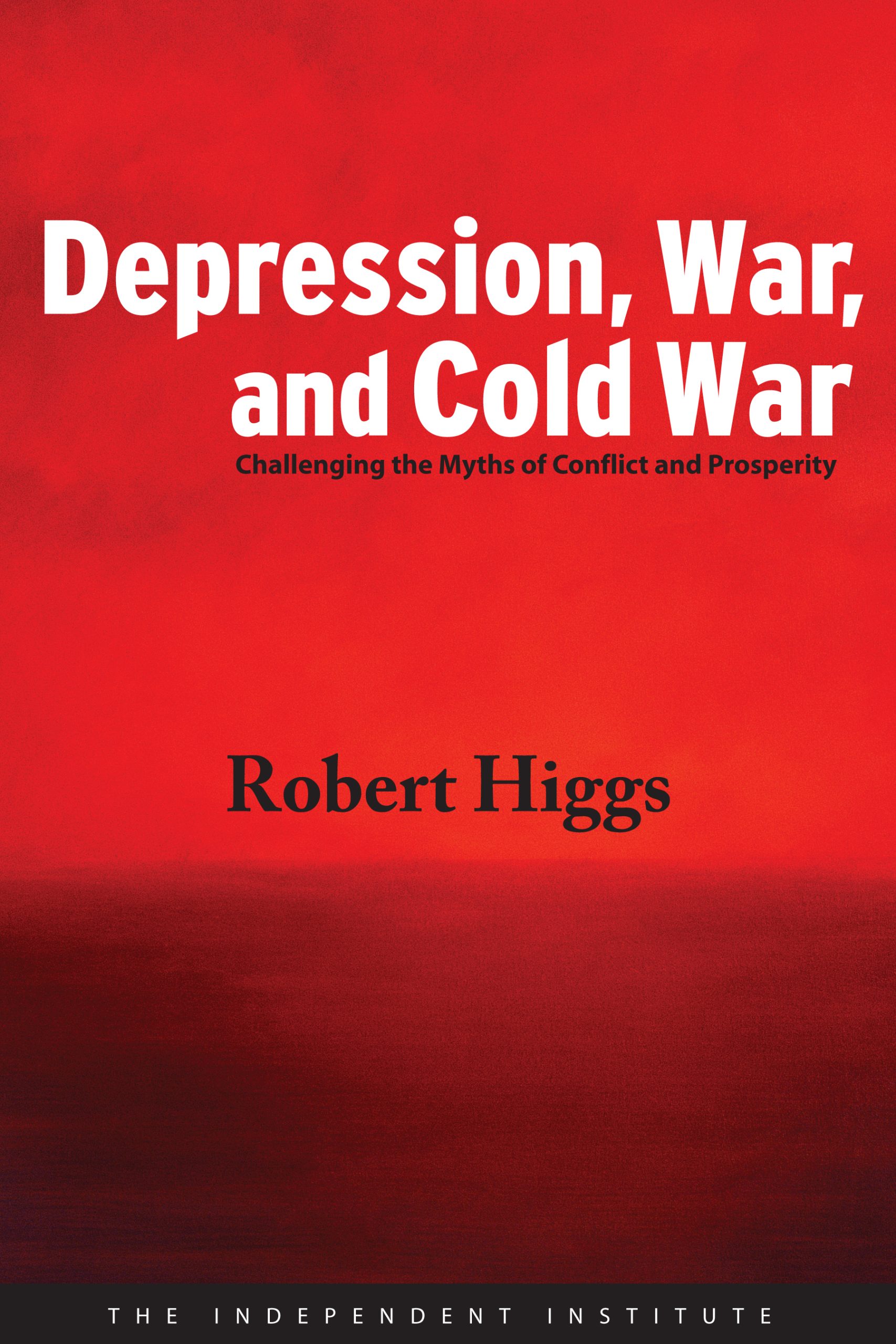
Depression, War, and Cold War
Challenging the Myths of Conflict and Prosperity
Format: Hardcover
Publication Date: May 6, 2009
Publisher: Independent Institute
List Price:
Price:
Discount:
Free Shipping On Orders Over $60! (Within U.S.A)
Bulk Discounts Available: Learn More
Overview
There is a newer edition of this book: Depression, War, and Cold War (2025 Edition)
Despite much attention to U.S. government policies since the early 1930s, key questions remain unresolved. In Depression, War, and Cold War, the scholarly sequel to his acclaimed classic Crisis and Leviathan, Robert Higgs sheds pioneering light on some of the most important of these questions: What accounts for the extraordinary duration of the Great Depression? What about “wartime prosperity” and whether World War II “got the economy out of the depression”? How did the war alter relations between the government and the leaders of big business? How did the postwar military economy alter the business cycle? What is Congress’s role in the military-industrial-congressional complex? This seminal book answers these and other crucial questions by presenting new insights, evidence, and statistical analyses.
Depression, War, and Cold War offers a powerful, solidly grounded interpretation of U.S. political economy from the early-1930s to the end of the Cold War, and refutes many popular ideas about the Great Depression and New Deal, the World War II economy, and the postwar national-security state still so pervasive today.
Table of Contents
Introduction
- Regime Uncertainty
Why the Great Depression Lasted So and Why Prosperity Resumed After the War - Private Profit, Public Risk
Institutional Antecedents of the Modern Military Procurement System in the Rearmament Program of 1940–1941 - Wartime Prosperity?
A Reassessment of the U.S. Economy in the 1940s - Wartime Socialization of Investment
A Reassessment of U.S. Capital Formation in the 1940s - From Central Planning to the Market
The American Transition, 1945–1947 - The Cold War Economy
Opportunity Costs, Ideology, and the Politics of Crisis - Hard Coals Make Bad Law
Congressional Parochialism versus National Defense - Airplanes the Pentagon Didn’t Want, but Congress Did
- Profits of U.S. Defense Contractors
Ruben Trevino & Robert Higgs - Public Opinion
A Powerful Predictor of U.S. Defense Spending
Robert Higgs & Anthony Kilduff
Appendix
Sources
Index
Abiut the Author
Highlights
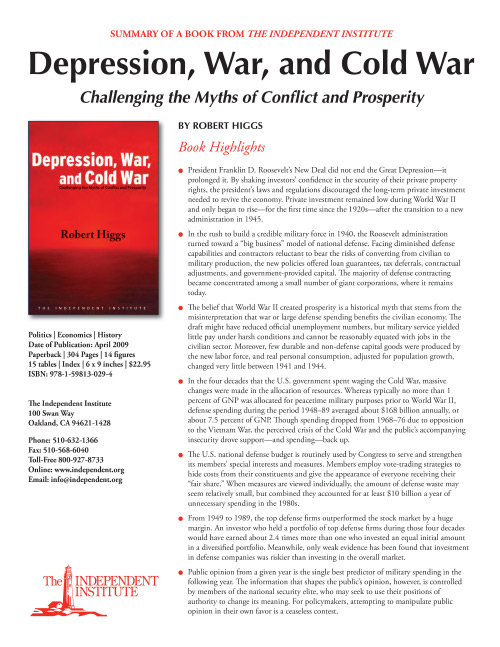
- President Franklin D. Roosevelt’s New Deal did not end the Great Depression—it prolonged it. By shaking investors’ confidence in the security of their private property rights, the president’s laws and regulations discouraged the long-term private investment needed to revive the economy. Private investment remained low during World War II and only began to rise—for the first time since the 1920s—after the transition to a new administration in 1945.
- In the rush to build a credible military force in 1940, the Roosevelt administration turned toward a “big business” model of national defense. Facing diminished defense capabilities and contractors reluctant to bear the risks of converting from civilian to military production, the new policies offered loan guarantees, tax deferrals, contractual adjustments, and government-provided capital. The majority of defense contracting became concentrated among a small number of giant corporations, where it remains today.
- The belief that World War II created prosperity is a historical myth that stems from the misinterpretation that war or large defense spending benefits the civilian economy. The draft might have reduced official unemployment numbers, but military service yielded little pay under harsh conditions and cannot be reasonably equated with jobs in the civilian sector. Moreover, few durable and non-defense capital goods were produced by the new labor force, and real personal consumption, adjusted for population growth, changed very little between 1941 and 1944.
- In the four decades that the U.S. government spent waging the Cold War, massive changes were made in the allocation of resources. Whereas typically no more than 1 percent of GNP was allocated for peacetime military purposes prior to World War II, defense spending during the period 1948–89 averaged about $168 billion annually, or about 7.5 percent of GNP. Though spending dropped from 1968–76 due to opposition to the Vietnam War, the perceived crisis of the Cold War and the public’s accompanying insecurity drove support—and spending—back up.
- The U.S. national defense budget is routinely used by Congress to serve and strengthen its members’ special interests and measures. Members employ vote-trading strategies to hide costs from their constituents and give the appearance of everyone receiving their “fair share.” When measures are viewed individually, the amount of defense waste may seem relatively small, but combined they accounted for at least $10 billion a year of unnecessary spending in the 1980s.
- From 1949 to 1989, the top defense firms outperformed the stock market by a huge margin. An investor who held a portfolio of top defense firms during those four decades would have earned about 2.4 times more than one who invested an equal initial amount in a diversified portfolio. Meanwhile, only weak evidence has been found that investment in defense companies was riskier than investing in the overall market.
- Public opinion from a given year is the single best predictor of military spending in the following year. The information that shapes the public’s opinion, however, is controlled by members of the national security elite, who may seek to use their positions of authority to change its meaning. For policymakers, attempting to manipulate public opinion in their own favor is a ceaseless contest.
Synopsis
American history is a subject filled with urban legends and propaganda promulgated by partisan interest groups. In his classic work Crisis and Leviathan: Critical Episodes in the Growth of American Government (Oxford University Press, 1987), economist and historian Robert Higgs (Senior Fellow, The Independent Institute) addressed dozens of misconceptions about the growth of the U.S. government during the twentieth century and offered a bold new theory in their place: The largest military and economic crisis of that century, he showed, eroded traditional constraints on the growth of American government. After the crises had passed, Americans were left with a government larger in size, scope, and power and more institutionally entrenched than before.
In Depression, War, and Cold War: Challenging the Myths of Conflict and Prosperity, Higgs shows how the Great Depression, World War II, and the Cold War transformed the American political economy. Collecting ten of his most important scholarly papers written since the publication of his earlier book, Depression, War, and Cold War demonstrates Higgs’s masterful grasp of the relevant scholarly literature and his keen analytical ability to discern the larger meaning of statistical minutiae overlooked by many economic historians. The result is a work that sheds light not only on three of the most monumental events in recent U.S. history, but also on the economic and institutional context in which the policymakers of today operate.
Prolonging the Great Depression
For decades, mainstream historians and members of the public largely believed that President Franklin D. Roosevelt “rescued” America from the depths of the Great Depression through his administration’s New Deal programs and court decisions. In recent years this view has met serious challenges from such noteworthy works as Gary Dean Best’s Pride, Prejudice, and Politics: Roosevelt versus Recovery, 1933–1938, and Gene Smiley’s Rethinking the Great Depression.
Higgs adds to this reassessment of Roosevelt’s legacy by arguing that FDR’s policies and appointees inadvertently prolonged the Depression by fostering “regime uncertainty”—i.e., doubts about the security of property rights and the rule of law—which discouraged investors from investing in the long-term projects necessary to return the economy to health.
Another misunderstood issue surrounding twentieth century America is the origin of the U.S. military’s growing size during peacetime. It is often assumed that this trend began during the Cold War or was carried over from World War II—perhaps because President Dwight Eisenhower, in his 1961 farewell speech, warned against the unwarranted influence of the “military industrial complex.” Higgs traces one key aspect of this relationship to changes in weapons procurement policies adopted in 1940–41. These policy changes shifted a large portion of risk from private suppliers to the taxpayers at large.
Wartime Prosperity vs. Genuine
Many historians and economists believe that standard measures of macroeconomic performance show evidence of “wartime prosperity.” But, as Higgs explains, because the United States had a command economy during World War II, many of these measures are highly misleading, while others are conceptually inappropriate. Meaningful national product accounting requires market prices, but the command economy of the war years rendered all prices, especially those paid by the government for goods and services, completely arbitrary. Furthermore, the U.S. government’s “socialization of investment” during the war distorted the allocation of capital goods and labor. Most of the capital formation alleged to have occurred during World War II consisted not of increases of real capital goods but of durable munitions such as weapons platforms, guns, ammunition, and related supplies—which did nothing to increase production for the civilian economy.
As Higgs explains, the postwar transition to a peacetime market economy was one of the most remarkable events in U.S. economic history. By 1947, real military spending had hit its postwar low of 4.3 percent of GNP, millions of workers had left government service and returned to the private sector, and the country had returned to an economic normality not seen since before the Great Depression. But despite the size, speed, and uniqueness of the postwar reconversion of the U.S. economy, economists and economic historians have devoted minimal attention to it. The little they have written about it often falsely assumes that the wartime command economy is directly comparable to the prewar and the postwar economy.
The Cold War Political Economy
The Cold War significantly affected the economic performance of the United States, although economic historians have neglected this subject as well, continues Higgs. From 1948 through the 1960s the dominant Cold War ideology and a bipartisan consensus on defense and foreign policy centered on global containment of Communism and deterrence of a Soviet attack on Western Europe or the United States. These conditions supported the unprecedented allocation of resources to the “peacetime” military establishment. This ideological climate was essential in maintaining high levels of resource allocation to defense but not sufficient to prevent citizens’ skepticism. From 1968 to 1976, for example, military spending fell sharply due to a decline of public support. Periodic crises, however, helped revive an atmosphere of tension, distrust, and insecurity, which in turn fostered the continuation of the U.S. Soviet arms race.
Yet not all of these crises were genuine. A U.S.-Soviet bomber gap in the mid-1950s, a missile gap between 1958 and 1961, and a subsequent antimissile gap and first-strike missile gap are among the “crises” later revealed to have been false alarms. One reason for the error was that the National Security Act of 1947 greatly expanded the kinds of government documents that could be classified as official secrets, thereby preventing citizens (and even most of their political representatives) from holding informed opinions on military spending. This asymmetry made the public highly susceptible to information distortion by the Department of Defense, the National Security Council, the intelligence community, and other components of the national security elite.
National Defense Expenditures
Another problem with national defense, as Higgs demonstrates, is that members of Congress have treated defense programs as a means to serve their own selfish, parochial, and wasteful ends. Consider two of the most successful members of Congress. Rep. Dan Flood (D-Penn.) served 16 terms from 1944 to 1980. Flood’s leadership on the Defense Appropriations Subcommittee and the Labor and Health, Education, and Welfare Appropriations Subcommittee enabled him to extract political favors from other legislators. Although Flood generously supported defense appropriations, at times his logrolling conflicted with specific proposals favored by the military, such as the transition from coal-to oil-powered furnaces on U.S. military bases in Europe. Flood’s obstruction of this conversion cost taxpayers hundreds millions of dollars in excessive heating costs but enabled him to win votes from the anthracite coal region of his state. Similarly, Rep. Joseph McDade (R-Penn.), who served on the Defense Appropriations Subcommittee, represented the hard coal region of his state and blocked base furnace conversion.
Congressional micromanagement of national defense programs grew dramatically after the Vietnam War and the Watergate scandal. In 1970, Congress made 830 adds or cuts to line items in defense authorization or appropriations acts; in 1987 that number had swelled to 3,422. Too often, line-item legislating has promoted the narrower interests of members of Congress rather than national security. This outcome is most evident where Congress has continued to fund projects the Pentagon had recommended scrapping in favor of projects it has deemed more deserving. In 1978–81, this “pork hawk” waste included Congress’s unnecessary purchase of 56 A-7 subsonic attack planes (at a cost of $575 million), mostly due to lobbying by the congressional delegation from the state in which the A-7s were manufactured.
What do U.S. defense contractors get for their efforts? Do they tend to earn average rates of profit for the amount of risk they face—or something more? In a co-authored paper, Higgs and Ruben Trevino compute three measures of profitability for the top 100 companies receiving the largest volume of prime contract awards. In the 1970s, the top defense contractors significantly outperformed the market in terms of stock market returns (i.e., dividends plus appreciation), whereas in the 1980s they significantly outperformed the market in terms of accounting rates of profit (return on investment and return on assets). From 1970 to 1989, an investor who held a portfolio of the top defense firms would have increased the value of his holdings by a multiple of 14.78, compared to a market multiple of 8.19 for the Standard & Poor’s 500.
Public Opinion and Defense Spending
The military-industrial-congressional complex, Higgs shows, is not monolithic; each component competes against the others for resources and influence. Public opinion also plays a significant role in defense spending, as Higgs and Anthony Kilduff explain. Drawing on the results of 181 national surveys taken from 1965 to 1989, they find that changes in military spending lag (and closely track) changes in public opinion on military spending. Employing a variety of statistical tests, they also find that changes in public opinion in a given year account for 65 percent of the variance of defense spending in the following year—a remarkably high explanatory power for just one variable—and that number reaches 89 percent when a model with four lags is employed. Thus, at first blush it seems that the public gets the amount of military spending it wants.
But Higgs and Kilduff hasten to add that although public opinions seems to influence both the executive branch’s and Congress’s budget decisions, one cannot assume that public opinion is autonomous or spontaneous. The competition among rival interests, within as well as outside the government, acts to move public opinion in a desired direction, while the public is largely dependent on the national security elite for its knowledge of military capabilities, the intentions of potential adversaries, and other facts that should inform public opinion.
Praise
“Outstanding Academic Book for 2007.”
—Choice Magazine
“Social Science Book of the Month.”
—Society Magazine (January-February 2007)
“Students are routinely taught that Big Government rescued the United States from the Great Depression and then won World War II while simultaneously producing prosperity at home. In Depression, War and Cold War, Higgs presents the most thoughtful and detailed criticism of this view yet undertaken. No serious student of American economic history can afford to ignore Higgs’s interpretation.”
—Hugh T. Rockoff, Professor of Economics, Rutgers University
“No American knows more about the link between the growth of Big Government and war than Higgs, whose 1989 classic Crisis and Leviathan documented how each new war or economic crisis ratchets up government’s size and power at the expense of individual liberty and a free society. This time, in Depression, War and Cold War, economic historian Higgs asks—and answers—such questions as why the Great Depression lasted so long, how the Cold War altered relations between government and big business and how Congress abetted the growth of the military-industrial complex.”
—Pittsburgh Tribune-Review
“In Depression, War and Cold War, Robert Higgs makes several major points. One example is that, contrary to the general ‘wisdom,’ the real level of prosperity during World War II was probably lower than during the late 1930’s, due to government policies responsible for the unavailability of goods, decay in housing and services, and more dangerous working conditions. Another is that throughout the cold war threat, information was manipulated by political elites to maintain high national security expenditures. These and other findings, and the evidence supporting them, carry new resonance in an era of the national security state’s revival.”
—Bruce M. Russett, Dean Acheson Professor of International Relations, Yale University
“In Depression, War and Cold War Higgs offers ten previously published papers covering a wide-range of subjects: from regime uncertainty during the Great Depression to budgetary politics during the Cold War. . . . Higgs uses an effective combination of historical and economic analysis to tell his story. The book’s introduction does an excellent job of highlighting its themes, and most chapters contain a conclusion, which I found well written and useful. The first half of the book—devoted to the depression and war—uses a wide-variety of data and methods to challenge the orthodox perspective. Readers interested in the political economy of the cold war will be especially interested in chapters 6-8. . . . [T]his book offers thoroughly researched and interesting perspectives on some important issues.”
—Journal of Economic Issues
“In Depression, War and Cold War, Robert Higgs gives intriguing answers to questions he raises about the Great Depression, World War II, and the Cold War. For example: Why did the Great Depression last so long? Why did the Great Escape from the Depression occur not during the war, as conventionally assumed, but in 1945-47? Why did the rearmament program of 1940-41 determine the features of the procurement of military supplies to this day? How should one evaluate the actual performance of the economy during the Cold War from 1949 to 1989, given that defense spending has tenuous relations to the well-being of consumers, investors, and the beneficiaries of government purchased civilian goods and services? How the parochialism of members of Congress results in defense spending that the military does not want? Robert Higgs’s answers to these and still other questions challenges the unthinking reliance on official measures of prices and real GNP, which do not distinguish between what a command economy and what a competitive economy produces. He makes use of insights from political science to support his interpretations. Readers will find this book enlightening.”
—Anna J. Schwartz, Research Associate, National Bureau of Economic Research
“A reading of the distressingly true facts and arguments in Depression, War and Cold War raises fundamental questions as to what can be done: how to find and apply the necessary correctives to the popular and scholarly willingness top remain emotionally invested in erroneous explanations, and how to avoid responding to social and economic problems by waging destructive war. This most recent addition to Robert Higgs’s body of work is an invaluable guide in that further quest.”
—Journal of American Studies
“Depression, War, and Cold War presents very interesting and important reinterpretations of the role of government in the economy since 1930. All points along the political spectrum will find ideas of considerable value here.”
—Stanley L. Engerman, Munro Professor of Economics, University of Rochester
“Depression, War, and Cold War is an important book. Those interested in the interaction between the domestic economy, war and heavily armed peace, will find it essential reading.”
—Paul Johnson, author, Modern Times and A History of the American People
“Depression, War, and Cold War questions some of the traditional (Keynesian) assumptions, e.g., that Roosevelt’s policies gave a boost to an economy in deep recession and that the war had more or less the same effects, only slightly more so. Recommendable . . . convincing . . . .”
—Economics of Peace and Security Journal
“Depression, War, and Cold War marks Higgs as one of the most important and original political analysts of our time. An intellectual tour de force!”
—Jonathan Bean, Professor of History, Southern Illinois University
“Higgs’s superb and pioneering book, Depression, War, and Cold War, is a real eye opener and bold foray into contemporary political economy.”
—Richard E. Sylla, Henry Kaufman Professor of the History of Financial Institutions and Markets, New York University
“Historian and economist Robert Higgs is known as the author of Against Leviathan—a collection of essays that serves as an all-out bombardment against the size and power of the federal government. Unlike that book, which is intended for the lay-reader, Depression, War, and Cold War is intended for a professional audience. In this book Higgs offers ten previously published papers covering a wide-range of subjects from regime uncertainty during the Great Depression to budgetary politics during the Cold War. . . . Overall, Higgs uses an effective combination of historical and economic analysis to tell his story. The book’s introduction does an excellent job of highlighting its themes, and most chapters contain a conclusion, which I found well written and useful. . . . Depression, War, and Cold War offers thoroughly researched and interesting perspectives on some important issues.”
—Journal of Economic Ideas
“Anchored philosophically in the views of Milton Friedman, Ludwig von Mises, Friedrich Hayek, and James Buchanan, Higgs sources the modern, intrusive state in the administration of Franklin D. Roosevelt. Echoing Herbert Hoover, he mourns the loss of individualism, deplores bureaucratic mismanagement of economic life, and, in an updated version of 1930s business-confidence theory, asserts that ‘regime uncertainty’ under Roosevelt threatened private-property rights and investment. . . . Higgs proceeds to reject the claim made by post-war Keynesian economists that massive compensatory public expenditure during the Second World War paved the way to a full employment economy and helped to prevent future depressions with the assertion, based on the work of Simon Kuznets, that government in wartime industry produced only intermediate goods. . . . Higgs also argues that Roosevelt’s acceleration of wartime production through government investment crowded out private investment, resulting in a command economy that lowered the trend rate of economic growth. . . . Having exhausted the subject of the Great Depression, economists recently turned to the sources of postwar recovery. Higgs situates the origin of the economic advances following the conflict in the immediate postwar years, attributing them to the shift from a command to a market economy. He attributes the growth in prosperity to Roosevelt’s demise, reversion of the Truman administration to a regime of private property based on lower taxation and profit retention, and the greater tractability of organized labor in response to the passage of Taft-Hartley.”
—Business History Review
“In Depression, War, and Cold War, Robert Higgs has written a brief but superb account of the Great Depression, the economic effects of World War II, and America’s proclivity for unnecessary military spending in the postwar period. This iconoclastic book is a coherent collection of ten essays on the political economy of the federal government’s welfare and warfare policies spanning the crucial decades of the twentieth century. When Higgs’s essays are put side by side, they send a persuasive message that military spending, whatever its international political effects, did not rescue the country from the Great Depression, did not increase standards of living during World War II, and did not provide weapons at competitive prices after the war. In challenging the ‘military-industrial-congressional complex,’ Higgs urges readers to focus not just on any benefits accruing to Dallas for making obsolescent planes or to Wilkes-Barre for stockpiling coal, but to focus on the flow of dollars out of the hands of hard-working taxpayers all over the country—all of whom could have invested or spent their money more wisely and beneficially.”
—The Freeman
“Robert Higgs describes Depression, War, and Cold War as an interim report on work related to his 1987 classic, Crisis and Leviathan. . . . Higgs provides a surprisingly incisive response to the broad range of questions that accompany efforts to explain this very intractable part of our economic history. Without doubt, this is the chief contribution of Depression, War, and Cold War. . . . Higgs’s interpretive framework presents key challenges to both the macromonetary and Keynesian explanations of the American experience in the era of depression and world war.”
—Journal of Markets & Morality
“Depression, War, and Cold War is a collection of ten previously published essays that address some of the most important questions of 20th century America. Robert Higgs provides detailed answers that challenge government propaganda of our past and provides ammunition for present and future policy deliberations. I highly recommend this book for every economist and the general public. The essays are well-written, easily accessible, and to the point. The book will appeal to conservatives, liberals, and libertarians. . . . Higgs’s book is a great anti-state tonic that is a direct challenge to government propaganda where history is shown to conform nicely to economic logic.”
—Quarterly Journal of Austrian Economics
“Robert Higgs is a contrarian and an iconoclast. He believes that economists and historians have misunderstood U.S. economic history during the middle decades of the 20th century. For Higgs, because government activity competes with and distorts markets, the burden of proof is carried by those who promote expanded government activity. And this obligation—whether for civilian or military programs—is rarely fulfilled. In this spirit, Higgs argues that the ‘New Deal prolonged the Great Depression by creating an extraordinarily high degree of uncertainty among investors.’ . . . But the New Deal is only a prelude to the most innovative and provocative claims at the center of Higgs’s effort. On the topic of war, Higgs makes a powerful case that resonates with the most strident of antiwar activists. . . . Relying extensively on Kuznets, Higgs makes the case that all war outlays should be deducted from the GNP. . . . On the basis of his challenges to the orthodox definitions and measurement of the GNP and personal consumption, Higgs calls into question the military Keynesian view of the war. That is, far from ending the Great Depression, the World War II mobilization prolonged it. . . . Sociologists studying war and peace and those concerned with the middle decades of the 20th century would profit from consulting his work.”
—American Journal of Sociology
“On the eve of entering World War II in 1941, America’s economy was still quite depressed—as it had been for more than a decade. And as economic historian Robert Higgs shows in his 2006 book, Depression, War, and Cold War, New Deal policies and the prevailing climate of ideas from which they sprang suppressed investment.”
—Pittsburgh Tribune-Review
“By bringing together ten previously published essays in his latest book, Depression, War, and Cold War: Studies in Political Economy, eminent economist Robert Higgs expresses his hope that ‘these trees do add up to a forest, that the individual studies, laid back to back, do tell a coherent overarching tale.’ Higgs, a Senior Fellow in Political Economy at the Independent Institute, need not worry about coherence here because his thesis is clear. It is a convincing testament to the observation made nearly two hundred years ago by German philosopher Friedrich Von Schlegel, ‘Where there is politics or economics, there is no morality. Higgs either wrote or cowrote the ten essays that compose Depression in the time since his previous book, Crisis and Leviathan. By revising and collecting them in one place, Higgs intends to ‘expand and refine the ideas’ that his landmark study originally proposed. . . . Higgs demonstrates the excessive nature of U.S. spending on military facilities had ‘little, if any, value for peacetime uses.’ Moreover, he raises a serious challenge to the idea that the American economy peaked between 1943 and 1945. Higgs discerns the psychological ramifications of the ‘command-and-control’ wartime economy by showing that the ‘frenetic activity of war production’ drastically altered the expectations of consumers and producers by reminding them of the nation’s vast potential.”
—History: Review of New Books
“Depression, War, and Cold War is challenging but essential reading for any who want to truly understand 20th-century economic history, the real causes of the Great Depression, and the relationship between militarism, inflation, taxes, and the expansion of state power.”
—New American
“Even though a spontaneous recovery occurred before World War II, it is important to stress that scholarship by Robert Higgs, and other economic historians, shows that—contrary to legend—the New Deal held down the spontaneous recovery and contributed to the 1938-1939 slump. Indeed, Higgs’ evidence demonstrates that investment was depressed by New Deal initiatives because of regime uncertainty—‘a pervasive uncertainty among investors about the security of their property rights in their capital and prospective returns.’ (Robert Higgs, Depression, War and Cold War). In short, investors were afraid to commit funds to new projects because they didn’t know what President Roosevelt and the New Dealers will do next.”
—GlobeAsia
“Depression, War and Cold War . . . is one of those rare offerings that explicates the truth of things related to the inimical conflation of government, the military, and our congressional banditti these past seventy years or so. . . . It is a book that reveals a singular and important element of the derailment of our culture: where human nature has triumphed in an egophanic revolt against the old order.”
—Human Events
“I am dying to read Depression, War, and Cold War. . . . This is invigorating for the mind and for understanding. Folks, I do agree that what is being done now by the government is hurting us terribly. . . . This not the last time you will be hearing from Professor Robert Higgs, and his book is Depression, War, and Cold War, which we’ve already ordered. It has answered so many questions.”
—Dennis Prager, author and nationally syndicated talk radio host
“In his new book, Depression, War, and Cold War, Robert Higgs makes a compelling case for the proposition that the U.S. did not really recover during World War II, that in many ways it regressed, and the growth that led to the relative prosperity of the 1950s did not begin until after wartime controls were lifted in 1946. . . . Higgs, who has taught at Oxford, Stanford and the University of Washington, has a rare combination of passion for liberty and the well-being of the American people along with a commitment to deep scholarship and a nuanced, intellectually honest approach to controversial issues. He is a treasure and a resource who deserves a great deal more prominence in our national conversation.”
—Orange County Register
Awards
Choice Magazine (January 2008) (American Library Association)
- Outstanding Academic Book“This prestigious list reflects the best in scholarly titles reviewed by Choice and brings with it extraordinary recognition of the academic library community. The list is quite selective. . . . In awarding Outstanding Academic Titles, the editors apply several criteria to reviewed titles: overall excellence in presentation and scholarship, importance relative to other literature in the field, distinction as a first treatment of a given subject in book or electronic form, originality or uniqueness of treatment, value to undergraduate students, and importance in building undergraduate library collections.”
Society Magazine (January/February 2007)
- Book of the Month
Media Inquiries
Robert Ade, Director of Media Relations(510) 635-3690 | Send email
News
Product Details
Course Adoption
The Independent Institute is pleased to offer both extended PDF excerpts and print exam copies to college instructors for course adoption consideration.
All orders are subject to a manual review and approval process and subject to inventory availability. We endeavor to verify submissions and process requests within three business days. For print copies, please allow an additional 5–10 days for delivery.
Extended PDF Excerpts of roughly the first 25% or first 50 pages of each book are offered free of charge.
Print copies will only be shipped to institution, university, or organization addresses. Shipping within the United States has no extra cost. For international orders, add $30 for shipping.
Bulk discounts for print copies are also available to all buyers. Learn more.
We reserve the right to refuse approval for unverifiable or fraudulent requests.
Taking a Stand

Crisis and Leviathan
Delusions of Power


Opposing the Crusader State