Beyond Politics (2026 Edition)
The Roots of Government Failure and the Case for Private Action (Fully Revised and Updated)
Format: Paperback
Publication Date: October 27, 2026
Publisher: Independent Institute
List Price:
Price:
Discount:
Free Shipping On Orders Over $60! (Within U.S.A)
Bulk Discounts Available: Learn More
Overview
Fully revised and updated third edition of Randy T. Simmon’s landmark examination of “government failure” viewed through the lens of public choice theory, explaining how governments produce stagnation, scandals, and public distrust.
Are there really as many market failures as we’ve been led to believe? Or might these be better understood as political failures?
Designed both as a stand-alone guide for curious readers and a classroom companion for undergraduate courses, this updated edition of Beyond Politics is a provocative introduction to public choice economics. Challenging the familiar assumption that government intervention is the natural solution to “market failure,” Randy Simmons—professor of economics, entrepreneur, and Director of the Center on Growth and Opportunity at Utah State University—and Diana W. Thomas—professor of Economics, co-editor of the prestigious The Independent Review journal, and Director of the Institute for Economic Inquiry at Creighton University—blend engaging stories, historical examples, and accessible analysis to show how political and economic systems really function.
Drawing on decades of public choice scholarship, each chapter of this book shows why well-intentioned political actors often produce outcomes that fall far short of the public good. After all, just as markets are shaped by incentives and information, so too are voters, bureaucrats, and policymakers—frequently leading to unintended consequences and costly policy failures.
Through compelling case studies—including the surprising history of privately operated lighthouses (which, as it turns out, often outperformed government monopolies!)—Beyond Politics shows how voluntary cooperation and institutional innovation can and do solve complex social challenges.
Clear, engaging, and thought-provoking, Beyond Politics challenges readers to look beyond traditional political solutions and discover how decentralized human cooperation has long been the most powerful force for peace and prosperity.
Previous editions of this book:
Beyond Politics: The Roots of Government Failure (2011)
Beyond Politics: Markets, Welfare and the Failure of Bureaucracy (1994)
Table of Contents
Introduction
Politics and Markets Without Romance
PART I: Market Failures and Political Solutions: Orthodoxy
- Market Failure and Government Intervention: The View from Welfare Economics
- Political Presuppositions of the Idealized State
- Politics of Free and Forced Riders: Traditional Public Finance
PART II: In Dispraise of Politics: Some Public Choice
- Who Guards the Chicken Coop? Public Choice Assumptions
- Choosing in Groups: Ignorance, Irrationality, and Intransitivity
- Concentrated Benefits, Dispersed Costs, Rent Seeking, and Regulation
- Politicians and Political Institutions
- Micro-Politics of Macro-Instability
- Hardworking Bureaucrats and Nonworking Bureaucracy
- Justice and Coercive Redistribution
PART III: Understanding Property, Prices, and Profit and Loss
- Private Property and Public Choice
- A New View of Market Processes: Rediscovering Prices and Profit and Loss
- Assurance and Governance
- Economic Analysis of the Law
PART IV: Comparing Real-World Markets with Real-World Government: Comparative Institutional Analysis
- Political Pursuit of Private Gain: Government Schools
- Political Pursuit of Private Gain: Environmental Goods
- Creating a Climate for Liberty and Self-Governance
Notes
Index
About the Authors
Highlights
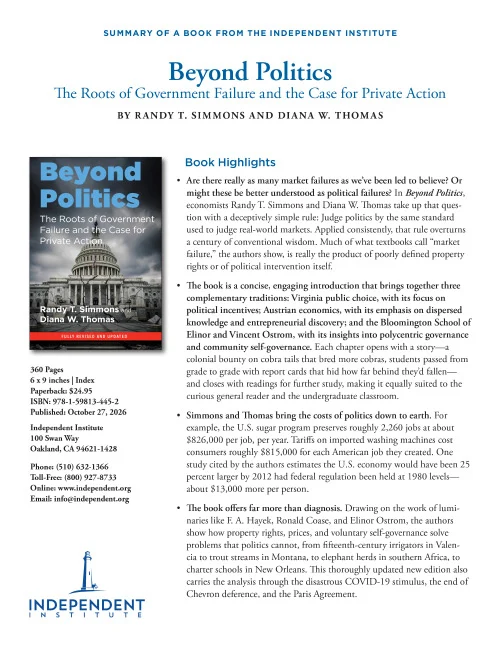
- Are there really as many market failures as we’ve been led to believe? Or might these be better understood as political failures? In Beyond Politics, economists Randy T. Simmons and Diana W. Thomas take up that question with a deceptively simple rule: Judge politics by the same standard used to judge real-world markets. Applied consistently, that rule overturns a century of conventional wisdom. Much of what textbooks call “market failure,” the authors show, is really the product of poorly defined property rights or of political intervention itself.
- The book is a concise, engaging introduction that brings together three complementary traditions: Virginia public choice, with its focus on political incentives; Austrian economics, with its emphasis on dispersed knowledge and entrepreneurial discovery; and the Bloomington School of Elinor and Vincent Ostrom, with its insights into polycentric governance and community self-governance. Each chapter opens with a story—a colonial bounty on cobra tails that bred more cobras, students passed from grade to grade with report cards that hid how far behind they’d fallen—and closes with readings for further study, making it equally suited to the curious general reader and the undergraduate classroom.
- Simmons and Thomas bring the costs of politics down to earth. For example, the U.S. sugar program preserves roughly 2,260 jobs at about $826,000 per job, per year. Tariffs on imported washing machines cost consumers roughly $815,000 for each American job they created. One study cited by the authors estimates the U.S. economy would have been 25 percent larger by 2012 had federal regulation been held at 1980 levels—about $13,000 more per person.
- The book offers far more than diagnosis. Drawing on the work of luminaries like F. A. Hayek, Ronald Coase, and Elinor Ostrom, the authors show how property rights, prices, and voluntary self-governance solve problems that politics cannot, from fifteenth-century irrigators in Valencia to trout streams in Montana, to elephant herds in southern Africa, to charter schools in New Orleans. This thoroughly updated new edition also carries the analysis through the disastrous COVID-19 stimulus, the end of Chevron deference, and the Paris Agreement.
Synopsis
Since the early twentieth century, economists have measured real markets against an imaginary ideal: perfect information, perfect competition, zero transaction costs. Unsurprisingly, they found them wanting. Whenever markets appeared to fall short, the remedy was assumed to be government: more regulation, more taxes and subsidies, more planning, more redistribution. Rarely did anyone ask whether government, staffed by real people facing real incentives, could actually do better.
Beyond Politics asks that rare but vitally important question.
Simmons and Thomas apply a simple rule of fairness that economists call behavioral symmetry: assume voters, politicians, bureaucrats, and interest groups are no more and no less self-interested than buyers and sellers. As it turns out, once politics is judged by the same standard as markets, the case for political solutions looks very different.
What incentives exist in government? Who wins and who loses? Do good intentions in government produce good results?
The book unfolds in four parts. Part I lays out the orthodox case for intervention and the political assumptions hidden inside it. Part II applies public choice analysis to voting, interest groups, politicians, macroeconomic policy, bureaucracy, and redistribution. Part III turns to the institutions that make markets work—property rights, prices, profit and loss, and private assurance—as well as the economics of law. Part IV puts real markets and real government side by side in two extended case studies, education and the environment, before closing with a hopeful vision of what lies beyond politics.
Clear, engaging, and thought-provoking, Beyond Politics challenges readers to look beyond traditional political solutions and discover how decentralized human cooperation has long been the most powerful force for peace and prosperity.
De-Romanticizing Politics
When James Buchanan won the Nobel Prize in 1986, a journalist asked him to sum up public choice economics. His reported answer: “Don’t let the fox guard the chicken coop.”
Simmons and Thomas argue that economists and political scientists have been asking the wrong question for generations. Markets have been held to an ideal of perfect competition and perfect information, and every shortfall has been recorded as a “market failure.” Government, meanwhile, has been treated as the obvious remedy, without anyone asking how real politicians, bureaucrats, and voters actually perform. Public choice insists on judging both by the same standard. It assumes that people do not change their nature when they move from the grocery store to the voting booth.
The results are sobering.
Because a single vote almost never decides an election, it is rational for voters to stay uninformed—what economist Anthony Downs of the Brookings Institution called “rational ignorance.” And because a nearly worthless vote costs the voter nothing, people can afford to back policies that feel virtuous, even when they suspect (often rightly) that those policies will backfire. As economist Bryan Caplan puts it, “Like diners at an all-you-can-eat buffet, we should expect voters to ‘stuff themselves’ with moral rectitude.”
But none of this, the authors stress, requires bad people in office: “Even a government and polity composed entirely of saints would produce results approximating those we currently get . . . unless the rules of the game were changed.”
Concentrated Benefits, Dispersed Costs
If the ballot box is a weak tool for ordinary citizens, organized interests quickly learn it is a powerful one for them. In 2019–20, American Crystal Sugar, a cooperative of about 2,800 sugar beet farmers, gave $2.8 million to political campaigns. Their reward? A program that has kept U.S. sugar prices near double the world price since the early 1980s, at a total cost of $2.4 billion to $4 billion a year. But spread across every household, the bill comes to just $20 to $34 annually—too little for anyone to notice. Which is precisely the point. The mere blip on the radar is a feature, not a bug.
Indeed, this pattern repeats across thousands of laws. Between 1995 and 2021, 78 percent of farm subsidies went to the wealthiest 10 percent of recipients. Economist Bruce Yandle’s “Bootleggers and Baptists” theory explains why such laws endure: Moralists supply the public rationale while self-interested industries supply the quiet, devil-laden details.
For example, when Tennessee made it a crime for anyone but licensed funeral directors to sell caskets, a federal appeals court found the state’s justifications came “close to striking us with the force of a five-week-old, unrefrigerated dead fish.” The agencies that administer these programs face every incentive to grow; staffing at federal regulatory agencies rose from about 57,000 in 1960 to nearly 287,000 in 2020, while their budgets grew sixteenfold.
Property, Prices, and Self-Governance
Asked in 2004 where market forces should be limited, Nobel laureate Vernon Smith answered simply: “None.” Markets, he explained, are about finding institutions that let people make good decisions “without anyone having to tell them what to do.”
In this book, Simmons and Thomas show how. Property rights that are defined, defendable, and divestible give owners reasons to conserve and to weigh the wishes of others. When farmers in Niger were finally allowed to own the trees on their land, they stopped clearing saplings and began nurturing them, adding tree cover across some 7.4 million acres. Prices, as F. A. Hayek showed, carry knowledge no planner could ever collect—whether about a sudden scarcity of tin or a snowstorm that sends Uber’s surge prices soaring and more drivers onto the road.
Even where formal ownership is hard to establish, people still find ways to cooperate. Elinor Ostrom, the 2009 Nobel laureate, documented self-governing communities such as the irrigators of Valencia, Spain. These irrigators have shared scarce water under their own rules for more than five centuries. Brand names, online ratings, warranties, and private certifiers do similar work for buyers facing unfamiliar sellers. Government mandates, by contrast, often backfire. In fact, a National Academy of Sciences report estimated that federal fuel-economy standards contribute to between 1,300 and 2,600 traffic deaths each year by pushing drivers into smaller, lighter cars—a reminder, the authors write, that “consumers should be cautious of their benefactor.”
Real Markets vs. Real Government
The authors set real markets beside real government in two areas where intervention is usually taken for granted: education and environment.
On education, Baltimore spends some $17,000 per student per year, yet in 2021, a student who had passed just three classes in four years ranked 62nd in a class of 120. School choice, meanwhile, is surging in America and across the globe: A large voucher program in Colombia raised secondary-school completion rates by 15 to 20 percent, and post-Katrina New Orleans, rebuilt around charter schools, saw student test performance climb by 15 percentage points.
On the environment, the authors recount how Ronald Coase won over a room of skeptical Chicago economists—thirteen to none!—with the insight that the real problem is not pollution “spillovers,” but missing property rights and high transaction costs. Where rights are clear and tradable, he argued, results follow. When sulfur dioxide permits became tradable, the cost of cutting emissions fell to as little as $150 a ton, far below official forecasts. Elephant populations rose more than 200 percent in southern African communities allowed to profit from wildlife, even as Kenya’s fell by 75 percent. And Montana’s instream water leases have protected nearly 800 miles of trout habitat. Asked whether his stream project was an example of “free market environmentalism,” one Trout Unlimited lawyer replied, “I do not know what that is. All I know is that this is environmentalism that works.”
Across seventeen chapters, the authors never lose sight of their larger purpose: not cynicism, but what they call “a kind of civic reformation.” The problem, they argue, is rarely bad people in office; it is that “liberty gets run over by the tyranny of good intentions.” The task ahead is “not to perfect the state, but to reweave the social fabric from the bottom up.”
For those who suspect politics has promised more than it can deliver, Beyond Politics belongs on their shelf.
Praise
“Beyond Politics is a superb, thought-provoking and penetrating book, analyzing the real, as opposed to the presumed, effects of government regulation. This outstanding book deserves to be read by all serious students of government policy.”
—Sam Peltzman, Ralph and Dorothy Keller Distinguished Service Professor of Economics Emeritus, University of Chicago
“Beyond Politics is a lively book that very effectively analyzes the very real phenomena of government failure. … The authors make a significant contribution by dealing informatively with the side of the matter that welfare economics tends to neglect and make a vigorous case for the view that government intervention in the workings of the market should never be taken lightly.”
—William J. Baumol, Director, C. V. Starr Center for Applied Economics, New York University
“Beyond Politics is a major contribution to informed comment. The book is so well written and the subject is so important and exciting that a great many people will find it very entertaining even if they do learn while reading it. We can welcome the book as a major step forward in understanding the dynamics of government and markets, and how both affect us all.”
—Gordon Tullock, University Professor Emeritus of Law and Economics and Distinguished Research Fellow, George Mason University
“Throughout the world, publics are looking for a new conception of government and its role. Happily, there is a whole new theory that fills the bill called ‘public choice,’ and which is clearly and persuasively presented in the excellent book, Beyond Politics.”
—Robert L. Bartley, Pulitzer Prize winner and late Editor, The Wall Street Journal
“Simmons make[s] a lucid case for a market economy and limited constitutional government. Beyond Politics is the most effective introduction to this topic that is now available.”
—William A. Niskanan, late Chairman Emeritus and Distinguished Senior Economist, Cato Institute; former Chairman, President’s Council of Economic Advisors
“Beyond Politics is a solid work in all respects. Truly a praiseworthy book, it is well written and carefully organized, providing a rich contrast between orthodox notions of democracy and the public choice alternative.”
—Richard E. Wagner, Hobart R. Harris Professor of Economics, George Mason University
“Beyond Politics is a valuable analysis, making a cogent case for thoroughly rethinking what government should do. The book deserves wide reading.”
—John Engler, former Governor of Michigan
“Beyond Politics is so well written and interesting that it appeals even to those, like me, who may disagree with several of its arguments.”
—Mancur Olson, Jr., late Distinguished Professor of Economics, University of Maryland
“We have needed an answer to the question often asked: ‘Can you refer me to a single book that will explain in simple language what Public Choice is all about?’ Beyond Politics … meets this need superbly. The authors have assembled the required understanding of both economics and politics that allows them to get straight to the important elements involved.”
—James M. Buchanan, Nobel Laureate in Economic Science; Distinguished Professor Emeritus, George Mason University
“Beyond Politics is a comprehensive and up-to-date account of the failures of U.S. governmental policies, with important suggestions for how to correct them. The book is a thorough introduction to what is wrong with America’s political system with remedies for its failure.”
—Dennis C. Mueller, Professor of Economics Emeritus, University of Vienna
“The best primer on political reality, Beyond Politics will revolutionize your thinking!”
—Pierre S. DuPont, IV, former Governor of Delaware
“Simmons ha[s] … done an outstanding job of illuminating the inefficient allocation of public resources in the face of politicians, bureaucracies and interest groups. Beyond Politics explains how and why the forces work in a constant struggle among these three elements in the continuum of public policy battles and why bureaucratic institutions are unable to deliver on their promises at the intersection of politics and economics.”
—James C. Miller III, former Chairman, Federal Trade Commission; former Director, Office of Management and Budget
“In Beyond Politics, Randy Simmons ha[s] . . . written an accessible and compelling account of the major issue of our time—the intersection of politics and the market. With great care they first develop and then demolish the standard arguments about market failure that are commonly taken to justify the creation of a vast government bureaucracy. They show how the forces of self-interest are given a new destructive range in political and administrative settings that allow interest groups, politicians and bureaucrats to enhance their own position at the expense of the public at large. And they illustrate their basic point with countless well-chosen examples of bureaucratic misdeeds that should make even the most ardent defenders of big government question the soundness of the ever-expanding welfare state.”
—Richard A. Epstein, Laurence A. Tisch Professor of Law, New York University; James Parker Hall Distinguished Service Professor of Law Emeritus, University of Chicago
“Beyond Politics is a cogent and readable book examining what public choice is all about.”
—Norman J. Ornstein, Resident Scholar, American Enterprise Institute
“Economics is full of people who know that markets work, but seem amazed that politicians are not following their advice. The authors of Beyond Politics make the important point that intervention in the face of ‘market failure’ does not necessarily lead to a better state of affairs. Their insight that government can fail too, and fail in ways that are subject to systematic analysis, is a most valuable contribution to the debate over public policies.”
—Glenn C. Loury, Merton P. Stoltz Professor of the Social Sciences and Economics, Boston University
“Beyond Politics: Markets, Welfare, and the Failure of Bureaucracy is the best non-Ph.D.-level summary of the basic insights of public-choice scholarship.”
—Donald J. Boudreaux, Professor of Economics, George Mason University
“There is a need for a public philosophy that would provide a framework for discussion of appropriate spheres for markets and government. One such philosophy might begin with recognition of the desirable features of markets and also of the possibilities of market failure. But it would build on material such as is in this book to identify the risks of government failure, that is, the possibility that government intervention may well make things worse. Such a philosophy could provide a basis for communication and discourse and a framework for reasoned disagreement between people with diverse points of view about the goals of public life. The seeds of such a public philosophy are to be found in this book.”
—American Political Science Review
“The book is well written, . . . That is why this book should be highly recommended for a course in economics at the junior or senior level. In fact, a curriculum in economics that does not include the subject matter covered by Simmons . . . will be, at least, questionable in its quality. Those who do read the book will come out with what may be considered the most important lesson of Beyond Politics: Governments rely on force, and when force is wielded for political purposes the government becomes the worst violator of individual rights. Such lessons in liberty and freedom are badly needed in contemporary American economic education. This book fills this void more than satisfactorily.”
—Public Choice
Media Inquiries
Robert Ade, Director of Media Relations(510) 635-3690 | Send email
News
Product Details
Course Adoption
The Independent Institute is pleased to offer both extended PDF excerpts and print exam copies to college instructors for course adoption consideration.
All orders are subject to a manual review and approval process and subject to inventory availability. We endeavor to verify submissions and process requests within three business days. For print copies, please allow an additional 5–10 days for delivery.
Extended PDF Excerpts of roughly the first 25% or first 50 pages of each book are offered free of charge.
Print copies will only be shipped to institution, university, or organization addresses. Shipping within the United States has no extra cost. For international orders, add $30 for shipping.
Bulk discounts for print copies are also available to all buyers. Learn more.
We reserve the right to refuse approval for unverifiable or fraudulent requests.

Anarchy and the Law
Deleting the State

Good as Gold

Liberty in Peril

The Midas Paradox

Choice

Boom and Bust Banking

Living Economics