

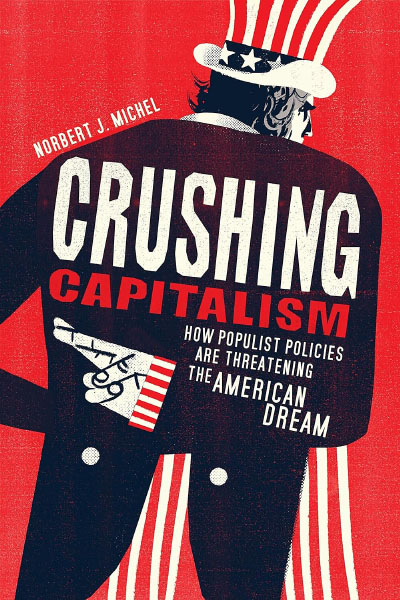
Crushing Capitalism
Book Review
Reviewed by
This book review is a web exclusive for the Spring 2026 issue of The Independent Review.
With Crushing Capitalism, Norbert Michel has written a fine little book on poor government policies and how they harm the economy and the little people. It’s in a tight package: seven chapters that you can bang out in an afternoon. (One-third of the book is endnotes and citations.) Despite its diminutive size, it packs a solid punch, defending markets and skewering government policies that are harmful and often regressive.
The guts of the book (in Chapters 3–5) are about the blessings of technological advance, immigration, and international trade. Michel handles each topic separately, but he notes the similarities between them. Each is beneficial overall but increases competition in certain areas of the economy. Each has broad benefits, but they impose concentrated costs on small subsets of people who often form interest groups seeking government policy protections.
In the context of international trade, I was reminded of Steven Landsburg’s parable (borrowed from David Friedman) about the “Iowa Car Crop” (The Armchair Economist [Free Press, 1994], pp. 197–99). An entrepreneur in a port city figures out how to manufacture low-cost, high-quality vehicles from grain. He buys tons of wheat from domestic farmers as the chief input to crank out desirable cars. People are pleased with the arrangement and patriotically proud of the entrepreneur. But then it’s revealed that he has been exchanging the grain for foreign-produced cars, using international trade. With this, the people become extremely upset.
Along the way, Michel repeatedly uses what economists call “scale” and “substitution” effects. For example, when technology advances, firms are more likely to use labor as their businesses grow—to scale up production. In this, the technology is a direct and an indirect supplement to labor productivity. Existing workers become more productive, allowing a firm to grow. And the growth of the firm can create more jobs (of various types). But often, technology also allows firms to substitute away from labor.
The same is true of immigration: immigrants may be substitutes for domestic labor, but they also drive up the demand for goods and services. And we see something similar with international trade: enhanced efficiencies can help some firms grow, while others suffer from greater competition. The net effect depends on the context, but distinguishing between the scale and substitution effects is a helpful way to conceptualize what’s happening.
As an example, Michel talks about how the invention of chainsaws was good for the lumber industry in particular and the economy in general. On the one hand, this led to much more output in the industry—and more jobs. But on the other hand, the new technology also replaced many lumberjacks. The net effect on jobs of such technological advance is typically mixed, but often negative, as jobs shift into other sectors of the economy. Stunning innovations in agricultural technology are another obvious example. But the same principles apply to all sorts of technological improvements—from the continuing emergence of AI and self-operated dry cleaning to streaming movies and compressing mattresses into relatively small boxes.
Michel is especially impressive in his description of mutually beneficial trade and comparative advantage—and in invoking Adam Smith in his critique of government intervention in trade. Michel provides a terrific description of the “trade deficit” in goods and services, our “investment surplus,” and the “balance of payments” (pp. 51–53). And he repeatedly interacts with the influential writings of Oren Cass, agreeing with him about the benefits (and challenges) of improved technology, but disagreeing about the impact of immigration and trade, the appropriate statistics to cite on income growth, and ideal policy approaches.
Along the way, Michel presents data that run contrary to popular narratives that the American economy is in decline. (For example, I was surprised to learn that the U.S. is #1 among developed countries in accepting immigrants, but near the bottom in terms of immigration as a percentage of population.) He explains why stagnant real household incomes are not the concern they seem to be. The statistics are a poor proxy for what we’re trying to measure. First, government’s measurement of inflation is typically exaggerated. Second, income distribution statistics typically ignore income dynamics as people move between income classes. Third, household structure changes over time, making a household-based statistic less helpful. Finally, the top quintile of households has almost twice as many people as those in the bottom quintile (p. 113), explaining some of the differences in measured income.
Michel also devotes considerable energy to discussing increased manufacturing productivity and the implications for jobs—overall and measured as the share of jobs in an increasingly service-based economy. Some concerns about this are driven by reasonable ignorance about how economies function and develop over time. But some of the complaints are useful as rhetoric to promote self-serving government policies. One of my favorite observations in this realm: When politicians and interest groups compare the best manufacturing jobs to the worst service jobs—say, high-end manufacturing jobs in a car factory and “burger-flippers”—you can be confident that they’re rubes or treating you like a rube.
All this said, Michel argues at length that things could be quite a bit better on the policy front, especially for those in the lower income classes. He describes the impact of tariffs on prices in general and their regressivity against the poor in particular. He’s effective in noting that the minimum wage can’t be particularly helpful. (If we were to routinely describe it as “trying to make it more expensive to hire less-skilled people,” maybe it wouldn’t be so popular!) He notes that massive federal government intervention in the housing market has not budged the home ownership rate since 1964. He points to troubles in K–12, higher ed, welfare policies, and health care—all areas with heavy subsidies and regulations.
In a word, Michel has written a paean to free markets and capitalism—and a critique of the cronyism and statism that generate unfortunate policies, harming the economy and those not in the political 1 percent. I only have two critiques to offer. First, Michel offers some discussion of vocational education and an implied endorsement of (far) greater school choice. But there is surprisingly little on the topic of K–12 education, given its connections to capitalism, populism, cronyism, economic growth, and opportunity for those in the lower income classes. The government’s expensive and ineffective monopoly power in K–12 is arguably the most important economic policy issue today. So, the minimal coverage here is a startling oversight.
Second, I’m not crazy about the title. “Crushing Capitalism” is a colorful and memorable alliteration. But the compendium of policies covered by Michel is more about impeding capitalism than crushing it. And ultimately, Michel is concerned about crusading for vulnerable people more than defending an unsympathetic economic system. Along these lines, I like the reference in the subtitle to “the American dream”, since it makes the point that achieving or reaching “the dream” is often made more difficult by government intervention.
The reference to “populist policies” in the subtitle is a nice connection to current lingo, if not to current events. But the term is fuzzy in general and not particularly well-defined by Michel. If populism is about popularity—at least among certain groups of people—there is no clear connection to policy. Popularity in a democracy is certainly no guarantee of efficient or equitable policy. Populism can be defined as a movement that strives to work “against the system.” But supposedly populist policies are implemented by elites and often benefit the politically connected. Maybe populism is more about a mood and a complaint—certainly a thing today—but this by itself would not necessarily result in policy at all.
Maybe P. J. O’Rourke described it best: “Populism is a muddle—a political, economic, and moral dog’s breakfast.” As such, Michel’s book isn’t really so much about populism as it is about bad government policy. Really, the larger issues here are simply standard fare from Public Choice economics: the universal rational ignorance of the general public; the increasingly irrational ignorance of partisans inflamed by social media and charismatic leaders; the desire of politicians and interest groups to benefit from government activism; and their mutually beneficial trades through law and regulation at the expense of society, given concentrated benefits and diffuse costs.
Comments
Related Book Reviews
The War on Prices

Why the Conventional Wisdom about the 2008 Financial Crisis Is Still Wrong: Ten Years Later

Re-Launch


Independent Review Issues
Articles by Issue