

The Legacy of Janos Kornai
Book Review
Reviewed by
This book review is a web exclusive for the Spring 2026 issue of The Independent Review.
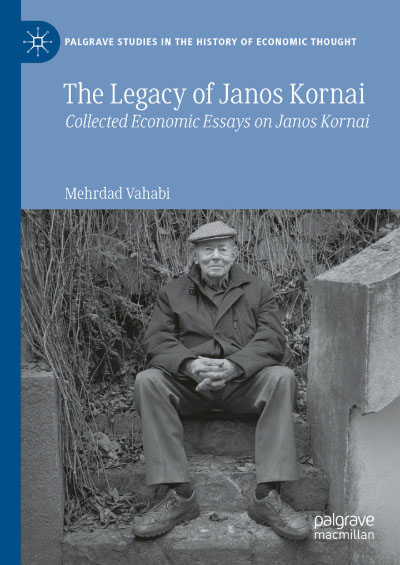
Hungary has always been given as an example of a country that was relatively successful in its transition from a centrally planned to a market economy compared to other Eastern European countries. János Kornai (1928–2021) was undoubtedly one of the architects behind this process, and his critical writings on socialism prepared the Hungarian path towards a free market economy. A newly published book, The Legacy of Janos Kornai: Collected Economic Essays on Janos Kornai, reconstructs his personal life and intellectual legacy. The author, Mehrdad Vahabi, is a Professor of Economics at Sorbonne University and director of the Centre d’Economie de Paris Nord (CEPN). He has been grappling with Kornai’s system theory since his PhD years, and his correspondence with Kornai has contributed to his research on the intellectual legacy of the Hungarian economist.
The book is divided into four sections: The first discusses Kornai’s life and academic career; the second looks at how Kornai regarded Karl Marx and Austrian Economics as inspirations for his writings; the third considers Kornai’s critical assessment of Walrasian general equilibrium and attempts to augment Marshallian partial equilibrium; and the fourth section focusses on Kornai’s innovative contribution to economics, as expressed by soft-budget and hard-budget constraints. The reader would benefit enormously from absorbing the biographical first section, which elaborates on Kornai’s experience with different dictatorial regimes. The Nazi-friendly regime of Miklos Horthy enforced anti-Jewish laws that were disastrous for Kornai’s family—a trauma that made him believe that the Soviet Union would offer a guarantee of a peaceful life after the Second World War. His sympathy for the Hungarian Communist Party became short-lived, however, when he realized that the planned Soviet-style economy gave rise to mismanagement of resources. His critical discussion of Marx’s ideas and his thoughts on socialism were the cornerstone of the doctoral thesis “Overcentralization in Economic Administration.” The biographical section of Vahabi’s book is characterized by the weakness that it constitutes a republication of independently published papers. This can make reading the chapters quite a tiresome endeavor due to the constant repetition of biographical details and the emphasis on Kornai’s unique contribution to economics.
The second section is of special interest, as it allows the reader to gain a brief insight into how an economist behind the Iron Curtain was able to emancipate himself from the monopolistic position of the Marxist ideology. Vahabi states that Kornai initially considered Marx to be a source of inspiration, but the moment of revelation was not too long in coming. Kornai held Marx’s ideas responsible for the failure of the Eastern European system and formulated an anti-Marxist stance that was later endorsed by prominent economists such as the Nobel Prize Laureate Amartya Sen. Kornai initially took refuge in the writings of the Austrian economists Friedrich A. Hayek and Ludwig von Mises. Mises’s argument against socialism, which stated that without private property there is no exchange of goods and services, occupied a prominent place in Kornai’s works. The lack of voluntary exchange does not allow the formation of prices, but prices send signals about the scarcity of resources to economic agents, and it is precisely because of the lack of prices that we cannot maintain reasonable accounting, which makes socialism fail to work. Based on these arguments, Kornai criticized the Hungarian planned economy.
The third part should be read as Kornai’s own contribution to economic theory, but as Vahabi admits and the reader would recognize, “[t]o measure the impact of Kornai’s work on our discipline, we first need to question what his specific contribution to economic science was. There is not a unique answer to this question” (p. 4). Vahabi reconstructs Kornai’s attempts to revolutionize economic theory by initially rejecting general equilibrium analysis. The purpose of this theory, which was developed by Leon Walras, is to mathematize the interdependences in the market economy. Kornai’s research was aimed at reforming the concept in order to make it appropriate for economic realities. Later, he recognized that the attempts to reform economic theory turned out to be a causa perduta. Vahabi positions Kornai’s ideas between the contending groups at the University of Cambridge, such as those of Nicholas Kaldor and Joan Robinson on the one hand, and Frank Hahn on the other. In the context of revolutionizing economic theory, Kornai tried to refine Marshallian partial equilibrium, a concept whose initial purpose was to describe the equality of demand and supply in a small market. With the help of this concept, Kornai tried to explain the economics of shortage, but he realized later that the idea of partial equilibrium was not of service at all. Vahabi recalls that in a later conversation, Kornai regretted not having concentrated on a maximization procedure, which he used in the critical treatment of the soft-budget constraints inherent in the economics of shortage.
The theory of soft-budget constraints occupies the fourth and final part of the book, with Vahabi emphasizing this as Kornai’s central contribution to mainstream economics. According to Kornai, state-owned enterprises can continue operating despite severe financial troubles, and even insolvency, because the government will never stop bailing them out. The action of the state makes this bailing out not an isolated case but a part of well-established economic policy, which gives rise to an over-bureaucratic apparatus that has been responsible for the mismanagement of resources. Although the notion of soft-budget constraints was initially developed for explaining socialist economies, it was also employed for the explanation of post-socialist and developing economies.
Vahabi’s book belongs to the history of economics, and every historian of economics should ask himself why a book should be written about a dead intellectual figure. Apparently, Vahabi was conducting a historical reconstruction whose main intention was to make the reader familiar with the concepts, methods, and propositions that occupied Kornai’s research program. This stands in contrast to a rational reconstruction, whose main purpose is to demonstrate the progress of economic science. In Kornai’s case, this should be a contribution to the critical theories of a centrally planned economy. Taking into account the three stages of the socialist calculation debate, which took place during the interwar period, the reader may still wonder what exactly Kornai’s contribution is—something that Vahabi should have made clearer. The ideas behind concepts such as soft-budget constraints and the economics of shortage would not surprise those historians familiar with the Austrian School of Economics. In particular, the third section of Vahabi’s book gives the impression that Kornai got lost himself in the intricacies of neoclassical theories. If Kornai was inspired by the Austrian School of Economics, then understanding their economic logic would have helped him recognize that many of the concepts the Cambridge economists developed after the Second World War were of no use in explaining the performances of different economic orders. His concept of the economics of surplus inherent in capitalism as the antipode to the idea of the economics of shortage represents a striking example for diverting the focus from the role of institutional factors, because the idea of surplus reminds us of the Marxist understanding of overproduction, which discredits the spontaneous forces of market orders and neglects those factors that can thwart the proper function of these forces. I am far away from the idea of propagating dogmatism by arguing in favor of adhering to one school of economic thought, but economists can never dispense with the history of economic thought and particularly understanding the long tradition of political economy. The macroeconomic approach of post-Keynesian economics, which Kornai pretended to have incorporated into his writings, did not consider how the institutional framework provides such conditions for human action so that the independent activity of each member of society can promote results at the societal level that were never part of their intentions. This is the central logic behind the foundation of political economy. The study of older theories in this tradition would have helped Kornai to recognize the emergence of the authoritarian regime. In the same vein, I cannot neglect one of the central messages of Vahabi’s book, namely that Kornai was thoroughly disappointed with the results of the Hungarian transition:
Now I see that my expectations about the benefits to come from capitalism and democracy were unrealistic. More than six decades later, the image formed in me is much more sober. I know how much injustice and inordinate income-inequality is born of capitalism. The institutions of democracy are unable to prevent the abuse of power and corruption, albeit to different degrees in different countries. (Kornai as cited by Vahabi, p. 22)
As an economist who should be aware of the interaction between institutions and human action, Kornai should always have been skeptical of the developments in Hungary in the early 1990s, because the road to an authoritarian regime is not a one-shot event, but a process resulting from tolerance of increasing governmental power and nihilism on the part of intellectuals and many economists. Such a critical discussion of Kornai’s research program would have elevated Vahabi’s book to a valuable contribution to the history of economics. Furthermore, the fact that this book was an outcome of independently published essays means that a second edition, or even another book on Kornai’s intellectual legacy, should concentrate on a more coherent storyline. The constant repetition of ideas makes reading this book a rather exhausting endeavor. However, in spite of these criticisms, the book represents an important contribution to Kornai’s wide-ranging research, which makes the broader audience familiar with one of the most prominent intellectual figures in Eastern Europe.
Comments
Related Book Reviews
Ending Homelessness


Economists and the State

Richer and More Equal


Apocalypse Never

Independent Review Issues
Articles by Issue