

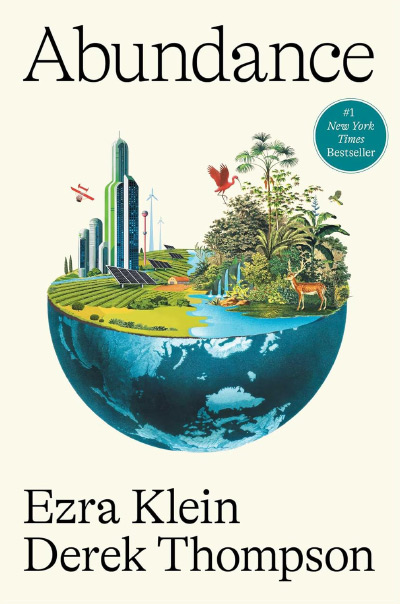
Abundance
Book Review
Reviewed by
This book review is a web exclusive for the Fall 2025 issue of The Independent Review.
Achieving abundance is pretty straightforward. The solution is on the supply side. Too many government policies try to create abundance the other way around—using subsidies to boost demand. But because other government policies restrain supply, the subsidies usually drive prices up or lead to rationing when prices aren’t allowed to rise. We see this in core sectors of the economy, especially in housing, health care, and education. Instead of spending taxpayer dollars to boost demand, we should remove restrictions on supply. This may sound like part of a mission statement from a conservative or libertarian think tank, but it’s the core message of journalists/commentators Ezra Klein and Derek Thompson, who are both proudly “liberals in the American tradition” (16). This is a book by progressives, written for progressives, to win them over to ideas often pitched by the Right. It embraces pro-market arguments but also envisions a state that might hypercharge markets—especially by funding scientific research—to make them even more effective.
The authors demonstrate a clear grasp of American cities like New York and San Francisco. Cities like these are the place to be. They are vibrant and productive. But they are too expensive. These cities must become more like Dallas and its suburbs—open to growth and building. Yet, they are locked into an equilibrium in which current residents often block growth. Residents realize that growth will make their cities more crowded and—much worse—can put their property values at risk as unwanted lower-income people make their neighborhoods less livable. Housing markets are intensely local and owners have almost all their eggs in one basket. Growth and building are seen as too risky, so many residents block it. Klein and Thompson’s analysis is sound, but they don’t really offer any solutions other than shaming liberal city-dwellers by exposing their policies as the causes of homelessness and the high cost of living for poorer people. People in cities like San Francisco say that they want housing to be affordable and even occasionally spend tax dollars to build some. But $400,000 per unit isn’t affordable. It’s window dressing, as Klein and Thompson seem to realize. It appears that there’s no way out of this conundrum, except migration to Texas and other places open to growth.
Basically stymied on housing abundance, Klein and Thompson see considerably more potential for solving climate problems and achieving environmental abundance. Their bottom line is that we need to fast track climate projects—such as building transmission lines from new green energy sources to where we live and work. However, this infrastructure is often handcuffed by layers of regulations and obstructed by lawsuits. These regulations helped solve the problems of the past, but they block us from solving the challenges of today and the future. Klein and Thompson boldly advocate new laws and policies that allow authorities to simply waive regulations in wholesale fashion—as Pennsylvania Governor Josh Shapiro did in 2023, allowing the rebuilding and reopening of I-95 in only twelve days after a massive tanker explosion caused part of the highway to collapse. They argue that we need to give those who govern the power to govern again, as it “[t]urns out that people like it when their government gets things done” (127). I would have added “useful” before “things,” but most would agree with this sentiment—until the other guys get into power and do things that we don’t want done. And that may be the ultimate cause of our gridlock, not enough agreement on which useful things government should do.
The strongest—and least divisive—chapter of Abundance considers how to encourage abundance by invention and the deployment of innovations. Klein and Thompson make the case that America’s governmental science funders—especially the National Institutes of Health (NIH) and National Science Foundation (NSF)—bear considerable blame for slowing down scientific progress. They argue that productivity growth isn’t lagging because we’ve already picked the low-hanging fruit and good ideas are getting harder to find, but because we’re looking for the fruit in unfruitful ways. “The idea that the NIH has become deeply biased against risky and novel research—and too fixated on funding only those projects that are practically guaranteed to succeed—is so widespread that it has become ‘the biggest cliché in science’” (148). Instead of funding bold risky ideas with big upside potentials, the NIH funds safe projects whose payoff is usually negligible. The authors quote sociologist James Evans: “Science moves forward one improbability at a time. . . . We want the most life-saving, life-enhancing, productivity-expanding inventions and innovations possible. . . . That means we need a system that is designed to take more risk, and accept more failures, as part of the scientific process” (157, 159, emphasis in the original). The NIH has amusingly recognized this by establishing a High-Risk, High-Reward Research program for scientists pursuing “new research directions,” which comprises a mere half of one percent of its budget. They should go much further in this direction, say Klein and Thompson, who offer a useful roadmap.
Klein and Thompson conclude that if the taxpayer is to subsidize research in the hopes of a high overall social rate of return, it should adopt market-like strategies and boldly swing for the fences. The grand slam they envision, however, is probably a strike out. We need, they argue, affordable green energy because the risks of climate change are so significant: “The only reason we have even the barest hope of avoiding catastrophic warming” is that the costs of solar and wind power have fallen so rapidly (14). Yet, America has a propensity to hatch great ideas—like solar electricity—but then pull back, allowing other nations to perfect them. The “US treated solar panels as a trifling inessential, with no long-term plan to make or deploy them at scale. And we lost decades of progress because of it” (181). In Germany, the share of electricity production from renewables rose from 3.5 percent to 30 percent, but it stagnated in the US “These were wasted decades” because government policies didn’t encourage solar enough. “In a parallel universe where we had continued to develop and deploy solar, we might today have the green energy paradise of our dreams” (182).
That’s an interesting narrative, but it misses the mark in too many ways. For starters, Germany’s electricity costs are about three times higher than ours. And progress wasn’t “lost” since Americans are able to buy solar panels at low prices when we trade with countries that make them cheaply. Most importantly, solar panels aren’t the bottleneck for renewable energy. The roadblock is storing renewable energy. Solar energy (from millions of years ago) is stored cheaply and effectively in fossil fuels, but not so for renewable energy. As I noted in my review of Steve Goreham’s Green Breakdown: The crux of the matter is that wind and solar are intermittent generators, requiring dispatchable power sources, such as natural gas, as backup to assure power reliability. As more renewables are added to power systems, 90 percent of traditional power plants must be retained as backup for wind and solar. That’s very expensive. And green power needn’t be stored merely overnight but for months on end due to massive seasonal fluctuations in solar and wind power production. If we want to swing for the fences, perhaps we should look to nuclear fusion instead of renewables, but Klein and Thompson fail to discuss it.
Finally, Klein and Thompson make the compelling point that crises may be “the ultimate push-and-pull mechanism—both galvanizing action and rewarding success,” but “it is always up to us to decide what counts as a crisis” (200). However, they turn Robert Higgs’s logic on its head: “The tragedy of the Great Depression allowed for the boldness of the New Deal” (199). Rather than creating Leviathan, as Higgs sees it, crisis brings out the best in us in Klein and Thompson’s world. “One interpretation might be that we are doomed to sleepwalk through history until a catastrophe jolts us into action” (200). The surge in productivity and prosperity embodied in the 1920s—electrification, the spread of internal combustion engines, rising standards of living driven by innovation, entrepreneurs, and the interaction of buyers and sellers in markets—were a “sleepwalk through history.” The Great Depression, largely caused and prolonged by inept government policies, was the “jolt” that somehow set us aright.
Perhaps this misguided view of history from authors who extol the “whirlwind of economic expansion” that the “New Deal set in motion” (48) is necessary to sell their core ideas to their intended audience. Nevertheless, their key takeaway to the progressive audience of Abundance bears repetition: “Decades of attacks on the state have turned liberals into reflexive champions of government. But if you believe in government, you must make it work. To make it work, you must be clear-eyed about when it fails and why it fails” (219–20).
Comments
Related Book Reviews


Independent Review Issues
Articles by Issue