

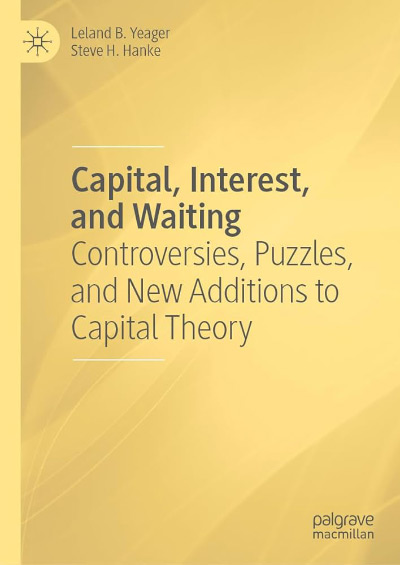
Capital, Interest, and Waiting
Book Review
Reviewed by
This book review is a web exclusive for the Fall 2025 issue of The Independent Review.
It is an honor, a pleasure and a very pleasant surprise to be asked to review Capital, Interest and Waiting: Controversies, Puzzles, and New Additions to Capital Theory. I have admired the work of Leland Yeager since first being assigned readings from The Fluttering Veil (Liberty Fund, 1997) as a PhD student. A few years later, as a visiting assistant professor at Washington College, with much excitement, I introduced some of these ideas to students in my only ever course in money and banking; telling them that Yeager was still with us at age 93. Alas, it was only so for a couple months, as Yeager passed away in April of 2018. The reader can imagine my surprise to find that, seven years later, Yeager had more to teach us. Steve Hanke deserves immense credit from all interested in monetary and capital theory for seeing this collaboration through to the end.
As an initial observation, it is difficult to collaborate without a collaborator. Books left unfinished to be finished by other authors often have telltale signs; seams if you will. The present work appears seamless to me. The authorial voice, the analytical apparatus, and the pedagogical judgements all seem of one piece. This makes the book a joy to read. Also, that I cannot distinguish the authorial voice of Hanke from that of Yeager is a testament to the depth of the original collaboration and Hanke’s dedication in carrying on alone.
The book begins with the puzzle of interest and reviews Joseph Schumpeter’s three possible solutions. Is interest a rate of return on some third factor after—land and labor? Or instead a shortcoming in competitive theory? Perhaps persistent innovation pushes us away from equilibrium so interest rates are never competed to zero? The authors adopt the first as the core idea of the book. This new factor is called “waiting” and interest is its price. This means that capital goods, while the result of waiting as they did not fall from the sky, are not themselves waiting. As all production takes place over time, inter-temporal opportunity costs matter. Interest is the price that coordinates activities over time. The chapter ends with some historical material, mostly regarding economists who anticipated these ideas but did not develop them as fully as in this book. These are interesting in their own right but I will leave them out for reasons of space.
Then the authors introduce a theme that informs the remainder of the book. To treat waiting as a productive factor is not a metaphysical claim but rather a practical modeling choice. This modeling choice is not arbitrary but rather context dependent. The authors describe interest as the price of tying up wealth over time. Thus, it is ubiquitous in the economy. To take a simple example, a business must decide to buy or rent cars. The decision to purchase involves waiting as that wealth will be tied up over time. The decision to rent involves paying the renting firm to do the waiting instead. Thus, rent payments are a form of interest in this context. This situation is also analogous to the firm borrowing the funds to buy cars from the bank and then paying the bank to do the waiting instead. We customarily call the second “interest” but analytically, they are similar.
The example just mentioned foreshadows chapters three and four which contain what I believe are the book’s most important lessons. The authors contend that the distinction between capital and intermediate goods and consumer durables is both arbitrary and unhelpful. Rather, to go back to the car example, the owner of the car waits for the services of the car over time. Analytically, what matters is who is doing the waiting. Further the authors argue that “waiting” sidesteps these fruitless terminological debates and warn against the notion that economic categories must apply objectively. The critical lesson here is to remember that economics requires subjectivity because the economist must take on the point of view of economic agents. These agents have subjective views and specific understandings of these constraints. Labels like “land,” “capital,” and “labor” may be applied in whatever way convenient to make sense of the situation. It is just vitally important not to double count factors. The authors then show how negative interest rates are actually quite natural within this framework. From here, the book takes interest as the price of “waiting”. What follows is an exercise in price theory with deep implications.
Chapter 6 adopts a supply and demand approach. Time preference matters but so must productivity. “Waiting” has both a supply and a demand which can be associated roughly with time preference and investment opportunities respectively. The market rate thus brings together preferences and available technologies all coordinated by an interest rate. Understanding both the supply and the demand sides is indispensable here as elsewhere in economics. Further, in chapter 7, the authors criticize not the concept of roundaboutness but rather attempts to measure it as of limited applicability; suggesting instead that the concept of “waiting,” quantified as “dollar-years” (185, defined viii) is analytically superior for understanding production over time.
With this supply and demand approach developed, the authors go on to analyze all the consequences of shifts in these curves. The interest rate is not only a monetary phenomenon and it certainly is not fixed but, like other prices, emerges from real economic forces. “Waiting” may and in general will be re-allocated due to a change in time preference, resources, or technology. The price system then allocates “waiting” across sectors, individuals, and firms.
The authors begin with the simplifying assumption that there is one interest rate. This is loosened in chapter 9 for a discussion of the yield curve. In essence, now there are markets for debt with varying maturities (or varying amounts of “waiting”) and the authors move from a partial equilibrium to a general equilibrium framework to deal with this. Jointly, expectations and liquidity preferences shape the yield curve. The theory is sufficiently flexible to generate both upward sloping yield curves as well as the more exotic inverted yield curves.
Thus far, the discussion has focused entirely on real variables. As might be expected of the authors, once they have given a thorough treatment of the real relationships, money enters to complicate the story. While the interest rate as such is a real quantity, actual observed interest rates are nominal. Following the injection of an excess supply of cash into the economy, agents spend down their excess money into various markets; including the market for loanable funds. This shift in the supply of loanable funds reduces interest rates; at least temporarily.
Similarly, an increase in uncertainty makes agents wish to hold more money and postpone purchases. The result is a shortage of funds in various markets including those for securities. Interest rates must rise. This chapter also contains an illuminating exposition of Don Patinkin’s Real Balance Effect Framework; general equilibrium with money added. The authors show how shifts in preferences affect interest rates. As expected though, these monetary distortions are short-run occurrences as over time arbitrage re-aligns real variables. The next chapter focuses on the more familiar effects of inflation on nominal interest rates. They offer an instructive new way to think about this. Unanticipated and especially volatile inflation obscures the true cost of “waiting” leading to resource misallocations.
The book ends with a persuasive discussion of how “waiting” and interest rate theory are a part of price theory. The book shows how the concept of “waiting” can unify the disconnected thoughts of many historical economists on capital theory and interest and correct some major errors such as that of Irving Fisher. The result is an extremely clear framework. Clear enough that it could, for example, be the basis of undergraduate macroeconomics courses vastly superior to most of those currently taught.
This work touches on themes familiar from other works by Yeager. Most obvious is The Fluttering Veil, though, as mentioned, money only appears fairly late in the book as the authors carefully enrich their models. Similarly, “Macroeconomics and Coordination” (Chapter 8 of Is the Market a Test of Truth and Beauty, Ludwig von Mises Institute, 2011) contains some common themes. Less obvious but perhaps more important to the book’s central message are those earlier themes which Yeager discusses in “Why Subjectivism” (Chapter 3 of Is the Market a Test of Truth and Beauty).
The book is also a good reminder to those of us in a profession obsessed with journal articles of the value of book-length treatments of economic ideas. As mentioned, the models carefully build on each other. A series of journal articles, even if intended to be read together would have been far less satisfying and far harder for the curious to stumble upon. Capital, Interest, and Waiting is a worthy final volume to the Complete Works of Leland Yeager, which I hope will someday exist as well as a worthy encore for Yeager’s scholarly career. As for Steve Hanke, I am sure he has much more to say and I eagerly await what is coming.
Comments
Related Book Reviews




Independent Review Issues
Articles by Issue