
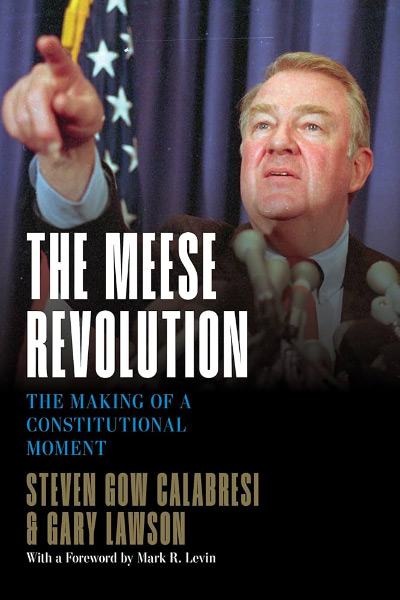
The Meese Revolution
Book Review
Reviewed by
This book review appeared in the Fall 2025 issue of The Independent Review.
On July 9, 1985, Attorney General Ed Meese delivered the now famous address to the American Bar Association in which he called for “a new method of judicial decision making.” Meese condemned the Supreme Court for being “incoherent” and “adrift.” Meese asserted that during the Court’s previous session, in the areas of federalism, criminal law, and religion, the Court’s decisions were “more policy choices than articulations of constitutional principle.” He concluded that the Court’s actions revealed “a greater allegiance to what the Court thinks constitutes sound public policy than a deference to what the Constitution—its text and intention—may demand” (p. 3). In contrast, Meese declared that the Court should embrace a new “Jurisprudence of Original Intention” in which judicial determinations would be “based on the original meaning of the text of the Constitution and not the policy views of the judges interpreting it” (p. 4). From that day forward, Meese’s Department of Justice embraced originalism and sparked a national conversation on judicial interpretation.
In The Meese Revolution, Steven Calabresi and Gary Lawson argue that through these actions, Meese transformed American jurisprudence and played a key role in the elevation of originalism as one of the preeminent modes of constitutional interpretation today. While recent scholarship emphasizes the importance of the Federalist Society in adding legitimacy to originalism, Calabresi and Lawson insist that Meese was central to this transformation. The top Reagan confidant and attorney general often gets overlooked due to his own humility and his unwillingness to take credit for his important role in transforming American jurisprudence. Indeed, the authors assert that Meese was the most consequential attorney general in American history.
The book is divided into two parts. The first is largely a biography of Meese; Calabresi and Lawson discuss his involvement in politics and also provide important context for the second half of the book. The authors then discuss the constitutional jurisprudence that predated the rediscovery of originalism. They spend the majority of their time, however, discussing the ways that Meese promoted, developed, and facilitated originalism from 1985 onward.
When Meese became attorney general, he “launched an intellectual revolution” (p. 21). Part of that was the way he and the Justice Department argued cases and the fact that he encouraged President Ronald Reagan to appoint originalist judges. But according to Calabresi and Lawson, Meese’s importance went much further. He turned the Department of Justice into “a hotbed of ideas, dialogue, contest, discussion, debate, and even formal academic conferences.” Under Meese’s direction, the department “incubated thoughts regarding originalism, separation of powers, federalism, religious liberty, criminal law theory, and a host of other topics. . . . It was an intellectual feast” (p. 207). Those involved in this intellectual experience sometimes referred to it as DOJ University School of Law, and the authors assert “that almost everything we know today as constitutional originalism traces back to the Meese Department of Justice” (p. 209).
Calabresi and Lawson argue that Meese was also essential to the originalist revolution through his speeches, the Office of Legal Policy monographs, and the Office of Legal Counsel opinions. The authors use these public statements to demonstrate that Meese’s “speeches argued for originalism in constitutional and statutory interpretation, directly challenging the jurisprudence of all nine justices on the Supreme Court at the time.” Calabresi and Lawson dedicate more than thirty pages to these public statements and conclude that “anyone who wants to understand modern law forty years later needs to understand those speeches’ contents, goals, and enduring impact on American law” (p. 175). While this chapter might be dense for some, it is essential to the authors’ larger argument that Meese was essential in developing, evolving, and disseminating the ideas of originalism.
In some ways, The Meese Revolution serves as a type of intellectual biography of Meese and originalism. The authors interviewed a large number of important actors from the Reagan administration, including Meese himself. As such, this volume has done important work in preserving the recollections of many Meese contemporaries. The use of oral history and textual analysis will make this an important book for any scholar of the Reagan era and for anyone who desires to understand the evolution of the American judiciary.
Although this book makes a significant contribution and contains a ton of important information—some of it never before known—it is not without its shortcomings. For me as a historian, it is frustrating that Calabresi and Lawson make broad claims without engaging with the relative historiographies. For instance, they assert that Reagan and Meese won “the Cold War without a shot being fired!,” that they “launched a global economic boom that lasted for four decades,” and that they undertook “an arms race that bankrupted the Soviet Union” (pp. 14, 18). While each of these positions could be defended, to make such grandiose claims without engaging the vast literatures on these subjects lends ammunition to critics who might claim the book lacks rigor. That note leads to another criticism: The book is too laudatory of Reagan and Meese. Perhaps Calabresi and Lawson did not set out to write an academic book that engages scholars who disagree with them. That’s fine. But readers should be aware that this book is in many ways a celebration of Ed Meese and lacks the nuance of traditional academic scholarship.
It is quite incredible that in just forty years, the originalist revolution of constitutional interpretation has resulted in the overturning of Roe v. Wade, Chevron deference, and affirmative action. Furthermore, the number of justices on the Supreme Court who consider themselves originalists has increased from zero in 1985 to six today. Originalism is now commonly taught in law schools across the country, and there is a Federalist Society chapter at almost every major law school in the United States. According to Calabresi and Lawson, Ed Meese was central to these successes. Whether one agrees with the trajectory of American jurisprudence, there is little doubt that the Meese revolution was extremely consequential. Calabresi and Lawson should be proud that they have made a significant contribution to the growing literature that emphasizes the importance of the 1980s in fundamentally changing the character of the American judiciary.
Comments


Independent Review Issues
Articles by Issue