The Business of Liberty and the Liberty of Business
Robert Nozick’s Classic, Anarchy, State, and Utopia at 50
October 24, 2024
Independent Institute Conference Center, Oakland, CA

Robert Nozick’s Classic, Anarchy, State, and Utopia at 50
October 24, 2024
When xxxxx
October 24, 2024
Thursday, October 24, 2024
6:00 p.m.: Wine and Hors d’Oeuvres Reception
7:00 p.m.: Program and Q&A
Location
Independent Institute Conference Center, Oakland, CA

Gregory J. Robson

Christopher Freiman

Phillip W. Magness
 Join us for a reception and discussion of Robert Nozick’s classic book, Anarchy, State, and Utopia, first published fifty years ago. Nozick’s book refuted social-justice statism—but also rankled many conservatives and libertarians. This event coincides with the publication of the Fall 2024 special issue of The Independent Review, featuring scholars who revisit Nozick’s rational, complex, and balanced case for individual liberty and limited government. These scholars not only admire Nozick and deepen our understanding of his seminal work but also honor him with important disagreements and reinterpretations.
The Guardian (U.K.), proclaimed Nozick “one of the 20th century’s greatest political theorists.” Nozick’s longtime colleague and friend, Alan Dershowitz, who will join us live remotely from New York, agrees with this assessment—and will also offer his own thoughts and personal reminiscences on Nozick.
The full set of contributors to the Fall 2024 issue of The Independent Review:
- Gregory Robson, “The Business of Liberty and the Liberty of Business: Nozick’s Contribution.”
- David Schmidtz, “My Dinner with Nozick.”
- Jason Brennan, “Robert Nozick and the Moral High Ground.”
- Jessica Flanigan and Chris Freiman, “Putting Wilt Chamberlain Back in the Game: Why Liberalism Is Not Compatible with Distributive Egalitarianism.”
- Aeon Skoble, “Anarchy, State, and Utopia at Fifty: Reassessing Nozick on Pluralism.”
- Richard Salsman, “Nozick on Taxation: The Necessity of Funding the Legitimate State.”
- David Gordon, “New Problems in Nozick’s Derivation of the Minimal State.”
- Eric Mack, “Nozick on the Separateness of Persons: A Reconstruction.”
- Gregory Robson, symposium editor and essay author of “Christianizing Nozick.”

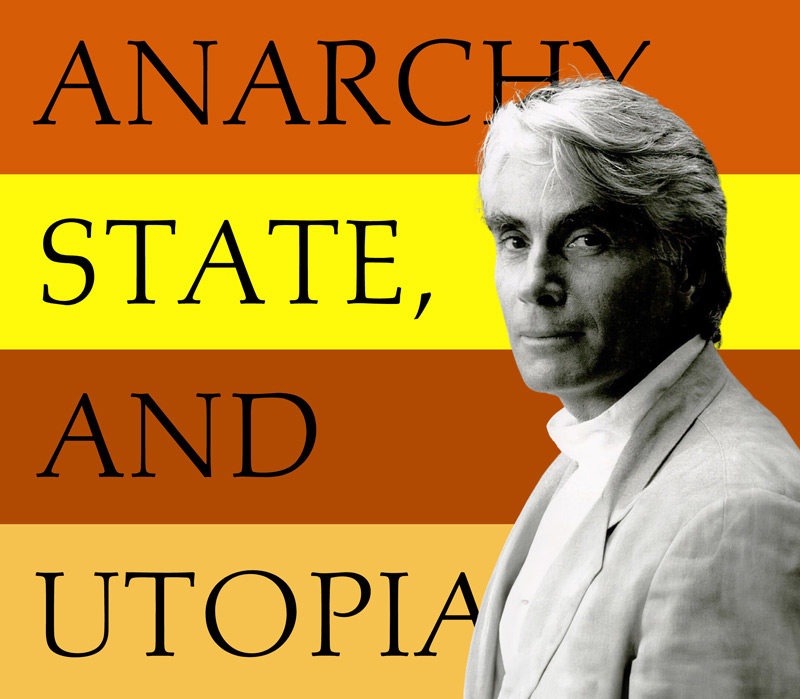
Anarchy, State,and Utopia
First published in response to John Rawls’ A Theory of Justice, Robert Nozick’s Anarchy, State, and Utopia has since become one of the defining texts in classic libertarian thought. Challenging and ultimately rejecting liberal, socialist, and conservative agendas, Nozick boldly asserts that the rights of individuals are violated as a state’s responsibilities increase—and the only way to avoid these violations rests in the creation of a minimalist state limited to protection against force, fraud, theft, and the enforcement of contracts.