|
|
 |
THE POWER OF HABEAS CORPUS IN AMERICA: From the Kings Prerogative to the War on Terror By
Anthony GregoryDespite its mystique as the greatest Anglo-American legal protection, habeas corpus's history features opportunistic power plays, political hypocrisy, ad hoc jurisprudence, and many failures in effectively securing individual liberty. The Power of Habeas Corpus in America tells the story of the writ from medieval England to modern America, crediting the rocky history to the writ's very nature as a government power. |
|
 |
RISKY BUSINESS: Insurance Markets and Regulation Edited by
Lawrence S. PowellInsurance regulation in the United States is at a crossroads. Market-based insurance should be celebrated for its innovation and competitiveness. Instead it is a constant target for politically motivated critics and politicians who excoriate the industry and call for ever-more regulation. |
|
 |
CRISIS AND LEVIATHAN (25TH ANNIVERSARY EDITION): Critical Episodes in the Growth of American Government By
Robert HiggsThe size and scope of government power has grown in response to crises of war and economic upheavals. Such increased power remains long after each crisis passes, threatening both civil and economic liberties, all at the behest of special interest groups. |
|
 |
BOOM AND BUST BANKING: The Causes and Cures of the Great Recession Edited by
David BeckworthLeading up to the late 2000s, The Federal Reserve played a critical role in creating a vast speculative housing bubble. Expansionary monetary policy formed the basis of soaring housing prices, excessive leverage, and mispricing of risk that characterized the Great Boom and created the conditions for the worst global recession in seventy years.
|
|
 |
PRICELESS: Curing the Healthcare Crisis By
John C. GoodmanTo cure the ailments of American healthcare we must get rid of the perverse incentives that raise costs, reduce quality, and make care hard to access. We must allow a free-market price system to emerge, so that the laws of supply and demand will work to the benefit of patients and providers alike. |
|
 |
LIVING ECONOMICS: Yesterday, Today, and Tomorrow By
Peter J. BoettkeEconomics affects all walks of life and every human activity, whether in the marketplace, the voting booth, the church, or the family. It not only illuminates the world, but it also inspires us to cherish the voluntary institutions that bring humanity together. |
|
 |
AQUANOMICS: Water Markets and the Environment Edited by
B. Delworth Gardner, Randy T. SimmonsHistorically, problems of water scarcity and pollution can be tied directly to government control over this vital resource. When the concepts of market-based solutions and property rights are applied, enormous ecological and economic benefits are possible. |
|
 |
DELUSIONS OF POWER: New Explorations of the State, War, and Economy By
Robert HiggsMany common assumptions about the U.S. government are not only false, theyre dangerous. Historical and theoretical misconceptions have spurred the growth of Big Government, encouraged U.S. entry into unnecessary wars, and invariably reduced the economic and civil liberties of ordinary Americans. |
|
 |
FINANCING FAILURE: A Century of Bailouts By
Vern P. McKinleyWith information obtained through Freedom of Information Act requests, Vern McKinley disproves the claim that federal financial regulators and politicians prevented a more severe financial crisis and argues that reining in federal regulators is a necessary step toward truly promoting the safety and soundness of the financial system. |
|
 |
NO WAR FOR OIL: U.S. Dependency and the Middle East By
Ivan ElandThe grab for oil resources has been a major factor behind many conflicts and military deployments because of its perception as a strategic commodity. This book debunks the notion that oil is strategic and argues that war for oil is not necessary to secure the flow of petroleum. |
|
 |
BEYOND POLITICS (REVISED AND UPDATED EDITION): The Roots of Government Failure By
Randy T. SimmonsGovernment intervention is frequently justified on the theory that market failures prevent the private sector and civil society from serving the public good. However, this pathbreaking book shows that government failures are far more common and harmful to society. |
|
 |
GOOD MONEY: Birmingham Button Makers, the Royal Mint, and the Beginnings of Modern Coinage, 1775-1821 By
George SelginThis fascinating story of British manufacturers challenge to the Crowns monopoly on coinage illuminates the role of private enterprise and provides a noted historical lesson for entrepreneurs today. |
|
 |
THE ENTERPRISE OF LAW: Justice Without the State By
Bruce L. BensonThe provision of justice and security has long been linked in most peoples minds to the state. To ask whether non-state institutions could deliver those services on their own, without the aid of coercive taxation and a monopoly franchise, runs the risk of branding one as a naïve anarchist or a dangerous radical. |
|
 |
THE CIVILIAN AND THE MILITARY: A History of the American Antimilitarist Tradition By
Arthur A. Ekirch, Jr.By elaborating on the role of the civilian and the military in American history up through the mid-twentieth century, the author helps us understand why the growing power and important of the armed forces over many aspects of nation and international policy is alarming for thoughtful citizens and policy makers today. |
|
 |
THE PURSUIT OF JUSTICE: Law and Economics of Legal Institutions Edited by
Edward J. LópezHow do decision makers in the lawjudges, lawyers, juries, police, forensic experts, and morerespond to economic incentive structures? The authors review a range of rules and incentives which then sheds light on outcomes and reforms that would create a more just and efficient legal system. |
|
 |
PROPERTY RIGHTS: Eminent Domain and Regulatory Takings Re-Examined Edited by
Bruce L. BensonProperty Rights explores the abuses of eminent domain and regulatory takings in terms of proposed constraints, compensation issues, a public choice perspective, and the spillover costs of takings. This comprehensive book brings together a diverse group of scholars and experts to explain the implications of these current issues. |
|
 |
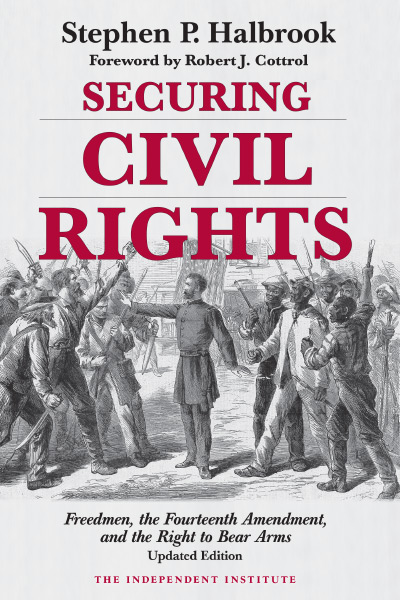
SECURING CIVIL RIGHTS: Freedmen, the Fourteenth Amendment, and the Right to Bear Arms By
Stephen P. HalbrookWhat did it mean to take civil rights seriouslyespecially the right to bear armsin the years following the abolition of slavery? By referencing historical sources of the time, constitutional scholar Halbrook shows that both supporters and opponents of the Fourteenth Amendment (1868) believed that it protected all Bill of Rights guaranteesespecially the Second Amendmentfrom infringement by the states. |
|
 |
THE NEW HOLY WARS: Economic Religion vs. Environmental Religion in Contemporary America By
Robert H. NelsonEconomics and environmentalism are types of modern religions. So says author Robert H. Nelson in this analysis of the roots of economics and environmentalism and their mutually antagonistic relations in the twentieth and twenty-first centuries. Questions about the proper relationship between human beings and nature have led to the growth of these public theologies, or secular religions, even while both avoid mentioning their derivation from Western Judeo-Christian sources. |
|
 |
HOUSING AMERICA: Building Out of a Crisis Edited by
Randall G. Holcombe, Benjamin W. PowellAlthough most housing in the United States is allocated in the private market, this market is heavily regulated and subsidized, with government policies dictating whether people can build, what type of housing is allowed, the terms allowed in financing and rental contracts, and much more. Involving the work of sixteen economists and policy experts, Housing America now critically examines government housing policies in the United States and how they impact housing at all levels. |
|
 |
RACE AND LIBERTY IN AMERICA: The Essential Reader Edited by
Jonathan BeanThe history of civil rights in the United States is usually analyzed and interpreted through the lenses of modern conservatism or "progressive" liberalism. In Race and Liberty in America, Jonathan Bean argues that the historical record does not conveniently fit into either of these categories and that knowledge of the American classical liberal tradition is required to gain a more accurate understanding of the past, present, and future of civil rights in the nation. |
|
 |
DEPRESSION, WAR, AND COLD WAR: Challenging the Myths of Conflict and Prosperity By
Robert HiggsDepression, War, and Cold War offers a powerful, solidly grounded interpretation of U.S. political economy from the early-1930s to the end of the Cold War, and refutes many popular ideas about the Great Depression and New Deal, the World War II economy, and the postwar national-security state still so pervasive today. |
|
 |
THE DECLINE OF AMERICAN LIBERALISM By
Arthur A. Ekirch, Jr.In The Decline of American Liberalism, renowned historian Arthur Ekirch chronicles the powerful and moving story of individual liberty across three centuries of American history. Contrary to the conventional view that this de-humanization, immense expansion and centralization of government power, and decline in liberty are temporary or manifest some sort of progress, Ekirch believes that this changethough hardly perceptible, often uneven, and occasionally reversed, is nevertheless a real descent. |
|
 |
PARTITIONING FOR PEACE: An Exit Strategy for Iraq By
Ivan ElandCombining a history of Iraq and its dominant sects with an acute awareness of the political machinations fomenting worldwide, this keen military analysis offers a practical exit strategy for U.S. armed forces in Iraq. Ivan Eland explains why partitioning, a solution that has been successful in other chaotic political situations, can be a uniquely effective political and military exit strategy for a country like Iraq. |
|
 |
RECARVING RUSHMORE: Ranking the Presidents on Peace, Prosperity, and Liberty By
Ivan ElandWho were the best and worst U.S. presidents? Taking a distinctly new approach, Dr. Ivan Eland profiles each U.S. president on the merits of his policies and whether those strategies contributed to peace, prosperity, and liberty. This ranking system is based on how effective each president was in fulfilling his oath to uphold the Constitution. |
|
 |
VIETNAM RISING: Culture and Change in Asias Tiger Cub By
William RatliffVietnam has emerged from poverty and isolation to become one of the fastest growing economies of Southeast Asia. Numerous pro-market reforms have helped spur foreign investment and domestic entrepreneurship. |
|
 |
THE FOUNDERS SECOND AMENDMENT: Origins of the Right to Bear Arms By
Stephen P. HalbrookAfter decades of silence on the Second Amendment, the U.S. Supreme Court has presided over the case of District of Columbia vs. Heller. At issue is whether the Second Amendment protects a private citizens right to keep and bear arms. While much has been written about gun control and related issues, no book has delved so deeply into the nature of the right to keep and bear arms as it was understood and practiced during the first generation of the American Republic. Stephen Halbrook captures the intent of the Founders in their own words to reveal that the Second Amendment was indeed designed to protect the individuals rights.
|
|
 |
LESSONS FROM THE POOR: Triumph of the Entrepreneurial Spirit Edited by
Alvaro Vargas LlosaHalf the people in the world live on two dollars or less per day and roughly 600 million live on no more than one dollar per day. With thousands of international relief organizations, strategic government programs, and billions of dollars in foreign aid, why do so many underdeveloped countries remain unable to grow their economies beyond mere survival? |
|
 |
THE EMPIRE HAS NO CLOTHES (UPDATED EDITION): U.S. Foreign Policy Exposed By
Ivan ElandMost Americans dont think of their government as an empire, but in fact the United States has been steadily expanding its control of overseas territories since the turn of the twentieth century. Now, through political intimidation and more than 700 military bases worldwide, the U.S. holds sway over an area that dwarfs the great empires of world history. The author shows how empire building is contrary to both liberal and conservative principles and exposes the imperial motives of U.S. policy. |
|
 |
TWILIGHT WAR: The Folly of U.S. Space Dominance By
Mike MooreIn Twilight War, Mike Moore argues that the U.S. merely provokes conflict when it circumvents treaties and presumes to station weapons of mass destruction in space. Rejecting treaty negotiations while further militarizing space renders America unable to lead by example. Moore concludes that instead of trying to stop an arms race in space by starting one, the U.S. must radically rethink its strategy.
|
|
 |
MAKING POOR NATIONS RICH: Entrepreneurship and the Process of Economic Development Edited by
Benjamin W. PowellWhy do some nations become rich while others remain poor? Making Poor Nations Rich demonstrates that pro-market reforms are essential to promoting the productive entrepreneurship that leads to economic growth, and where this institutional environment is lacking, sustained economic development will remain elusive. |
|
 |
OPPOSING THE CRUSADER STATE: Alternatives to Global Interventionism Edited by
Carl P. Close, Robert HiggsFor more than a century U.S. foreign policy has been based on the assumption that Americans interests are served best by intervening abroad. Before the twentieth century, however, a foreign policy of nonintervention was widely considered more desirable, and Washingtons and Jeffersons advice that the republic avoid foreign entanglements was largely heeded. |
|
 |
NEITHER LIBERTY NOR SAFETY: Fear, Ideology, and the Growth of Government By
Robert HiggsEconomist and historian Robert Higgs illustrates the false trade-off between freedom and security by showing how the U.S. governments economic and military interventions have reduced the liberty, prosperity, and genuine security of all Americans. |
|
 |
ANARCHY AND THE LAW: The Political Economy of Choice Edited by
Edward P. StringhamAnarchy and the Law assembles for the first time in one volume the most important classic and contemporary studies exploring and debating non-state legal and political systems, especially involving the tradition of natural law and private contracts. |
|
 |
ELECTRIC CHOICES: Deregulation and the Future of Electric Power Edited by
Andrew N. KleitCan forces handle the delicate matter of transmitting electricity when the simple model of supply and demand must be more precise than other goods and services? How much regulation does the electric industry need? Electric Choices explores these difficult questions and proposes a new, market-based plan to improve Americas electrical future. |
|
 |
STREET SMART: Competition, Entrepreneurship, and the Future of Roads Edited by
Gabriel RothExamines private, market-based alternatives for road services, both in theory and practice including at least four such possible directions for private services: testing and licensing vehicles and drivers; management of government-owned road facilities; franchising; and outright private ownership. |
|
 |
THE CHALLENGE OF LIBERTY: Classical Liberalism Today Edited by
Carl P. Close, Robert HiggsThe Challenge of Liberty restores the ideas and ideals of classical liberalism and shows how its contemporary exponents defend such pillars of free societies as individual rights, human dignity, market processes, and the rule of law.
|
|
 |
THE CHE GUEVARA MYTH: And the Future of Liberty By
Alvaro Vargas LlosaNearly four decades after his death, the legend of Che Guevara has grown worldwide. With eyewitness accounts, Vargas Llosa sets the record straight regarding Ches murderous legacy, brutally crushing any and all dissent, and concentrating wealth in the hands of an elite. |
|
 |
JUDGE AND JURY: American Tort Law on Trial By
Eric A. Helland, Alexander TabarrokWith inordinate amounts of money spent in the United States on lawyers and lawsuits and multibillion-dollar settlements growing each year, the very timely book Judge and Jury asks, Is the tort system benefiting the public?
|
|
 |
RESURGENCE OF THE WARFARE STATE: The Crisis Since 9/11 By
Robert HiggsResurgence of the Warfare State is Robert Higgss real-time analysis of the U.S. governments tragic but predictable response to 9/11: the quick enactment of the USA PATRIOT Act, the federal takeover of airport security, the massive increase in defense and other government spending, and the carnage in Afghanistan and Iraq wrought by leaders unaccountable for their costly and deadly mistakes. |
|
 |
PLOWSHARES & PORK BARRELS: The Political Economy of Agriculture By
Ernest C. Pasour Jr., Randal R. RuckerPlowshares & Pork Barrels provides the historical and economic context necessary to make sense of U.S. agricultural policy and examines possible market-based alternatives that could benefit consumers and ensure the advancement of American agriculture in an increasingly interdependent global economy. |
|
 |
RE-THINKING GREEN: Alternatives to Environmental Bureaucracy Edited by
Carl P. Close, Robert HiggsRe-Thinking Green exposes the myths that have contributed to failed environmental policies and proposes bold alternatives that recognize the power of incentives and the limitations of political and regulatory processes. It addresses some of the most hotly debated environmental issues and shows how entrepreneurship and property rights can be utilized to promote environmental quality and economic growth. |
|
 |
RESTORING FREE SPEECH AND LIBERTY ON CAMPUS By
Donald A. DownsDonald Downs addresses a major problem in contemporary American higher education: deprivations of free speech, due process, and other basic civil liberties in the name of favored political causes. |
|
 |
LIBERTY FOR LATIN AMERICA: How to Undo Five Hundred Years of State Oppression By
Alvaro Vargas LlosaIn Liberty for Latin America, Alvaro Vargas Llosa offers an incisive diagnosis of Latin Americas woesand a prescription for finally getting the region on the road to both genuine prosperity and the protection of human rights. |
|
 |
THE EMPIRE HAS NO CLOTHES: U.S. Foreign Policy Exposed By
Ivan ElandThe Empire Has No Clothes advocates a return to the Founding Fathers policy of military restraint overseas and argues that the concept of empire is contrary to the principles of both liberals and conservatives. Eland warns that in recent years, blowback from this overextended empire has begun to threaten the American homeland and curtail the very liberties and well-being U.S. interventions were supposed to protect. |
|
 |
AGAINST LEVIATHAN: Government Power and a Free Society By
Robert HiggsIn Against Leviathan, economist and historian Robert Higgs offers an unflinching critical analysis of government power. Topics include Social Security, the paternalism of the FDA, the War on Drugs, the nature of political leadership, civil liberties, the conduct of the national surveillance state, and governmental responses to a continuing stream of crises, including domestic economic busts and foreign wars both hot and cold. |
|
 |
DRUG WAR CRIMES: The Consequences of Prohibition By
Jeffrey A. MironThe War on Drugs claims thousands of lives every year in the United States. Each year, the U.S. government spends over $30 billion on the drug war and arrests 1.5 million American citizens on drug-related charges. There are now nearly half a million Americans imprisoned for drug offenses. The official claim is that drug prohibition deters drug use, reduces crime, and improves public health. But is this claim valid? |
|
 |
FAULTY TOWERS: Tenure and the Structure of Higher Education By
Ryan C. Amacher, Roger E. MeinersAs debate accelerates over the declining standards in higher education, academic tenure is viewed with suspicion by many, who see it merely as job protection for incompetent teachers. Even many professors believe tenure is a guarantee of lifelong entitlement, whereby only the commission of a crime can lead to dismissal. Faulty Towers sets the record straight by elucidating the history, legal status, and common misunderstandings regarding tenure. |
|
 |
RECLAIMING THE AMERICAN REVOLUTION: The Kentucky and Virginia Resolutions and Their Legacy By
William J. Watkins Jr.Thomas Jefferson and James Madison saw John Adams Alien and Sedition Acts as a threat to individual liberty and a precursor to federal government with unlimited power. The Kentucky and Virginia Resolutions sought to return the nation to the tenets of the Constitution, in which rights for all were protected by checked federal power. Watkins examines this important and timeless controversy and demonstrates the Resolutions' crucial relevance to the major issues facing us today. |
|
 |
CHANGING THE GUARD: Private Prisons and the Control of Crime Edited by
Alexander TabarrokChanging the Guard is an authoritative book on one of the most controversial aspects of criminal justice and corrections: the growing use of private prisons. |
|
 |
STRANGE BREW: Alcohol and Government Monopoly By
Douglas Glen WhitmanAfter Prohibition ended in 1933, many states passed laws regulating the sale of alcoholic beverages, now known as Franchise Termination Laws. Ostensibly intended to protect wholesalers from shady suppliers, and the public from the harmful effects of alcohol, these laws in fact created government-protected monopolies. |
|
 |
A POVERTY OF REASON: Sustainable Development and Economic Growth By
Wilfred BeckermanOxford University economist Wilfred Beckerman puts sustainable development to the test, questioning several of its core claims: Will economic growth burn itself out by depleting the natural resources it requires? Will global warming wreak widespread havoc? Does human activity threaten to throw a delicate planet dangerously out of balance? |
|
 |
SCHOOL CHOICES: True and False By
John D. MerrifieldEconomist John Merrifield shows that the school choice movement has become mired in false alternatives, petty distinctions, and diminished vision. Yet, he argues that the school choice program must not be allowed to fail like so many other government programs a freely competitive market for education must remain the ultimate goal. School Choices charts a course for the achievement of this goal. |
|
 |
ENTREPRENEURIAL ECONOMICS: Bright Ideas from the Dismal Science Edited by
Alexander TabarrokEntrepreneurial Economics is the best of applied economics with a twist of fun. Chapters in this stimulating book ingeniously apply simple economic principles to create new solutions to problems of genetic testing, patents, health and wealth insurance, legal gridlock, probation and parole, urban transit, the shortage of human organs and much more. An ideal way to really learn what economics is all about. |
|
 |
MARKET FAILURE OR SUCCESS: The New Debate Edited by
Tyler Cowen, Eric CramptonRecent years have seen the rise of new theories of market failure based on asymmetric information (wherein one party in a transaction knows more than the other) and network effects (the more popular a product, the more valuable it becomes). According to this new paradigm, we would expect substantial failures in a variety of markets. But despite the new market-failure theories, no systematic critical examination has been availableuntil now. |
|
 |
THE VOLUNTARY CITY: Choice, Community, and Civil Society Edited by
David T. Beito, Peter Gordon, Alexander TabarrokThe Voluntary City assembles a rich history and analysis of private, locally based provision of social services, urban infrastructure, and community governance. Such systems have offered superior education, transportation, housing, crime control, recreation, health care, and employment by being more effective, innovative, and responsive than those provided through special interest politics and bureaucracy. |
|
 |
LIBERTY FOR WOMEN: Freedom and Feminism in the Twenty-First Century Edited by
Wendy McElroyLiberty for Women is an eye-opening book that vividly charts a new individualist feminism for the 21st century in a highly lucid, provocative, and inspiring way. Choice is the key, and every womans choices and expressions of self-ownership must be equally and legally respected, from housewives to CEOs. Only then can a meaningful debate arise over which choices may be the best ones for women to make freely. |
|
 |
AMERICAN HEALTH CARE: Government, Market Processes and the Public Interest Edited by
Roger D. FeldmanA powerful book that examines why harmful consequences too often follow when government sets out to direct our health care systems. It contrasts government programs and private market alternatives for supplying health care services. Required reading for health policy-makers, economists, historians, and health care professionals. |
|
 |
CAN TEACHERS OWN THEIR OWN SCHOOLS?: New Strategies for Educational Excellence By
Richard K. VedderEconomist Richard Vedder examines the economics, history and politics of education and shows how public schools could be radically improved by being privatizedthrough giving teachers a direct equity stake in the outcome of their services. |
|
 |
CUTTING GREEN TAPE: Toxic Pollutants, Environmental Regulation and the Law Edited by
Roger E. Meiners, Richard L. StroupWhile multi-million dollar environmental lawsuits proliferate and Superfund has spent billions on hazardous waste cleanups, there appears little evidence of progress in cleaning up toxic threats to the environment. This book examines whether current regulation and policies benefit lawyers, bureaucrats and special interests diverting attention away from the real health and safety risks; creating disincentives for industry to safeguard against actual hazards. |
|
 |
FIRE AND SMOKE: Government, Lawsuits and the Rule of Law By
Michael I. KraussFire and Smoke carefully examines so-called government recoupment lawsuits over firearms and tobacco and finds them to be flagrant abuses of the constitutional separation of powers, seriously undermining over two hundred years of common-law torts adjudication. |