The Alienation of Marxists
History of a New-Old Concept
August 3, 2026
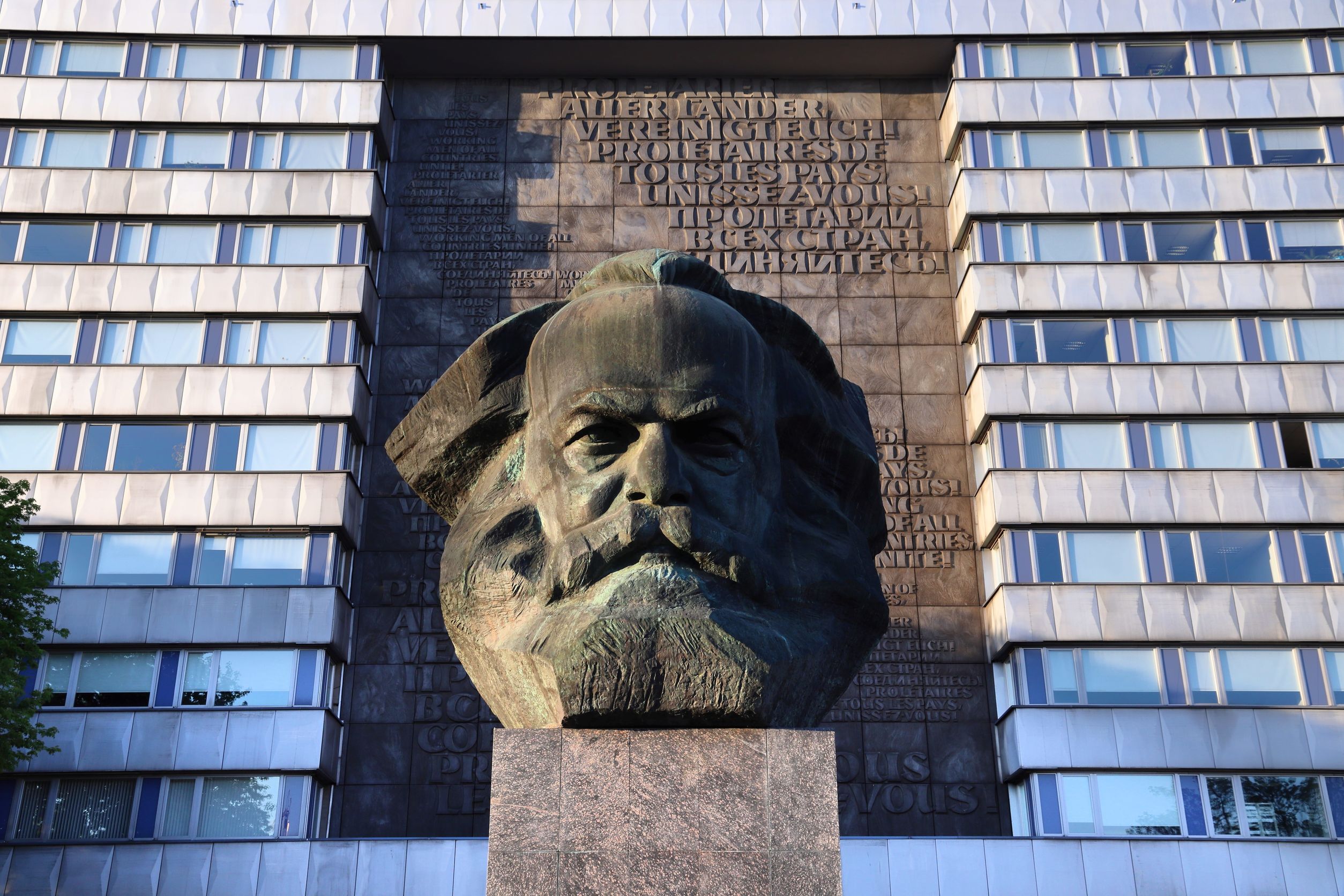
Karl Marx monument in Chemnitz, Germany
News Article
History of a New-Old Concept
Karl Marx is widely known today as the foundational theorist of “alienation,” a concept that can now be applied to many of his followers. In a now-viral clip, content creator Nate Friedman asks a DSA leader to make an elevator pitch to his audience: Why is socialism better than capitalism? “Community. Are you tired of being alone, being by yourself with no one to talk to? [Become] a socialist.” The Knicks fever, the World Cup watch parties, the camaraderie he feels walking around Astoria—all are proof points that socialism works. The leader tells Friedman he’s hugged more strangers in the past summer than he ever has in his life, all thanks to Zohran Mamdani.
Marx’s conception of alienation posits that, under capitalism, workers become alienated from the products of their labor. Instead, the owner of the factory who employs them asserts control over something that was made by another’s hand and sells it for his own profit, depriving their workforce of not only its full economic value but any meaningful stake in how it is sold. Since Marxists view laborers and owners of capital as adversarial parties, alienation also reveals a disparity of economic power through which the latter exerts control over the former and reduces them to subjugation.
The sense of estrangement that follows becomes the impetus for revolutionary action that aims to assert worker control over the means of production, thereby ushering in a socialist age. In framing their system as a pathway by which workers may overcome their alienated position, socialists claim to imbue it with a sense of “justice” that corrects a wrong by reasserting collective worker control over economic output. By implication, any who stand in the way of socialism are thus propping up an unjust capitalist elite, making them complicit in the fault that Marx claims to have identified.
This view, that capitalism has alienated us from the natural world, from potential friends, from our own activity, provides a crucial link between an abstract Marxist concept and rising populist movements, most notably the Democratic Socialists of America. Whereas conventional Marxist class theory rests on the premise of material conflict between two well-defined classes (the proletariat versus the factory-owning bourgeoisie), this economic model is anchored to a 19th-century conceptualization of industrial production. Today, assembly lines and steel mills offer little in the way of an entry point to socialist activism for college-educated, unmoored Millennials (save for the old trick of appointing themselves as an intellectual “vanguard of the proletariat”). When a personal sense of alienation becomes the pretext for broader social grievance, this sort of activism becomes a never-ending participatory exercise for the aggrieved, regardless of their actual economic position.
Aside from turning “capitalism” into a blame-all explanation for the very-real loneliness epidemic, alienation theory also allows modern-day socialists to sidestep several pitfalls in Marx’s economic framework. In Das Kapital and related works, Marx built his economic system upon the labor theory of value. He contended that the capitalist engaged in economic exploitation of his workforce by appropriating the “surplus value” of its labor. In practice, this meant selling a product at a level far above the pay to the worker who produced it and pocketing the difference. He believed that it established a scientific mechanism by which he could prove that workers were being exploited, thereby exposing the main fault of the capitalist system as well as a mathematical impetus for its overthrow.
Marx thought very highly of the theory of surplus value. He considered it his most original theoretical contribution to economics. We know this because Marx said as much in private letters to his friends, ranking it among the “best points” in his magnum opus. Those who knew Marx well, including his daughter Eleanor as well as his primary patron and collaborator Friedrich Engels, characterized his writings on surplus value as the centerpiece of his system. It added a “scientific” basis to “scientific socialism,” distinguishing Marx from the “utopian” socialists who came before him.
In reality, surplus value theory was the Achilles heel of Marx’s theories. He built it from the mistaken premise that economic value derives from labor performed to improve upon nature.
This seemingly intuitive belief traces back to the ancient world, and had been studied by economists for generations before Marx came along, including Adam Smith and David Ricardo. Taking it as a starting point, Marx then attempted to build a logical proof of socialism by calculating the allegedly-expropriated surplus value that the factory owner retains for himself and deprives from its rightful creators.
Except economic value does not actually derive from labor performed. It arises from subjective preferences, as exercised by two transacting parties at the moment of an exchange. This insight came from the “Marginal Revolution” of 1871, a near-simultaneous discovery of William Stanley Jevons and Carl Menger as they each attempted an explanation of a longstanding paradox of value in the previous economic literature (you can read more about this here). The gist of their discovery made Marx’s system from Das Kapital, published only four years earlier in 1867, obsolete in its infancy.
Marx was largely unknown outside of socialist circles during his lifetime, and Das Kapital remained an obscure book until well after his death in 1883. When economists started paying attention to it in the 1880s and 1890s, they quickly made mincemeat of surplus value theory. By the early 20th century, the economics profession had judged Marx’s contributions and found them wanting—an “obsolete textbook… without interest or application to the modern world,” as John Maynard Keynes described it.
Reinvigorated by the Bolshevik Revolution of 1917, Marxist theoreticians tried to cling to surplus value theory as an alternative to the emerging Marginalist consensus. Some attempted complex mathematical proofs of Marx’s works, only to find themselves in a circular trap of a theory that assumed its own premises. For all the discussion that Marx’s “scientific socialism” generated among economist critics in the early 20th century, one concept is almost entirely missing in this period: alienation. And thereby hangs a tale.
Marx’s earliest explorations into the concept likely came from socialist theorist Moses Hess, originally a mentor of his in the 1840s. Despite this early date, few of Marx’s writings on alienation ever made their way into print until the 20th century. Indeed, his attention shifted elsewhere.
Marx had a vicious falling out with Hess, though, in the late 1840s, precipitating the Communist Manifesto’s tirades against “utopian” socialism. Not long thereafter, the once-elaborate theory of alienation began to disappear from Marx’s writings. By the time he completed the first volume of Das Kapital in 1867, it had been almost entirely supplanted by the more “scientific” theory of surplus value.
Marx’s earlier notebooks treated alienation as a formal and well-defined concept, known by the quasi-interchangeable terms of Entfremdung and Entäusserung in the original German. He further specified a condition of Entfremdete Arbeit, or “alienated labor,” which is the basis of most modern sociological adaptations of Marxism.
By contrast, these concepts are missing from Das Kapital and Marx’s other later writings. Note that the word alienate/alienation does appear a few times in Das Kapital’s text, but scholars of this work have long recognized that it is an imperfect English translation of Entfremdete as a root for a casual adjective use, not the formally defined concepts of his earlier writings.
The reason is not difficult to identify. After his break with Hess and the earlier “utopian” socialists, Marx abandoned the formal concepts of Entfremdung and Entäusserung—likely because they could not be established on a scientific footing. They resembled the same type of normative claims that Marx denounced as mysticism and ideology when it came from his socialist competitors. His quest for an unimpeachable “scientific” basis for socialism accordingly led him to turn elsewhere, eventually settling on surplus value—a theory we now know to be defective, but also one that clearly qualified as scientific in Marx’s eyes.
So how, then, did 21st-century socialists settle upon alienation as one of Marx’s most important doctrines, when Marx himself certainly deemphasized it from his mature writings and probably moved away from it out of the belief that it was insufficiently scientific? The answer comes from a fluke of history.
Marx’s writings on alienation almost all appear in a series of unfinished notebooks referred to as the Economic and Philosophical Manuscripts of 1844 (with a few final scraps in the similarly unfinished Grundrisse that Marx wrote as a transitional work in the 1850s). Although they predate Das Kapital on the timeline, these manuscripts were never published by Marx. Nor did his children or his literary curator Friedrich Engels see fit to place them into print, even though they edited and published several of Marx’s other works posthumously.
As late as 1917, when Lenin launched his revolution in Russia around Marx’s ideas, the 1844 Manuscripts remained unpublished and unknown—even to most Marxist theoreticians, including those in the Bolshevik leadership. Alienation was simply not considered a significant component of the Marxist system, as Marx’s writings on alienation were not yet available to those who studied and interpreted Marx.
It might have stayed that way but for a personal project of Lenin. The Soviet revolutionary made doctrinal education in Marxist theory a central principle of his new regime and, with it, the publication and dissemination of Marx’s writings. As Marxist historian Eric Hobsbawm observed, these projects were “backed by the—for these purposes—unlimited resources of the Soviet Communist Party.”
Lenin and his successors directed vast resources from the Soviet state toward publishing Marx’s works, including a dedicated project to gather and curate every scrap of his still-unpublished writings that they could get their hands upon. The Bolsheviks funded the Moscow-based Progress Publishers to print translations of Marx’s works in almost every major language. They also commissioned an edited multi-volume series of Marx’s private correspondence with Engels. Their most ambitious project was the Marx-Engels-Gesamtausgabe, or MEGA1 as it is abbreviated, which aimed to publish a complete edition of all of Marx and Engels’s known writings.
The MEGA1 project emerged from a committee convened by Lenin shortly after he seized power, initially commissioning Marx scholar and fellow Bolshevik David Riazanov to complete the task. In 1924, Riazanov traveled to Germany and struck a partnership with the Frankfurt Institute for Social Research (better known today as the Frankfurt School), a Marxist academic outpost that helped him secure access to Marx’s papers in the archives of the German Social Democratic Party (SPD).
Riazanov began publishing the project’s first volumes in the late 1920s. He ran afoul of Joseph Stalin not long thereafter, and was eventually removed from the project and executed in 1938 in one of the Soviet dictator’s infamous “purges” of competitors from the Bolshevik leadership. The publishing project initiated by Lenin and cultivated by Riazanov would continue until the outbreak of World War II, though, placing 12 volumes of materials into print.
The previously-unknown 1844 Manuscripts were among the materials that Riazanov photographed and sent back to Moscow for transcription. He released some short excerpts of these new documents in 1929, and his Stalin-approved successors on the MEGA1 project published the first full text version of these documents in German in 1932.
Almost simultaneously a pair of SPD-aligned German academics, Siegfried Landshut and Jacob Peter Mayer, began working with the same notebooks and published a small collection of Marx’s early writings from the SPD archives. Their version of the 1844 Manuscripts appeared, with some truncations, under the title Nationalökonomie und Philosophie. A pair of Frankfurt-affiliated scholars then completed a French translation of the 1844 Manuscripts the following year. By the mid-1930s, they had become available in German and French, albeit on limited print runs and in a time of intense political turmoil in Europe.
Several Marxist academics in the Frankfurt School orbit—most notably Herbert Marcuse and György Lukács—began to champion the documents’ discovery as a “novel” tool for interpreting Marx. Marcuse touted the new publication as “a crucial event in the history of Marxist studies” in an essay that same year, emphasizing how alienation theory provided a “foundation” for Marx’s later “scientific socialism.” His article went practically unnoticed by his contemporaries, though, and did not begin to accrue citations in other academic works until the 1960s and ’70s. (The disruptions of World War II Nazi-era suppressions of Marxism forced the core of the Frankfurt group, including Marcuse, to relocate to the United States. But the fact remains that Marcuse’s 1932 reinterpretation of Marx around the 1844 Manuscripts had negligible levels of scholarly notice or impact until its own rediscovery some three decades later.)
After the war, the 1844 Manuscripts received a renewed burst of attention. Progress Publishers put out an English translation in 1959, and a flurry of new books and articles appeared to try to integrate its arguments into the existing Marxist canon.
Alienation theory spread quickly among Marxist intellectuals, and at an extremely convenient time as well. The 1844 Manuscripts appeared on the scene at almost the exact moment that even Marxist economists had started to acknowledge that surplus value theory, as developed in Das Kapital, was unsalvageable on economic grounds. In their place, a novel reformulation of Marx appeared that got them to more or less the same prescriptive outcomes. Whereas classical Marxism styled itself as scientific, the new variant achieved its goals through unfalsifiable appeals to worker alienation and estrangement, all allegedly reinforced by power disparities that coerced them to abide an exploitative capitalist labor market.
Yet for Marxists of both stripes, the shift to alienation theory created a conundrum. If Entfremdung was the real essence of the Marxist system rather than surplus value, why had almost nobody in the Marxist universe noticed it until the 1950s and ’60s? Why did Marx’s own self-assessment of his theories omit this supposed insight while he profusely credited himself for surplus value theory? And why did none of the Marxist theorizing behind Lenin’s Bolsheviks, or really any Marxist movement up until that point in time, center itself on this allegedly crucial concept?
The sudden appearance of alienation theory in the Marxist universe is no matter of speculation. German-language uses of the word Entfremdung surged rapidly starting around 1960, directly coinciding with the shift.

This pattern becomes even more stark for Entfremdete Arbeit, or “alienated labor”—a proprietary phrasing that only appeared in Marxist writings. This formulation was nonexistent until briefly registering in 1932 with the initial German publication of the 1844 Manuscripts, and uses of it remained at negligible levels until suddenly taking off after 1960.

Some scholars noticed that a shift was afoot. In 1959, Harvard sociologist Daniel Bell penned an insightful essay on the “rediscovery” of alienation in Marx. He depicted the move as an attempt to reframe Marx not as an economist and political theorist “but as a philosopher who first laid bare the estrangement of man from an oppressive society.” As Bell not so subtly noted, this pivot offered a younger generation of socialist intellectuals a means of distancing themselves from Stalinism following revelations of Soviet mass-atrocities after his death, and gave them an alternative formulation of socialist theory while still retaining “umbilical cords to Marx.”
Other Marxist theorists tried to solve the conundrum of alienation’s sudden appearance by dividing Marx’s writings into “young” and “mature” phases. French Marxist Louis Althusser called this the “epistemological break” in Marx’s system and dated it to the mid-1840s. In his formulation, the “young” Marx was still attached to humanist concepts that he borrowed from figures like Hegel and Hess, with alienation being foremost among them. The “mature” Marx, by contrast, is said to have jettisoned these concepts for being overly reliant on ideology and incompatible with his efforts to build a “scientific” replacement to Utopian socialism.
Other Marxists pushed back at Althusser. In 1970, István Mészáros published a rebuttal claiming that alienation was the main conceptual thread of Marx’s entire corpus, uniting his early works from the 1840s with Das Kapital in 1867. He conceded that Entfremdung largely disappeared from Marx’s later writings, but instead insisted that it was an implicit underlying basis for the argument that Marx developed in Das Kapital. It is absent in the literal sense, but allegedly encompassed through a shift in Marx’s terminology toward concepts such as “commodity fetishism.”
This semantic reinvention offers a convenient argument for injecting tactical concepts from the “young” Marx into his mature works—even a bit too convenient. But it still does not explain how an alleged uniting thread of Marx’s entire career went unnoticed until the mid-20th century—even within the intense textual exegesis of Marxist theorists from Engels to Lenin.
Instead, bibliometric evidence, such as the word diagrams above, illustrates the obvious: alienation theory is a modern invention stemming from manuscripts that remained inaccessible and unknown until the mid-20th century. Marxist theorists in that era desperately needed to plug the hole from the collapse of surplus value theory in the economic realm, and the newly-available concept of Entfremdung became their improvised solution.
Rather than suffer the dual discrediting effects of scholarly rejection by most economists and the disrepute brought by the revelation of Stalin’s human rights abuses, Marxism gained a new life in the 1960s by way of a timely reinterpretation of its core doctrines. Untethered from the surplus value basis that the historical Marx imposed upon his own economic system, his followers reinvented him as a sociologist and philosopher of the human condition.
No longer bound by the judgment of peers and practice from the political–economic realm, today’s socialists proceeded as if Marx’s theories had emerged intact after almost a century of withering scrutiny by claiming to find a novel basis for them in alienation theory. It is sufficient for Zohran Mamdani, Alexandria Ocasio-Cortez, and other Democratic Socialists of America politicians to appeal to alienation as a pretext for a sweeping Marxist overhaul of the American economy. It matters not that socialism draws its strongest support from a niche segment of well-educated Millennials (recent survey data show that socialism’s favorability is higher among people who have college degrees and especially postgraduate degrees). Alienation theory makes Marxism available to anyone, even the bourgeoisie.
Whereas surplus value involves a mechanical calculation specific to the economic position of the working class, alienation can be adapted to almost any social or cultural grievance imaginable. Emotional concerns are repackaged as material concerns, paving the way to resuscitate long-debunked economic policies such as rent control, price-fixing, and public ownership of businesses as an alleged corrective to a fluid and ever-changing sociological diagnosis.
Marxist policy outcomes become the socialist’s default answer not only to every economic grievance, but to the societal atomization that leaves young people feeling adrift.