







The Climate-Industrial Complex
In an article in the May 22nd issue of The Wall Street Journal, Bjørn Lomborg (former Director, Environmental Assessment Institute, Copenhagen) correctly discusses the climate-industrial complex, in which many top firms in the U.S. and elsewhere stand to greatly benefit financially from the gigantic wealth-transfer and cartelization schemes being pushed by Al Gore and the global-warming lobby. This environmental corporatism is akin to the military-industrial complex that our Senior Fellow Robert Higgs has so well documented (see here, here, and here). As Lomborg notes:
Naturally, many CEOs are genuinely concerned about global warming. But many of the most vocal stand to profit from carbon regulations. The term used by economists for their behavior is “rent-seeking.”
The world’s largest wind-turbine manufacturer, Copenhagen Climate Council member Vestas, urges governments to invest heavily in the wind market. It sponsors CNN’s “Climate in Peril” segment, increasing support for policies that would increase Vestas’s earnings. A fellow council member, Mr. Gore’s green investment firm Generation Investment Management, warns of a significant risk to the U.S. economy unless a price is quickly placed on carbon.
Even companies that are not heavily engaged in green business stand to gain. European energy companies made tens of billions of euros in the first years of the European Trading System when they received free carbon emission allocations.
American electricity utility Duke Energy, a member of the Copenhagen Climate Council, has long promoted a U.S. cap-and-trade scheme. Yet the company bitterly opposed the Warner-Lieberman bill in the U.S. Senate that would have created such a scheme because it did not include European-style handouts to coal companies. The Waxman-Markey bill in the House of Representatives promises to bring back the free lunch.
U.S. companies and interest groups involved with climate change hired 2,430 lobbyists just last year, up 300% from five years ago. Fifty of the biggest U.S. electric utilities—including Duke—spent $51 million on lobbyists in just six months.
Many have forgotten that it was no less than Enron that was the biggest backer of the Kyoto Protocol for the simple reason that as a major natural gas producer, Enron stood to make billions of dollars from a system of mandated emission credits.
The cozy corporate-climate relationship was pioneered by Enron, which bought up renewable energy companies and credit-trading outfits while boasting of its relationship with green interest groups. When the Kyoto Protocol was signed, an internal memo was sent within Enron that stated, “If implemented, [the Kyoto Protocol] will do more to promote Enron’s business than almost any other regulatory business.”
In addition to Duke Energy, among the firms pushing for mandatory controls on carbon dioxide emissions are General Electric, Shell, British Petroleum, Ford, ConocoPhillips, Dow Chemical, DuPont, Alcoa, American Electric Power, Caterpillar, John Deere, Johnson & Johnson, PepsiCo, PNM, Siemens, Xerox, IBM, PG&E, News Corp., PricewaterhouseCoopers, and Nike.
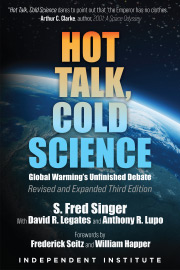
Yet, this obvious interest-group component of the stampede to adopt extremely costly (and pointless, as Lomborg himself has shown) regulations of such non-pollutants as carbon dioxide appears to matter little in the major media or among most environmental groups. Indeed, there is no outcry! While true-believing climate alarmists have sought to smear and dismiss legitimate, scientific questions raised by scholars and organizations that receive funding from businesses opposed to climate controls, claiming that they are simply stooges for corporate interests, pro-alarmist groups supported by firms having an obvious interest in the adoption of climate statism are somehow enlightened, objective, incisive, and reliable. Why the double standard? The answer is that the climate alarmist view has far more to do with power politics, the shallowness of “elite” culture, and the fact that global warming is largely about environmental religion, not science.
Meanwhile, the Copenhagen Climate Council’s upcoming World Business Summit on Climate Change in Copenhagen is stacked with proponents of climate catastrophe with Mr. Gore as keynote speaker and media sponsors including MSNBC, National Geographic, the New York Times Company, and Berlingske Tidende. And next week, the Heartland Institute’s Third International Conference on Climate Change will be held in Washington, D.C., featuring two dozen climate skeptics and co-sponsored by forty skeptic groups. So, how do you believe the two events will be reported?