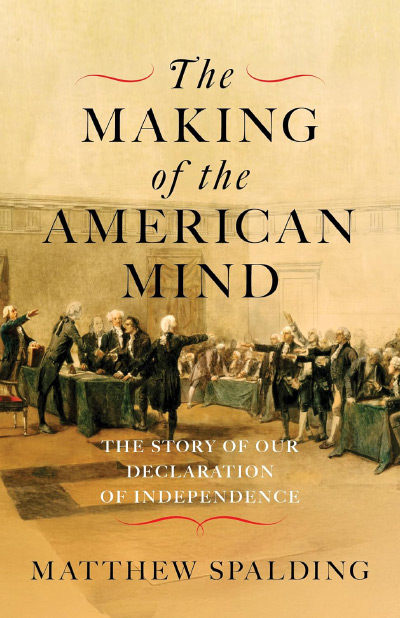
The Making of the American Mind
Book Review
Reviewed by
This book review is a web exclusive for the Summer 2026 issue of The Independent Review.
The Making of the American Mind is a standard “court” history and reading of the Declaration of Independence. Hillsdale’s Matthew Spalding asserts that the Declaration created a propositional nation, an amalgamated American people, and a central government for the union superior to the thirteen states. The theory of the Declaration, Spalding explains, is not limited to the unique situation of the American Revolution but is universal. In the words of Abraham Lincoln, who the author views as the greatest expositor of the Declaration, it applies “to all men and all times” (p. 7).
Despite significant omissions discussed below, the book offers a good summary of events leading to the American Revolution. Spalding covers the years of salutary neglect, imperial restructuring after the Seven Years’ War, and the British desire that the colonies should contribute more for their own defense. The book also explains the rise of Parliamentary sovereignty (i.e., Parliament possesses an uncontrollable right to legislate for the empire) and how this bedrock of the British constitution was an obstacle to colonial protests.
To counter the omnipotent Parliament, the colonists resurrected dominion theory whereby they averred that the king served as the only glue holding his colonies to the empire. Outside of the king’s authority as chief executive, the colonists denied that any other branch of the British government had authority over them. Spalding points out that had George III accepted such a theory and come to the aid of the colonists as they implored, he would have undone the Glorious Revolution of 1688–89 and threatened his own reign. Dominion theory is evident in the Declaration of Independence as it is directed to the king and declines to acknowledge Parliament.
Spalding knows his history—and this knowledge makes the book’s omissions all the more frustrating. Spalding is a proponent of the individualistic and liberal interpretation of the Declaration which is widely propagated in the academy. While a book on the Declaration should explain this Lincolnian interpretation, it should not ignore the majoritarian and democratic interpretation holding that the Declaration primarily advanced the corporate ends of the thirteen states. The majoritarian and democratic understanding focuses on the sovereignty of the states and the people’s right to self-government in their individual states. Unfortunately, The Making of the American Mind does not acknowledge this alternative approach nor grapple with evidence supporting it.
Inasmuch as the Revolution was fought over the issue of whether Parliament or the colonial assemblies would exercise legislative authority, the majoritarian and democratic interpretation is a logical reading of the Declaration. This is especially true considering the Articles of Confederation which Spalding also discounts. The first draft of the Articles of Confederation was presented to Congress on July 12, 1776—just eight days after the signing of the Declaration. The final version of the Articles was submitted to the states for ratification in November 1777. Consequently, the state of the American mind at the signing of the Declaration should be best exemplified in this first constitution for the union.
Spalding’s book spurns the Articles of Confederation likely because they focus on preserving self-government in the individual states and limit the Confederation Congress to certain enumerated powers, many of which could not be exercised absent a supermajority of state delegations. The document says little about individual liberty or equality except for the deduction that the drafters believed these two concepts were best secured in the several states where the people could keep a close watch on their representatives. Indeed, it was in the states that we find great statements of rights such as the Virginia Declaration of Rights of 1776 and the Massachusetts Constitution of 1780.
Spalding tries to minimize the states by casting them as two-bit players in the drama of the Revolution. To him the Continental Congress is the heart, not of a federation of states, but of a new centralized nation-state. To support this thesis, he makes claims such as “no colony or state ever argued or claimed its independence as a sovereign state” (p. 204). This is incorrect. Virginia, for example, adopted a new constitution on June 29, 1776, and thus established itself as an independent state. Kevin R. C. Gutzman in his Virginia’s American Revolution (Lexington Books, 2007, p. 7) observes that this event “was understood at the time and for decades thereafter to mark the moment of Virginia’s independence.” Hence, prior to the Declaration of Independence, Virginia established itself as an independent commonwealth.
South Carolina acted even earlier than Virginia. On March 26, 1776, state leaders convened in Charleston and adopted a new constitution, and the state’s first General Assembly convened later that evening. South Carolina’s first president was John Rutledge, and its first vice president was Henry Laurens.
Moreover, the Treaty of Paris (1783) which ended the Revolutionary War enumerated all thirteen states and declared them to “be free sovereign and independent states.” It is doubtful that the treaty’s signatories (which included John Jay, Benjamin Franklin, and John Adams) misunderstood the status of the states and thus erroneously agreed to such verbiage.
Of course, the Continental Congress was key to the war effort and Spalding points out that it often conducted all manner of business. From this Spalding concludes that Congress was “a de facto national sovereign” superior to the states (p. 204). Throughout the Revolution Congress, state committees of public safety, and state legislatures were often extralegal bodies attempting to survive a conflict with the superpower that was Great Britain. It is misleading to evaluate the myriad functions these bodies performed and discern a constitutional standard. Moreover, in any federation a general government naturally performs most tasks related to foreign affairs and war. The Continental Congress served as a general government with the consent of the thirteen colonies/states who provided the delegates that composed Congress. It did exercise significant authority, but only with the approval of the state delegations.
A close reading of the book reveals that Spalding is not merely interpreting the history of the Revolution but also seeks to justify Lincoln’s actions in the Civil War and to perpetuate the national civic religion found in President Trump’s 1776 Commission Report. Spalding was the executive director of the Commission which was dominated by Straussian scholars. “In 1860,” Spalding writes, “another generation arose to fight for that old Declaration” (p. 236). The reader is supposed to assume this generation marched off wearing blue and singing hymns to liberty and equality.
The Making of the American Mind does nothing to address how Southerners, such as South Carolina’s Wade Hampton, could also rely on the Declaration when marching off in butternut. “If we were wrong in our contest,” Hampton proclaimed, “then the Declaration of Independence of 1776 was a grave mistake, and the revolution to which it led was a crime” (Hampton quoted in Walter Brian Cisco, Wade Hampton: Confederate Warrior, Conservative Statesman [Potomac Books, 2004], 319). Hampton reasoned that “if Washington was a patriot, Lee cannot have been a rebel; if the enunciation of the grand truths in the Declaration of Independence made Jefferson immortal, the observance of them could not have made Davis a traitor” (p. 319).
Hampton might very well have been wrong in his assumption that the “grand truths” of the Declaration were state self-government, federalism, and secession. But The Making of the American Mind does not acknowledge Hampton’s position or investigate its pedigree. Spalding sells the reader short in this regard. One suspects the author assumes the average reader is unaware of the corporate ends of the Declaration and wants to keep it this way.
In summary, The Making of the American Mind contains a useful history of the events leading up to the American Revolution. Spalding works hard in making his case for the individualistic and liberal interpretation of the Declaration. The persuasiveness of his argument is diminished by the choice to ignore competing interpretations and to treat his favored view as gospel.
Comments
Related Book Reviews


Independent Review Issues
Articles by Issue