The Golden Dome: A $1.2T Missile Shield Built on Bad Economics and Worse Strategy
Missile defense in space is an expensive answer to the wrong strategic question.
June 5, 2026
May 20, 2025
News Article
Missile defense in space is an expensive answer to the wrong strategic question.
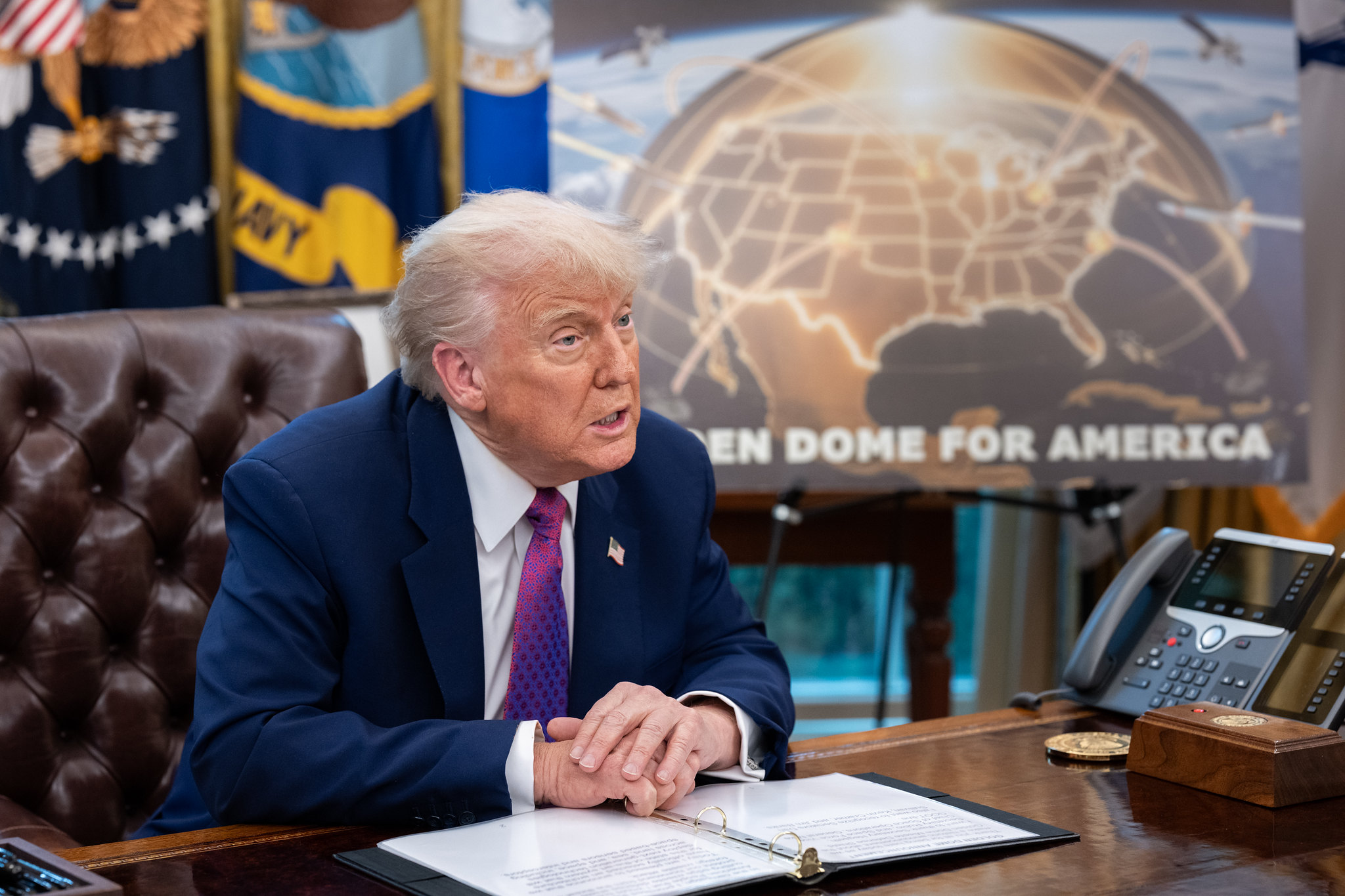
Last December, Washington greenlit the “Golden Dome,” a controversial plan to weaponize space with an orbiting network of missile interceptors. While initial projections were vague, a new Congressional Budget Office report has unmasked the staggering reality: The system is now estimated to cost an eye-watering $1.2 trillion over 20 years.
It’s a project so detached from economic sanity and physical constraints that it treats science fiction as a blueprint and taxpayer wallets as a bottomless pit.
The Golden Dome aims to create a nationwide missile-defense system like Israel’s much smaller “Iron Dome.” The system would rely heavily on orbiting satellites capable of striking missiles during flight or a missiles’ “boost-phase”—a feat the U.S. has never achieved, and physics all but forbids. Despite concerns, the administration has framed the project as the future of national security.
However, the Golden Dome collapses under even the most basic economic reasoning. It pours trillions of dollars into protecting against a hypothetical strategic missile strike on the U.S. mainland—one with no historical precedent—while incentivizing adversaries to build more missiles and creating an ethical hierarchy of whose lives get prioritized in a crisis. It’s our very own Death Star: shiny, oversized, and built on the fantasy that firepower can replace strategy.
Initial Congressional Budget Office estimates for the Golden Dome’s space-based component—an orbiting network of missile-tracking and intercept satellites—ranged from $161 billion to $542 billion. The newly released CBO report estimating the Golden Dome at $1.2 trillion signals just how speculative and volatile this project truly is—and even this figure likely understates the final cost. To function as advertised, the system would require hundreds, possibly more than a thousand, new satellites in Earth’s orbit, each needing launch, maintenance, replacement and protection.
Even then, the economic realities facing the Golden Dome project are brutal. The massive $1.2 trillion price tag amounts to roughly $3,500 per person in the United States. These costs would ultimately be paid for by taxpayers, either now or in the future. The latter is the most likely, which means this project would add trillions to the national debt.
But that’s not all. It is far cheaper to overwhelm or evade missile-defense systems than to build one capable of stopping every threat. The hypothetical attacker needs only one missile to get through; the defender needs perfection.
That asymmetry matters because the U.S. is not defending against crude, short-range rockets like those intercepted by Israel’s Iron Dome. In the event of a major conflict, the threats would be intercontinental ballistic missiles, maneuverable reentry vehicles, and increasingly hypersonic weapons designed specifically to defeat missile defenses. Pouring hundreds of billions of dollars into a system that struggles against the very weapons it is meant to deter is not strategic foresight; it is sunk-cost thinking dressed up as innovation.
The Golden Dome also creates perverse incentives. Defense contractors are rewarded for promising revolutionary capabilities, not for delivering realistic ones. This leads to cost overruns, subpar performance, but no penalties for those in bed with the Pentagon. Meanwhile, adversaries would respond predictably by building more missiles, more decoys and more countermeasures to ensure their deterrents remain credible. Missile defense does not end arms races; it accelerates them. What Washington frames as “state of the art” protection will be viewed elsewhere as escalation, worsening the very security dilemma it aims to solve.
None of this is new. The Golden Dome echoes the Reagan administration’s Strategic Defense Initiative—dubbed “Star Wars.” From “Brilliant Pebbles” to proposals like “Rods from God,” the initiative flirted with space-based kinetic defense systems. These proposals collapsed under the same realities now confronting the Golden Dome—astronomical costs, technical infeasibility and destabilizing strategic incentives. Decades later, the technology is shinier, but the logic is unchanged.
Beyond feasibility and cost, the Golden Dome raises a far more uncomfortable ethical question. Its design calls for extra layers of protection against so-called “countervalue attacks,” prioritizing areas of high civilian population and economic importance. In practice, that means deciding which cities—and which Americans—are worth defending. National security, long understood as a “public good” provided by a benevolent government to all citizens, is transformed into a selectively allocated resource—less a shield for the nation than a bidding war over who gets covered.
In the end, the Golden Dome reflects a worrying, yet familiar Washington impulse: When confronted with uncertainty, spend more and think less. Every dollar poured into a speculative missile shield is a dollar not spent on cyber defense, intelligence, diplomacy or addressing vulnerabilities at home. If Congress is serious about national security, it should demand strict cost-benefit analyses, not cinematic promises.
In the real world, the Force is no substitute for economics.