Flock Sells Fear. Government Buys Power. Citizens Lose.
It shouldn't be up to citizens to prove they're worthy of freedom.
September 3, 2026

News Article
It shouldn't be up to citizens to prove they're worthy of freedom.
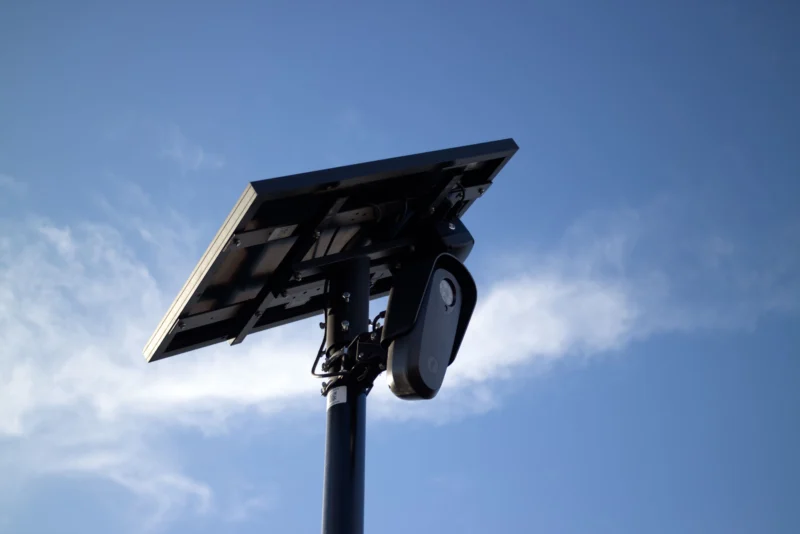
As controversy grows over law enforcement’s abuse of Flock Safety’s Automated License Plate Readers and camera networks, law-enforcement officials and some lawmakers are vigorously defending their widespread use. Officials insist that removing Flock technologies would make municipalities “open season for criminals,” be “crippling” to investigations, and limit law enforcement’s ability to “bring closure and justice” to victims.
Perhaps the strongest defender of these surveillance tools is the company itself. Flock CEO Garrett Langley, for example, recently stated, “When people talk about just one of these, privacy or safety, they’re prioritizing the wrong thing, and what we have to prioritize as a country is compromise.”
“Compromise” may sound reasonable. But it obscures important questions. Who decides what privacy the public must compromise? What evidence would demonstrate the promised safety? Who is to blame for abuse?
This doesn’t mean that surveillance tools can’t help solve crimes or that living in a free society is risk-free. But framing this as simply a matter of tradeoffs ignores the danger of treating elected officials as though they have the knowledge, incentives and capacity to assess conditions correctly, craft appropriate policy, implement it and reverse course as conditions change.
The defenders’ argument treats liberty and safety as opposite ends of a spectrum, with each increment of security necessitating a reduction in freedom. Policymakers are portrayed as neutral technicians, continuously adjusting a dial until they achieve the right balance.
This idea seems reasonable on its face—but under the surface, it falls apart.
First, its proponents neglect the policymakers’ knowledge constraints. Our elected officials are assumed to know everything relevant about liberty and safety, as well as when and how to adjust things to maintain the “optimal mix.”
This doesn’t pass the smell test. Do we really expect the same officials who often don’t know or can’t articulate the legislation they voted on to know what is needed to keep us safe and keep us free?
This knowledge problem is much deeper than just knowing data points. A large body of economics literature, for example, illustrates the officials’ real knowledge constraints. On the other hand, while imperfect, mechanisms within markets, such as prices, profit and loss, continuously transmit information to individuals about changing conditions and preferences. In politics, feedback mechanisms are weaker, incentives often align poorly with the public interest, and oversight is highly imperfect.
Flock’s network demonstrates these problems. While a city council or police department may believe an integrated surveillance network will benefit local citizens, they cannot know how the data will be used or distributed by other agencies—or even individuals within their own organizations. As we’ve seen, oversight has been lacking, at best.
Even if we assume away the knowledge problem and imagine that officials have the best intentions, we still have problems. Again, the economics literature is instructive. The policymakers’ incentives to reduce the scale or scope of their authority are weak, if not altogether absent. This is particularly true with power obtained under the auspices of safety, when the public—afraid of some threat—calls on lawmakers to do something.
In 15 years of studying policies undertaken in the name of safety, I’ve seen a clear pattern: Powers touted as required temporarily in a crisis become normalized. Meanwhile, the promised safety is never quantified or proven. Instead, policymakers often claim that programs are successful while refusing to reveal the evidence for safety reasons.
The advocates of surveillance ignore what our founders understood quite well: Any government with the power to protect could also use it to prey on its citizens. Perhaps the greatest threat to our safety and liberty is not an external threat, but the expansion of government power. The most recent controversies related to Flock and its abuses illustrate this dynamic clearly.
Ultimately, the burden of proof should be on the government to prove that surveillance is necessary, independently verified and reversible. It shouldn’t be up to citizens to prove they’re worthy of freedom. Until the government can meet this burden, calls for “compromise” are really just asking citizens to give up something concrete—their privacy—for safety that may never materialize.