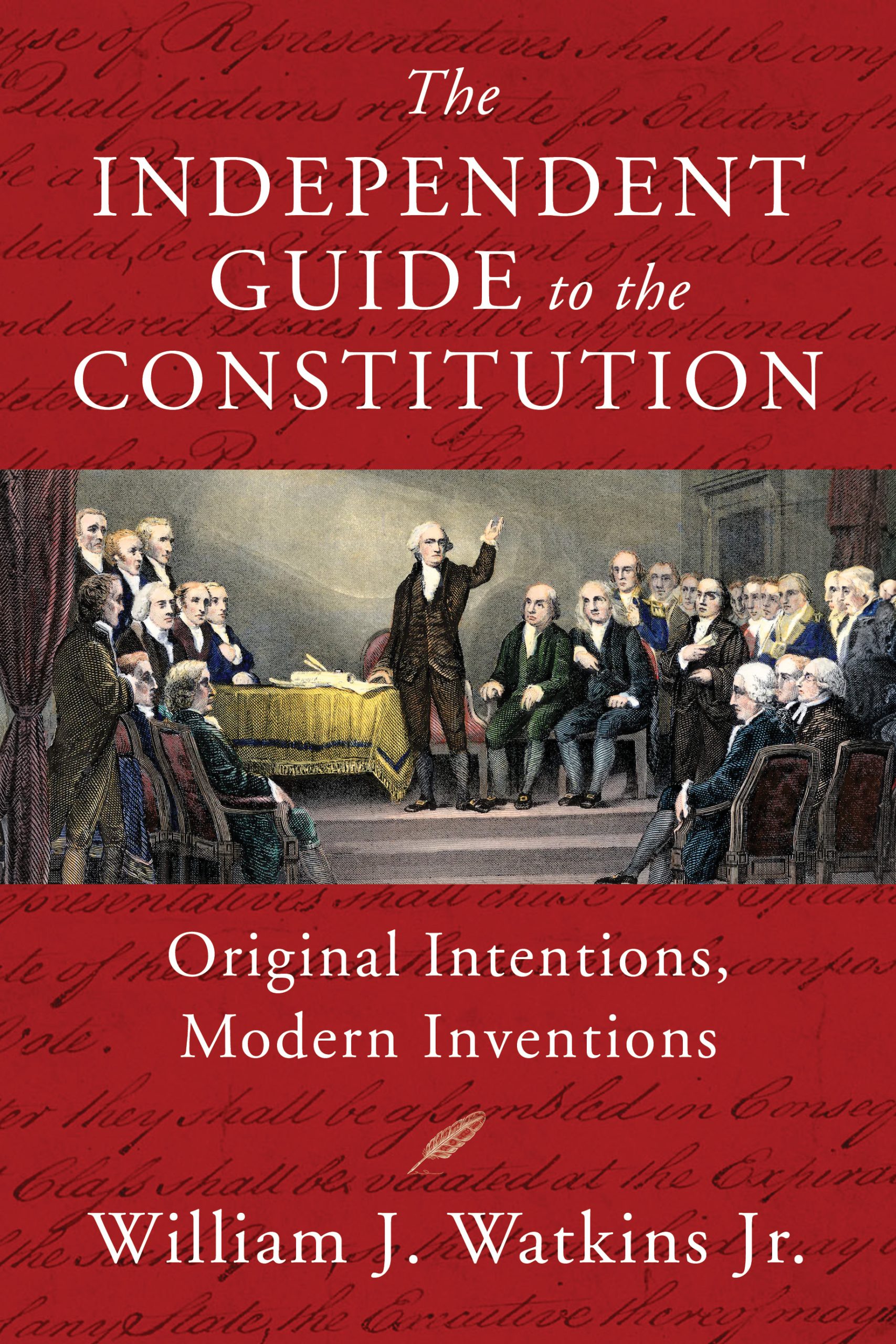
The Independent Guide to the Constitution
Original Intentions, Modern Inventions
Format: Hardcover
Publication Date: February 10, 2026
Publisher: Independent Institute
List Price:
Price:
Discount:
Free Shipping On Orders Over $60! (Within U.S.A)
Bulk Discounts Available: Learn More
Overview
The Independent Guide to the Constitution: Original Intentions, Modern Inventions cuts through the partisan noise and helps readers reclaim the original, time-tested principles of liberty that America’s Framers worked so hard to protect.
The Constitution is one of the most studied—and most willfully misunderstood—documents in American life. Now more than ever, Americans need an objective, thorough, and clear-headed analysis of what our Founders meant when they wrote it … and perhaps even more importantly, what they didn’t mean. How should we confront the distortions layered onto the Constitution over generations—distortions that continue to shape, and misshape, American life today?
Enter William J. Watkins, Jr. Drawing on a lifetime of experience in the law—as prosecutor, defense attorney, and constitutional scholar—Watkins offers a bold, independent examination of the most important legal document in modern history. His book provides a meticulous, clause-by-clause analysis of America’s founding charter, revealing both the Framers’ original intentions and the modern interpretations that have reshaped constitutional governance—not always for the better. Clear and rigorous, he explores how the Constitution was designed to secure liberty and limit power—and how its meaning continues to spark debate today.
Expertly researched, fascinating, and urgent as ever, this book is indispensable for laymen and scholars alike to understand the Constitution.
Table of Contents
Preface
Acknowledgments
Abbreviations
Preamble
Articles
Amendments
Afterword
Appendix I
Appendix II
Notes
Index

Highlights
- In a field crowded with abstract theories, William J. Watkins Jr. brings the rare authority of a practicing lawyer—someone who has argued, applied, and lived under constitutional law—to the question of how the Constitution should be read. America’s earliest constitutional thinkers offer a “North Star” for interpreting the Constitution. Few dispute the brilliance of the document itself; the great debate concerns how to read it. Watkins, a practicing lawyer and former law clerk in the Fourth Circuit, argues for a return to “strict construction originalism,” an interpretive method grounded in the original intent and understanding of the Framers and ratifiers. This approach, exemplified by figures such as Thomas Jefferson, St. George Tucker, and James Madison, treats the Constitution as a genuine grant of limited powers, not an endlessly malleable charter.
- Modern methods of interpretation—especially the influential school of “living constitutionalism” theory—have distorted the Framers’ and ratifiers’
original intent almost beyond recognition. Watkins identifies three major interpretive traditions: early strict construction originalism, late twentieth-century modern originalism, and living constitutionalism. Each successive school has grown more flexible in its interpretive method and more willing to expand federal power beyond anything envisioned in the early republic. Watkins argues that living constitutionalism in particular treats the Constitution less as binding law and more as a symbolic text, whose meaning may shift with contemporary values. The result? An unmoored, confused, and increasingly unstable regime. - The people of the United States are not one single, undifferentiated national mass; rather, the American constitutional order rests on the
sovereignty of the people of each state. Watkins shows how and why the Constitution did not convert states into mere administrative arms of the federal government. In matters such as criminal law, domestic relations, and public safety, states originally functioned as fully independent political communities with authority over their own internal affairs. Even the Fourteenth Amendment—rightly interpreted within the framework described by its congressional proponents—did not dissolve this structure or remake the federal government into a national overseer of all state policy. State power was a key for the Founders. - This book is not a technical, law-school treatise. It is a practical, hands-on road map to constitutional sanity. Watkins walks through the entire document, clause by clause, explaining its history, the interpretive distortions that have emerged over time, and concrete proposals for restoring fidelity to the original design. With a clear index, a detailed table of contents, and explanations accessible to nonspecialists, this volume equips every civic-minded American with the tools needed to understand, interpret, and defend the Constitution. Constitutional stewardship, Watkins insists, is the right and responsibility of the people themselves—not merely lawyers, judges, or academics.
Synopsis
The Independent Guide to the Constitution: Original Intentions, Modern Inventions cuts through the partisan noise and helps readers reclaim the original, time-tested principles of liberty that America’s Framers worked so hard to protect.
The Constitution is one of the most studied—and most willfully misunderstood—documents in American life. It is the oldest written constitution still in use in the world, and its longevity rightly compels our admiration and examination. But now more than ever, Americans need an objective, thorough, and clearheaded analysis of what our Founders meant when they wrote it … and perhaps even more important, what they didn’t mean.
In America today, the president can send armed forces abroad without even a nod to the legislature. The Supreme Court micromanages all manner of state policy decisions, from Christmas decorations, public health measures, and criminal penalties. And as of this writing, nearly $40 trillion of national debt is ultimately the taxpayers’ responsibility to pay back—$120,000 for every American, nearly half a million dollars for a family of four, plus interest, for benefits that are long gone.
Is this what the Founders intended? Does this sound like the “few and defined” national powers James Madison delegated to the federal government?
Of course not.
This state of affairs—called “living constitutionalism” by some, “tyranny” by others—has not brought political peace. Clearly, something has to change. But how should we confront the distortions layered onto the Constitution over generations? Especially when those distortions continue to shape (and misshape) American life today?
Enter William J. Watkins Jr. Drawing on a lifetime of experience in the law—as prosecutor, defense attorney, and constitutional scholar—Watkins offers a bold, independent examination of the most important legal document in modern history. His book provides a meticulous, clause-byclause analysis of America’s founding charter, revealing both the Framers’ original intentions and the modern interpretations that have reshaped constitutional governance—not always for the better. Clearly and rigorously, he explores how the Constitution was designed to secure liberty and limit power—and how its meaning continues to spark debate today.
Expertly researched, fascinating, and urgent as ever, this book is the authoritative road map for laymen and scholars alike to reclaim the Constitution.
Popular Sovereignty
Popular sovereignty, as envisioned by the Framers and ratifiers of the Constitution and as defined by Watkins, means that the individual people of a republic (or, in the case of the states, thirteen republics) possess ultimate political authority. All government actors are but agents of these sovereign people. Individuals themselves are the creators and modifiers of the fundamental laws of the land.
At the time of the founding, this was a significant departure from the British system, in which Parliament—not the people—retained ultimate authority. But today, Watkins argues, the administrative state and federal judiciary have effectively replicated Parliament’s usurpation of the people’s voice. “Experts” within the political bureaucracy regularly issue edicts that are treated as binding law, even though they were never elected and are not accountable to the American people.
This is a problem. In 1822, John Taylor of Caroline warned how popular sovereignty, the pillar of the American experiment, could be turned on its head. Watkins cites him at length: “By our political theory,” Taylor wrote, “the people are supposed to be the patrons of the government, and not the government the patron of the people.” A reversal of this tenet, Taylor warned, will mark an “advance toward tyranny,” with the government dictating constitutional regulations to the people and distributing their money and property to favored “individuals or combinations.” Today, with over half of Americans receiving federal subsidies, entitlement payments, or both, and with interest costs on national debt rivaling national defense spending, Taylor would surely agree with Watkins that the “advance toward tyranny” is complete.
Balancing State and National Government
Maintaining a proper federalist balance between the states and the national government is at the heart of strict construction originalism. Federalism, as defined by Watkins, is a system dividing power between the national and state governments. Each is independent in its own sphere, but powers are limited by fundamental laws (federal and state constitutions) as established by the people.
The Founders’ Constitution aimed to allow diverse and differing interests to coexist, but key to this coexistence was a demand of unity—in certain limited cases. For example, congressional regulation of foreign commerce (such as imposing high duties on the goods from countries having no commercial treaty with the United States) would be undermined unless all members of the union adhered to the national policy. Such external matters, requiring the states to speak with one voice, were (and still are) obvious and few.
In matters not implicating uniformity in dealing with the outside world, however, the Founders believed the states must be left to serve as laboratories of democracy. If they were not allowed to do so, they argued, Americans would remain at one another’s throats—as they seem to be today.
There is no question that Americans today are deeply divided. Many question whether the United States can survive as a nation. Watkins quotes Time magazine’s Ian Bremmer: “There is no advanced industrial democracy in the world more politically divided, or politically dysfunctional, than the United States today.” Properly balancing state and federal power, Watkins argues, would help cool tempers and move Americans toward a much-needed unity.
The Fourteenth Amendment
The Fourteenth Amendment overruled the Dred Scott decision, which held that blacks were not citizens of the United States. In connection with the establishment of national citizenship, the Fourteenth Amendment commands that all individuals—regardless of color—be treated the same under the law. Though unobjectionable when interpreted through the originalist framework, this amendment has been distorted to disastrous effect.
One notable distortion has been the fashionable demand for equal racial outcomes (instead of equal racial opportunity) in American institutions, from higher education to corporate America to the judiciary itself. Watkins gives the example of Justice Sonja Sotomayor pointing to “systemic inequities” (not modern state-sanctioned discrimination) stacked against minorities as justification for her continued endorsement of discrimination against white students in college admissions. Indeed, much of the diversity, equity, and inclusion regime hinged on distortions of the Fourteenth Amendment. The Founders would not have agreed with Sotomayor’s logic for a multitude of reasons, and neither would the authors of the Fourteenth Amendment itself.
Watkins argues we must return to the originalist understanding of the Fourteenth Amendment. Laymen and experts alike must understand that while it wisely prohibits state and local government from racial discrimination, it leaves the federal system’s structural bones in place. That is how the amendment was offered to the people of the North: as affording freedmen protection in enjoying basic rights, yet otherwise leaving the states that fought to save the union to govern themselves, as they always had. Self-governance was the animating spirit behind the entire Constitution; the Fourteenth Amendment was no exception.
“Man Cannot be Governed but by a Rod of Iron”
At the time of the founding, Jefferson reminded Americans that their experiment rejected the old presumption “that man cannot be governed but by a rod of iron.” The Framers understood the people of each of the thirteen states to be sovereign, and that recognition remains essential to preserving constitutional limits on federal authority and genuine self-government.
To interpret the Constitution faithfully and correctly, one must understand the exalted place of the people of the states. Only the people—not judges, legislators, or executives—can grant powers to their servants in government. These servants are mere agents of the political power, not the source. Watkins defines “agency” as “a fiduciary relationship in which the principal appoints an agent to conduct designated business. The agent is subject to the principal’s ultimate control and must account for his actions. The principal, then, is superior to the agent.”
In Watkins’s view—and the Founders’ view, too—the people are the principal. Not an amalgamated, abstract mass of “humanity,” but the specific, individual people of the states. It was their consent—not Washington’s—on which the Constitution rested. It was their liberty—not the prerogatives of distant officials—that the document was crafted to protect. And it is their vigilance today that must restore the boundaries that have eroded under generations of bureaucratic expansion and judicial invention.
Reclaiming the Constitution therefore begins where the Constitution itself began: with ordinary citizens confident in their own dignity and authority. Watkins invites readers to see themselves not as subjects of an overpowering national bureaucracy, but as heirs of a political tradition built on trust in free people. His message is clear: the Constitution still belongs to us. And if we have the courage to understand it—and to insist on its limits—we may yet recover the liberty it was designed to secure.
Praise
“The ‘original intentions’ of the people who ratified the U.S. Constitution were largely unlike the ‘modern inventions’ under which we now live. With The Independent Guide to the Constitution, William J. Watkins Jr. makes all clear.”
—Kevin R. C. Gutzman, J.D., Ph.D., professor of history, Western Connecticut State University
“William Watkins has, for many years, been the most daring and insightful proponent of ‘Jeffersonian originalism,’ the interpretation put forward by our earliest critics of a federal government run amok. As Watkins explains, he follows the teaching of that great Jeffersonian, John Randolph of Roanoke, leader of the ‘Old Republicans’ in the House of Representatives, who characterized this Jeffersonian ‘strick construction’ view as ‘the plain, common-sense construction of the Constitution.’ This elegant volume is an owners’ handbook to the Constitution, and is one of the most powerful attacks on the ‘living Constitutionalism’ view on both the left and right which has led us into the constitutional morass in which we are currently enmeshed. Simply stated, this is a great and important effort at recovering the genius of the Constitution’s Framers and, really, of republican government itself.”
—Stephen B. Presser, Raoul Berger Professor of Legal History Emeritus, Northwestern University Pritzker School of Law; author, Recapturing the Constitution: Race, Religion, and Abortion Reconsidered
“William Watkins’s study of the American Constitution is both well written and impressively erudite. It is full of memorable comments on the original articles and later amendments to our founding document. Some of the author’s comments are provocative or informative enough to justify purchasing the entire volume, particularly his explanation for why (a presumably Democratic) Congress is constitutionally unqualified to grant the District statehood. Watkins’s arguments here are carefully constructed and forcefully expressed, even if they will have no effect on those partisan fanatics to whom they are addressed.”
—Paul Gottfried, editor in chief, Chronicles
“William J. Watkins’s The Independent Guide to the Constitution should be required reading for every American college student, lawyer, and judge. Written in the tradition of the great nineteenth-century jurists, Watkins’s treatise provides a graceful, lucid, clause-by clause reading of the U.S. Constitution. The great virtue of this book is that it remains true to the Founders’ original vision as written and ratified, while also showing how the Constitution has been distorted over time. Let us hope that Watkins’s ‘strict construction originalism’ will become the dominant mode of constitutional interpretation in the twenty-first century. Everything depends upon it! This is a fantastic book, and I highly recommend it.”
—C. Bradley Thompson, Ph.D., professor of political science, Clemson University; executive director, Snow Institute for the Study of Capitalism
“In times of constitutional tension and crisis, citizens must equip themselves to understand the true purpose and character of the American Constitution. No better guide exists than the accessible and lively The Independent Guide to the Constitution to help us sort through the confusion. This volume, with its timely and vital surveys and interpretations of each article and amendment of the American Constitution, is essential reading! Watkins, a respected lawyer and scholar of the evolution of the early republic and constitutional development, assumes a ‘strict construction originalism’ approach as his guide for this enduring commentary, allowing the reader to encounter the actual Constitution bequeathed by the Founders instead of contemporary constitutional interpretations from conservatives and liberals alike that justify some form of judicial activism.”
—H. Lee Cheek Jr., dean emeritus, East Georgia State College; senior fellow, Alexander Hamilton Institute
Media Inquiries
Robert Ade, Director of Media Relations(510) 635-3690 | Send email
News
Product Details
Course Adoption
The Independent Institute is pleased to offer both extended PDF excerpts and print exam copies to college instructors for course adoption consideration.
All orders are subject to a manual review and approval process and subject to inventory availability. We endeavor to verify submissions and process requests within three business days. For print copies, please allow an additional 5–10 days for delivery.
Extended PDF Excerpts of roughly the first 25% or first 50 pages of each book are offered free of charge.
Print Copies are offered at significantly reduced rates compared to the normal sale price:
- Print Copies with a list price under $30 are $8.00.
- Print Copies with a list price above $30 are $15.00.
Print copies will only be shipped to institution, university, or organization addresses. Shipping within the United States has no extra cost. For international orders, add $30 for shipping.
Bulk discounts for print copies are also available to all buyers. Learn more.
We reserve the right to refuse approval for fraudulent requests.

The Right to Bear Arms

Securing Civil Rights
The Founders’ Second Amendment (2019)

Crossroads for Liberty

Recarving Rushmore

Gun Control in the Third Reich

The Civilian and the Military