Without Reforms, Big Social Security Cuts Coming in 2033
July 28, 2025

News Article
Listen to the article here:
The doomsday date for Social Security benefits is coming in 2033. For years, the Social Security Administration’s Trustees have warned that the retirement benefits the agency provides to elderly Americans will be cut after the Old Age and Survivors Insurance (OASI) trust fund is depleted. The timing of when that will happen has been in question. As the doomsday date approaches, the Trustees’ projections have firmed with each passing year. They are locking in on 2033 as the year the OASI trust fund will run out of money.
They also say it can last a year longer if they pull money from Social Security’s Disability Insurance (DI) trust fund to prop up retirement benefits.
This timing falls within the Trustee’s short-range projections for both trust funds. Here’s how they describe their combined fiscal health in their 2025 Annual Report:
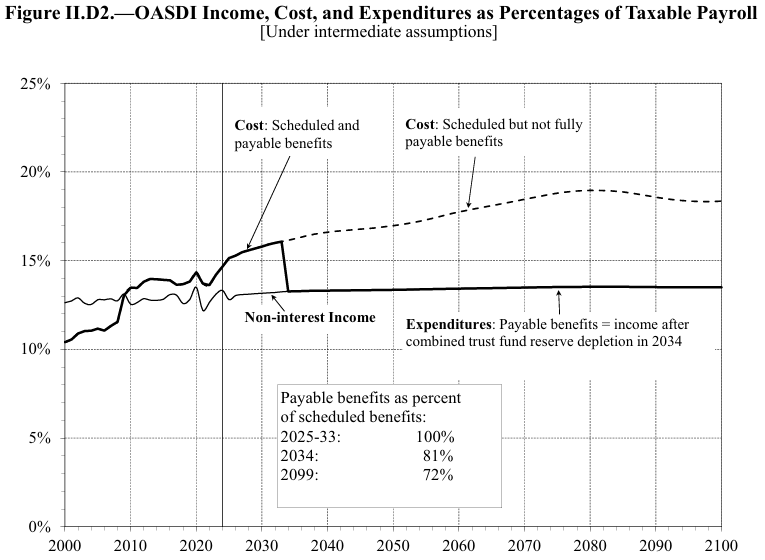
To illustrate the Social Security program’s actuarial status as a whole, the OASI and DI Trust Funds’ operations are often shown on a combined basis as OASDI. However, the two funds are separate entities by law, and therefore the combined fund operations and reserves are hypothetical. The combined reserves are projected to decrease from $2,721 billion at the beginning of 2025 to $214 billion at the beginning of 2034, and are then expected to become depleted during 2034, the last year of the short-range period….
Considered separately, the OASI Trust Fund fails the test of short-range financial adequacy, but the DI Trust Fund satisfies the test. The OASI reserves are projected to become depleted during 2033 under the intermediate assumptions. The DI reserves along with projected program income are sufficient to cover projected program cost over the next 10 years.
When the OASI trust fund has been fully depleted, the Trustees indicate everyone who receives Social Security retirement benefits will see them cut reduced by 23%. But if they pull in money from the Disability Insurance trust fund they manage, it will reduce the size of the cuts to 19%. Left unsaid, doing that would mean cutting disability insurance benefits by 100%.
Social Security Reforms Needed, But How?
When Social Security’s OASI trust fund runs out of money, under current law, the amount of benefits it pays out cannot exceed the revenue it gets from Social Security’s payroll taxes. Those taxes are currently set at 12.4% of taxable income, which is equally split between employers and their employees. People who are self-employed pay the full 12.4%. In a sense, running out of money will force Social Security to operate with a balanced budget requirement.
But with so many senior citizens drawing Social Security checks, it’s very likely U.S. politicians will attempt to keep their gravy train flowing.
Social Security’s Trustees outline two basic options they might take to make the program sustainable through the end of the 21st century.
- Revenue would have to increase by an amount equivalent to an immediate and permanent payroll tax rate increase of 3.65 percentage points to 16.05 percent beginning in January 2025;
- Scheduled benefits would have to either be reduced by an amount equivalent to an immediate and permanent reduction of 22.4 percent applied to all current and future beneficiaries effective in January 2025, or by 26.8 percent if the reductions were applied only to those who become initially eligible for benefits in 2025 or later; or
- Some combination of these approaches would have to be adopted.
The Trustees report that if actions like these are delayed, the size of tax changes and benefit cuts will only get bigger.
One possible action the Trustees don’t consider is politicians diverting money from other parts of the U.S. federal government’s budget to keep paying out benefits at pre-trust fund depletion levels. Keeping retirement benefits going like that however means Social Security would crowd out almost everything else the government does.
It also means forcing tax hikes, spending cuts, or more borrowing onto U.S. taxpayers. No matter what they do, politicians will be choosing designated losers in reforming Social Security. It’s no longer a question of either if or when, but rather, who.