

The Triumph of Fear
Book Review
Reviewed by
This book review is a web exclusive for the Spring 2026 issue of The Independent Review.
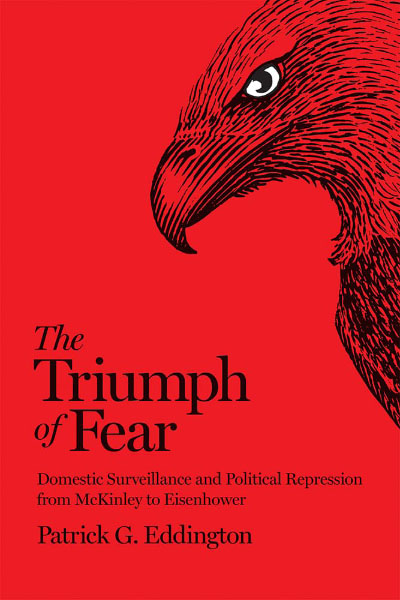
Unchecked state surveillance is as American as apple pie. That would be my one-sentence summary of Patrick Eddington’s important book, The Triumph of Fear: Domestic Surveillance and Political Repression from McKinley to Eisenhower. Drawing on declassified federal records, congressional hearings and reports, participant accounts, and secondary sources, Eddington provides a comprehensive historical account of the emergence and evolution of the American surveillance state, and its use for political repression, over a six-decade period.
Eddington’s history starts in the late 1800s. The United States Secret Service Division (SSD) was established in 1865, as part of the Department of the Treasury, to combat counterfeiting. In this role, the SSD became the first federal law enforcement agency to engage in systematic surveillance. With the assassination of President William McKinley in 1901, the scope of the SSD expanded to include presidential protection and the broader surveillance of the civilian population. Importantly, those controlling these surveillance powers exercised a significant amount of discretion over how they were used. This established the foundation for continued extensions of state power over the coming decades.
A few years later, in 1908, Attorney General Charles Bonaparte, acting on orders from President Theodore Roosevelt and without congressional authorization, created the Bureau of Investigation (BoI), the precursor to the Federal Bureau of Investigation (FBI). The BoI operated with legal impunity, enabling political elites to investigate and punish their enemies. According to Eddington, a key part of Roosevelt’s legacy was the creation of “new federal law enforcement structures and operational precedents that shredded the Bill of Rights and provided his successors a template for future crackdowns, a pattern that has repeated itself with regularity for over a century” (p. 34).
This became evident during World War I. Driven by concerns about German espionage and sabotage on domestic soil, the U.S. government’s surveillance efforts expanded to cover even more of the general population. The Espionage Act, passed in 1917, was used to prosecute and silence political dissenters and members of the media. The Supreme Court, in Schenck v. United States (1919), ruled that free speech was contextual, establishing the “clear and present danger” doctrine for wartime speech, further empowering the executive and state agencies to exert control over the citizenry.
The Russian Revolution of 1917 led to the First Red Scare, further intensifying domestic political repression. The U.S. government’s surveillance efforts were deployed against a wide range of ethnic and minority groups on the grounds of national security. J. Edgar Hoover, the head of the BoI, oversaw mass raids and deportations with little concern for the rights of those targeted.
During the 1933–1945 period, President Franklin D. Roosevelt engineered a dramatic and permanent increase in the size, power, and reach of the federal domestic surveillance state. This included a range of old and new activities, such as political targeting in the form of congressional witch hunts. The House Un-American Activities Committee, for instance, investigated people for alleged disloyalty to America with little concern for civil liberties.
Despite the Supreme Court’s ruling in Nardone v. United States (1939) banning wiretapping, FDR secretly ordered Attorney General Robert Jackson to do so in the name of national security. Roosevelt also authorized, through Executive Order 9066, the internment of over 100,000 Japanese Americans. FDR also established his own private intelligence operation, led by journalist John Franklin Carter, to bypass formal intelligence channels and to engage in political espionage.
Upon Roosevelt’s death, President Harry Truman did nothing to dismantle the now sprawling state-security apparatus. He continued the now-established tradition of using the FBI (the BoI was renamed the FBI in 1935) to conduct surveillance, including illegal wiretaps, on political rivals and White House officials. He formalized the Federal Employee Loyalty Program using vague criteria, such as associating with a person of a different color, to launch government investigations into members of the federal workforce.
The same story continued under subsequent presidential administrations. Eisenhower broadened the loyalty criteria, adding sexual orientation as a federal employment disqualifier, and continued prior surveillance programs. Further expanding executive power was the Supreme Court’s decision in U.S. v. Reynolds (1953), which established the state secrets privilege, allowing the executive branch to conceal actions deemed vital to national security. During this same period, J. Edgar Hoover secretly launched COINTELPRO, a series of surveillance programs designed for the internal disruption and subversion of organizations viewed as a threat to the domestic political order. These programs, which entailed significant discretion on the part of Hoover, quickly expanded their focus to civil rights leaders, such as Martin Luther King, Jr.
There is much more to the story, but these highlights provide a brief illumination of the magnitude and reach of the U.S. surveillance state. Eddington notes that across all of the administrations discussed, countless lives and careers were destroyed through the deployment of discretionary power. At the same time, constitutional constraints, both in letter and spirit, were simply ignored and, as a result, made irrelevant. Several other themes emerge across the chapters.
The first is the role of fear, which was a fundamental driver in the rise and expansion of the U.S. surveillance state. During various historical episodes, there was genuine fear of external threats. However, Eddington’s history shows that the growth of the surveillance state was often driven by political elites who were fearful of losing their grip on power. In these instances, acts of domestic repression and constitutional violations were justified on the grounds of protecting those very things.
A second theme is the nature of government growth. Eddington’s detailed history serves as an excellent illustration of Robert Higgs’s idea of the “ratchet effect” of government growth (Crisis and Leviathan: Critical Episodes in the Growth of American Government [Oxford University Press, 1987]). In this framework, government expands in the wake of a crisis and never returns to its pre-crisis level. Part of the reason is the creation of new bureaus and interests which expand the scale of government. Another part is due to increases in the scope of government power as people’s ideology regarding the appropriate role of the state changes. Things once viewed as unacceptable become normalized, leading to persistent increases in the overall size (scale and scope) of government. Eddington refers to Higgs and the ratchet effect in the concluding chapter, but it would be useful for readers to keep this framework in mind from the start of the book to understand the dynamics at work.
A final theme is how little American political leaders seem to care about the U.S. Constitution. Eddington’s history clearly shows that despite legal safeguards in the First and Fourth Amendments, government officials have consistently employed extraconstitutional means to suppress and repress political activity. The specifics of constitutional neglect vary from person to person and administration to administration, but the U.S. surveillance state has consistently moved in one direction since the late nineteenth century. The executive branch, with acquiescence from Congress and the judiciary, has gained increasing discretionary power, which it rarely hesitates to deploy against private citizens, constitutional rights be damned. In this regard, Eddington’s narrative poses a challenge to those who believe in the power of constitutions to constrain government power to some limited set of activities.
Although Eddington’s story stops in 1961, his insights remain relevant today and certainly will tomorrow. We know from the Church Committee in 1975, from the Edward Snowden revelations in 2013, and the experience with the COVID-19 pandemic that state surveillance continues to flourish. Given the importance of this topic, we can only hope that Eddington has plans for a sequel to The Triumph of Fear covering the period from 1961 to the present. Pulling back the curtain on the scale, scope, and pernicious nature of the U.S. surveillance state might be the only hope for ridding ourselves of the associated political repression it has consistently delivered.
Comments
Related Book Reviews

The New Constitutional Order


Understanding Institutional Diversity

The Conscience of an Anarchist


Democracy and Populism

Why Government Fails so Often—and How It Can Do Better


Independent Review Issues
Articles by Issue