

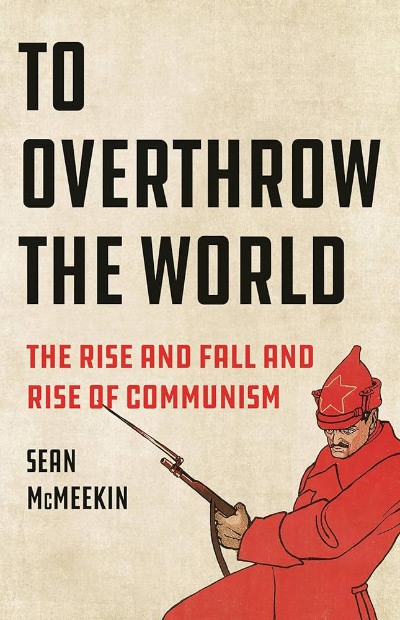
To Overthrow the World
Book Review
Reviewed by
This book review is a web exclusive for the Winter 2025/26 issue of The Independent Review.
Some say socialism has never succeeded; others say it has never been tried. The evidence for the “never succeeded” view rests on the total failure of socialist systems to deliver even mediocre economic performance. Whatever else is true, however, Karl Marx was quite right when he predicted that “Violence is the midwife of every old society pregnant with a new one” (Capital, vol. I, chapter 31, 1867).
Sean McMeekin describes a practical, material history of the cultural and personal violence of socialist movements, and the havoc they wrought on the nations and citizens that suffered through them. The book pays relatively little attention to the content of the ideas themselves, but instead focuses on their actual consequences, at least as they were implemented in the instances that make up the book’s account.
It was once imagined, by Oskar Lange, Abba Lerner, and the American Roosevelt administration, that a planned “war economy” could outperform the “chaos” of the market system. One of my prized possessions (I have to have a copy to show, because otherwise students won’t believe it!) is the 1937 book Planned Society (edited by Findlay Mackenzie and Lewis Mumford, Prentice-Hall). The book was published as the proceedings of a conference on central planning, substituting the judgments of bureaucrats for the processes of commerce and markets, and ideally imposing actual state ownership of the means of production.
Most of the participants in the conference were dry academics and credentialed planning experts, but on the final day, in the highlight of the whole gathering two “leaders” of the movement gave keynote addresses. Benito Mussolini of Italy gave a serious lecture entitled “The Political and Social Doctrine of Fascism,” and Joseph Stalin of the Soviet Union lectured on the “Work of the Central Committee” in planning the Russian economy. The conference participants simply took it for granted that industrial concentration would make some form of socialism necessary; the only question was how soon, and in what manner, the transformation could be effected.
The motivation was the failure of capitalism, evidenced by the apparently endless “Great Depression” in market systems, and by the success of different versions of the “war economy” (David Levy and Sandra Peart, “Socialist Calculation Debate,” The New Palgrave Dictionary of Economics, Palgrave Macmillan, 2008). World War I had showed the value of central planning, and the difference in economic performance between nations that tried to return to markets—US, England, Weimar Germany—and the nations that used wartime methods on peacetime problems—the Soviet Union, Nazi Germany, Italy—was stark.
The difficulty is that the “success” stories are all countries whose economies had been destroyed by the first great war. Between 1917 and 1924, Russia was a basket case of internal struggle and economic sabotage, as McMeekin shows in some detail. Instead of causing growth, muddled attempts at planning and collectivization resulted in collapse of the agricultural and industrial economy, and mass starvation of recalcitrant “kulaks” who pressed for the promised redistribution of land rather than the substitution of commissars for oppressive local feudal lords. An interesting note: McMeekin points out (p. 210) that “kulak” simply means “fist,” and the meaning of the term was that the peasants were “tight-fisted,” unwilling to give up the land they had been promised and to turn over all their crops to the self-appointed new Communist lords of the economy.
Those mass killings and intentional starvations, which McMeekin documents in detail, happened in the late 1920s and early 1930s. But there was Stalin, along with that other paragon of planning excellence, Mussolini, giving plenary speeches at the Planned Society conference in 1937. Mussolini, of course, soon fell out of favor; Stalin, however, at least for many supporters of communism in the US and the rest of the Western world, did not.
A big part of the reason is the claim that the Soviet economy, and the system of planning generally, was simply better. When Nikita Khruschev said, “We will bury you!,” he was not making a military threat, but an economic prediction. This wasn’t just bluster; I have a copy of Paul Samuelson’s Economics text from 1961; Samuelson agreed with Khruschev, predicting that the Soviet Union would surpass US GDP in 1984, and that the difference would then quickly widen. There were three reasons, for Samuelson: (1) no profits, which cut costs; (2) correct pricing, since the Soviets could internalize externalities, and produce the “correct” amounts of things; and (3) investment in a planned system was both greater, and more accurately targeted at the “right” industries.
Of course, those predictions were not just wrong, but absurd, raising questions about the supposed “reasons.” Alec Nove, in his book An Economic History of the USSR, 1917–1991 (3rd ed., Penguin, 1992), reproduces a corrected time series of GDP growth for the Soviet economy, one that had been calculated and published in Russian by economist G.I. Khanin. Those data show that before 1940 the average annual Soviet growth rate had been a little more than 3 percent, not bad but hardly impressive, given how depressed the Russian economy had been by the Revolution and its aftermath. In the 1950s, Khanin showed an average growth rate of more than 7 percent, which is impressive, until one compares it with other war-ravaged economies such as Japan and Germany. Russia’s infrastructure had been so thoroughly destroyed that there was a low baseline level of economic activity, making a high growth-rate inevitable. In the 1960s, when Samuelson was making his fatuous predictions, the growth rate had fallen to 4 percent, followed by a decline to about 1 percent annual growth by the end of the 1970s. Throughout the 1980s Soviet growth was either negative or barely positive, never more than 0.7 percent complete stagnation and decay.
The reason for this long introduction is to complement the motivation McMeekin cites for writing this book, which required years of concentrated effort. All real socialist systems, without exception—there are no counterexamples, not one—have resulted in appalling human costs. As McMeekin points out, the effects on freedom and the ability to live as a fully realized human being are catastrophic; as I have noted, the effects on prosperity and growth are calamitous.
Yet, as McMeekin tells it, his students were not only willing to accept the notion that socialism was economically viable (it isn’t), but also to defend mass murderers such as Vladimir Lenin and Mao Zedong, based on some kind of “greater good” rationale arising from the social justice goals of socialists.
McMeekin’s personal experience is borne out in the larger US population. A Cato Institute poll (Michael Chapman, “Young Americans Like Socialism”) in May of 2025 found that nearly two-thirds of young people have a positive view of socialism, and more than one-third favor full-blown communism.
In my experience, students wave off the claims about economic stagnation as unimportant. Some believe that with new AI technology, that problem can be solved, of course. But the real goal is to end the gross unfairness of capitalism. Communism’s appeal is its claim to focus on social justice.
McMeekin, a professor of European History and Culture at Bard College, wrote this book to show that there are no examples of that, either. The book offers a sweeping narrative that traces the evolution of Communism from its theoretical roots through its implementation. All of its implementations, at least in any sizable polity.
His accounts, ranging from Lenin’s seizure of power, Stalin’s bank robberies and intentional mass starvation as a tool of control, rural collectivization and industrialization in China, Pol Pot’s bizarre Rousseauvian nightmare, to modern-era regimes, are vivid and well-sourced. The “well-sourced” aspect is important, because such an approach is required to counter the tendentiously romantic or simply naïve views of Communism by emphasizing its inherent, organic authoritarian realities and history of shocking violence and economic destruction.
The most significant contribution of the book, and the reason it should be read (I read quite a bit of it twice) lies in McMeekin’s vivid, evidence-rich account of how Communist regimes seized and maintained power—through revolutionary manipulation, terror, and state machinery. His archival storytelling brings to life the mechanics of how Communist parties implemented authoritarian control, making complex historical dynamics tangible and memorable.
Comments
Related Book Reviews
The Magic Money Tree and Other Economic Tales


On Classical Economics

Understanding Institutional Diversity


The Spirit of Smithian Laws

Mercantilism

Independent Review Issues
Articles by Issue