Essays on Liberty 250 Years On
July 4, 2026

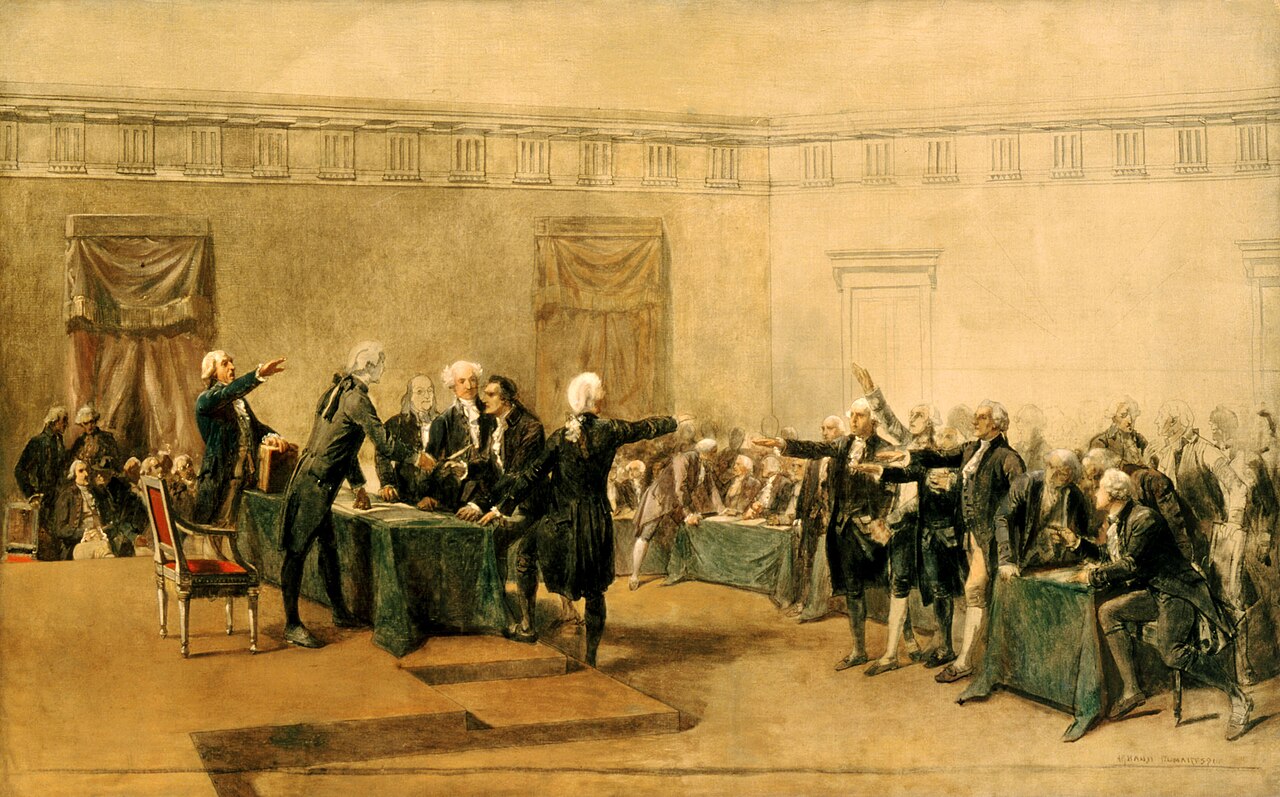
The United States was the first country in the history of the world to build a nation around an idea rather than an ethnicity. It was the first country to declare that:
- All men are created equal and they have individual rights;
- Rights inhere in individuals rather than coming from the bequests of kings;
- Government should be based on universal principles rather than blood, tribe, or religion; and
- People should be governed by a written constitution with separation of powers and regular democratic elections.
The influence of the American Revolution, the United States Declaration of Independence, and the United States Constitution on the rest of the world was enormous.
During the early 1800s, many Latin American independence leaders consciously looked to the United States as a model for breaking away from European empires and creating republican governments. The influence was not just institutional. The language of popular sovereignty, natural rights, anti-colonialism, and government by consent spread throughout Spanish America after 1776 and influenced such leaders as Simón Bolívar and José de San Martín. In time, these ideas made their way around the globe.
The essays that follow will answer three questions:
- What cultural changes made the ideas in the Declaration of Independence possible?
- How does it reflect the thinking of classical liberalism?
- How does classical liberal thought differ from the way most people think today?
As we celebrate America’s birthday, it’s helpful to understand what this birthday is all about:
Cultural Foundations of The Declaration of Independence. [1]
The idea that people have an unalienable right to pursue their own happiness is a very radical idea. Prior to the eighteenth century, almost no one in the world believed it. Even today, only a small sliver of humankind agrees with it.
Equally radical is the idea that the only purpose of government is to protect that right. We can quibble about some of the details, but the central idea is unequivocal. If you and I both have the right to pursue our own happiness, it would be wrong for a government to impose burdens on you just to make me happier.
Critics of this political philosophy invariably note that some of the authors of the Declaration of Independence owned slaves. But remember, just about everyone else in the world at the time thought that there was no such thing as an individual right. In recognizing that some people had rights, the founders opened a door that would inevitably extend to everyone.
Their declaration of the right to representation and self-governance initially applied to the free, property-owning men of thirteen North American colonies. Thanks to their foresight, we extended the right to everyone else.
Two Preconditions
The Declaration of Independence was written at a time when the world was undergoing two major changes—both of which made the Declaration possible.
One major change was intellectual: a radical shift in thinking about the relationship of human beings to one another. Today it is called The Enlightenment or the Age of Reason. In place of domination by the Church or the State (empire or monarchy), Enlightenment thinking held that human beings were independent moral entities who should deal with each other on the basis of reason, persuasion, and voluntary exchange.
Steven Pinker has devoted an entire book to the idea that The Enlightenment is the reason why we are not living at the subsistence level today—grubbing around in the forest for roots and berries, as our ancestors lived for several hundred thousand years. [2]
The other major change was economic.
Prior to the eighteenth century, most people in most places could probably not have survived under the political arrangement envisioned by the Declaration of Independence. Our distant ancestors were hunter-gatherers who lived in small groups.[3] They existed at the subsistence level, and they were continually at war with other tribes. In hunting and gathering and in making war, they relied on cooperative action, in which individuals subordinated their short-term self-interest to the long-term welfare of the group.
Think about a troop of soldiers on a military mission. If each one pursued his own happiness, the mission would never be achieved. Our distant ancestors, like that military troop, were at war with other tribes and at war with nature. Since they had no markets and no government (at least as we know those institutions today), they relied very heavily on cultural norms to enforce cooperative activities.[4]
Cultural rites and rituals celebrated self-sacrifice—heroism in battle, risk-taking in the pursuit of large game, diligence in gathering food and other cooperative duties. People were encouraged to think of the entire tribe as extended kin. Other tribal inhabitants were seen as family, not parties to exchange. Outsiders were enemies.
In time, the tribal life that dominated human existence for over 200,000 years began to give way to the marketplace. People began to view strangers in other communities as trading partners rather than military adversaries. Specialization and trade began to link people who lived in distant places. Tribes grew into cities, and specialization and trade replaced kinship relations in local communities as well.
One recent paper, though written about more recent market developments, summarizes trade’s pro-social benefits by noting that: “increased market access fostered universalism, tolerance, and generalized trust.”[5] When we are supported in predictable patterns of cooperating with strangers, we extend trust and willingness to transact beyond our tribal and kin-based ties.
In the communities populated by our distant ancestors, an individual could do the most good for others around him by sacrificing his own self-interest to the whole group. In contrast, an interconnected marketplace enabled an individual to do the most good for the most others by pursuing his own self-interest, meeting the needs of others by providing something they wanted to buy.
It may be no coincidence that the Declaration of Independence was published in the same year as Adam Smith’s The Wealth of Nations. By 1776, the best minds in the Western world believed individuals had a right to pursue their own happiness and government should ensure they respected the rights of others. The two big changes—a change in how people thought and a change in how they made a living—fused into a political arrangement that had never existed before: classical liberalism.
Extending Rights to Others
The Constitution, which embodied the spirit of the Declaration of Independence, placed restrictions on the federal government, but placed no such constraints on state and local governments. However, after the Civil War, rights guaranteed under federal law were increasingly seen as appropriate and desirable under state and local governments as well. The Supreme Court and evolving popular opinion rapidly expanded the ideals of the Declaration to more residents of the nation. The rights of black men to vote and, later, of all women, were eventually recognized.
Even so, as we approach the Declaration’s 250th birthday, it is helpful to think about which subsequent policy shifts were consistent with its underlying vision, and which were not.
Where have we lived up to its ideals, and where have we failed?
The Changing Role of Government
When it comes to the role of government, history is a public policy roller coaster.
In 1905, the Supreme Court prohibited bakery workers from working more than 60 hours a week.[6] The law protected established bakers by suppressing competition from bakers who were willing to work longer hours, mostly ethnic immigrants, including Italians, Jews, and the German immigrant Joseph Lochner, the plaintiff. Incumbent businesses were using the state government to block people’s productive pursuits, operating like a medieval guild.
Between 1897 and 1937, in what is known as the Lochner era,[7] the Supreme Court struck down 184 laws. For the most part, these were laws that limited people’s freedom of contract—usually for some obvious special-interest reason. Clearly, the Lochner era rulings were consistent with the classical liberal concept of the proper role of government. They reversed special-interest public policies that trace their roots all the way back to the early settlements in this country.
The political pressures of the Great Depression ended the Lochner era,[8] and special interests regained their power. Today, even if the backers of a public policy admit that it has no defensible public purpose, that it robs the many for the benefit of the few, and that it makes almost everyone worse off—the courts will not step in to stop it.
During the twentieth century, economic studies show that the Interstate Commerce Commission largely served as a cartel agent for the railroads and then for the trucking industry. The Civil Aeronautics Board served as a cartel agent for the airlines. The Federal Communications Commission served the interests of the broadcasters. Through price supports, quotas and other devices, the federal government helped farmers restrict output and sell at higher prices. All of these interventions were to the detriment of consumers.[9]
Beginning in the Jimmy Carter era, deregulation helped undo some of the special-interest harm—much of it stemming from the administration of Franklin Roosevelt. And we are lucky that the Roosevelt era wasn’t even worse.
Had he not been stopped by the Supreme Court, Roosevelt would have required every industry in the country to limit output and fix prices through the National Industrial Recovery Act[10]—which was mercantilism on steroids.
Today, nearly 30 percent of all workers require a government license,[11] and economists across the political spectrum often agree that these requirements serve as barriers to entry. City after city has regulated low-income housing out of existence. Teachers’ unions are still blocking escape routes from bad schools for disadvantaged children in many places.[12] In this way, government continues to select who may pursue happiness and in what way.
Reclaiming the Promise of the Declaration
Political change is hard. But acknowledging the meaning of the Declaration and honoring its creators should not be hard.
In 1776, few people anywhere in the world believed individuals had an essential right to life, liberty or the pursuit of happiness or that government was bound to honor those rights. Fewer still were ready to die for that belief.
When the founders first asserted the existence of individual rights, they were challenging what everyone else thought, and at great cost. For this, we owe them a great deal of gratitude. In opening the door for themselves, the Founding Fathers ultimately opened it for everyone else.
To honor the real spirit of the Declaration, a public policy inventory is long overdue. So much of our government actions neither protect individual rights nor promote the general welfare. We could honor the Declaration by scuttling them.
Classical Liberalism [13]
Prior to the 20th century, classical liberalism was the dominant political philosophy in the United States. It was the political philosophy of Thomas Jefferson and the signers of the Declaration of Independence and it permeates the Declaration of Independence, the Constitution, the Federalist papers and many other documents produced by the people who created the American system of government. Many of the emancipationists who opposed slavery were essentially classical liberals, as were the suffragettes, who fought for equal rights for women.
Basically, classical liberalism is the belief in liberty. Even today, one of the clearest statements of this philosophy is found in Jefferson’s Declaration of Independence. At that time, as is the case today, most people believed that rights came from government.
People thought they only had such rights as government elected to give them. But following the British philosopher John Locke, Jefferson argued that it’s the other way around. People have rights apart from government, as part of their nature. Further, people can form governments and dissolve them. The only legitimate purpose of government is to protect these rights.[14]
It has become fashionable, especially on university campuses, to view the Founding Fathers as hypocrites because many were slave owners and they appeared to believe that women, slaves, Indians and other groups were not entitled to the same rights as white, male property owners.
Yet this attitude misses the forest for the trees. In 1776, the world was full of hypocrites. It was not full of people who believed in individual rights. In fact, outside of a handful of people, who mainly lived in America, no one in the world believed in classical liberalism. For example, many people at the time may have thought that slavery was distasteful. But almost no one in the world thought that you have a right not to be a slave.
Although many of our democratic institutions find their roots in ancient Greece and ancient Rome, in those societies, slavery was a normal and natural part of everyday life. In ancient Greece, for example, slaves outnumbered non-slaves, with the average household owning as many as three or four. More than one-third of all the people living in ancient Rome were slaves.
The United States is the first government in the history of the world whose founding documents endorsed the idea of individual rights that are prior to the government’s founding and that legitimize the government’s existence.[15]
Once it was granted that some people have natural rights, it was inevitable that the idea would spread to everyone else. Good ideas have to start somewhere. People who live in the United States today and who are not white, not male and not property owners nonetheless have the same rights as everyone else precisely because almost 250 years ago, a group of men went to war to defend the idea that they had rights.
People who call themselves classical liberals today have a more expanded view of rights. But the basic idea of what a right is and the role of government in protecting it is the same concept that Jefferson and his contemporaries had.
At the time of the country’s founding, classical liberals did not make any important distinction between economic liberties and civil liberties. When they spoke of freedom of speech, they tacitly assumed a market free enough to allow a publisher to buy a newspaper, ink and a printing press. When they spoke of freedom of assembly, they implicitly assumed people would be able to rent a hall to hold meetings.
In other words, they did not foresee that years later, communist and other totalitarian systems’ governments would be able to suppress basic civil liberties through their control of economic resources. It’s as if they assumed that free minds and free markets would naturally go together.
Nor did they foresee that in the United States in the 20th century, the distinction between economic liberty and civil liberty would become a political dividing line. Conservatives in the 20th century were more concerned with economic rights than civil rights. For liberals, the preference was reversed.
The major difference between 19th-century liberals and 20th-century liberals was that the former believed in economic liberties and the latter did not. Twentieth-century liberals believed that it was not a violation of any fundamental right for government to regulate where people work, when they work, the wages they work for, what they can buy, what they can sell, the price they can sell it for, etc. In the economic sphere, then, almost anything was fair game.
At the same time, 20th-century liberals continued to be influenced by the 19th-century liberalism’s belief in and respect for civil liberties. In fact, as the last century progressed, liberal support for civil liberties grew, and groups like the American Civil Liberties Union (ACLU) began to proudly claim the label “civil libertarian.” Since liberalism was the dominant 20th-century ideology, public policy tended to reflect its beliefs. By the end of the century, people had far fewer economic rights than they had at the beginning. But they had more civil rights.
A change has begun to occur in the 21st century, however. Today, particularly on college campuses, many people who are left-of-center have ceased using the term “liberal” altogether and are asserting that rights and obligations accrue to people as members of groups, not as individuals. So, racial identity, ethnic identity, economic condition, sexual preference, etc., may create rights for people within a group that are not shared by those outside the group, for no other reason than the fact that the outsiders are outsiders. They reject the notion of individual rights across the board—both economic rights and civil rights. Unlike liberals, they believe that what a person may permissibly say or write or publish may differ, depending on what group they identify with.
This is clearly a collectivist notion of rights, and I will briefly discuss the historical roots of this type of collectivist thinking below.
Characteristics of Individual Rights
The U. S. Constitution’s Bill of Rights proclaims that individuals have “rights.” But what does it mean to have a right? Are some rights fundamentally different from others? In the classical liberal tradition, rights have several characteristics, including the following:
Rights Are Relational.
Rights pertain to the moral responsibilities that people have to one another. In particular, they refer to a zone of sovereignty within which individuals are entitled to make choices without interference by others. In this way, rights serve as moral side-constraints on the actions of other people. In a world consisting of only one individual, or in which people never interacted, rights would not exist in the sense that there would be no one to claim a right against and no one who could interfere with the exercise of any individual’s rights. Rights exist because people do interact in pursuit of their own interests. Rights are also relational in another sense: They limit the morally permissible actions government may take to interfere with the lives of individuals who are governed.
Rights Imply Obligations.
Rights sanction morally allowable actions. In the process, they create obligations for other people to refrain from preventing those actions. To say that “Joe has the right to do X” implies that all other people have an obligation not to interfere with Joe’s doing X. For example, to say “Joe has a right to build a swing set in his backyard” implies that other people are obliged not to interfere with Joe’s construction of the swing set.
Rights Imply Negative Obligations.
Joe’s right to build a swing set obliges others to stay out of the way. It does not obligate others to help Joe—by furnishing labor, materials, etc. So, Joe’s right creates negative obligations for others, not positive ones. All fundamental rights imply negative obligations in this way.
For example, the right to free speech implies a (negative) obligation on the part of others not to interfere with your speaking. It does not create the (positive) obligation to provide you with a platform, a microphone and an audience. The right to freedom of the press implies a (negative) obligation for others not to interfere with your publishing. It does not create the (positive) obligation to provide you with newsprint, ink and a printing press. The right to freedom of assembly creates the (negative) obligation for others not to interfere with your association with others. It does not create the (positive) obligation to furnish you with an assembly hall.
From primary rights (e.g., the rights to life, liberty and property) flow derivative rights. These are new obligations that arise as people exercise their primary rights. Virtually all rights created through trade, exchange or contract are derivative. For instance, Joe owns a motorcycle and agrees to let Tom rent it for a period of time. Joe has a right to expect to get his motorcycle back, along with the agreed-upon rental fee. Joe’s rights entail positive obligations on the part of Tom.
Rights Are Compossible.
Can rights conflict? In the classical liberal conception, a conflict of rights implies a contradiction.
Consider two claims:
- Joe has the right to do X.
- Tom has the right to interfere with Joe’s doing X.
The first sentence implies that Tom has an obligation not to interfere with Joe’s doing X, whereas the second sentence implies that he has no such obligation. Hence, there is a contradiction.
In order to be logically consistent, therefore, rights cannot conflict; which is to say, they must be compossible. Compossibility means that each person’s rights are compatible with everyone else having the same rights. This is the feature behind the adage “Your right to act ends at my nose,” and vice versa. Take the claim that each person has a right to liberty. Compossibility implies that when any one person is exercising her liberty, she is not violating other people’s right to liberty.
This does not mean that people cannot compete to achieve mutually exclusive goals. It does mean that the competition must be in the context of rights. Put differently, there may be conflicts among people (e.g., they may be pursuing conflicting goals), but there cannot be conflicts of rights. Also, the statement that rights are compossible does not imply that there cannot be arguments and disputes about what those rights are (which is why we have courts of law). But the presumption of a legal hearing is that even though the disputants may disagree, there are objective, non-contradictory rights for the court to discover.
Fundamental Rights Are Unalienable.
In the Declaration of Independence, Thomas Jefferson declared that basic rights (life, liberty and the pursuit of happiness, e.g.) are unalienable. This means they cannot be alienated from the individual who holds the rights. They cannot be given away or taken away. They cannot be bought, sold or traded. They can be violated, however.
Joe can give away his swing set or sell it or trade it for some other asset. Joe can also buy, sell, trade or donate other pieces of property. But he cannot give away, sell or trade away his right to own property as such. Individuals, through consent or contract, may limit their liberty to take specific acts (e.g., under the terms of a contract), but they may not give up their right to liberty as such.
Fundamental Rights Do Not Come from Government.
Not only do rights not get their legitimacy from government, but—as the Declaration of Independence so eloquently states—it’s the other way around. Government gets its legitimacy from the existence of rights. In the view of Locke, Jefferson and others, rational, moral people form governments for the express purpose of protecting rights. In his Second Treatise on Government, Locke argued that legitimate governments are instituted to facilitate the more effective protection or enforcement of these rights, and they may not abrogate an individual’s natural rights. In natural rights theories, legitimate governments are created by consent, but fundamental rights are not grounded in consent.
Substantive Rights and Procedural Rights.
Some of the rights enumerated in the Bill of Rights are “substantive” rights. Others are “procedural.” The Founding Fathers were clearly very concerned with both. The distinction is as follows. Legitimate governments are created to protect substantive rights. But in carrying out this task, the government is required to adhere to certain procedures, and these requirements create procedural rights. For example, the Constitution specifies that certain government officials must be elected. This implies that citizens have a (procedural) right to vote.
Procedural Rights Protect Substantive Rights.
In order to protect rights and to adjudicate disputes about rights, the government must exercise certain police powers. In our system, certain procedural safeguards were built into the Constitution specifying how the government must act in exercising these powers. For instance, the Constitution requires the government to get a warrant before arresting a person or seizing his property. In addition, for serious crimes, it requires the government to provide the accused with a speedy, public trial before an impartial jury and the ability to confront witnesses and to compel testimony. All these rights are procedural rights.
Characteristics of Procedural Rights.
As noted, the right to vote, the right to a trial by jury, the rights that flow from all the rules of evidence that courts enforce—these are examples of procedural rights. Procedural rights have at least four characteristics of interest:
- They are less fundamental than substantive rights. Indeed, the reason for establishing procedural rights is to protect substantive rights.
- They are conventional. Whether the legislature has one house or two, whether we vote once a year or once every six months, whether we have three branches of government or four or five—all these are decisions to be made. And one decision is not necessarily superior to any other. Despite the fact that these rights are conventional, many of them are nonetheless constitutional. The Founders did not want them to be easily changed.
- They imply positive obligations. Unlike fundamental substantive rights (which imply only negative obligations), procedural rights imply positive obligations. For example, the right to vote obligates others (government officials) to provide a polling booth, set aside a day for voting, print up ballots, etc. The right to a trial by jury obligates others (government officials) to empanel jurors, provide a judge, make a courthouse available, etc.
- They are the result of a balancing of interests. Because procedural rights create positive obligations, arguably, they cannot be secured without the exercise of force or the threat of force. Governments are thus empowered to make people do things which they might otherwise not do in order to secure such rights (including, for example, collecting taxes from unwilling taxpayers). For this reason, the securing of procedural rights requires a delicate balancing between the value of the substantive rights they are designed to protect and the danger of violating these rights in the very act of attempting to protect them.
Substantive Rights vs. Police Powers of the State
In the classical liberal world, people are free to pursue their own interests so long as they do not violate the rights of others. They are free to trade with others or not to trade. They are free to associate with others or not to associate. Since fundamental, substantive rights create negative obligations, one respects another’s rights by not interfering with the exercise of those rights. Interference generally consists of force, the threat of force, or fraud (which is interpreted to be an indirect form of force). The classical liberal world, therefore, is a peaceful world. All interactions are voluntary. A world in which all rights are respected is a world without force or fraud.
However, in order to prevent crime, catch and punish criminals, settle disputes and carry out other duties necessary to protect rights, every government will necessarily exercise police powers—powers that are generally denied to ordinary citizens. Among the questions these powers raise, here are three important ones:
- If one individual violates another’s rights (say, by committing a crime), does the violator forfeit his rights to life, liberty, etc.?
- If the government compels testimony, subpoenas records, secures property, etc., from people who are subsequently shown to be completely innocent of any crime, is government violating the rights of the innocent? If the answer to the preceding question is “not always,” where is the boundary to be drawn beyond which the legitimate exercise of police powers becomes a violation of individual rights?
- What is the role of police powers in defense of rights? A classical liberal citizen clearly has the right not to be seized or searched at random. But suppose a government official suspects the citizen is a thief and that he harbors contraband. Suppose also that after a search, seizure and trial, the citizen is proved to be guilty. How can we describe these government acts using the language of rights?
Under certain circumstances, rights are defeasible. That is, they are justifiably set aside. For instance, people who are imprisoned for committing crimes (i.e., violating the rights of others) have not lost their inalienable rights to life, liberty and the pursuit of happiness; but in order to punish them for the crimes they committed, their rights are (temporarily) set aside.
A person need not have done wrong, however, to have his or her rights set aside. For instance, the same reasoning applies to the search and seizure of a person who is later shown to be innocent. If the search was reasonable and well-founded, it does not count as a violation of the innocent person’s rights. Instead, those rights are suspended or ignored in pursuit of a larger objective (defending everyone else’s rights).
Clearly, a lot hinges on defining what is “reasonable.” Defined too broadly, the police powers of the state threaten every substantive right of every citizen. To ensure that these powers are narrowly circumscribed, procedural rights are established and enshrined in the Constitution. These procedural rights are important not only to drug dealers and mafia capos (who use them to maximum advantage). They are important to every citizen in the exercise of every right.
Rights vs. Needs
To appreciate the classical liberal concept of individual rights, it is as important to understand what is being rejected as it is to understand what is being asserted. To say that individuals have the right to pursue their own happiness implies that they are not obliged to pursue the happiness of others. Put differently, the right to life, liberty and the pursuit of happiness implies that people are not obligated to serve the needs, concerns, wishes and wants of others. This doesn’t mean that everyone has to be selfish. It does imply that everyone has a right to be selfish.
In the classical liberal world, need is not a claim. That is, the needs, wishes, wants, feelings and desires of others are not a claim against your mind, body or property. At the time the Declaration of Independence was written, this meant that the American colonists had the right to pursue their own interests, independent of the needs of King George and the British Empire. In time, the concept was broadened—affirming each individual’s right to pursue his or her own interest, despite the existence of unmet needs somewhere on the planet or even next door.
The idea that need is not a claim applies to procedural rights as well as substantive rights. Tom may feel safer if all suspicious-looking people are routinely seized and searched. But in the world of classical liberalism, Tom’s need to feel safe is not a justification for initiating force against all suspicious-looking people.
The Collectivist Notion of Rights
It is worth noting that all forms of collectivism in the 20th century rejected this classical notion of rights and all asserted in their own way that need is a claim. For the communists, the needs of the class (proletariat) were a claim against every individual. For the Nazis, the needs of the race were a claim. For fascists (Italian-style) and for the architects of the welfare state, the needs of society as a whole were a claim. Since in all these systems the state is the personification of the class, the race, society as a whole, etc., all these ideologies imply that, to one degree or another, individuals have an obligation to live for the state.
Despite the fact that 20th-century collectivists opposed the classical liberal concept of rights, very rarely did they attack the notion of “rights” as such. Instead, they often tried to redefine the concept of “right” in a way that virtually eviscerated any meaningful notion of liberty. For example, in his 1944 State of the Union Address, President Franklin D. Roosevelt called for a “second Bill of Rights,” which included the following:
- The right to a useful and remunerative job in the industries, shops or farms or mines of the nation.
- The right to earn enough to provide adequate food and clothing and recreation.
- The right of every farmer to raise and sell his products at a return which will give him and his family a decent living.
- The right of every businessman, large and small, to trade in an atmosphere of freedom from unfair competition and domination by monopolies at home or abroad.
- The right of every family to a decent home.
- The right to adequate medical care and the opportunity to achieve and enjoy good health.
- The right to adequate protection from the economic fears of old age, sickness, accident and unemployment.
- The right to a good education.
Note that these rights are very different from the rights Locke, Jefferson and the Founding Fathers had in mind. Among the characteristics of Roosevelt’s rights are the following:
- They imply positive obligations on the part of others. When Roosevelt says people have the right to “earn enough to provide adequate food, clothing and recreation,” he does not mean that people have the right to work hard (extra hours if necessary) to earn money to buy what they need. Instead, he means that other people (including potential employers, consumers, other workers, etc.) have an obligation to ensure each worker’s wage is sufficiently high. Similarly, “the right of every farmer to…a decent living” does not mean farmers have the right to work the land and produce sufficient output. Instead, it means others are obliged to act in a way that ensures the farmer’s minimum income. In general, your “right to a useful…job” implies others are obligated to provide that job if you can’t find one on your own. Your “right…to a decent home” implies others are obligated to provide you with a home if you cannot otherwise obtain one. And so forth.
- Each individual’s positive obligations are notoriously unclear. Consider all the ways in which you could potentially violate a farmer’s “right” to a decent income. You might buy groceries on sale, or at a discount outlet, instead of paying a higher price. You might buy cheaper substitute products (corn instead of soybeans or vice versa). You might grow some crops in your own backyard instead of buying items at the supermarket. You might buy some land and become a farmer yourself—thereby increasing output and depressing overall market prices. You might change your diet and not buy the farmer’s output at all. Clearly, the list is almost endless, as is the list of things you might do to increase the farmer’s income. One thing is certain: From the statement that a farmer has a “right to a decent income,” there is no way for any of us to determine what precisely our positive obligations are.
- As a practical matter, only government action could ensure such rights. Even if you could figure out how your actions might help the farmer, you would by no means be home free. In Roosevelt’s view, everyone has the right to earn a decent income. So, in the very act of helping the farmer, you might be hurting someone else. Whenever you buy from A at the expense of B, you help the employees of A at the expense of the employees of B—and vice versa. Indeed, every transaction you make—every act of buying and every act of selling — potentially violates one of Roosevelt’s “rights.” As a practical matter, therefore, Roosevelt’s rights could be observed only if all of us ceded much of our liberty to make economic decisions to the government. And the amount of power that would have to be ceded would be enormous.
- They imply virtually unlimited government power with respect to the economy. Incredibly vague rights imply incredibly vague obligations, and, if nothing else, all of Roosevelt’s rights are very, very vague. Hence, if government is to act as the agent for all of us, the potential scope for action would be enormous. In fact, Roosevelt believed that there was no economic decision—no act of buying or selling or producing—that government should not be able to regulate. Thus, in implementing Roosevelt’s second Bill of Rights, one would at the same time be eliminating all of the economic rights that classical liberals thought people had. That is, implementation of Roosevelt’s scheme would eliminate the right of every individual to pursue his own happiness—at least in the marketplace.
Historical note
It’s hard to exaggerate how truly collectivist Roosevelt’s vision was. At his behest, Congress passed the National Industrial Recovery Act (NIRA), which attempted to regulate the entire economy, based on the Italian fascist model.[16] In each industry, management and labor were ordered to collude to set prices, wages, output, etc. (acts that today would be a criminal violation of the antitrust laws). So intrusive were these regulations that what in retrospect seems like an incredibly silly regulation made it all the way to the Supreme Court, which responded by declaring the entire scheme unconstitutional.
Roosevelt was among the most collectivist (anti-individual rights) presidents the United States has ever had. And not just in the economic realm. Although Abraham Lincoln and Woodrow Wilson before him had suspended constitutional rights in time of war, Roosevelt went further than any president before or since. On his orders, Japanese Americans were rounded up and forced into detention camps (for no other reason than the fact that they were of Japanese ancestry) for the duration of World War II.
The Source of Rights
Where do rights come from? How can they be defended? The Founding Fathers believed that fundamental, substantive rights come from nature. Hence the term “natural rights.” But they also relied on other types of reasoning to defend both substantive and procedural rights, including utilitarianism, common law and social contract theory.[17]
Nature as a Source of Rights.
Rights as moral (and subsequently) legal claims limiting government and individual actions taken against an individual or for enforcement of certain claims arose first in the natural rights tradition in philosophy. Philosophers Hugo Grotius (1583–1645), Samuel von Pufendorf (1632–1694), and, most famously, John Locke (1632–1704) argued that humans have certain fundamental rights (e.g., to life, liberty and property). These ideas clearly influenced our Founding Fathers and are reflected in the Declaration of Independence and other documents. While early theorists, including Locke, believed that God granted humans these rights, all of them argued that, even absent God, humans had rights and that they could be discovered by using the human capacity for reason to examine the natural laws of the universe.
The argument from natural rights is appealing when applied to broad categories of substantive, fundamental rights, such as the right to life, liberty and property. It is easy to see how natural rights theory conforms to the substantive rights listed in the Bill of Rights, including the areas of speech, religion, assembly, etc. But what about the procedural rights? In a natural rights theory, procedural rights or subsets of rights and restrictions upon government action are chosen on the basis of how well they protect the fundamental rights that government was established to protect.
Utility as a Source of Rights.
A second philosophical line of argument used to ground rights, and one recognized by the Constitution’s writers, is the argument from utility. On this view, certain rights are vital because they create the conditions under which happiness, or the general state of welfare, is maximized. And because most individuals are the best judge of their own needs, wants, desires and values, the sum of individual (and cumulatively) social welfare is likely to be maximized when people are free to make their own decisions rather than have those decisions made by someone else. Thus, in order to secure human happiness and well-being, it is necessary to create a sphere of personal autonomy within which each individual’s personal judgment concerning what he or she wishes to do is paramount and cannot be legitimately interfered with by either other individuals or by governments, even for that person’s own good.
Theorists as far back as Locke recognized a utilitarian argument for rights. For example, in arguing for property rights, Locke observed that by allowing people to remove property from the commons and make it their own, the effort they put into improving their property would produce benefits for society as a whole.
The Common Law as a Source of Rights.
A third source of rights, closely tied to the natural rights view and known and noted by the Founders, was the common law. In general, the law can be divided into two broad categories: public law and private or common law. Public laws, created by legislative bodies, consist of statutes based on constitutional strictures. Private law, on the other hand, historically evolved as a result of court rulings or judicial determinations in the areas of property, contract and tort law.[18]
“Common law” is a label used to describe the ancient legal process of discovering and delineating the law on a case-by-case basis. Historically, common law judges did not see themselves as creating law so much as discovering it. They subscribed to natural law doctrine whereby “there are natural rules of conduct inherent in humanity itself, most easily discovered by the evolution of customs of dealing. The job of the common law judge was to look to custom in an effort to discern the law that already existed and then render rulings based upon it. Over time, the notion evolved that similar cases should be decided similarly and the concept of stare decisis was born.[19]
Until the latter part of the 19th century, individuals used three bodies of the common law (e.g., trespass, tort and riparian law) to quite good effect. It is easy to see why the Constitution’s authors were supportive of the common law. Its development is closely tied to recognition of the rights that they cherished. The common law is connected to the classical liberal analysis of natural rights to life, liberty and property.[20]
Note that although the common law approach and the utilitarian approach to individuals’ rights start with very different premises, theorists such as Richard Posner,[21] John Goodman[22] and Paul Rubin[23] have argued that both approaches often arrive at the same conclusions.
Social Contract as a Source of Rights.
In writing the Constitution, its authors were also aware of and profoundly influenced by social contract theory and its relation to individual rights. The philosopher Thomas Hobbes argued that legitimate government is founded on a social contract between subjects (who promise to obey the sovereign) and the sovereign (who, in return for their obedience, promises to protect them from crime and foreign aggression). Locke, whose views had more direct influence on the founders, construed the contract as between the members of society who mutually promise to forgo certain freedoms that they could rightfully exercise in the state of nature in exchange for security provided by a government instituted by the contract. Both Hobbes, in a very limited sense, and Locke argued that certain citizens retained certain rights even against government action. Once the contract is instituted and the government becomes established, it is expected to set up certain procedural rights and safeguards (derivative rights) to secure individuals’ basic rights from violation, whether by third parties or the government itself.
The basic insight of social contract theory is that government gains its legitimacy from the consent of the governed—people who have the right to form a political compact. The compact itself creates obligations and powers for both the governed and the governors. While no government ever arose from an actual social contract, social contract theory was developed as a way of both justifying obedience to the government by the governed—and placing justified limits on the government. On this view, governments are justified to the extent that they protect rights and are unjustified when they either fail to persistently protect individuals from other persons violating their fundamental rights or when the government itself oversteps its legitimate authority and begins to violate individual rights.
More recently, John Rawls, among other philosophers, has brought new life to social contract theory. Rather than viewing rights as gifts from government or from God or basing rights on utility or on principles that could be divined by applying reason to a study of natural law, Rawls argues for a social contract as the basis of rights.[24]
This is not an actual contract that people sign. Instead, it is a hypothetical agreement that rational people would agree to if they knew they were going to have to live under the agreement but did not know what their individual positions were going to be. In real life, each of us has assets and liabilities, including intelligence, strength, health, income, wealth, family relations, etc. With this knowledge, each of us would be inclined to choose social institutions advantageous to us. But Rawls asks us to imagine we are standing behind a “veil of ignorance.” That is, we know we are going to be born into a world and be one of its people, but we don’t know which one, so we have to choose institutions “position blind,” without knowing which person we will be.
Rawls and others have argued that in an original position, absent personal biases or prejudices, rational people would conclude that basic political institutions are just if and only if each person has an equal right to the most extensive basic liberty compatible with similar liberty for all. Seen in this light, the social contract position is a distinctive way of reasoning toward people having fundamental rights to life and liberty, with compossibility built in.
3. Classical Liberalism vs. Modern Liberalism and Modern Conservatism [25]
In the history of politics, there is only one fundamental, abiding issue: It is individualism vs. collectivism. Do individuals have the right to pursue their own happiness, as Thomas Jefferson thought and as the Declaration of Independence deemed self-evident? Or do we have an obligation to live our lives for the community or the state, as most societies have claimed throughout most of history?
Yet if this is the paramount political issue, why is it not forthrightly debated in presidential elections and in other contests for public office? The reason is that American political debates tend to be dominated by modern liberalism and modern conservatism—approaches to politics that are properly called “sociologies” rather than “ideologies.”
Modern liberalism is not completely collectivist; nor is it completely individualistic. It has elements of both doctrines. The same is true of conservatism. Neither view provides a coherent approach to politics, built up from first principles. Instead, they both reflect a process that is akin to picking items from a dinner menu. What is chosen is a matter of taste rather than a matter of thought. Just as people with similar tastes in food tend to frequent the same restaurants, people with the same tastes in politics tend to vote for the same candidates.
What that leaves us with are candidates, platforms and political parties whose ideas are inconsistent and often incoherent. The thoughtful voter may sometimes vote for the conservative, sometimes for the liberal and sometimes just abstain.
The classical liberal perspective will not solve this problem, but it will help us better understand it.
Classical Liberalism as an Ideology
As noted, classical liberalism was the political philosophy of the Founding Fathers. It permeates the Constitution, the Federalist Papers and many other documents produced by the people who created the American system of government. Many emancipationists who opposed slavery were essentially classical liberals, as were the suffragettes, who fought for equal rights for women.[26]
The 19th century was the century of classical liberalism. Partly for that reason, it was also the century of ever-increasing economic and political liberty, relative international peace, relative price stability and unprecedented economic growth. By contrast, the 20th century was the century that rejected classical liberalism. Partly for that reason, it was the century of dictatorship, depression and war. Nearly 265 million people were killed by their own governments (in addition to all the deaths from wars!) in the 20th century— more than in any previous century and possibly more than in all previous centuries combined.[27]
All forms of collectivism in the 20th century rejected the classical liberal notion of rights, and all asserted in their own way that a need is a claim. For the communists, the needs of the class (proletariat) were a claim against every individual. For the Nazis, the needs of the race were a claim. For fascists (Italian-style) and for architects of the welfare state, the needs of society as a whole were a claim. Since in all these systems the state is the personification of the class, the race, society as a whole, etc., all these ideologies imply that, to one degree or another, individuals have an obligation to live for the state.
Yet, the ideas of liberty survived. Indeed, almost everything that is good about modern liberalism (mainly its defense of civil liberties) comes from classical liberalism. And almost everything that is good about modern conservatism (mainly its defense of economic liberties) also comes from classical liberalism.
Modern Liberalism and Modern Conservatism as Sociologies
One of the difficulties in describing political ideas is that the people who hold them are invariably more varied and complex than the ideas themselves. Take Southern Democrats, for example. For most of the 20th century, right up through the 1960s and even into the 1970s, virtually every Democratic politician in the South was an advocate of segregation and Jim Crow laws. This group included Arkansas Sen. J. William Fulbright (a favorite of the liberal media because of his opposition to the Vietnam War); North Carolina’s Sen. Sam Ervin (an ardent constitutionalist and another liberal favorite because his Senate hearings led to the downfall of Richard Nixon); Lyndon Johnson (who as president changed his public views on race and pushed through the Civil Rights Act of 1964); such economic populists as Louisiana Gov. Huey Long and Alabama Gov. George Wallace; West Virginia Sen. Robert Byrd, one-time Ku Klux Klan member and king of pork on Capitol Hill; and small government types, such as South Carolina’s Sen. Strom Thurmond (who changed his views on race, began hiring black staffers and then switched parties and became a Republican).
This group held the balance of political power in Congress throughout most of the post-World War II period. To even try to use words like “conservative” and “liberal” when describing them is more likely to mislead than to shed any useful light. With that caution, let us attempt a brief summary.
As reflected on the editorial pages of The New York Times, in the New Republic, and in Slate and other forums, contemporary liberals tend to believe in an almost unrestricted right to abortion and actively encourage stem cell research and sometimes even euthanasia. Yet they think the state should never execute someone, not even a vicious serial killer. As reflected in National Review, the Weekly Standard and other forums, contemporary conservatives tend to hold the opposite views.
Liberals tend to believe that marijuana consumption should be legal, not just for medical care but also for recreational use. Yet they are quite content to have the government deny terminal cancer patients access to experimental drugs. Conservatives tend to hold the opposite opinion.
In elections, most liberals support restricting the role of financial capital (money), but they want no restrictions on real capital (printing presses, radio and TV broadcast facilities) or organizational capital (labor union get-out-the-vote resources). Most conservatives are at least consistent in opposing almost any restriction on capital other than mandatory disclosure.
By and large, conservatives believe in punishment, liberals in rehabilitation. Conservatives believe in tough love; liberals are more likely to coddle. Conservatives tend to favor school choice; liberals tend to oppose it. Many anti-war liberals support the military draft; many pro-war conservatives oppose conscription.
Is there some theory that connects these diverse views and gives them coherence? Perhaps. But it is doubtful that a garden-variety liberal or conservative could produce such a theory. Instead, how a person selects from the menu of policy options is more likely to be determined by where he went to school, where he lives and with whom he socializes. These choices reflect socialization, rather than abstract thought.[28]
There is, however, one difference between conservatives and liberals that is neither random nor chaotic. It is a difference that is systematic and predictable.
Whereas conservatism and liberalism are both outgrowths of classical liberal thought, they differ in what they accept and reject from their intellectual roots. Conservatism tends to accept the classical liberal commitment to economic liberty but rejects many of its applications to the non-economic realm. Liberalism accepts the classical liberal commitment to civil liberties but largely rejects the idea of economic rights.[29]
As libertarians are wont to say, liberals want government in the boardroom but not in the bedroom. Conservatives want the reverse. Much more is involved, however, than bedrooms and boardrooms.
The Sociology of Modern Liberalism
Most liberals—at least mainstream liberals—believe you should be able to say anything you like (other than yelling fire in a crowded theater), no matter how much it offends and, for the most part, no matter how seditious. They also believe you should be able to publish almost anything as a matter of right. But they reject the idea of economic rights. They reject, for example, the notion of a right to freely sell one’s services in the labor market. The New York Times, in particular, supports minimum wage legislation that keeps people from working if they cannot produce at least $7.25 an hour (the federal minimum wage).
Similarly, in the liberal view of the world, the butcher, the baker and the candlestick maker have no fundamental right to enter their chosen professions and sell their goods to the public. The medieval guilds that Adam Smith criticized were, in this view, not violating any fundamental rights when they restricted entry, controlled prices and output, and imposed other monopolistic constraints. The same principle applies to modern special interest legislation.
Liberals are not advocates of special interest legislation per se. But they are apologists for it in the sense that they believe economic regulations should be decided by democratic political institutions, not by court-enforced rights to freedom of contract. So if butchers, bakers and candlestick makers succeed in obtaining special interest favors from government at the expense of everyone else, that is a legitimate exercise of political power.
The New York Times believes that you have a right to engage in almost any sexual activity in the privacy of your own bedroom. But the Times does not believe you have a fundamental right to rent your bedroom (or any other room) to your sexual partner—or to anyone else, for that matter. Indeed, the Times is fully supportive of the principle of government regulation of who can rent to whom, for how long, under what circumstances, and at what price.
The liberals’ view of rights is closely connected to the issue of trust. The editorial page of the New York Times does not trust government to read our mail or listen to our phone calls—even if the caller is talking to young Arab males behaving suspiciously. Yet the Times editorial writers are completely comfortable with having government control our retirement income, even though Social Security has been managed like a Ponzi scheme. They are also willing to cede control to government over our health care, including the power to make rationing decisions about who lives and who dies!
The Sociology of Modern Conservatism
Most conservatives—at least mainstream conservatives—believe in economic rights. Individuals should be able to freely sell their labor to any buyer or enter almost any profession and sell goods and services to the market as a matter of freedom of exchange. Any restrictions on these rights are justified only if there is some overriding general welfare concern.
Conservatives are far more willing than liberals to restrict freedom of thought and expression, however. For example, some conservatives believe that anyone should be able to make a flag (with wages and working conditions determined in a free labor market) and anyone should be able to sell a flag (fetching whatever price the market will bear), but many conservatives are quite willing to impose government controls on what can be done with the flag, including how it can be displayed, whether it can be worn, etc.
Is flag desecration obnoxious, reprehensible and unpatriotic? Of course. But the First Amendment was not written to protect the views of the majority. It was written to protect dissent.
Many conservatives, given a free hand, would impose additional government restrictions on our non-economic liberties. In the past, conservatives were quite willing to control the books and magazines we read, the movies we watch, etc. These were the same people who believed that what went on in the workplace was none of the government’s business.
At the time of its founding, America was one of the few countries in the world that did not have a state religion. This was no accident or oversight. The founders themselves were a religiously diverse group. Thomas Jefferson removed all mystical (spiritual) references from the Bible and bequeathed us the Jefferson Bible. Tom Paine’s Age of Reason was a wholesale attack on Christianity. And although the overwhelming majority at the time were Christian, America’s second and third presidents (Jefferson and Adams) were Deists and some argue that Washington was as well.[30]
The founders clearly did not intend to remove religion from the public square. They did intend for the American system of government, at least at the federal level, to be pluralistic and tolerant with respect to religion. This is in contrast to some modern conservatives who would like to use the power of the state to impose their religious views on the culture.
Conservatism, Liberalism and the Courts
As noted earlier, the U.S. Supreme Court has increasingly sided with the liberal view of rights over the conservative view. Throughout the 20th century, Court rulings strengthened substantive First Amendment rights, as well as procedural rights related to most non-economic liberties. At the same time, the Court weakened (indeed, eliminated) constitutional protections for substantive economic rights.
As a result, you have today an almost unrestrained constitutional right to say whatever you want to say. In any attempt by government to limit your speech, the Court will start with the presumption that you are exercising your First Amendment rights and the burden of proof will be on government to show why there is a compelling public interest in restraining you.
On the other hand, the Court has said that you have virtually no constitutionally protected rights to acquire and own property or engage in voluntary exchange. There is almost no constitutional constraint on government’s power to prevent you from entering virtually any profession or to regulate what you produce, how you produce it, or the terms under which you sell your output to others.
In any conflict over government’s economic regulatory power and your freedom of action, the Court will presume the government is acting within its authority and you will face a very strong burden to prove otherwise.
Platonic Roots of Conservative and Liberal Sociologies
The distinction between economic and civil liberties actually has its roots in philosophy. It rests on an idea that goes all the way back to Plato. Whether the distinction is between consciousness and reality, mind and body, mental and physical, spiritual and material, etc., all philosophers in the Platonic tradition have focused on two fundamentally different dimensions of human life. And following Plato, they have all believed that the world of thought is somehow more important, more moral, and more pure than the world of everyday affairs, and certainly more so than the world of commerce.
What follows from that distinction? Actually, not very much. One could argue (as liberals do) that unimpeded thought and the benefits that flow from it are too important to be left to politicians to regulate the way they regulate commodities. Or one could argue (as conservatives do) that culture and mores and the ideas that nurture and support them are too important to be left to the vagaries of a laissez-faire market for ideas.
The Impossibility of Consistent Conservative and Liberal Thought
Regardless of one’s view of the mind-body dichotomy, the case for freedom of thought is not stronger than, weaker than, or any different from the case for freedom of contract. Just as there are externalities in the world of commerce, so there are externalities in the world of ideas. Just as public goods exist in the economy, so there are public-good-type ideas in the culture. For every argument against a laissez-faire economy, there is an equally persuasive argument against laissez-faire cultures, laissez-faire mores and a completely free market of ideas.
Or if the case for government intervention is stronger in one realm than in the other, it is not clear where the stronger case lies. This helps us understand why consistent classical liberalism makes no distinction between freedom of thought and freedom of commerce. Both are subsumed under the general notion that people have a right to pursue their own happiness in any realm.
Any attempt to argue for differential rights fails on close examination. As noted, most liberals favor minimum wage laws that prevent common laborers from working if they cannot produce goods and services worth, say, $7.25 an hour. Yet these very same pundits would recoil in horror at the idea of a law that prevents people from being authors, playwrights and artists unless they can produce a minimum annual income. On what basis can one argue for economic freedom for musicians, painters and novelists while denying it to everyone else? There is no basis.
There is an even more fundamental problem with applying Platonic distinctions to politics. Although in theory we can separate mind and body, spiritual and material, etc., in practice these realms are not separable. Freedom of speech is a meaningless right without the economic right to acquire space, buy a megaphone and invite others to hear your message. Freedom of the press is a meaningless right if one does not have the economic right to buy paper, ink and printing presses. Freedom of association is a meaningless right if one cannot own property or rent property or otherwise acquire the right to use the premises where a group can assemble.
The idea that political rights are meaningless without economic rights was made abundantly clear in one of the presidential elections in Russia, where international chess star Garry Kasparov sought to challenge President Vladimir Putin’s hand-picked successor. Russian law requires that each candidate be endorsed at a meeting of at least 500 citizens. Yet under pressure from Putin, every landlord in Moscow refused to rent Kasparov’s group a hall where they could hold a meeting. Unable to acquire the economic right to exercise his political right, Kasparov was forced to withdraw from the race.
Conservatism, Liberalism and the Reform of Institutions
Classical liberals were reformers. Throughout the 19th century, they reformed economic and civil institutions—abolishing slavery, extending the right to vote to blacks and eventually to women, expanding the protections of the Bill of Rights to state and local governments and creating a largely free market economy. Indeed, part of the notion of what it meant to be a “liberal” was to favor reform.
In the 20th century, those with a zeal for reform continued calling themselves “liberals,” even as they abandoned the belief in economic freedom, while those who resisted reform took on the mantle of “conservatism.” In the words of National Review publisher William F. Buckley, conservatives were “standing athwart history and crying Stop!” This aspect of the two sociologies is most unfortunate.
As the last century grew to a close, it became obvious all over the world that economic collectivism did not work. Communism didn’t work, socialism didn’t work, Fascism didn’t work and the welfare state didn’t work. So in the economic realm, the great need was to privatize, deregulate, and empower individual citizens.
The natural people to lead this reformation were conservatives, who profess belief in the goals. Yet conservatives lacked the needed skills, having spent the better part of a century playing defense. This may explain why so often-needed reforms have been implemented by parties of the left in the United States and other countries. In the United States, for example, the effort to deregulate our most oppressive regulatory agencies began under President Jimmy Carter and had the support of such liberal stalwarts as Sen. Ted Kennedy.
Other Varieties of Liberalism and Conservatism
Not all liberals think alike. Nor do all conservatives. Two strands of these sociologies deserve special attention, particularly in light of the contrast with classical liberalism.
Liberal Aberration: Political Correctness and the Emergence of Group Rights
A variation of modern liberalism is popular among faculty at college campuses. Its adherents reject not only the idea of individual economic rights, but also the idea of individual rights as such. Instead, they believe that people enjoy rights and incur obligations as members of groups.
On this view, a black American should enjoy rights that are denied to white Americans—not because of some injury or harm one has done to the other or because of some contract, but merely because one is black and one is white. Similarly, Native American Indians should have rights that a black does not have. A woman should have rights that a man does not have.
Adherents of this view believe there is no such thing as an individual right to freedom of speech or expression or association. What rights or privileges you have depends on what group you are a member of, and the state may properly enforce such distinctions. For example, speech that is permissible if the speaker is black might be actionable if the speaker were white, Asian or Hispanic, depending on how the speech affects the sensibilities of other blacks. Or if blacks or Hispanics, say, form groups and exclude others, that is generally permissible; but the same actions by a group of whites or any of the European ethnic groups would probably be proscribed.
Assigning rights and responsibilities to groups rather than individuals is at the heart of collectivism. Political correctness is a sort of barnyard version of collectivism. In this sense, the type of liberalism that is popular on college campuses is far more consistent than mainstream liberalism. This version of liberalism rejects individualism as such.
Such consistency, however, exists only in the abstract. In practice, politically correct liberalism is anything but consistent. For example, the standard justification for giving group A more rights than group B is some injustice committed by B’s ancestors against A’s ancestors. Yet among the black students at Harvard University (all of whom presumably qualify for racial preferences), only one-third are unambiguous descendants of slaves. More than half are immigrants! Harvard and many other prestigious universities are assigning privileges to students not based on past grievances but on skin color alone.[31]
Conservative Aberration: Protectionism and the Rise of Tribal Politics
There is a strand of conservatism that rejects the thinking of mainstream economists for the last 200 years. In the modern era, it was represented most visibly by columnist and sometime Republican presidential candidate Pat Buchanan and, more recently, by President Donald Trump. This group of thinkers wants government to impose tariffs and quotas and other restrictions to prevent foreigners from competing with domestic companies and their workers.[32]
Yet as Adam Smith explained more than two centuries ago, trade does not reduce the number of jobs. Instead, it changes the nature of the work people do. Furthermore, trade is income-enhancing. It makes citizens better off, on average, than they otherwise would have been—although some individual incomes may fall as others rise in the process. So what Buchanan and Trump’s agenda is really about is not saving jobs or protecting incomes. It’s about saving some jobs at the expense of other jobs and preventing some people’s income losses at the expense of other people’s income gains.
Conservatives who hold these beliefs view the world from the right in exactly the same way as some trade unionists view the world from the left. They believe that people are entitled to their jobs for no other reason than that’s what they happen to be doing. They are entitled to their current incomes for no other reason than that’s what they happen to be earning.
Readers will have no difficulty seeing that the Buchanan/Trump view of the world is a small-scale version of the economic views of Franklin Roosevelt. Whereas Buchanan and Trump focus on international trade, Roosevelt understood that jobs and incomes are threatened by exchange itself. Whereas Buchanan and Trump want to freeze in place the international economy, Roosevelt wanted to freeze in place the domestic economy.
The motives are the same. The vision is the same. And although these views today sometimes parade under the “progressive” label (at least when the advocate is on the political left), they are anything but progressive. The desire to freeze economic relationships and prevent the kind of creative destruction that is essential in all growing economies is the epitome of “reactionary” thought.
Buchanan and Trump are not only economic protectionists, they are also cultural protectionists who want to stop the flow of immigration. There are legitimate (classical liberal) reasons to be concerned about illegal immigration, not the least of which is the practice of subsidizing it with free education, free medical care and other public services.
The objection of Buchanan (and to a lesser extent, Trump) is different. They want government to protect the culture from immigrants. Also, Buchanan would go much further than most other conservatives in restricting freedom of expression. Although they are viewed as poles apart, Buchanan actually has a lot in common with the politically correct crowd on college campuses. He believes, for example, that Christians, Muslims and Jews should not have to tolerate irreverent insults to their beliefs and has even hinted that it may be permissible to outlaw blasphemy.
Historical Roots of Conservatism and Liberalism
Where do conservatism and liberalism come from? Strangely, this is a question that is rarely asked. It is even more rarely answered.
In American politics these days, it is increasingly common for those on the left to call themselves “progressives” rather than “liberals.” The term is apt in the sense that much of modern liberalism has its roots in the Progressive Era, which flourished in the first several decades of the 20th century. Interestingly, much of contemporary conservatism also finds its roots in that era. In fact, it’s probably fair to say that while the best of modern liberal and conservative ideas are extensions of classical liberalism, their worst ideas are products of progressivism.[33]
To many people, the term “Progressive Era” evokes fond caricatures of Teddy Roosevelt and such reforms as safe food, the elimination of child labor and the eight-hour workday. Yet real progressivism was much more profound and far more sinister. Here is how Jonah Goldberg describes the World War I presidency of Woodrow Wilson:[34]
The first appearance of modern totalitarianism in the Western world wasn’t in Italy or Germany but in the United States of America. How else would you describe a country where the world’s first modern propaganda ministry was established; political prisoners by the thousands were harassed, beaten, spied upon, and thrown in jail simply for expressing private opinions; the national leader accused foreigners and immigrants of injecting treasonous “poison” into the American bloodstream; newspapers and magazines were shut down for criticizing the government; nearly a hundred thousand government propaganda agents were sent out among the people to whip up support for the regime and its war; college professors imposed loyalty oaths on their colleagues; nearly a quarter-million goons were given legal authority to intimidate and beat “slackers” and dissenters; and leading artists and writers dedicated their crafts to proselytizing for the government?
Some readers may be inclined to dismiss these tyrannies as unfortunate excesses of wartime, much as Abraham Lincoln suspended habeas corpus and trampled on other constitutional liberties during the Civil War. The difference is that Lincoln truly believed in Jeffersonian democracy and classical liberal principles. Wilson, by contrast, was our first Ph.D. in the White House, and in his books and other writings, he made clear his complete rejection of the ideas of Jefferson and classical liberalism. As Ronald Pestritto notes, liberty, in his view, was “not found in freedom from state actions but instead in one’s obedience to the laws of the state.”[35]
Wilson was by no means alone. He was at the epicenter of an intellectual trend that swept the Western world in the early part of the last century. In Russia, there was Bolshevism; in Italy, Fascism. In America, Britain and other parts of Europe, the new ideas were called progressivism. There were, of course, many differences—political, moral and otherwise—in the content of these isms and huge differences in resulting policies. But all had one thing in common: they saw classical liberalism as the intellectual enemy, and they disliked liberalism far more than they disliked the ideas of each other.
At the time of the Wilson presidency, progressives did not view the exercise of state power and the violation of individual rights as a wartime exception to be set aside in times of peace. To the contrary, Herbert Croly (founding editor of the New Republic), John Dewey (father of progressive education), Walter Lippmann (perhaps the century’s most influential political writer), Richard Ely (founder of the American Economic Association) and many others saw war as an opportunity to rid the country of classical liberalism and the doctrine of laissez-faire.
In fact, the primary domestic objective of progressives was to create in peacetime what Wilson had accomplished during war. They were able to do so a little more than a decade later. Franklin Roosevelt was assistant secretary of the Navy under Wilson, and when he led Democrats back to the White House in 1932, he brought with him an army of intellectuals and bureaucrats who shared the progressive-era vision. Indeed, most of the “alphabet soup” of agencies set up during the Great Depression were continuations of various boards and committees set up during World War I.
Perhaps because of World War II, the revelations of all the gory details of the Nazi Holocaust, and the subsequent Cold War, it quickly became inconvenient, if not acutely embarrassing, for historians and other commentators to remind people of the state of intellectual relations before hostilities broke out. At that time, it was commonplace for intellectuals on the left to be enamored of Lenin’s communist regime in Russia. And almost everyone who was enamored of Lenin was also an admirer of Mussolini’s Fascist government in Italy. For example, General Hugh “Iron Pants” Johnson, who ran Roosevelt’s National Recovery Administration (NRA), kept a picture of Mussolini hanging on his wall. The admiration was often mutual. Some writers for publications in Nazi Germany and Fascist Italy wrote of their fascination with Roosevelt’s New Deal.
What was the political philosophy that all these very diverse people shared? Basically, the idea that nations are “organic entities in need of direction by an avant-garde of scientific experts and social planners,” who would “erode the ‘artificial,’ legal or cultural boundaries between family and state, public and private, business and the ‘public good.'”[36] As Goldberg explains:[37]
The reason so many progressives were intrigued by both Mussolini’s and Lenin’s “experiments” is simple: they saw their reflection in the European looking glass. Philosophically, organizationally, and politically the progressives were as close to authentic, homegrown fascists as any movement America has ever produced. Militaristic, fanatically nationalist, imperialist, racist, deeply involved in the promotion of Darwinian eugenics, enamored of the Bismarckian welfare state, statist beyond modern reckoning, the progressives represented the American flowering of a transatlantic movement, a profound reorientation toward the Hegelian and Darwinian collectivism imported from Europe at the end of the nineteenth century.
What was the progressives’ approach to economic policy? Given Teddy Roosevelt’s attacks on “the trusts” and the muckraking novels of Upton Sinclair and Ida Tarbell, one might be inclined to think that progressives were anti-business. Yet nothing could be farther from the truth.
As the leftist historian Gabriel Kolko has documented, the Interstate Commerce Commission (ICC)—our first federal regulatory agency—was dominated by, and served the interests of, the railroads. Similarly, the regulatory apparatus created by the Meat Inspection Act of 1906 served the interests of large meat packers. Safety standards were invariably already being met—or were easily accommodated—by large companies. But the regulations forced many small enterprises out of business and made it difficult for new ones to enter the industry. This same pattern—of regulatory agencies serving the interests of the regulated—was repeated with the establishment of almost all subsequent regulatory agencies as well. For this reason, Kolko called the entire Progressive Era the “triumph of conservatism.”[38]
The practices Kolko described were elevated to a refined science by Wilson’s War Industries Board (WIB) during World War I. Trade associations were allowed to organize along industry lines—controlling output, setting prices and effectively functioning as an industry-by-industry system of cartels. By the time Franklin Roosevelt established the NRA during the Depression years, planners could draw not only upon the experience of the Wilson-era WIB, but also on the far more extensive experience of Mussolini’s Italian economy—which was organized in the same way.
There are even more eerie transatlantic parallels. The symbol of the NRA was the Blue Eagle, which businesses were expected to hang on their doors to show compliance with NRA rules. Newspapers in both America and Germany compared the Blue Eagle to the swastika and the German Reich eagle. A quasi-official army of informants and even goon squads helped monitor compliance. Nuremberg-style Blue Eagle rallies were held, including a gathering of 10,000 strong at Madison Square Garden. A New York City Blue Eagle parade was larger than the ticker-tape parade celebrating Charles Lindbergh’s crossing of the Atlantic.[39]
Through the NRA, the federal government—backed by the full force of criminal law—intruded into virtually every transaction. An immigrant dry cleaner spent three months in jail for charging 35 cents to press a suit when the code required a minimum charge of 40 cents. Another case—one that went all the way to the Supreme Court—involved immigrant brothers who ran a small poultry business. Among the laws they were accused of violating was a requirement that buyers of chickens not select the chicken they were buying. Instead, the buyer needed to reach into the coop and take the first chicken that came to hand. (The reason: buyers would be tempted to take the best chicken, leaving less desirable options for other buyers.)[40]
In Schechter Poultry Corp. v. United States (the so-called “sick chicken” case), a unanimous Supreme Court declared the NRA unconstitutional. Roosevelt responded by trying to intimidate the justices and by asking Congress to expand the number of justices so that he could pack the court with judges more to his liking. Although he lost the battle, Roosevelt eventually won the war. Today, it is highly unlikely that a NRA would be declared unconstitutional.
The interests of progressive era intellectuals were not limited to economics. They saw the state as properly involved in almost every aspect of social life. Herbert Croly envisioned a state that would even regulate who could marry and procreate. In this respect, he reflected the almost universal belief of progressives in eugenics. These days, there is a tendency to think that interest in racial purity began and ended in Hitler’s Germany. In fact, virtually all intellectuals on the left in the early 20th century believed in state involvement in promoting a better gene pool. These included H.G. Wells, George Bernard Shaw, Sidney and Beatrice Webb (founders of Fabian Socialism), Harold Laski (the most respected British political scientist of the 20th century) and John Maynard Keynes (the most famous economist of the 20th century). Pro-eugenics articles routinely appeared in the left-wing New Statesman, the Manchester Guardian and in the United States in the New Republic.[41]
One of the ugliest stains on American public policy during the 20th century was the internment of 100,000 Japanese Americans during World War II by the Roosevelt administration. Another stain is the re-segregation of the White House under Wilson. One writer argues that these acts were consistent with the personal racial views of the president and that the Democratic Party has a long history of racial bias it would like to forget.[42] But similar views appeared in early editions of the conservative, pro-Republican National Review as well.[43]
The worst excesses on the right in the 20th century are usually associated with Senator Joe McCarthy; the hearings of the House Un-American Activities Committee (HUAC), including pressuring Hollywood actors to reveal their political activities and name the identities of their colleagues; and domestic surveillance of political enemies.
Yet all of these activities have roots in the Progressive Era as well. Joe McCarthy started his political life as a Democrat (and later switched to be a Republican) in Wisconsin, the most pro-progressive state in the union. As Goldberg observes, “Red baiting, witch hunts, censorship and the like were a tradition in good standing among Wisconsin progressives and populists.” The HUAC was founded by another progressive Democrat, Samuel Dickstein, to investigate German sympathizers. During the “Brown scare” of the 1940s, radio journalist Walter Winchell read the names of isolationists on the radio, calling them “Americans we can do without.” Even American communists in this period supplied the names of “German sympathizers.”[44]
Civilian surveillance under American presidents in the modern era (for example, under Republicans Richard Nixon and George W. Bush and under Democrats John Kennedy and Lyndon Johnson) was an extension of what went on earlier in the century. However, modern surveillance does not begin to compare in magnitude to what went on during the Wilson and Roosevelt presidencies.
The Need for a Neoclassical Synthesis
The use of the word “progressive” by modern liberals is appropriate to the degree that it reminds us of the historical and intellectual roots of much liberal thinking. But there is another sense in which the word is very misleading. In general, there is nothing truly progressive about modern progressives. That is, nothing in their thinking is forward-looking. Invariably, the social model they have in mind is in the distant past. Many explicitly admit they would like to resurrect Roosevelt’s New Deal.[45]
In this sense, most people on the left who use the word “progressive” are actually reactionaries. And the problem is not only on the left. In general, the greatest intellectual danger we face is from reactionaries on the left and right.
Reactionaries (mainly on the left, but sometimes also on the right) want to freeze the economy, preserving the current allocation of jobs and the incomes that derive from those jobs. Although their current focus is on opposition to globalization and international trade, consistency requires them to oppose virtually all of the “creative destruction” that Joseph Schumpeter said was inevitable in any dynamic, capitalistic economy.
Reactionaries (mainly on the right, but sometimes also on the left) want to freeze the culture. They see new ideas, different religions and different cultures as threats to their worldview. Rather than allow ideas, religions and mores to compete in a pluralistic, tolerant society, they want to use the power of government to force their ideas on others.
Against these threats to liberty, the basic classical liberal understanding of rights is a powerful defense. I may disagree with the wage you work for, the conditions you work under, the hours you work and even the profession you have chosen. But in a free labor market, you do not have to ask my permission (or the permission of anyone else) in order to exercise your right to work. The same principle applies to the world of ideas. In a free society, you should not have to ask my permission (or anyone else’s permission) to write a book, read a book, give a speech, hear a speech, read a magazine, watch a movie or listen to rock music.
The intellectual framework developed in the 18th and 19th centuries, however, is not sufficient.[46] Two hundred years ago, there were no weapons of mass destruction—no nuclear arms, no biological or chemical weapons. There was also no threat of global warming, and mankind’s ability to harm the environment was much more limited than today. Also, there are new frontiers today. How do we determine who gets what satellite space in Earth’s upper orbit, or who has rights to minerals on the floor of the sea? The ideas of John Locke may illuminate our search for answers, but they do not offer simple solutions.
To meet these newer challenges, what is needed is a neoclassical synthesis—a political theory that incorporates the best of modern conservatism and modern liberalism and discards the worst. I call such a theory neoclassical liberalism because it builds on the foundation laid by the Founding Fathers and brings the spirit of their concept of liberty into the 21st century.
Endnotes
[1] This essay is adapted from John C. Goodman, “The Pursuit of Happiness: The Growth of a Radical Idea,” American Institute for Economic Research, August 1, 2025.
[2] Steven Pinker, Enlightenment Now: The Case for Reason, Science, Humanism, and Progress (Harlow, England, Penguin Books, 2025).
[3] Thomas Widlok, “Hunting and Gathering,” The Open Encyclopedia of Anthropology, ed. Felix Stein, (2020) 2023. http://doi.org/10.29164/20hunt.
[4] David C. Rose and John C. Goodman, “An Economic Theory of the Origins of Culture,” May 5, 2025, SSRN, https://ssrn.com/abstract=5242129 or http://dx.doi.org/10.2139/ssrn.5242129.
[5] Max Posch and Itzchak Raz, “Doux Commerce: Markets, Culture, and Cooperation in 1850–1920 U.S.,” CEPR Discussion Paper No. 20960. CEPR Press, Paris & London, 2025, https://cepr.org/publications/dp20960.
[6] Lochner v. New York, 198 U.S. 45, 1905, https://supreme.justia.com/cases/federal/us/198/45/.
[7] “Lochner Era,” Wikipedia, Wikimedia Foundation, accessed August 2025, https://en.wikipedia.org/wiki/Lochner_era.
[8] Lauren K. Saunders, “Janice Rogers Brown and the ‘Revolution of 1937,'” National Senior Citizens Law Center, June 6, 2005, https://www.acslaw.org/expertforum/guest-blogger-janice-rogers-brown-and-the-revolution-of-1937/.
[9] John C. Goodman, “What Most People Don’t Know About Our 250-Year History, Part II,” Forbes, July 29, 2025, https://www.forbes.com/sites/johngoodman/2025/07/29/what-most-people-dont-know-about-our-250-year-history-part-ii/.
[10] “National Industrial Recovery Act of 1933,” Wikipedia, Wikimedia Foundation, accessed August 2025, https://en.wikipedia.org/wiki/National_Industrial_Recovery_Act_of_1933.
[11] Brad Hershbein, David Broddy, and Melissa S. Kearney, “Nearly 30 Percent of Workers in the U.S. Need a License to Perform Their Job: It Is Time to Examine Occupational Licensing Practices,” Brookings Institution, January 17, 2015, https://www.brookings.edu/articles/nearly-30-percent-of-workers-in-the-u-s-need-a-license-to-perform-their-job-it-is-time-to-examine-occupational-licensing-practices/.
[12] Karl Zinsmeister, “Education Reform Will Weather the Left’s Assault,” Wall Street Journal, September 2, 2019, https://www.wsj.com/articles/education-reform-will-weather-the-lefts-assault-11567460136.
[13] This essay was originally published as “What is Classical Liberalism,” National Center for Policy Analysis, 2010, http://debate-central.ncpathinktank.org/wp-content/uploads/2013/08/Classical-Liberalism-John-Goodman.pdf.
[14] See, for example, John Locke, Second Treatise on Government (1952) Sections 85, 88, 94 and Chapter IX (among other places) for statements concerning the role of government, and Sections 93, 131 and Chapters XI and XIX (among other places) for statements concerning the limitations on government power and what can be done when a government violates its trust. Following standard practice, citations of Locke are to section or chapter numbers.
[15] This is not the world the Founding Fathers created. It is instead a vision or ideal that guided much of what they did in forming a government. Moreover, that ideal became more fully developed in the 19th century by classical liberals who argued for an end to slavery and for women’s suffrage and the expansion of liberty in other ways.
[16] The National Industrial Recovery Act (NIRA), passed in 1933, established price and wage codes with the intent of stimulating economic recovery during the Great Depression. The U.S. Supreme Court overturned the NIRA, when it ruled in A.L.A. Schechter Poultry Corp. v. United States (1935) (often referred to as the “sick chicken” case) that the Act encroached on states’ rights and gave the executive branch powers reserved for the legislature.
[17] A number of contemporary scholars have gone to great lengths to provide defenses of or arguments for rights, rather than treating rights or liberty as fundamental and not needing justification. See, for example, Robert Nozick, Anarchy, State and Utopia, (New York, N.Y.: Basic Books, 1974); A. John Simmons, The Lockean Theory of Rights (Princeton, N.J.: Princeton University Press, 1992); Ellen Frankel Paul, Property Rights and Eminent Domain (Somerset, N.J.: Transaction Publishers, 1987); Tibor R. Machan, Individuals and Their Rights (Peru, Ill.: Open Court Pub. Co., 1989).
[18] Marlow H. Green, “Common Law, Property Rightsand the Environment: Analysis of Historical Developments and a Model for the Future,” Cornell International Law Journal: Vol. 30: Issue 2, Article 7, http://scholarship.law.cornell.edu/cilj/vol30/iss2/7.
[19] Stare decisis literally translates as “to stand by decided matters.” The phrase “stare decisis” is itself an abbreviation of the Latin phrase “stare decisis et non quieta movere,” which translates as “to stand by decisions and not to disturb settled matters.” What the doctrine of precedent declares is that cases must be decided the same way when their material facts are the same. Paul Perell points out in “Stare Decisis and Techniques of Legal Reasoning and Legal Argument,” Legal Research Update, 11–21, 1987, pages 1–2., that although the doctrine of stare decisis does not prevent reexamining and, if need be, overruling prior decisions, “It is . . . a fundamental jurisprudential policy that prior applicable precedent usually must be followed even though the case, if considered anew, might be decided differently by the current justices. This policy . . . is based on the assumption that certainty, predictability and stability in the law are the major objectives of the legal system.”
[20] As opposed to the common law, public or legislatively created law may be characterized as one group of individuals creating rules that govern others and sometimes themselves as well. This might be unobjectionable if the first group’s interests were coextensive with the interests of everyone, but this is not often, if ever, the case. Rather, public law represents the interests of some groups too strongly and others too weakly, with rent-creating and rent-seeking rather than an equitable distribution of the benefits and burdens of social life being the norm.
[21] Richard Posner, Economic Analysis of Law (New York: Aspen Law & Business), 1998.
[22] John C. Goodman, “An Economic Theory of the Evolution of Common Law,” Journal of Legal Studies 7 (1978): 393, https://www.journals.uchicago.edu/doi/abs/10.1086/467600.
[23] Tarunya Shankar, “Paul Rubin’s Theory of Common Law Efficiency,” Academike, March 27, 2015, https://www.lawctopus.com/academike/paul-rubins-theory-of-common-law-efficiency.
[24] John Rawls, A Theory of Justice (Belknap Press, 1971).
[25] This is adapted from John Goodman, “Classical Liberalism vs. Modern Liberalism and Modern Conservatism, National Center for Policy Analysis, 2010. https://www.goodmaninstitute.org/about/how-we-think/classical-liberalism-vs-modern-liberalism-and-modern-conservatism/#footnotes.
[26] David Boaz, Libertarianism: A Primer (New York, N.Y.: Free Press), 1997.
[27] Rudolph J. Rummel, Statistics of Democide: Genocide and Mass Murder since 1900 (Berlin-Hamburg-Munster: Lit Verlag), 1998.
[28] A number of studies have discovered that conservatives and liberals have different personality types. See, for example, Mathew Wolssner and April Kelly-Wolssner, “Left Pipeline: Why Conservatives Don’t Get Doctorates,” in The Politically Correct University: Problems, Scope, and Reforms, published by the American Enterprise Institute (AEI Press, 2009).
[29] Barack Obama, for example, has been described as a “civil liberaltarian” who nonetheless favors all manner of government intervention into the economy. See Jeffrey Rosen, “A Card-Carrying Civil Libertarian,” New York Times, March 1, 2008, https://www.nytimes.com/2008/03/01/opinion/01rosen.html.
[30] David L. Holms, The Faith of the Founding Fathers (Oxford: Oxford University Press), 2006.
[31] Sara Rimer and Karen W. Arenson, “Top Colleges Take More Blacks, but Which Ones?” New York Times, June 24, 2004, https://www.nytimes.com/2004/06/24/us/top-colleges-take-more-blacks-but-which-ones.html.
[32] Patrick J. Buchanan, Day of Reckoning: How Hubris, Ideology, and Greed Are Tearing America Apart (New York, N.Y.: Thomas Dunne Books), 2007.
[33] See Ronald J. Pestritto, “Liberals, Conservatives and Limited Government: Are We All Progressives Now?” Unpublished manuscript, January 28, 2008.
[34] Jonah Goldberg, Liberal Fascism: The Secret History of the American Left from Mussolini to the Politics of Meaning (New York, N.Y.: Doubleday, 2007), 11–12.
[35] Ronald J. Pestritto, Woodrow Wilson and the Roots of Modern Liberalism (Lanham, Md.: Roman & Littlefield), 2005, 55.
[36] Goldberg, Liberal Fascism, 247, 297.
[37] Ibid.
[38] Gabriel Kolko, The Triumph of Conservatism: A Reinterpretation of American History, 1900–1916 (New York, N.Y.: Free Press), 1963.
[39] Goldberg, Liberal Fascism, 153–155.
[40] Amity Shlaes, The Forgotten Man: A New History of the Great Depression (New York, N.Y.: Harper Collins), 2007, ch. 8.
[41] Goldberg, Liberal Fascism, 7.
[42] Bruce Bartlett, Wrong on Race: The Democratic Party’s Buried Past (New York, N.Y.: Palgrave Macmillan, 2008).
[43] Paul Krugman, The Conscience of a Liberal (New York, N.Y.: W.W. Norton, 2007,) 101–104; 224–225.
[44] See, for example, Krugman, Conscience of a Liberal.
[45] John C. Goodman, “Do Inalienable Rights Allow Punishment,” Liberty, Vol. 10, Issue 5, May 1997; and John C. Goodman, “N-Space: The Final Frontier,” Liberty. 13, no. 7 (July 1999).
[46] For an example of how a naïve application of the 18th-century view of rights applied to modern problems can lead to silliness, see Murray Rothbard’s views on pollution; Murray Rothbard, “Law, Property Rights and Air Pollution,” Cato Journal 2, no.1, (Spring 1982).