News Article
Stranger Things might be over. But Trump’s interventions are threatening to open a portal to an upside-down economy with lower growth and a higher cost of living.
Netflix’s hit series Stranger Things finally came to an end last week. But just as one portal closed in the fictional town of Hawkins, President Trump has threatened to tear open another one in our world—not to an alternate dimension, per se, but to an “upside-down” economy that’s a dark inversion of the one that made America great in the era the show so nostalgically depicts.
In the show, the “Upside Down” is a ghostly inversion of Hawkins: familiar yet twisted, where demagorgons roam the streets and tendrils choke the rustic townscape.
Trump’s upside-down economy likewise bears a haunting semblance to ours, except his is overrun not by demagorgons and tendrils but by demagogues and the tentacles of state control.
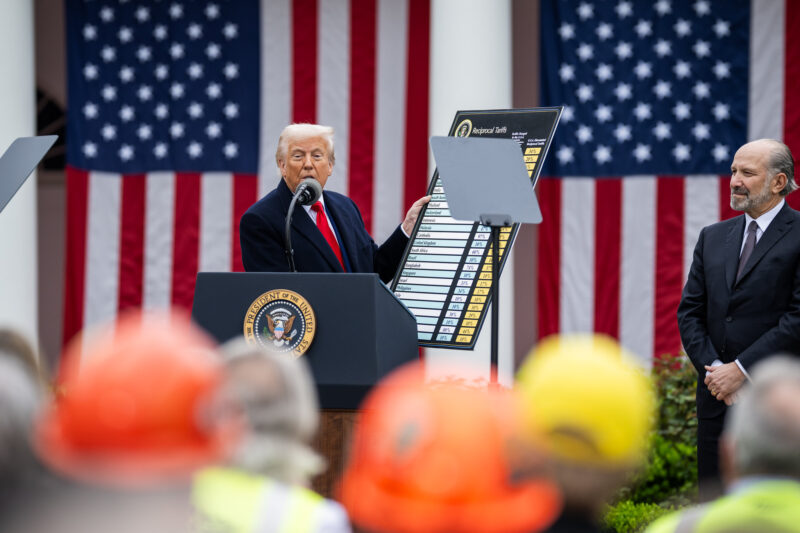
Take Trump’s tariffs. Economists don’t hate tariffs because we think they’ll crash the economy. (Foreign trade is too small a share of U.S. GDP for tariffs alone to cause such calamity.) We hate them because they’re a slow-moving cancer, silently invading an economy’s healthy cells like toxic spores from the Vale of Shadows. Tariffs distort prices, diverting resources from more productive uses. This inefficiency erodes our standard of living, albeit in ways that are hard to detect or quantify. They won’t cause a surge in inflation or an immediate depression. But they will suppress growth and keep costs artificially high, giving consumers less bang for their buck.
Protective tariffs are bad enough. Even more destructive is the vortex of uncertainty they’ve unleashed. If Trump’s tariffs were set in stone, our economy would suffer, but businesses could at least plan around them. Sadly, they’re not. Trump’s trade war is as volatile and unpredictable as The Gate in Hawkins Lab. This on-again, off-again dynamic may work for Steve and Nancy, but it’s a drag on our economy. When standard market uncertainty gets compounded by political uncertainty, consumers delay big purchases while investors stockpile cash rather than invest in new ventures. The result? Low consumer confidence, sagging investment, and anemic GDP growth that, despite a strong third quarter, is still slated to come in well below its 2024 mark.
What’s more, Trump’s tariffs have opened up a series of portals for special interest groups to break through like demagorgs and feast on American taxpayers. Trump has singlehandedly revived the corrupt “spoils system” of the late-1800s (for more on that, see another Netflix hit: Death By Lightning). All trade now effectively flows through “The Swamp,” making it easier for Trump to reward his friends and punish his enemies. Why compete with foreign firms the old-fashioned way when you can maneuver to get tariffs slapped on them? A few million Trumpcoins is a small price to pay to box out your competition. Run a business that relies on foreign inputs? Easy: grovel for exemptions. A simple press release should do the trick–the bigger and more unrealistic the numbers, the better. Sycophancy is the new coin of the realm.
If this seedy spoils system strikes you as an obvious grift or a hotbed of corruption, well spotted. But don’t blame corporations for playing the game. Once businesses realize they can earn more profits by lobbying politicians than serving their customers, expect them to respond accordingly.
Which brings us to nationalizing private industry. Few things are stranger than a president who campaigned on standing up to China but then bending the knee to their economic model: state capitalism. Yet here we are.
Economists define socialism as “government ownership of the economy’s factors of production.” Trump isn’t a socialist, per se. But he has generously paved a wide road to serfdom for future President Ocasio-Cortez by taking a “Golden Share” in U.S. Steel and a large equity stake in Intel, among others. Maybe he’s still basking in the “warmth of collectivism” from his Oval Office hobknob with Comrade Mamdani? Either way, the Soviets beneath Starcourt Mall will be thrilled.
Then there’s the biggest threat of all to our long-term economic security: the national debt.
Raising the alarm about the debt has become trite–like doomsdayers predicting an apocalypse or some boy named Will crying “Mind Flayer!” Our debt is $38 trillion and counting. Think that’s scary? Then you may want to ignore our $120 trillion in unfunded liabilities, driven mostly by entitlements like Medicare, Medicaid and Social Security that Trump stubbornly refuses to address. The numbers are so large that they sound make-believe. But make no mistake: they’re real. And our day of reckoning is coming, sure as Vecna’s final assault on Hawkins.
The debt is already a major drag on the economy. Every dollar that goes to service the debt is a dollar ripped away from the private sector. This drives interest rates higher, affecting everything from a company’s ability to open a new factory to a young family’s ability to purchase a home. The debt also puts pressure on central banks to print more money, as debtors are the biggest beneficiaries of inflation. It’s no coincidence that Trump has pressured, nay, threatened, Fed Chairman Jerome Powell to slash rates, economic indicators to the contrary be damned.
To be fair, President Trump didn’t open this portal all by himself. His predecessors opened it with their own sweeping interventions and executive overreach. But like Vecna, he’s broken it wide open. Now he’s a puppet for the Mind Flayer’s most destructive lie yet: that debts don’t matter, and the only way we can fend off utter ruin is by embracing a command-and-control economy.
Trump campaigned on draining “the Swamp.” But like Vecna, he became One with it, conjuring its dark magic to exact revenge on his enemies while rewarding his toadies. And with each excessive intervention he makes and executive order he signs, he drags us closer to the Abyss.
Like Henry/Vecna, it’s not too late for Trump to avert disaster. In DnD terms, he can still rescue us from the Abyss by casting the Wish spell to undo his ill-fated campaign. He could also summon the courage to take on the Tarrasque that is our national debt. Such a play would unleash the “Golden Age of America” he’s long prophesied. But first, he must accept the error of his ways by rejecting the Mind Flayer’s dark power and turning his entire worldview right-side-up.
So don’t hold your breath.
Much like the NPC residents of Hawkins, most Americans are blissfully unaware of this threat. Most businesses still operate as they did in the before-times. Stocks continue to rise. Inflation and GDP growth are near normal levels. Life seemingly continues apace.
But something feels off-kilter. Main Street isn’t feeling Wall Street’s gains. Cost of living remains high. Growth lags below expectations. Consumer sentiment is flagging.
Why the dissonance? Perhaps it’s because, as Trump suggests, Americans are too stubborn or stupid to give him credit for “the Greatest Economy in the History of our Country.”
Or maybe, just maybe, it’s because lurking beneath the surface of our increasingly fragile economy, there is a destabilizing force—a wormhole of corrupt and ill-fated policies whose gravitational pull is slowly dragging our real economy in and turning it topsy-turvy.
Lights are flickering all over the economy. A final battle is imminent. Alas, Chief Hopper and Eleven aren’t coming to save the day. Congress has shown it’s too weak and cowardly to close Trump’s portal. The Supreme Court may step into The Void to help us if it summons the courage of a Dustin Henderson.
That said, the battle isn’t lost. We’ve escaped slow-moving disasters before.
After a decade of “malaise,” President Reagan brought us back from the Abyss by following an “inescapable conclusion” from history: “Our economic system—based on individual freedom, private initiative, and free trade—has produced more human progress than any other in history.”
It’s not too late to save our “shining city on a hill.” The odds are stacked against us, but stranger things have happened.