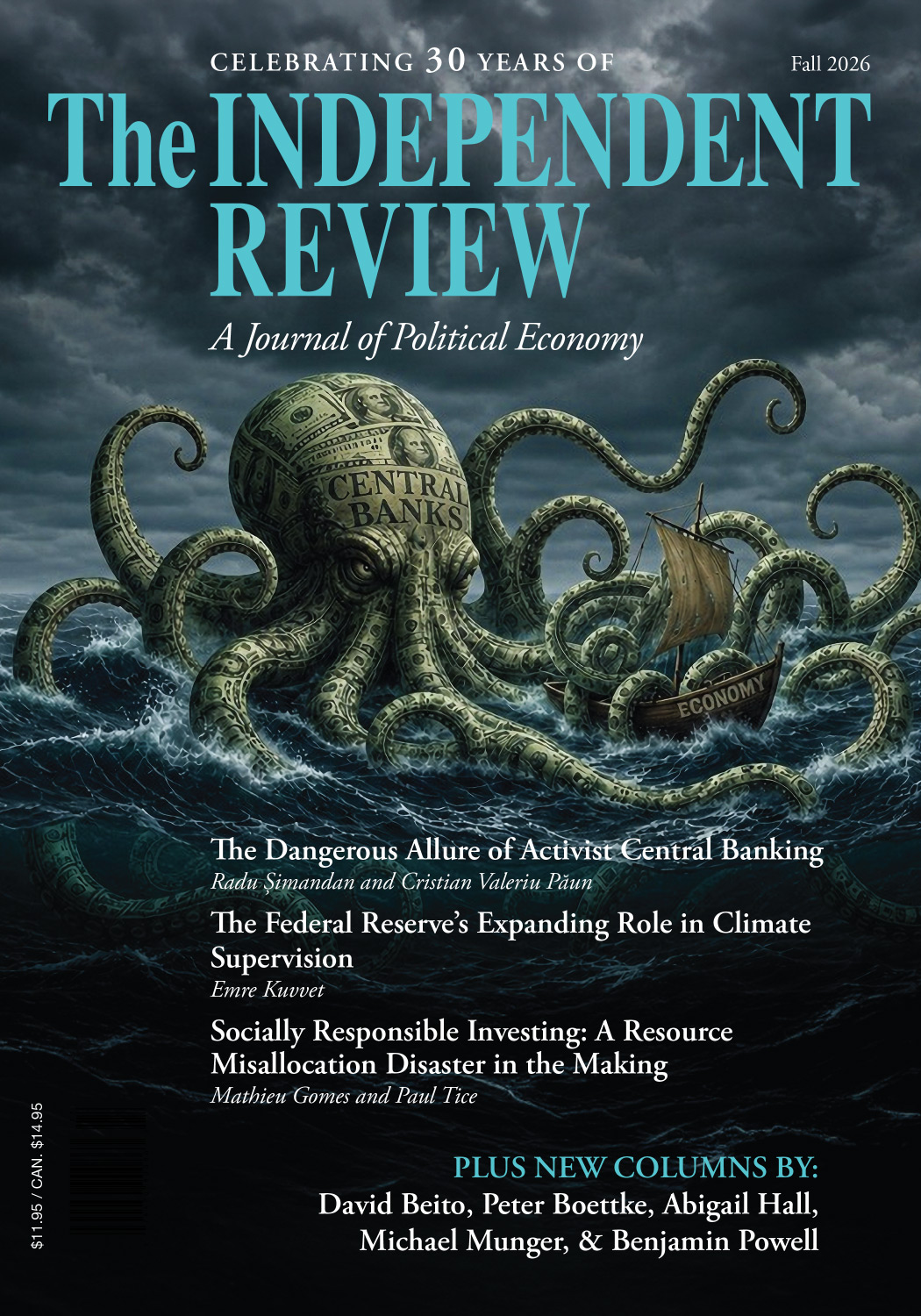


Moral Economics
Book Review
Reviewed by
This book review is a web exclusive for the Fall 2026 issue of The Independent Review.
Alvin Roth’s Moral Economics examines “repugnant markets” (a term he coined in a widely read article, “Repugnance as a Constraint on Markets,” Journal of Economic Perspectives 21, no. 2 [2007]: 37–58). To Roth repugnance is not disgust. “Let’s call a transaction repugnant if all parties to the transaction want to engage in it, and others think they shouldn’t be allowed to for moral or religious reasons, even though those others can’t detect that the transaction has taken place unless someone tells them” (p. 4, emphasis in the original).
Roth recounts that he has often been told that his original article presented both sides of many issues so evenhandedly that most people thought he was really on their side of the argument: “I thought you gave a fair presentation of both sides of the argument. But I could tell that you really agree with me” (p. 15, emphasis in the original). I agree that he did a remarkable job of presenting both sides impartially in that article, which I regularly use in my Current Economic Issues class, but don’t think as many readers will have the same reaction to Moral Economics. I don’t. Rather, I think it’s pretty obvious what side he’s on in virtually every case, even though he maintains that he’s not trying to put his “thumb on the scale” (p. 15).
The book’s chapter titles pithily explain the topics covered: “Sex,” “Reproduction,” “Marriage and Adoption,” “Alcohol and Drugs,” “Credit and Prices,” “Medical Aid to the Dying,” “Vaccines and Challenge Trials,” “Blood and Blood Money,” and—the capstone—“Kidney Transplants.” Roth, a Nobel-laureate, has been a key player in the creation of kidney exchanges and in debates about how to save more lives of people suffering kidney failure. The chapter on kidney transplants is immensely informative and is ideal for classroom use.
“Paying for a kidney has become the very emblem of a repugnant transaction” (p. 204). Although over 500,000 Americans are on dialysis and over 90,000 are presently on a waiting list for a transplant, most people who need a kidney transplant will die without ever receiving one, largely because it is against the law to pay someone for their kidney. Finding a friend or family member whose kidney is compatible—and who is willing to suffer the risks and inconvenience of donating a kidney—is very difficult. Roth has played a pivotal role in creating matching algorithms so that strangers can exchange kidneys. For example, your child needs a kidney, but yours is incompatible, so you give up your kidney to a stranger’s father, and the stranger gives up her kidney for your child. More complicated trades involving many parties are becoming more common. In recent years, 1,500 to 2,000 kidneys have been exchanged this way. That’s a lot of lives saved.
However, many more lives might be saved if it were permissible to compensate donors. That’s where repugnance comes in. Roth explains the reasons that most people don’t think paying donors is a good idea, which is why the practice is almost universally banned. However, bans rarely entirely eliminate markets and there are active black markets for kidneys in countries around the world. The most fascinating part of the chapter examines the one country where organ sales are allowed: Iran. Roth draws on a study that examined data on every transplant in Tehran from March 2012 to October 2017. Most of the payments come from recipients, with the government adding a small portion. “It is expected that donor and recipient will meet before the surgery and agree on [a] payment from the recipient to the donor, within guidelines meant to keep transplants affordable,” with the transfer of funds handled by the Iran Kidney Foundation (p. 224). The average kidney price was about twice the annual minimum wage at the start of the study but fell to about one and a half times the yearly minimum wage due to inflation. The study’s most important finding—based on estimates using postal codes of patient and donor home addresses—counters the repugnance objection that allowing sales will “exploit” the poor to a large degree. The study finds that the wealth distributions of donors and recipients overlap considerably—i.e., kidney sales are not a one-way flow from the poor to the rich. The study finds that 78 percent of donors had lower wealth than the median while, surprisingly, 41 percent of patients purchasing kidneys also had wealth below the median. There were about five times more male donors than female donors—in comparison to the United States, where payments cannot be made and women make almost twice as many living donations as men. Even more fascinating is a study that involved registered Iranian donors, which assessed their impatience and tolerance for risk by having them participate in choices over financial lotteries. It found that those who complete donations are both more patient and less willing to take risks than others who didn’t complete donations. The paper concludes that donating a kidney may be a lower risk for many people—who might otherwise patronize loan sharks or sell important assets to raise money. “While the Iranian experiment has been largely condemned in the international medical literature, my colleagues and I have suggested that there is much to be learned from and appreciated about it” (p. 229, emphasis added). These findings mesh well with Roth’s broader argument that allowing “experiments” will allow us to discover the impacts of changing market rules regarding “repugnant” goods.
Roth is fairly open in his advocacy for relaxing the ban on compensation for organ donations. He suggests that it will save lives and money: “A team of health care researchers carefully estimated that paying American donors about $80,000 for a kidney would not only save tens of thousands of additional lives each year, but would also save taxpayers about $7 billion annually since Medicare covers dialysis for patients of all ages” (p. 216, see Frank McCormick et al., “Projecting the Economic Impact of Compensating Living Kidney Donors in the United States: Cost-Benefit Analysis Demonstrates Substantial Patient and Societal Gains,” Value in Health 25, no.12 [2022]: 2028–33). Dialysis is incredibly expensive, costing around $100,000 per year per patient—totaling about one percent of the entire federal government budget.
The chapter on blood and blood products is also very illuminating. Roth reports that the World Health Organization (WHO) “maintains its insistence that nations should be self-sufficient in [blood] plasma, despite the fact that its own data indicate that the voluntary nonremunerated blood donation system has been a tragic failure for precisely the resource-poor countries they seem to believe it protects” (p. 198). Boo WHO! In the United States there is little repugnance toward payment for donating blood plasma—the pale-yellow, liquid component of blood that makes up more than half of total blood volume—so we have emerged as the world’s dominant plasma supplier. The U.S. supplies about 70 percent of global plasma, which is used in therapies and medications. Most of these paid donors are poorer than average and Roth cites a study finding that when a plasma center opens in a community, the demand for high-interest, short-term loans from nearby “payday” lenders falls. He could also have cited Brendon McConnell, Mariyana Zapryanova, and Sam Kang’s finding that “opening of a plasma center in a city leads to a 12% drop in the crime rate, an effect driven primarily by property and drug-related offenses.”
The chapter on credit markets includes findings that defuse some of the repugnance toward small, high-interest loans, such as those made by “payday” lenders in the U.S. These loans often charge annual-percentage interest rates well over one hundred percent. For example, economists Dean Karlan, Sendhil Mullainathan, and Benjamin Roth “reported experiments in India and the Philippines in which they fully paid off the debt of some borrowers and compared the subsequent borrowing behavior of these randomly chosen borrowers with borrowers whose debts were not paid off. The idea was to see if borrowers were in a debt trap from which they could be rescued by easing their debt. But even this intervention failed: ‘Most borrowers returned to debt within six weeks. One to two years after intervention, treatment individuals [whose debts had been paid off] were borrowing at the same rate as control households [whose debts were not paid off]” (p. 152).
Unfortunately, a few of the chapters don’t work as well. For example, Roth doesn’t seem to grasp the repugnancy to assisted suicide. He recognizes that repugnance toward suicide is “old and profound” (p. 164) but doesn’t really explain why. He notes that people who committed suicide are among those condemned to the Seventh Circle of Hell in Dante’s Inferno. However, he never clearly explains the objection to suicide. Doing so would force him to address issues regarding the nature of man and the nature of creation itself. The traditional Jewish and Christian objection to suicide is that human life is a divine gift, rather than one’s personal property to dispose of. The right to life, in this view, is truly inalienable. But Roth skims over these “profound” ideas. He puts his “thumb on the scale” by noting that New Zealand’s assisted dying website includes “these cheerful words ‘Assisted dying is a new health service in New Zeeland’” (p. 174, emphasis added). The words won’t sound “cheerful” to opponents of the policy, who would have written, instead, that the website includes these “dreadful” words and who would regard “assisted dying” as a “disservice,” not a service at all. Such readers will conclude that Roth simply doesn’t get it and shake their heads in sadness when he dismisses objections to suicide as an “ancient” repugnancy (p. 173), describes physician-assisted suicide as “not yet legal” (p. 1, emphasis added), and quotes a prominent suicide as dismissing the last years of his own life as “superfluous” (p. 163). Civilization rests on the recognition that no human life is superfluous.
Comments
Related Book Reviews


Independent Review Issues
Articles by Issue