
False Dawn
Book Review

Reviewed by
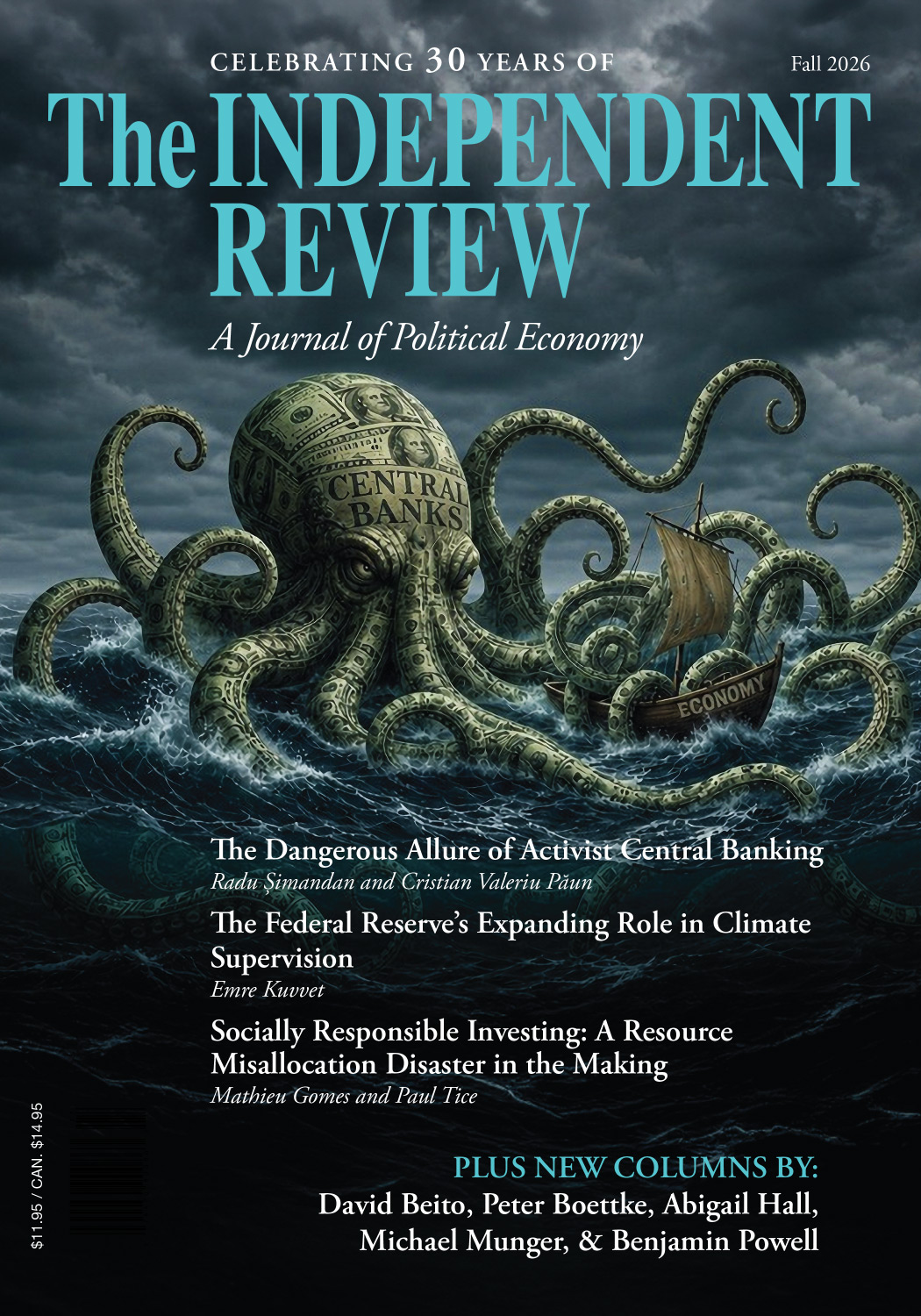
This book review appeared in the Fall 2026 issue of The Independent Review.
George Selgin’s False Dawn opens with a defense of its own necessity. In a field as crowded as the history of the Great Depression and the New Deal, what new is there to say? Selgin proposes that his book specifically addresses two questions: (1) What allowed the United States to recover from the Depression? (2) How did the New Deal contribute to or inhibit this process? Of course, these are hardly narrow issues, but the opening usefully frames what the book is not about. Of the “three R’s”—relief, recovery, and reform—this book is squarely focused on recovery. Whatever the long-run effects of structural changes in the economy, from the Fair Labor Standards Act in labor markets to Glass–Steagall in banking, those are not the focus here.
Selgin anticipates another objection to his book: Will this be a polemic from a scholar with a well-known and forthrightly acknowledged bias toward libertarian-leaning, though firmly neoclassical, economics? While no one could criticize Selgin for hiding his opinions, this book is not a screed. Historians with whom Selgin disagrees, such as Eric Rauchway, come in for harsh criticism, of course. Episodes such as the issuance of Executive Order 6102, forbidding the “hoarding” of gold, unsurprisingly are decried, as are events such as the Federal Reserve being asked to prepare lists of individuals who had withdrawn gold from member banks prior to Roosevelt’s own inauguration. Yet this is not a goldbug’s lament or a call for Mellon-esque liquidationist policy. Instead, Selgin heaps scorn on the dithering of Franklin Delano Roosevelt’s administration, during which, despite a de facto devaluation of the dollar, neither the Treasury nor the Fed allowed this to translate into the ultimately desired goal of monetary expansion. In fact, Selgin repeatedly returns to regime uncertainty as the central explanation for the mediocre results of much of the New Deal.
If this book is not a jeremiad and is covering well-trod ground, what is the purpose of the book? To me, the answer lies in the revolution in macroeconomic methods over recent decades, a revolution that has increasingly filtered into economic history. Consider a simple question: Were the actions—or the inaction—of the Federal Reserve responsible for the banking panic? While of course the Fed has long been blamed for the crisis, prominently by Milton Friedman and Anna J. Schwartz’s A Monetary History of the United States, 1867–1960 (1963, Princeton University Press), the solution to the severe endogeneity problems here is not obvious. After all, the Fed was not then and is not now setting policy randomly. How, then, are we to understand the causal relationship between monetary policy and banking stability?
Here is one idea, from Gary Richardson and William Troost (2009, “Monetary Intervention Mitigated Banking Panics During the Great Depression: Quasi-Experimental Evidence from a Federal Reserve District Border, 1929–1933,” Journal of Political Economy 117, no. 6: 1031–73). Simply put, the regional Federal Reserve Banks had far more independence during the Depression than they do now, creating the kind of quasi-random variation beloved by the modern applied micro-econometrician. The undergraduate econometrics textbook Mastering ’Metrics by Joshua Angrist and Jörn-Steffen Pischke (2015, Princeton University Press, pp. 178–91) in fact uses this precise example to introduce the method of difference-in-differences as an identification strategy, showing how “clean” this experiment is (and allowing me to smuggle some economic history into an econometrics class). Ultimately, these authors do find that more accommodative monetary policy could have dramatically lessened the number of bank failures.
Is that the question we are ultimately interested in, however, or is it rather whether the banking panic was responsible for the downturn in the real economy? How to answer this is by no means obvious, since of course real shocks can cause banking panics, leading to a clear identification problem. Richardson and Troost show evidence of how the different policies affected real economic activity, as does Nicolas L. Ziebarth (2013, “Identifying the Effects of Bank Failures from a Natural Experiment in Mississippi During the Great Depression,” American Economic Journal: Macroeconomics 5, no. 1: 81–101), who uses establishment-level manufacturing data from Mississippi—which was, and remains, split across two Federal Reserve districts—and finds large negative real effects from following the strict monetary policy dictated by the real bills doctrine.
I go through this example to show how, even in questions such as “What caused the Great Depression?,” the macroeconomic answers are increasingly built from micro work—not just in the sense of “micro-founded” theoretical models, but in terms of nitty-gritty questions such as “Can we come up with a convincing, well-identified causal estimate of the employment effects of the National Industrial Recovery Act, despite the surrounding policy chaos?” Economists who labor to produce such microeconomic studies, including myself, owe a debt of gratitude to authors such as Selgin, who blend the disparate results into a coherent narrative. This is where Selgin’s book is at its strongest. And the overall argument is convincing. Whatever else one can say about Roosevelt’s experimental policy in terms of relief for struggling Americans, it is hard to look at the economy of 1938 and say recovery had been achieved or even that it was in sight.
Thematically, the book is divided into three sections: “Groundwork,” covering the period leading up to Roosevelt’s inauguration and the immediate crisis actions of his administration, most notably the banking holiday; “The New Deal,” which is the meat of the book, covering the success and lack thereof of the alphabet soup of the New Deal; and “After the New Deal,” a coda pointing toward the ultimate end of the Depression. The chapters in each section are short, punchy, and reasonably self-contained, in the sense that someone who was interested mainly in the National Recovery Act or housing policy could focus on those areas only, if they so chose. Particularly useful for me was chapter 2, “Inventing the New Deal,” which lays out the historiography of the term itself. While this history is intellectually interesting for its own sake, the somewhat chaotic invention of the term reflects the overall theme of the book: that the lack of a coherent plan, or even a connection between campaign promises and eventual policies, injected harmful uncertainty into the economy.
The chapters on individual programs such as the National Recovery Administration are fresh, modern, and convincing. A particular highlight of this part of the book is the discussion of the recession of 1937–38. If Selgin perhaps betrays his bias in the labeling of the “Roosevelt Recession,” he is scrupulously fair in allowing that the baffling contractionary policies of the Federal Reserve, based on phantom fears of inflation in an economy still dramatically below the 1929 price level, did Roosevelt no favors. Yet here Selgin shows how modern empirical work has convincingly placed much of the blame for the intra-Depression downturn on shocks that can be blamed squarely on the Roosevelt administration, in particular labor policies promoting high wages.
Where the book is marginally less convincing than in the apt diagnoses of the failures of the New Deal is in explaining the ultimate escape. Selgin lays out in detail the failed predictions of a return to malaise and depression after the end of World War II. For him, the explanation is ultimately a resolution of the regime uncertainty via a rapprochement between the government and capital. Freed of the fear of capricious Roosevelt actions, and with pent-up savings from suppressed consumption during the war, the economy was poised to boom with the growth in investment. Here, though, there are fewer citations to modern studies. I do not fault Selgin for this, as to the best of my knowledge this is still a wildly unsettled question. Shigeru Fujita, Valerie A. Ramey, and Tal Roded recently suggested that market forces alone are sufficient to explain the recovery (2024, “Why Didn’t the U.S. Employment Rate Rise at the End of WWII?,” NBER Working Paper No. 33041, National Bureau of Economic Research). This to me is a call to arms to economic historians today to attack World War II with the same enthusiasm with which they have studied the New Deal and to put microeconomic flesh on the macroeconomic bones here.
Quibbles aside, Selgin has written a book intended not just for specialists in economic history, but rather for anyone interested in what governments can or cannot do to fight recessions. Is this necessary? Unfortunately, yes, and increasingly so. Very recently, the president of the United States posted on his own social media network that credit card interest rates would be capped at 10 percent, with unknown (if any) legal authorization. Will that policy be enacted? Almost certainly not, and yet if ever there were policy-induced uncertainty, it would be here. The counterproductive effects were immediately apparent, with bond yields rising in response to this attempt to fight an “affordability crisis.”
And yet, the United States did return to normalcy after the Great Depression: Prosperity returned after World War II at a rate that astounded contemporary observers. Whatever our problems are today, they do not reach the scale of the Great Depression. Adventurism and uncertainty can fade again, with unexpected positive results. Selgin’s book is a reminder that recovery is about not just action, but credible and coherent action.
Comments
Related Book Reviews

The Fair Trade Scandal


The Uninhabitable Earth

Common Enemies

Equality

The Economics of the Parables


Independent Review Issues
Articles by Issue