Why Televisions Have Become So Cheap
Goods and services that enjoy capitalism become cheaper and better. Those that fall under heavy government regulation do the opposite.
January 17, 2026
News Article
Goods and services that enjoy capitalism become cheaper and better. Those that fall under heavy government regulation do the opposite.
Have you noticed how much cheaper—and better—televisions have become the last few decades?
In the early 2000s, most Americans were still watching television on heavy cathode-ray tube sets. The average household TV was 25 inches, with a thick plastic frame, curved glass screen, and picture quality that now looks unwatchable. Flat screens existed but were luxury items, with plasma TVs starting at $2,000, rendering them aspirational tech rather than a mass-market option.
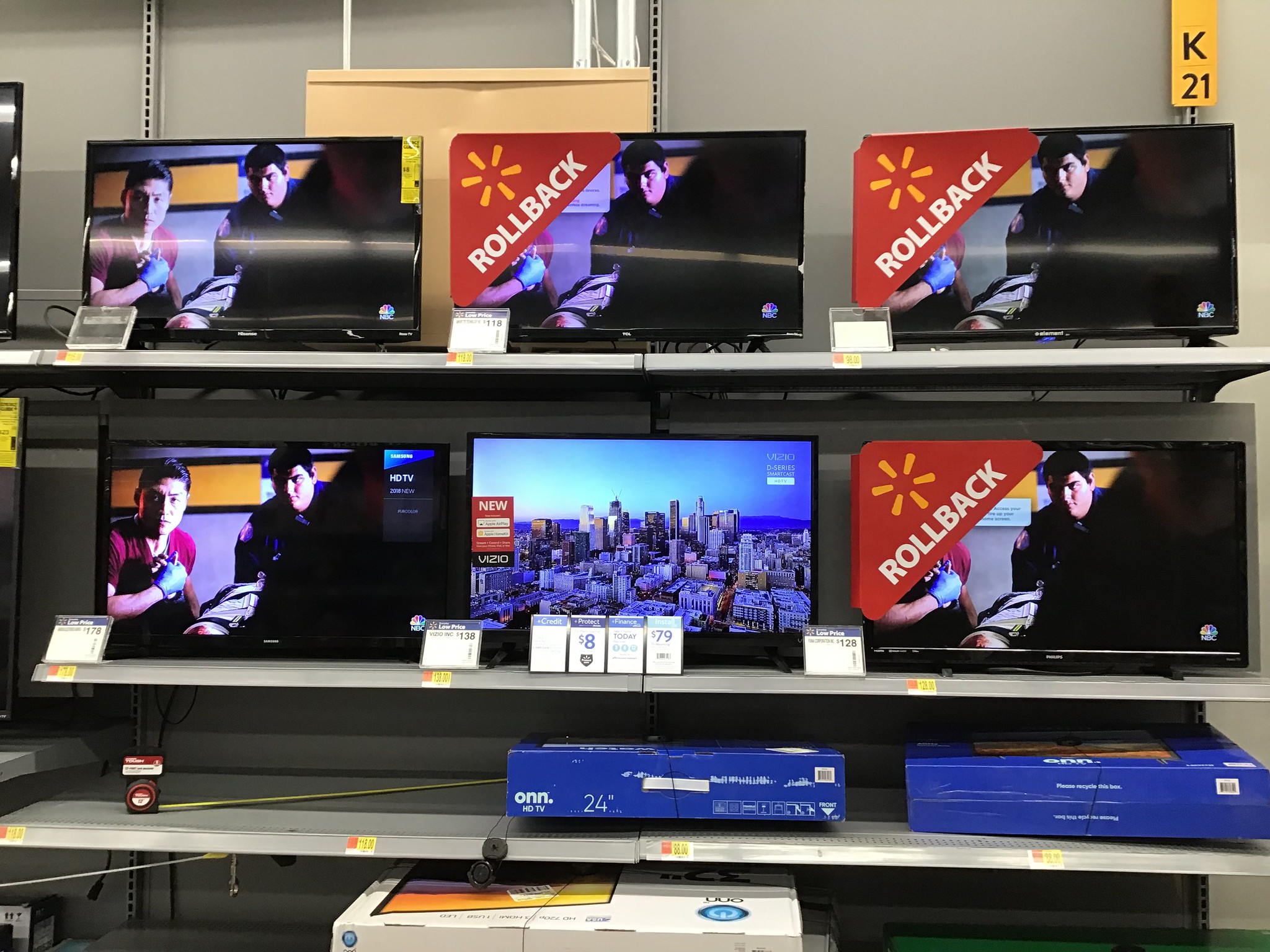
Nowadays at Walmart, you can buy a 75-inch ultra-high-def “smart” TV for under $500, with immersive sound, voice control, and other computerization that would’ve been science fiction in the TiVo days. This price flattening has occurred not just with televisions, but all consumer electronics, and has happened during the same period when more essential goods and services rose in price. It’s a great case study in what happens when industries are largely unregulated and exposed to competitive pressures, while others are heavily regulated or even socialized.
The discrepancy was highlighted by AEI economist Mark Perry, who updated a now-famous chart comparing price changes across major consumer categories since 2000.
Between 2000 and 2025, according to the Bureau of Labor Statistics, prices for many goods have grown more slowly than overall inflation—or even declined in real terms. These include televisions, computer software, phone service, household furnishings, and new cars. In each category, quality has also greatly improved.

Meanwhile, costs in other sectors have soared beyond inflation. Housing, childcare, and higher education have all experienced price increases well above CPI. Hospital services, in particular, increased at three times the inflation rate.
The goods that have fallen in price relative to inflation tend to be less labor-intensive and easier to scale using global supply chains. They are also heavily tech-infused, which drives down marginal costs. By contrast, sectors that grew more expensive are labor-intensive, domestic, and hard to automate.
But there’s another pattern hiding in plain sight.
The low-cost side of the chart overwhelmingly consists of industries with limited government involvement, while the high-cost side is dominated by sectors subject to extensive regulation, subsidies, licensing regimes, and political management.
Televisions are a global product in every sense. Their components are sourced from dozens of countries. Panels may come from South Korea, Japan, or China; processors from Taiwan; software designed in the U.S.; and assembly performed wherever costs are low and logistics most efficient.
Crucially, there are no binding restrictions on how many TVs can be made, what sizes can be sold, or which firms are allowed to compete. The market is crowded with competitors—Samsung, LG, Sony, TCL, Hisense, Vizio—each forced to innovate relentlessly to maintain market share.
There are some protectionist elements: tariffs on imported electronics, trade disputes involving China, and subsidies for domestic semiconductor manufacturing. But relative to other sectors, TV production remains open, creating competition and collapsing prices.
Automobiles operate under similar forces, but with more friction. Safety and emissions standards, dealership franchise laws, and trade protections all raise costs and limit competition. As a result, new cars, while generally seeing improvements in quality, haven’t fallen in price like TVs.
Housing is among the clearest examples of how regulation drives cost. Local zoning laws, environmental reviews, parking mandates and much more restrict density and raise costs before construction even begins. A widely cited study by the National Association of Home Builders estimates that government regulation accounts for roughly 24% of the final price of a new single-family home. That is not market failure, but a policy choice made intentionally by incumbent homeowners who benefit from restricting supply for aspiring new homebuyers.
Healthcare costs reflect a similar dynamic. The Affordable Care Act expanded insurance coverage, increasing demand—but did little to expand the supply of doctors, hospitals, or services. At the same time, licensing restrictions limit the number of practitioners, liability rules increase malpractice costs, and regulatory compliance consumes vast resources. The result is higher utilization layered onto constrained supply, all mediated through opaque third-party payers (namely insurers), which function as cartels who obscure the true cost of medical procedures.
Education may be the most striking example. Public K-12 is almost entirely state-managed, with costs per student jumping from $14,000 to $20,000 per year from 2002 to 2023. Higher education tuition rose even faster, doubling over the last three decades.
Despite this spending explosion, educational outcomes have declined. National Assessment of Educational Progress (NAEP) scores show falling proficiency in math and reading.
Where has the money gone, if not into funding better outcomes? Largely into administration, with colleges spending between 20-30% of their budgets on that. Universities are lathered with subsidies—some schools receive as much as 40% of their income from federal spending—and protected with accreditation rules rather than forced to become competitive actors. Naturally, then, they have devolved into politicized institutions where the instinct is to grow bureaucracy, since that increases a school’s status as a political bloc and lobbying force.
The lesson from the above chart is not subtle. When industries are exposed to competition, innovation, and price pressure, they become cheaper and better. Government involvement, by contrast, makes things more expensive. Televisions did not get cheaper because of central planning, but if the government ever decided—God forbid—to lean in on television production policy the way it has with housing, healthcare, or education, we should expect higher prices and lower quality.
Cover image use authorized under the Creative Commons Attribution 2.0 Generic license.