How Will the U.S. Government Pay the National Debt?
December 1, 2025

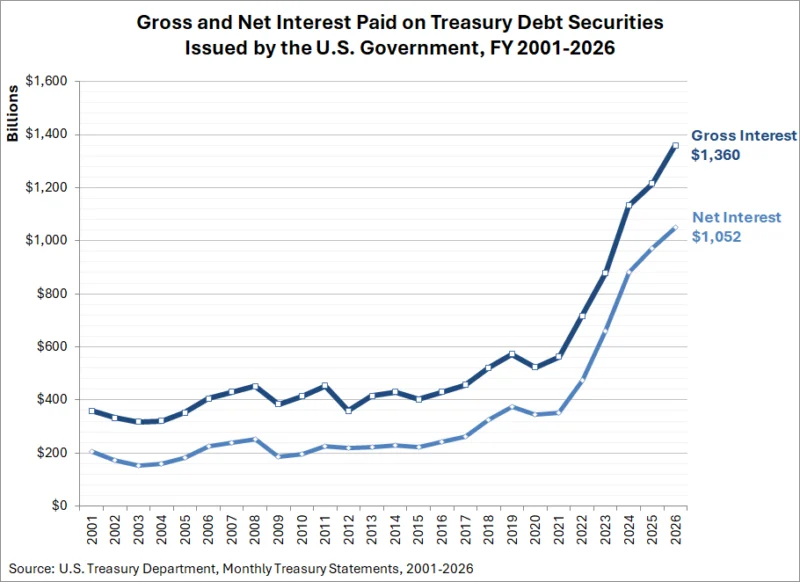
Between August 8 and October 21, 2025, the U.S. government’s total public debt outstanding increased by more than $1 trillion, reaching a total of $38 trillion. One month later, the national debt had risen to $38.3 trillion. Despite being shut down for much of that month, the rate at which the federal government borrows to support its excessive spending has not slowed.
Divided equally, that works out to be $284,125 for each of the country’s 134,800,000 households. That amount is about what the typical house for sale costs in Kentucky, which the government is borrowing to pay for the equivalent of over 47,500 such houses per day.
If you’re like most American households, you probably can’t afford the cost of borrowing to own an extra home in Kentucky. In truth, neither can Uncle Sam. And yet, the national debt continues to grow as if the U.S. government can afford to buy a town’s worth of houses every day. Elected officials and bureaucrats need to do more to get the government’s fiscal house in order.
Writing at Bond Vigilantes, fund manager Robert Burrows outlines three things politicians could do to address the growing problem of the national debt.
1. Default, the least palatable option
A sovereign default is theoretically possible, but for a country like the US, which has full control over its monetary system, this is extremely unlikely. Default is economically destructive, politically toxic, and would undermine the very foundation of the global financial system, given the role of Treasuries as the world’s reserve asset. This path is a last resort.
2. Growth, the most desirable but unlikely
Growing out of debt is the cleanest option. Strong GDP growth allows debt-to-GDP ratios to fall naturally, as the economy expands faster than debt accumulates. But this solution has proved elusive for most developed economies. Growth has been disappointing over the past two decades, and demographic trends, particularly slowing population growth, suggest headwinds will only get stronger. Perhaps an AI-driven productivity boom could shift this picture.
3. Inflation, the most likely outcome
The most realistic path is to let inflation do the work. As nominal GDP rises, the burden of fixed-rate debt shrinks in relative terms. This method spreads the cost across the population quietly and gradually, eroding the real value of government liabilities, while the electorate suffers from a lower standard of living.
There’s a fourth option: Reduce the growth rate of the government’s spending to be lower than the growth rate of its revenues over time. This option is extremely unlikely given the current crop of politicians in Washington, D.C. They have already had the opportunity to reduce federal government spending and they haven’t taken it.
So inflation it is. As measured by the Consumer Price Index, today’s inflation has been running at an average annualized rate of 3.1%. It has been running at that rate since mid-2022, when the Federal Reserve finally acted to get control over the runaway inflation unleashed by the Biden administration. This new inflation target compares with the 1.7% average inflation rate recorded from 2000 through 2020.
Instead of doubling roughly every 42 years, the prices American consumers pay for everything they buy will double every 23 years. That’s a substantial reduction in the standard of living for American households, all to make the national debt more affordable for the U.S. government.