The Postliberal Push: The Mainstreaming of Carl Schmitt’s Authoritarianism
November 20, 2025

News Article
An increasing amount of public attention has been drawn to an obscure ideological movement called “postliberalism,” which argues that free markets, individual liberty, and limited government handicap a societal commitment to what they call the “common good.”
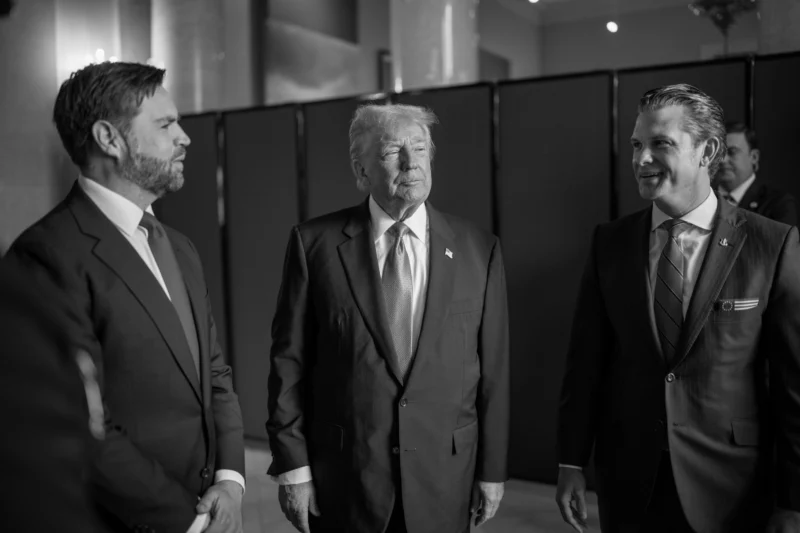
Until just a few years ago, postliberalism hovered around the extreme periphery of the political right. That is no longer the case. The most obvious reason is that Vice President J.D. Vance self-identifies as a postliberal. And more recently, the postliberal movement has found itself at the center of a string of controversies. These included Heritage Foundation president Kevin Roberts, another self-described postliberal, who had to apologize for his controversial defense of Tucker Carlson’s interview of antisemite Nick Fuentes, as well as a near-simultaneous board shakeup over the promotion of postliberal speakers by the Intercollegiate Studies Institute. Shortly thereafter, postliberal pundit Rod Dreher condemned the platforming of Fuentes while issuing a jaw-dropping warning about the rise of antisemitic influences upon the American right. In Dreher’s estimation, perhaps as many as 30-40% of young conservative staffers and interns in DC hold Fuentes and his movement in high esteem.
Most intellectual postliberals, unlike Nick Fuentes’s “groyper” followers, are not usually antisemitic. The primary criticism of postliberals in these recent affairs is their welcoming of extremist voices into the conservative coalition. Some postliberals have made efforts to capture DC institutions and political appointments by flooding them with right-wing loyalists, and this has opened the door to young radicals sympathetic to Fuentes. That is not to say that postliberals do not have their own radicalism, however.
James M. Patterson and I have been working for the last two years on a book critiquing postliberalism, which often associates itself with traditionalist Catholicism. We are both Catholics, so it matters to us when these thinkers try to normalize authoritarian reactionaries like Joseph de Maistre or Nazi jurist Carl Schmitt. This has required us to go back and read these thinkers and respond to them. In a recent essay, I critiqued the implicit tribalism of Schmitt’s emphasis on the friend-enemy distinction made popular by his essay “The Concept of the Political.” Here, I would like to instead critique the latent authoritarianism in his account of a “state of exception” in the book Political Theology.
Schmitt’s “State of Exception”
One such effort to normalize Schmitt appears in postliberal theorist Adrian Vermeule’s book Common Good Constitutionalism. Vermeule, a Harvard Law School professor, interprets what is called in Catholic Social Teaching the principle of subsidiarity, normally thought to limit state power, in terms of Carl Schmitt’s idea of a “state of exception.” Schmitt, a prominent German legal theorist who fell into discredit in the 1930s by embracing the Nazi government, devoted considerable energy to espousing a theory of unbounded executive authority during times of political emergency. In his own time, Schmitt’s theories aided the Nazis in overturning the Weimar Constitution and ruling by “emergency” decree. More recently, he has undergone a rehabilitation as a critic of liberal modernity, a recurring grievance of the postliberal movement.
Schmitt’s “state of exception” in that work refers to when the sovereign must act above the law for the sake of preserving or restoring order. Vermeule likens this to how subsidiarity allows for exceptional support by the state for lower levels of organization that are not properly executing their function. The effort to identify subsidiarity with this idea of a state of exception, however, is problematic for a couple of reasons. For one, in papal social encyclicals, the emphasis is always on the principle of subsidiarity as a limit on state power:
This is a fundamental principle of social philosophy, unshaken and unchangeable. . . Just as it is wrong to withdraw from the individual and commit to a community what private enterprise and industry can accomplish, so too it is an injustice, a grave evil and a disturbance of right order, for a larger and higher association to arrogate to itself functions which can be performed efficiently by smaller and lower societies. Of its very nature the true aim of all social activity should be to help members of the social body, but never to destroy or absorb them” (Pope Pius XI, Quadregesimo Anno, as quoted by Pope John XXIII, Mater et Magistra 53, clarifying by its selection some of the ambiguity of the original encyclical)
It is thus strange to define the principle of subsidiarity in terms of its exception: the justifiable instances of state interference. You can defend such interference directly without reference to subsidiarity, but with an appeal to the common good or solidarity.
It is even stranger to define the principle in Schmittian terms. Schmitt’s treatment of the “state of exception,” in fact, is more problematic than a mere defense of emergency powers or exceptional interference in civil society. Read in the context of Schmitt’s Political Theology, and in light of his own application of the principle, as well as the way it has been applied by other Schmittians, it is functionally a veiled rationalization of (democratic) authoritarianism.
“Sovereign is he who decides on the exception” is the famous first line of Political Theology. In this work, Schmitt defends emergency powers, which he believes should be broad and open, allowing the head of state to determine when an emergency occurs and what sort of emergency action needs to be taken to restore order. But more than that, Schmitt is concerned with defending the notion of a personal sovereign, a rule-by-law of one person in opposition to the liberal-constitutional emphasis on a rule of law. He defends personal sovereignty because he thinks it is necessary to preserve an element of transcendence in politics.
To defend personal sovereignty, Schmitt devotes the third chapter of Political Theology to analyzing modern political history, arguing that the loss of transcendence in politics, linked to the erosion of personal sovereignty, stems from changes in theological vision. Liberal constitutionalism, he argues, is connected with deism, whereas personal sovereignty is more associated with traditional Catholicism. One problem is that Schmitt’s analysis of the history in this chapter is superficial, relying on truisms about the “enlightenment” and modernity. Not only were many American founders Christian, but the founding generation that supported independence and later ratified the Constitution was mostly Christian (albeit somewhat less observant than later generations). Also absent from Schmitt’s account is the history of Catholic social contract and consent theory, particularly as it was defended by the Spanish scholastics, or a consideration of the way the latter thinkers were often critical of political absolutism, even if they had not yet discovered the institutional corrective to it.
The bigger problem, however, is not these superficial associations but the political philosophy and political theology themselves. The reason a personal sovereign strikes Schmitt as transcendent is that the sovereign takes on a God-like role in relation to the political community. But that grants a human political leader a status that he cannot legitimately possess. This is the opposite mistake of conciliarism, which interpreted the Church like an ordinary political community that delegates its natural authority to the pope, a view that papalists like Cajetan, Vitoria, and Bellarmine saw as appropriate for political communities but not for the Church.
Implied in Schmitt’s discussion of transcendence is that the “sovereign” of a political community, whose sovereignty becomes manifest in the “exception,” is more like a divine authority. It should be no surprise that playing God, directly or vicariously through a charismatic leader, creates a feeling of transcendence, just as stealing or murder can make people feel transcendent to their community, but this kind of personal sovereignty is at best unwise, at worst unjust. It is unwise as a constitutional arrangement, given the whole history of absolutism, whether it was Caesar Augustus, Louis XIV, or Hitler. Constitutionalism, by creating a rule of law, allowed us to check leaders and hold them accountable without recourse to violence—it allowed, that is, for the institutionalization of the right of resistance. Personal sovereignty becomes not only unwise but also unjust, especially when it contradicts the social contract of the community. Political leaders only have the authority that their political communities grant them through the law. Emergency moral exceptions may exist, but not because the person becomes a transcendent “sovereign,” but for reasons similar to those for equity in courts: a leader interprets what the political community would accept if it knew the exceptional circumstances. In a constitutional democracy, however, there will ideally be checks, limits, and accountability for abuses of such discretion, because the law, legitimated by the consent of the community, is sovereign, not the leader.
In discussing states of exception, Carl Schmitt was more concerned with defending personal sovereignty, even democratic authoritarianism. This becomes particularly evident in his application of these ideas. For instance, Schmitt defended a broad (unconventional) interpretation of Article 48 of the Weimar Constitution to justify the 1932 Prussian coup led by Franz von Papen, which President Hindenburg sanctioned. This coup weakened the separation of powers within Weimar Germany and subsequently facilitated the Nazis’ ability to establish totalitarian control when they came to power the following year. And, second, in 1934, after the “Night of the Long Knives,” when Adolf Hitler had political opponents in the SA murdered, Schmitt defended the move with an article, “The Führer Protects the Law.” As Tracy B. Strong notes in his foreword to George Schwab’s translation of Political Theology, it was precisely “the reality of taking power and manifesting sovereignty in the use of power that attracted Schmitt: his understanding of law required that he support Hitler.” One can separate some of Schmitt’s ideas from his Nazism and his personal support for Hitler, but the reasons that motivated his concern for the “state of exception” are more difficult to separate.
The case is not wholly different from contemporary Schmittians. Vermeule first discovered Schmitt in the 2000s while researching the constitutional dimensions of emergency power in the aftermath of the 9/11 attacks. With contemporary Schmittians, it is not uncommon to see a twofold rhetorical strategy for normalizing a view of an unbound executive: 1) highlight extreme cases where emergency discretion seems plausible to normalize broader executive authority; 2) argue that executive discretion has grown anyway, so we might as well embrace it. The former is that most in line with Schmitt’s own approach, and can be seen in the debates about torture that appeal to a radical scenario, the so-called “ticking bomb,” about a detainee who knows how to stop a nuclear attack. Whatever one thinks about the ethics of torture in such a scenario, it has been used to justify the ordinary application of interrogation techniques that arguably constitute torture, for instance, waterboarding at Guantanamo Bay, and with detainees who never received anything like due process.
Again, it is not the “exception” that typically motivates the contemporary Schmittian; it is the reinstitution of an authoritarian sovereign, albeit an elected one. While Schmitt’s friend-enemy doctrine in “The Concept of the Political” serves in practice as a rationalization for tribalism, his thoughts on a “state of exception” in Political Theology are almost always used to rationalize autocratic power. As arguments for mere emergency powers, they are superfluous.
Therefore, these two most famous works of Schmitt are most valuable to those with tribalist and authoritarian feelings in need of rationalization. For the rest of us, uninterested in rationalizing such feelings, these works are mostly valuable for understanding why we should not revive the authoritarian relics of interwar German postliberalism as a model for the United States in the 21st century.