Trickle-Up Tariffs: How Protectionism Leads to Bailouts
September 17, 2025

News Article
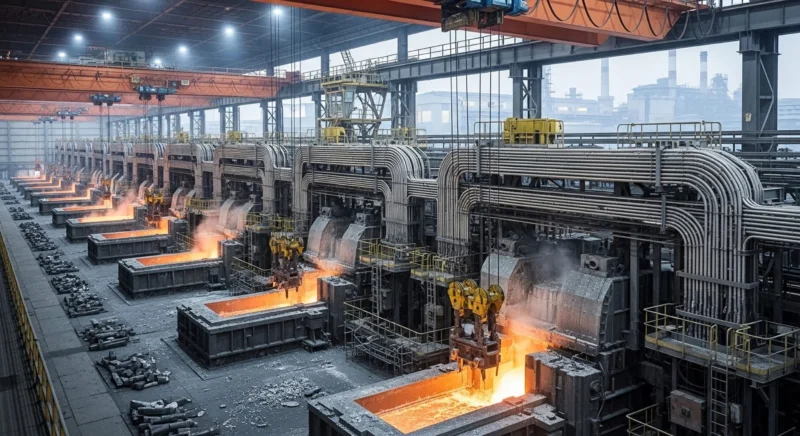
Despite their economic downsides—declining consumer confidence and a contracting U.S. economy—tariffs remain popular among certain voters. Why? Because they serve special interests. For example, the United States has levied tariffs on foreign steel, petroleum, and machinery. Further tariffs include a stupefying duty of up to 145% on Chinese goods.
These trade barriers protect favored industries from foreign competition at the expense of other factors of production and smaller competitors. The steel and auto industries, which spent more than $100 million combined on lobbying in 2024 alone, benefit greatly from barriers to entry. Rent seeking helps entrench their positions, even when market forces might say otherwise. Trade barriers also promote another problem that may take years before showing itself.
This protection can function like a subsidy, allowing the firm to expand not through innovation, but through being insulated from outside competition. As time passes, protectionism encourages firms to grow exponentially larger than they otherwise would have. If a firm becomes large enough, it will be considered vital for the U.S. economy to function, and the rules of risk are altered. Usually, if a firm does something risky that results in consequences, it must bear those consequences. But what happens when an oversized firm is indispensable for U.S. economic stability?
For some firms, protectionism has created a noticeable cycle. Market discipline would normally balance firm size and consumer demand, but unnatural growth makes this impact muted. For large firms that benefit from protectionism, these consequences do not exist, as these firms have been deemed too big to fail (TBTF). Due to this doctrine, irresponsible choices do not always mean suffering consequences—instead, the financial repercussions fall on the taxpayer. In the short term, protectionism benefits both firms and consumers, but in an economic downturn, the costs fall on the taxpayer through bailouts. The idea of TBTF started in the 1970s, although it didn’t take on its modern usage until 1984. At this time, Congressman Steward McKinney, when discussing the bailout of Continental Illinois, described the Chicago-based bank as TBTF. But what does this mean?
When a firm is deemed TBTF, it is considered systemically important to the financial system. If a firm of this size were to go bankrupt, the economic consequences would be catastrophic. Other important firms could collapse, a credit crunch could ensue, and entire markets could seize up. A bailout is provided to ensure solvency when this kind of firm is at risk. This argument is typically used to defend tariffs and trade barriers that are created in the name of national security, yet the argument falls short. Protecting certain industries by impeding trade allows these same industries to become complacent and weak, further harming the U.S. economy. Additionally, the cost of bailing out a weak economy is greater when the market is not allowed to correct itself naturally.
Bailouts are not free; they are tradeoffs. The tradeoff occurs between taxpayers and the financial system. Essentially, the taxpayer provides the money for the bailout, and in exchange, the financial system does not suffer losses that exceed the cost of the bailout. The logic holds, and the tradeoff is present; however, incentives are altered when a bailout is provided.
The bailout of Continental Illinois in 1984 is where the modern story of TBTF began. Continental Illinois was a bank holding company in Chicago that was an aggressive participant in purchasing oil and gas loan participations from Penn Square Bank, which would issue massive, risky loans. While it is debated what exactly caused issues with Penn Square (poor underwriting, oil prices collapsing, and funding issues), it is clear that Penn Square was unable to fulfill its deposit outflows. Because of Square’s position, the Federal Reserve extended a total of $25.7 million in emergency loans over the span of a week. Ultimately, the Comptroller of the Currency declared the bank insolvent on July 5th, 1982, after the Federal Reserve would not extend more credit to the failing institution.
Due to Square’s failure, Continental Illinois realized $492 million in loan losses. Of this amount, $220 million resulted from the failure of Penn Square Bank. This losing streak peaked two years later, when nonperforming loans totaled $2.7 billion. On May 17th, 1984, the Federal Deposit Insurance Corporation (“FDIC”) stepped up with a bailout totaling $5.5 billion in new capital and $8 billion in emergency loans.
The bailout of Continental Illinois ushered in a new financial era. Once a firm was large enough and“deemed “systemically important, freedom from failure was guaranteed. This implicit guarantee reshaped marketplace incentives. Now, additional risk-taking is shouldered under the assumption of government redemption.
Looking back at Continental Illinois, the firm should have been allowed to fail. Its preservation in 1984 set the precedent for future bailouts. The Savings & Loan Crisis soon followed, costing anywhere from $125 to more than $175 billion. Then came Fannie Mae and Freddie Mac—who were bailed out at a combined $189 billion—and Bear Stearns, which received a $30 billion guarantee from the Federal Reserve. The perpetual bailouts that followed would dwarf that of Continental Illinois because the precedent of TBTF changed the incentives. Now, firms were encouraged to diversify risk so that they would be deemed systemically important. This diversity would secure survival, as bankruptcy would spell disaster for the system.
While Continental Illinois is today’s standard, there are other, much larger systemically important companies that exist today. More importantly, TBTF no longer applies only to banks. During the 2007-2008 financial crisis, non-bank firms like General Motors, AIG, Chrysler, and Ally Financial were all seen as too big to fail and subsequently bailed out.
It is important to note that one firm that was supposedly TBTF did fail—Lehman Brothers. The collapse of Lehman in 2008 eliminated approximately $10 trillion in stock market value. This led to a liquidity crisis. Lehman’s collapse is generally believed to have ushered in the Great Recession. When it declared bankruptcy, Lehman had debts totaling $613 billion and assets totaling $639 billion. This mix was like that of Bear Stearns, which was bailed out in March 2008. Evidence suggests that Lehman intended to be bailed out, which only further prevented Lehman from dealing with their leverage. Lehman’s collapse only strengthened the TBTF doctrine. The firm became the perfect example of what happens when a systemically important firm is not bailed out, giving protectionists and special interests a strong reason as to why government bailouts are necessary. Supposedly, without government protections, firms can cause the level of harm that Lehmann did by failing. Paired with the idea that U.S. consumers are being cheated by foreign production, a basis for strong U.S. domestic protectionism is formed.
In a free market, businesses lack the advantages of rent seeking and risk shifting. When firms bear the full consequences of risk, they are naturally more cautious. Moral hazard declines, and the incentive to engage in excessive risk dwindles. Markets also have inherent discipline: if a firm displeases the consumer or other entities in the market, it will suffer falling profits.
Large firms will still exist in a free market setting. However, when firms are not allowed to entrench their positions through legislation and special favors, they remain susceptible to disruption via the entrepreneur. Entrepreneurship allows for the potential undermining of large companies, as the overall goal is to do what incumbents do, except in a faster, cheaper, and overall better way. This process of creative destruction benefits the consumer and keeps large businesses on their toes.
Sadly, we do not live in this idealized world and are stuck with the consequences of repeated government intervention. Now that the bailout precedent has been set, a significant amount of accountability has disappeared. The financial system has become bloated, weak, and distorted by policies meant to stabilize it. In preserving these firms, we may ensure their individual survival, but this comes at the cost of a resilient market. Failure becomes the ultimate systemic risk if everything becomes too big to fail.