“Capitalism” with American Characteristics
Intel's bailout is a continuation of anti-market protectionism
September 3, 2025

News Article
Intel's bailout is a continuation of anti-market protectionism
When companies fail, they should face the consequences of their decisions. Intel should be learning this lesson the hard way; instead, they have been continuously bailed out by the Biden Era Chips Act. Now under the Trump Administration, the federal government has acquired a hefty stake in the chip manufacturer, which is issuing the government nearly 275 million shares, with another 240 million shares promised in return for around $11 billion in public investment. The government bailouts now support Intel due to the company’s repeated failures to innovate and remain competitive. In a free market, competition drives innovation; bailouts hinder that process. Through these actions and the proposals to acquire stakes in defense companies, Trump continues to march away from free markets.
The Commander in Chief argues that buying equity in Intel will bring more jobs to the United States, but it is doubtful. The lifeline they have been given will not lead to sudden innovation and market demand. Intel has been bleeding out; the demand for these jobs is artificial. Consumers are moving on to its competitors like AMD. In 2020, Apple even started making its own M-series chips to phase out its use of Intel products, ending its contentious fifteen-year relationship.
On August 7th, Trump called for the resignation of Intel CEO Lip-Bu Tan for his alleged ties to the Chinese Communist Party (CCP). These supposed ties to the CCP have yet to be substantiated. Tan says he is personally divested from companies linked to the Chinese military; other sources list his investments as current. But this call for resignation does not seem to be related to actual ties to the CCP. Nvidia and AMD struck a deal with the U.S. government to pay 15 percent of revenue generated from Chinese deals. These actions have shown that the federal government is not opposed to doing deals with China, so long as it benefits from it.
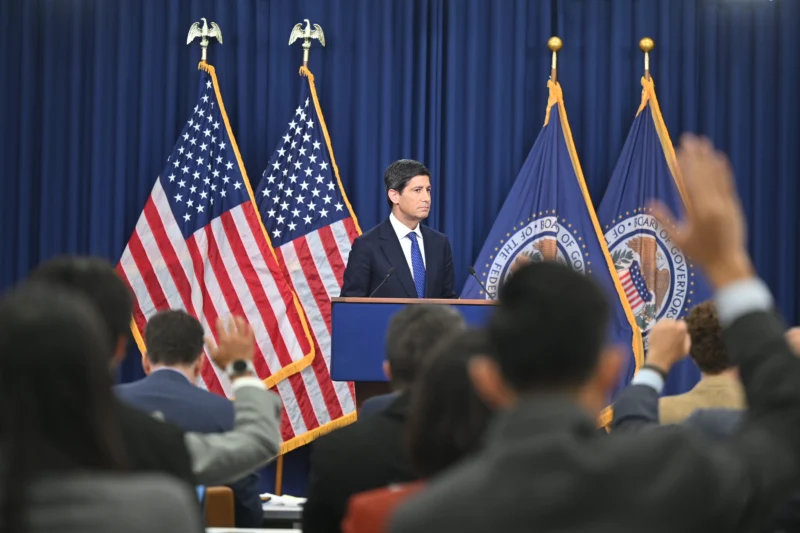
Four days after calling for Tan’s resignation, Trump hosted a meeting in which he and the CEO agreed that the government would acquire a stake in Intel. After this meeting, Trump called the CEO a “success.” This encounter illustrates a frightening political reality: in America, in order not to be targeted by the administration, one must seemingly bend the knee. Trump has significant leverage over Intel. The company has already taken 2.2 billion dollars in CHIPS Act money, and there is $5.66 billion from the agreement still on the table, meaning that they are essentially forced to comply with the Trump administration.
America’s commitment to free-market principles has taken a back seat over the decades. In 2008, the Obama Administration bailed out General Motors after years of corporate mismanagement and declining revenue. The company had stopped producing cars that consumers were interested in, and it should have faced the corresponding consequences. Some continue to tout the GM bailout as a success, but the record is dubious at best. Some might argue that protecting domestic chip makers is in the service of national security. There is ample reason to doubt that strategy. No corporation should be deemed “too big to fail” in a free market to maintain proper incentives and avoid moral hazard. “Free market” does not mean unqualified pro-business.
Trump has stated that deals similar to Intel will be made “all day long.” This sets a frightening tone that, going forward in the United States, political connections will matter more than innovation. As the government increases its stake in massive private companies, there will be no end to its reach. CEOs will answer to the president or, at the very least, make decisions that consider his potential political overreach. Trump has called detractors “stupid people” for expressing opposition to this deal.
As Donald Trump acquires stakes in strategically important companies and imposes his will over them, he is taking a page out of Xi Jinping’s playbook. During Xi’s reign as president of China, he has consistently attacked the private sector. Like Xi, Trump uses his power to control major corporations; he recently blocked the Japanese acquisition of the private U.S. Steel. In 2015, Trump claimed that he was “a free trader 100 percent,” yet he blocks deals when it suits his needs and uses his political power just like Xi.
Executive overreach has been the overarching theme of the 47th president’s second term. A new era of quid pro quo is well underway, and constitutional limits continue to be stretched under his watch. Donald Trump proudly wears the badge of capitalism with “American” characteristics.