A Silver Lining in U.S. Interest Payments
What it means for debt
August 18, 2025

News Article
What it means for debt
The U.S. government’s gross national debt has surpassed $37 trillion, a record number that highlights the accelerating debt on America’s balance sheet and increased cost pressures on taxpayers.
The $37 trillion update is found in the latest Treasury Department report issued Tuesday which logs the nation’s daily finances.
The national debt eclipsed $37 trillion years sooner than pre-pandemic projections. The Congressional Budget Office’s January 2020 projections had gross federal debt eclipsing $37 trillion after fiscal year 2030. But the debt grew faster than expected because of a multi-year COVID-19 pandemic starting in 2020 that shut down much of the U.S. economy, where the federal government borrowed heavily under then-President Donald Trump and former President Joe Biden to stabilize the national economy and support a recovery.
The Impact of the Exploding National Debt
Hussein quotes Michael Peterson of the Peter G. Peterson Foundation on what the impact of the explosion of the national debt means:
Chair and CEO of the Peter G. Peterson Foundation, Michael Peterson said in a statement that government borrowing puts upward pressure on interest rates, “adding costs for everyone and reducing private sector investment. Within the federal budget, the debt crowds out important priorities and creates a damaging cycle of more borrowing, more interest costs, and even more borrowing.”
We can see what Peterson is describing in the records of the U.S. government’s gross interest payments on the national debt. In the first quarter of 2020, this mandatory spending totaled $544 billion, representing about $1 out of every $9 the U.S. government spent. One year later, this spending category fell to $534 billion because the government’s cost of borrowing dropped to near-zero percent. The decline in the cost of borrowing offset how much the government was borrowing during the pandemic.
That situation changed dramatically during the Biden administration, whose fiscal policies ignited inflation in early 2021, which caused interest rates to soar. So much so that paying interest on the national debt became the fastest-growing component of the U.S. government’s outlays. The chart below shows that impact, as gross interest payments on the national debt doubled by the first quarter of 2024.
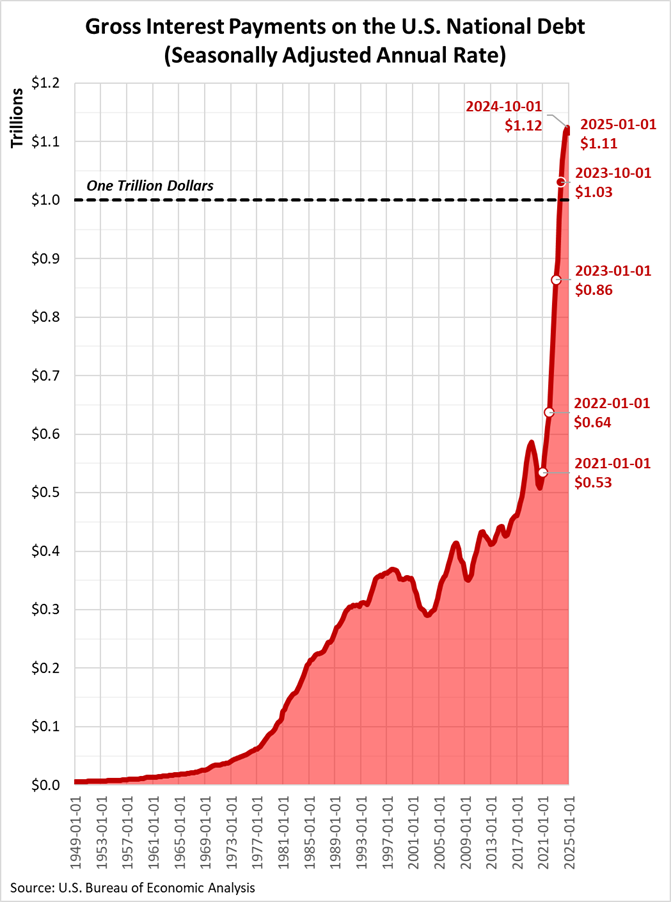
Because paying interest on the national debt is a mandatory expenditure, such an increase automatically reduces the amount of money available to pay for the U.S. government’s other “important priorities”. The Biden administration’s main approach to deal with that problem was to borrow even more. Peterson describes how fast the U.S. government blew through many other grim milestones for the national debt since the first quarter of 2024:
The U.S. hit $34 trillion in debt in January 2024, $35 trillion in July 2024 and $36 trillion in November 2024. “We are now adding a trillion more to the national debt every 5 months,” Peterson said. “That’s more than twice as fast as the average rate over the last 25 years.”
An Unnoticed Silver Lining
A recent trend in the U.S. government’s gross interest payments provides a glimpse of a silver lining at this latest grim milestone, which has gone almost unnoticed. The rate at which the federal government’s gross interest payments are rising has slowed since the fourth quarter of 2024 and has even dipped for the first time since the first Trump administration.
That improvement coincides with President Trump’s actions to restrain the Biden administration’s excessive spending during the first six months of his new term in office and the Federal Reserve’s interest rate cuts during the second half of 2024.
The recent passage of the One Big Beautiful Bill Act has the potential to reverse that improvement. Its increased spending in support of President Trump’s initiatives needs to be offset by additional spending reductions in other federal programs to minimize its effect on the overall growth of the national debt. Lower interest rates would also improve the U.S. government’s fiscal situation.
Avoiding the worst fiscal errors of the Biden administration, the Trump administration is working through the regular budget process to restrain the growth of government spending. It is also considering additional rescissions of previously approved expenditures. President Trump is also making a point of using the presidential bully pulpit to advocate for the Federal Reserve to resume cutting interest rates.
Over six months into President Trump’s second term in office, his administration has made some progress toward putting the U.S. government on a more sustainable fiscal path. However, much more progress needs to be made.