Trump’s Tariffs Could be in Trouble
July 30, 2025

Listen to the article here:
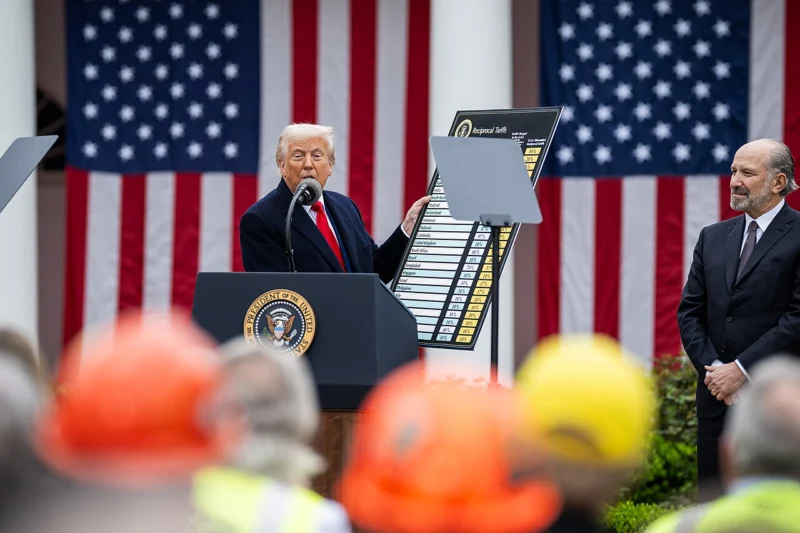
It’s difficult to find a subject more central to the start of President Trump’s second term than tariffs. He has described “tariff” as the most beautiful word in the dictionary, and his actions fully support that view. The timeline of his tariff updates this year shows that he has changed policy weekly, if not daily, since taking office. However, the tariffs he has implemented could soon come to an end.
In May, the Court of International Trade ruled unanimously in V.O.S. Selections, Inc. v. Donald J. Trump that the tariffs based on the International Emergency Economic Powers Act (IEEPA) are unconstitutional. The administration has appealed the case, which will be heard on July 31. If the court of appeals rules the tariffs unconstitutional, they would all be undone.
That would certainly be good for America. The Constitution explicitly delegates the authority to tax and to regulate international commerce to Congress. It is foundational to our system of government that Congress has no authority to delegate its legislative powers to the other branches of government. An originalist interpretation of the Constitution cannot support Trump’s tariffs.
Separation of powers and limitations on executive power have made America a great nation for nearly a quarter of a millennium. The administration’s tariffs have threatened the separation of powers by shifting the power to tax to the presidency, which would concentrate power in the hands of the executive.
Moreover, limited government, low taxes, free markets, separation of powers, a constrained executive, and an originalist interpretation of the Constitution are core principles of American conservatism. These tariffs betray the conservative principles that the Republican Party is supposed to stand for.
Trump’s tariffs also weaken the Republican Party’s outlook for the midterm election. They are extremely unpopular. Republican candidates will have to choose between distancing themselves from the tariffs and backing the administration. If the courts shoot down Trump’s tariffs, Republican chances in the midterms could be salvaged.
But such a legal result would create a number of challenges as well. For example, it could produce confusion and uncertainty in the short term. The president recently rolled out new tariffs, scheduled for August 1, on a number of countries, including Vietnam, South Korea, Japan, the European Union, and the Philippines. A court decision would likely come soon after that, so rapid change could take place over the next few weeks.
Moreover, the Big Beautiful Bill assumes revenue from Trump’s tariffs. If they are declared unconstitutional, $2.8 trillion would be missing from planned government revenue for the next decade.
Striking down the tariffs would be good for restoring constitutional order and improving the economy, but would also increase budget deficits when deficits are already quite large.
A lot hangs in the balance with the Court of Appeals. Tariffs, unfortunately, have been at the center of political action for the Trump administration. The court’s decision could put all of that behind us.