The Art of the Trade Deal: Playing Chess, Not Checkers
Mythbusters: Debunking the New Mercantilists, Part 7
June 24, 2025

News Article
Mythbusters: Debunking the New Mercantilists, Part 7
Note: This is the seventh article in a multi-part series on teaching economics through today’s ongoing trade war. You can read Part 1 here, Part 2 here, Part 3 here, Part 4 here, Part 5 here, and Part 6 here. Stay tuned for more.
Throughout this series, we’ve tackled some of the most popular arguments that today’s mercantilists have used to justify President Trump’s “Liberation Day” tariffs. In short, we’ve argued that there is no good economic argument for tariffs and other protectionist policies. Protectionism doesn’t create jobs or wealth; it destroys them. Indeed, all the leading economic arguments for tariffs fall apart under even the slightest hint of scrutiny. Tariffs aren’t an effective way to raise revenue, nor were they responsible for America’s economic growth in the 19th and early 20th century. Lastly, tariffs can’t be justified by fears about our bilateral or overall trade deficits with other nations.
In this article, we tackle the most clever argument raised by today’s trade warriors: the “strategic” case for using tariffs to strong-arm other nations into lowering their trade barriers on U.S. exports.
It’s a bold strategy, to put it mildly. Why? Because if the end goal is free trade, it’s essentially a high-stakes bluff. Economic theory teaches us that the case for free trade is unilateral—even if other nations don’t practice free trade with us, we’d be better off dropping our restrictions on them. But in practice, what if tariff threats are a better way to achieve reciprocal free trade?
If threatening trade wars actually worked—if every other nation did, in fact, eliminate their trade barriers in response to the mere threat of “mutually assured economic destruction”—then it’d be difficult for economists to oppose this strategy on pure principle. Isn’t a world of completely free trade even better than a world where only we practice it?
If playing hardball works, economists can’t let their romantic ideas get in the way of progress. Like a bluff in poker, “all’s well that ends well”—even if your logic is faulty and the cards you’re playing are weak. War itself is never a first-best option, but at times it’s necessary. Why wouldn’t trade wars operate under the same rules?
In 2007, the legendary running back-turned-actor-turned-accused-murderer O.J. Simpson released a book titled If I Did It (with the words “I Did It” colored in crimson red for dramatic effect). In it, he outlined how a “hypothetical” killer would have committed the brutal double homicide that he was infamously accused of and ultimately found not guilty of. As a general rule, we aren’t fond of comparing ourselves to O.J. Simpson. But in this case (literally just this case), we must confess to taking a page out of the Juice’s playbook as we consider what a well-executed trade war might look like “if we did it.” Could we help mastermind the perfect economic crime?
Our goal here is essentially to “steelman” the strategic case for using the threat of tariffs to elicit free trade deals. In particular, we want to make the best possible case for where hardliners in the administration might be onto something with their tough talk on tariffs. Is there a case for using tariff threats as a negotiating ploy? If so, then hypothetically, how would economists conduct the trade war to usher in our dream world of free trade? Think of this as an economic version of “red teaming” in cybersecurity or “wargaming” in the military. Only by engaging in this exercise can we discover where the case for unilateral trade disarmament that we’ve laid out thus far may be flawed.
Playing Chess, Not Checkers: An Economists’ Guide to Fighting Strategic Trade Wars
Asking economists to help fight a trade war is like asking a cat to swim or forcing Ron Swanson to eat vegan. Restricting trade is unnatural for us. It goes against everything that economics has taught us since the days of Adam Smith.
Nevertheless, let’s suppose our conscientious objector claims were denied and we were enlisted in today’s trade war. If forced to devise a “strategic trade war plan” to bring about freer trade, our strategy would be grounded on three pillars. We’ll call them the “three T’s” of trade wars.
First, a strategic trade war should be Targeted. In particular, its scope should be squarely focused on “bad actors” nations and “strategically important” industries. For our purposes, “Bad actors” refers to nations that impose significant trade restrictions on American firms and exports; “strategically important” refers to products and industries deemed essential for economic and national security.
Why is it so vital that the trade war be targeted? Since trade promotes peace and prosperity, we want to avoid inflicting any collateral damage on friendly trading partners. Reliable trading partners don’t need to be catching strays in a well-executed trade war. To the extent they do, we’re unnecessarily hurting our relationship with those allies and harming our own economy. We also want to minimize any blowback we might face in the form of retaliatory tariffs. When it comes to using tariffs and other weapons in our strategic trade arsenal, we want to shoot with a sniper rifle, not a shotgun.
Second, it should be Transparent. This means that officials should announce any tariffs or sanctions well in advance. There’s also a case in which they should be phased in rather than going into effect all at once.
Why telegraph your maneuvers? In chess or traditional warfare, the element of surprise is essential. You don’t want your foe to predict your next move or see your attack coming. Trade wars, however, operate under very different rules of engagement. If the goal is to negotiate better (i.e., freer) trade deals, guerrilla warfare and surprise attacks aren’t the best course of action.
Instead, you want your counterpart to know exactly what you plan to do and when you plan to do it. This gives them ample time to negotiate and strike a deal before a mutually destructive conflict begins. Telegraphing your actions is also smart because it gives businesses more time to adjust their supply chains and plan for the future. As any economists worth their salt can attest, uncertainty is a surefire recipe for economic stagnation. If we want to avoid an economic quagmire, transparency is critical.
The key thing to keep in mind is that tariff threats should be a form of deterrence. The goal is to avoid hostilities, not incite them. Remember: trade is, by definition, “win-win.” When people trade, they’re both made richer. This is just as true for trade between people in different nations as for trade within a country. Thus, anything that impedes trade is a “lose-lose”—it makes people in both nations poorer. It’s one thing to talk tough and threaten tariffs. But it’s another to enact them. The moment those talks fall apart and a trade war actually breaks out, both sides have already lost.
Third, trade wars should be Temporary. For tariff threats to be effective, they must be negotiable and, ultimately, reversible if your terms are met. The sooner an armistice is reached, the better.
Why should trade wars be short-lived? For the same reason, traditional wars should be as brief as possible: wars are bad. They are bad for international relations, for business, and for the economy writ large. Economics teaches us that trade restrictions make us poorer. Prolonged sanctions and economic trench warfare don’t do anyone any good. If the whole point is to get bad actors to jettison their restrictions on us, then we must be willing to lay down our arms as soon as they lay down theirs.
This also means tariffs can’t remain in place for the sake of economic protection. Digging our heels in and maintaining our tariffs even when other nations surrender is a fool’s errand. There’s no point in nations negotiating with us if they don’t think we’re willing to uphold our end of the bargain.
Playing Checkers, not Chess: Why the President’s Trade War Blew Up in His Face
Taken together, these three T’s—the idea that trade wars should be Targeted, Transparent, and Temporary—form the basis of any effective trade war strategy. So, how does the Trump administration’s strategy on “Liberation Day” stack up to these three pillars? Not great.
Let’s start with the first pillar (Targeted). Strategically, we conceded that it may make sense to target “bad actors” and play hardball with them, particularly if these threats get them to the negotiating table.
The most notorious example is China. Rendering a judgment on whether China is, in fact, a bad actor is beyond our scope here. Reasonable people disagree on whether its trade practices are “unfair” and, even if so, what constitutes an appropriate response. It’s not a stretch to assume that the Chinese Communist Party (CCP) isn’t exactly a reliable partner or good-faith actor on trade.
That said, we don’t want to conflate the CCP regime with its citizens, the vast majority of whom are honorable trade partners. Remember our point about methodological individualism from earlier in this series: “Nations” don’t trade with each other—people do! To the extent that we can minimize the collateral damage of our trade war on innocent civilians, we absolutely should.
For the sake of argument, let’s assume China is, in fact, a bad actor that deserves to be targeted in our trade war. Risky as it may be to play hardball with the world’s largest exporter and one of our largest trade partners, if we could, in theory, pressure them to drop their trade restrictions on us, then the free trade ends may justify these rather risky and unsavory means of getting there.
Did the administration only target “bad actors” like China with its tariffs? Not in the slightest. They slammed every country on the planet with tariffs—roughly 190 nations. Norm Macdonald quipped that Germany made the fatal mistake of declaring war on the “entire world” not once but twice in the 20th century. Though the stakes weren’t quite as high, President Trump effectively made the same mistake on April 2 when he declared a trade war on the entire world, including nations we had trade deals with and that most Americans probably hadn’t heard of and certainly couldn’t locate on a map! (Looking at you, Lesotho. We think. Or is that Swaziland…?) Instead of using precision strike missiles, the President effectively fired nukes at the rest of the world (figuratively speaking).
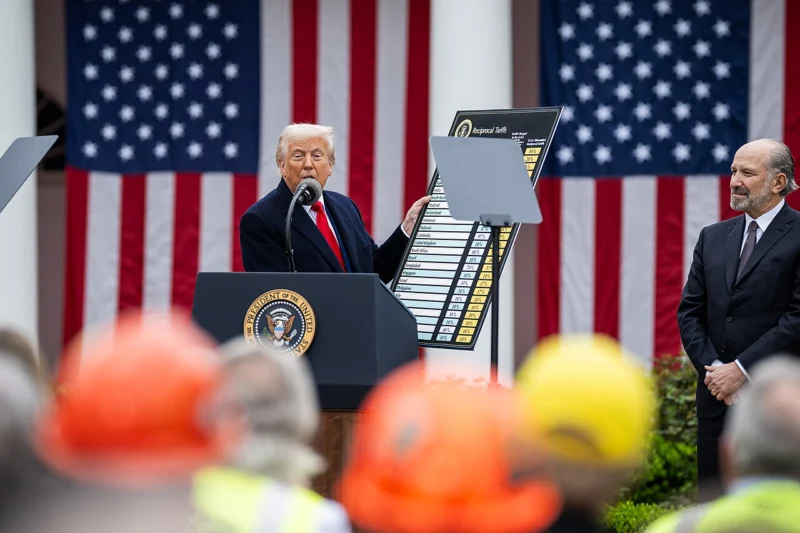
Contrary to the President’s claims, most of his tariffs weren’t “reciprocal” or “retaliatory” in any meaningful sense of the words. Most of the nations we imposed our steepest tariffs on did not have exorbitant tariffs or non-tariff barriers on us. In fact, America’s track record isn’t exactly above reproach when it comes to free trade. Before April 2, the average tariff rate the U.S. imposed on foreign imports was approximately 2.5%; the average tariff rate that foreign nations imposed on U.S. exports was only about 2%. After “Liberation Day,” our average tariff rate shot north of 25%. Even after the President’s 90-day pause on April 9, our trade-weighted average tariff rate still exceeds 24%, making the U.S. the most protectionist nation in the developed world. Even the alleged “worst offenders”— China, the EU, Mexico, and Japan—charged no more than 4-5% tariffs on U.S. exports, which is well below the President’s 10% baseline tariff rate that’s been in place since April 2.
What about another rationale for precisely-targeted tariffs: protecting strategically vital industries? Theoretically, an economist could justify restricting trade on vital goods to protect domestic producers and ensure that we wouldn’t be left in the lurch if a war or pandemic broke out. Indeed, protecting national security is often the one exception that economists carve out to the general rule of thumb that trade restrictions are bad, even if its proponents often vastly overstate the threat such trade poses to our economy and the pleas from domestic firms are fraught with ulterior motives.
Take a popular example: semiconductors. Roughly 90 percent of the semiconductors we use in America are imported from abroad, with the largest share coming from small countries in Southeast Asia, like Thailand, Vietnam, and Taiwan. Suppose the cold war between the U.S. and China heats up. In that case, it’s conceivable that China could prevent us from accessing these markets by imposing a naval blockade or threatening sanctions or military intervention. Cutting off these trading networks would deliver a critical blow to our tech sector. For this reason, the bipartisan CHIPS and Science Act was passed in Congress and signed by President Biden.
Both the Biden and Trump administrations invoked the Defense Production Act to protect and incentivize domestic production of essential tech inputs. But were the recent tariffs, as a matter of fact, narrowly tailored to aid strategically vital industries? Again, not in the least. By choosing to base its tariff rates on our bilateral trade deficits, the tariff has affected every import industry, from computer chips to children’s dolls. At length, we’ve discussed the folly of basing tariffs on bilateral trade deficits. Suffice it to say it’s hard to imagine a less targeted way to wage a trade war than basing it on trade deficits. Far from using a sniper to target key industries, the President shot from the hip using a sawed-off shotgun. No matter how you slice it, if strategic trade wars work best when they’re precisely targeted, the administration has failed abysmally.
What about the second pillar (Transparent): were the administration’s tariffs telegraphed in a way that allowed American businesses to adapt while also giving foreign nations time to negotiate freer trade deals with us? Not at all. Even though markets began pricing in some smaller-scale tariffs earlier this year (expecting them to be more akin to the first Trump administration’s more limited tariffs in 2018), it’s safe to say they weren’t prepared for the sweeping and totally random nature of the tariffs that were announced on April 2, as evidenced by the stock market’s double-digit decline in the three days after “Liberation Day.”
The President’s sporadic pauses in the ensuing weeks may have prevented markets from spiraling even further, but that is hardly an endorsement of his tactics.
The quixotic, on-again, off-again nature of the tariffs has been one of the most costly aspects of today’s trade war. As we advised earlier, these sputtering pauses shouldn’t be confused with prudent policy or effectively “phasing” them in to give markets time to adjust. Indeed, the whimsical nature of the tariffs has hurt the economy and created a dizzying level of regime uncertainty. Even in the midst of the 90-day pause, the fog of the trade war has hardly lifted. Business investment has cooled dramatically, and the economy is performing well below its pre-tariff trend. Given that the President’s 90-day pause is slated to end in early July, the relative calm that markets have experienced over the past month is most likely the eye of the storm, not the end of it.
But couldn’t all this chaos be part of the President’s deal-making genius? After all, doesn’t the “Art of the Deal” require a little turbulence to throw our opponents off-kilter? Almost certainly not.
The “madman theory” that many believe the President deploys as part of his deal-making persona might work in foreign policy, but it’s not well-suited to trade policy. Why? For the same reason that Fortune 500 companies don’t invest in basketcase nations, chaos and uncertainty are bad for business. Few people are willing to enter into long-term relationships with “madmen.” This is especially true in business. It’s hard to get a trade partner to the negotiating table when they can’t follow your logic and it’s not even clear what’s at stake. This is where the chaotic nature of today’s trade war has backfired most.
Many nations are hesitant to make concessions because the President has shown that he’s liable to change his policies on a whim. It’s hard to get to “yes” in a negotiation when the side that started the talks has no clear idea what they’re trying to accomplish. It’s even harder when you don’t trust that they’ll negotiate in good faith or ultimately hold up their end of the bargain.
Remember that in a strategic trade war, the aim is not “total victory” as with traditional warfare. We’re not here to completely eliminate our adversaries as we did with the Nazi regime. Our main goal is to increase trade, not to end it. We want to build strong, lasting partnerships instead of creating conflicts. We also don’t want to cause ongoing economic harm to others or to ourselves. Hayek noted that the Greek word for trade—katallassein—also means “to turn a foe into a friend [1].” This is a fitting way to view the end goal of strategic trade talks. Madmen may be formidable enemies in a war, but they’re terrible trade partners.
How about the third pillar of strategic trade wars (Temporary): have the tariffs been short-lived, serving as an effective prod to get other nations to the table as quickly as possible to ink new trade deals? Furthermore, has the administration credibly shown it’s willing to hold up its end of the bargain by eliminating trade restrictions on nations that do the same for our exports? Again, no.
Three months into the trade war, the Trump administration has inked only one new trade deal (with the U.K., which, ironically, America had a trade surplus with and had significantly lower tariff rates on U.S. goods than vice versa). If you’re keeping score at home, that means there are roughly 189 trade deals that have yet to be signed. Even worse, the one trade deal the administration can tout turned out to be lousy, particularly for American consumers. Tariffs on imports from the U.K. tripled from 3.4% to 10%. History and economic theory tell us these tariffs will be borne almost entirely by Americans in the form of higher prices and lost gains from trade.
Is the administration at least negotiating in good faith by credibly indicating they’re willing to nix all of their tariffs at the drop of a hat if others do the same? Far from it. The President has made it clear that he’s committed to maintaining a 10% baseline tariff on all nations indefinitely, regardless of what concessions other nations make. Negotiating “better” deals may be a part of his vision, but it’s certainly not his overriding objective. At the end of the day, Occam’s razor provides the best explanation of his motives: He likes tariffs and he thinks protectionism is good.
In the coming weeks, readers should gird themselves for an onslaught of “positive” headlines leaking from the administration about new trade deals being struck. Many nations will inevitably be forced to the negotiating table before the 90-day pause comes to an end in July. This shouldn’t come as a surprise—on April 2, the U.S. launched the biggest trade war in modern history. It’s hardly a diplomatic feat, then, that dozens of nations, particularly close trading allies that we’ve long enjoyed fairly free trade with, have allegedly reached out to the administration to negotiate. They’re negotiating out of duress, not out of any legitimate sense of guilt or reparation.
Recall our discussion of the broken window fallacy. Celebrating new trade deals is as economically foolish as celebrating a broken window because repairing it will make the economy wealthier. Destruction doesn’t create wealth. Broken trade deals, like broken windows, call out for repair. But that doesn’t mean that it was wise to smash through them in the first place. This is especially true if the new deals are worse because they involve far more trade restrictions than the ones they replaced. Before you toast the administration on striking a new trade deal, be sure to read the fine print. We’re all getting a raw deal to the extent that these new deals result in higher tariffs and less foreign trade.
Don’t get hoodwinked into thinking that new trade deals are a great leap forward from the pre-April 2 status quo ante. They’ll likely be a small step forward after a giant leap back. At the end of the day, the President isn’t playing 4-D chess with his tariffs. He’s playing checkers. And we’re all losing.
Playing Devil’s Advocate: The National Security Argument for Restricting Trade
At the beginning of this article, we noted that there is no good economic argument for restricting trade. But there is one non-economic argument that economists typically grant as an exception to the general rule that tariffs and trade restrictions should be off the table: legitimate national security concerns.
Earlier, we used the example of semiconductors to show how, in theory, there might be an argument for using trade policy to protect key domestic industries. In practice, there are very few products or industries that truly warrant protection on national security grounds. As we noted, once politicians open the door to this argument, it’s often a slippery slope to outright protectionism. Pleas from domestic industries for protection are often fraught with self-interest and ulterior motives. That’s why we should look skeptically at any and all such claims.
There is a related non-economic argument, however, that merits consideration: cutting off trade with a geopolitical bad actor that might pose a severe or existential threat to our national security. Take a historical example. There’s a reasonable case to be made, especially in hindsight, that the U.S. and other nations should’ve suspended trade with Nazi Germany in the 1930s. We call this argument “non-economic” because, contrary to what protectionist politicians often claim, such a trade war will not make our economy “richer.” Trade wars, by definition, make us poorer.
The argument for launching a trade war, in this case, is a geopolitical one, not an economic one. When the U.S. and Germany trade, they both grow richer. It follows that if we halt trade with Germany, Americans will be made poorer—but so will Germany! Inflicting economic pain on Germany to help starve the Nazi war beast is, in fact, the whole point. Americans must be willing to sacrifice some wealth in the short run for greater security in the long run.
If politicians were honest about this trade-off, economists wouldn’t cry foul. Alas, politicians love to have their cake and eat it too—they prefer to promise that trade wars will hurt our enemy’s economy and enrich ours. The latter is dead wrong. Americans will inevitably be poorer when they lose access to major trading partners like Germany in the 1930s or China today. Trade wars require pain, not gain. The argument any honest politician needs to make to the public is that this pain is worth it. Slower growth is the price we pay today for greater security tomorrow. There is no free lunch in a trade war, only trade-offs. The relevant question we must ask, then, is this: Is the trade-off worth it?
Trade War: What is it Good For? (Absolutely Nothing)
Traditionally, economists’ advice for how to fight a trade war is very simple: don’t. As we’ve argued throughout this series, trade is good. It makes both sides richer. This is just as true for nations as it is for individuals. It follows, then, that anything that inhibits trade, by definition, makes us poorer. As Henry George observed when he likened trade wars to a self-imposed blockade: “protectionists seek to do to our own nation in times of peace what our enemies seek to do to us in times of war.”
If economists had their way, every nation on Earth would abandon its protectionist policies and adopt free trade, not just because it would benefit the world economy but also because it would benefit its citizens!
Calls for “fair trade” and “leveling the playing field” with retaliatory tariffs sound reasonable, but they’re rooted in a misunderstanding of how trade works. Parents love to tell their kids, “Just because your friends are dumb enough to jump off the Brooklyn Bridge doesn’t mean you should too!” Economists yearn to remind us that the same exact logic applies to trade. The fact that some nations impose tariffs and restrict trade with us does not imply we should do the same to them. If tariffs are a tax primarily borne by that nation’s citizens, then it’s silly to argue we should hike taxes on our citizens just because, say, China is foolish enough to hike taxes on theirs.
How do you win a trade war, then? By avoiding it entirely, even if that means unilaterally disarming by getting rid of your own protectionist policies. Two wrongs don’t make a right when it comes to trade policy. Every nation would be wise to follow the Golden Rule of trade by eliminating its tariffs.
Alas, as The Rolling Stones sang and economists are all too aware, we can’t always get what we want. In populist moments like today, the “first-best” solution of unilateral free trade might not be on the table politically. Often, the only viable options in life are “second-best” ones. As Thomas Sowell said, there are no solutions, only trade-offs. So, if forced to devise a “second-best” strategy of using tariff threats to usher in a world of free trade, our best advice would be to follow the “three T’s” above.
Regrettably, the Trump administration has done exactly none of these things since “Liberation Day.” Its policies weren’t targeted, transparent, or temporary.
To be clear, even our hypothetical strategy of threatening tariffs to elicit trade concessions is fraught with risks. Economists don’t exactly have a comparative advantage in hardball negotiations. Even if our role was restricted to crunching the numbers to determine what tariff rates would yield the most concessions, those calculations would inevitably be flawed. The unintended consequences on our politics would be even worse. Opening the floodgates of tariffs, even slightly, would cause more lobbyists and special interest groups to come pouring into “The Swamp.” Once these cronies get a seat at the table, there’s no telling what they’ll wheedle politicians into doing on their behalf.
Even if politicians decide they must take action to protect key industries or target “bad actors,” tariffs are an especially blunt and ineffective tool for achieving these goals. Using broad-based tariffs in the hopes that it will only harm bad actor nations and aid certain industries is like using a napalm bomb to conduct a controlled burn. The damage is almost impossible to contain, and in the end, you’ll only wind up burning yourself. This damage inevitably gets worse when other nations respond with retaliatory tariffs on your exports, as is historically the norm. As Daniel Hannan put it: “Tariffs are like suicide bombs. They may incidentally hurt other people, but they’re guaranteed to hurt you.”
It’s worth noting that there are far better diplomatic tools at our disposal than threatening trade wars in cases where foreigners aren’t playing by the rules of the game and a little hardball is warranted. For instance, to the extent “bad actors” receive U.S. foreign or military aid, we could threaten to cut that aid. Slashing aid is a far nimbler way to target bad actors than relying on ham-fisted tariffs. Whereas trade wars hurt people in both nations (including your own), rescinding aid primarily harms people in countries you’re trying to exert pressure on. An added bonus: it saves U.S. taxpayers money.
Another option would be to sanction government officials in bad actor nations by freezing their personal bank accounts or prohibiting them from making deals in the U.S. This is a much better, more surgical option than imposing tariffs that harm the general population of those nations as well as your own citizens After all, our quarrel isn’t with the people of China or any other “bad actor” nation—it’s with their government and its policies. Trade wars hurt the general public far more than they hurt the officials who dictate trade policy. Remember: abstract “nations” don’t trade—individuals do. The last thing we want to do is hurt the foreigners who trade with Americans.
At the end of the day, our lesson here is simple: trade wars are bad, and we should avoid them to the extent we’re able. There may be some legitimate non-economic arguments for restricting trade (e.g. national security). However, there is no good economic argument that trade wars make the economy richer.
It’s perfectly reasonable that Americans want to see more domestic production and faster growth. Thankfully, there are many better ways to accomplish this than by launching destructive trade wars. We could slash unnecessary regulations that make it prohibitively costly to produce in the U.S.. We could also simplify our labyrinthine tax code and reform it to encourage more savings and investment. We could also slash government spending and our deficits to lower interest rates and prevent government borrowing from “crowding out” private investment. Of course, doing these things is far easier said than done. It requires political will and a tolerance for some short-term pain. Entitlement reform, for instance, remains a third rail in our politics.
But these challenges only serve to highlight the importance of economic education. The best way to make the U.S. economy more competitive is to get our own economic house in order, not wage a trade war on everyone else’s.
Notes
[1] Building on Hayek’s point, James Buchanan advocated changing the name of economics to “catallactics” (or “symbiotics”) to stress that economics is fundamentally about finding ways to facilitate peaceful exchange.