One Month Later: Rewinding Canada’s Election Results
What comes next?
May 29, 2025

News Article
What comes next?
British Prime Minister Harold Macmillan once said the greatest challenge for a statesman is “events, dear boy, events.” That quote proved prophetic in Canada’s recent federal election, which ended nearly a month ago but continues to reverberate. The recent federal election sparked an “elbows-up movement” as a protest against the trade war between the United States and Canada. Conservative leader Pierre Poilievre entered the race with a commanding lead, only to be overtaken by a revitalized Liberal party under Mark Carney, whose win stunned many political observers.
What happens next?
Poilievre was seen as one of the country’s most talented politicians. He is a disciplined thinker with skillful oratory that can skewer an opponent before they can blink. He is a conservative with a classical liberal streak who, as a teenager, was influenced by economist Milton Friedman’s book Capitalism and Freedom. While at university, he won $10,000 for an essay in which he proposed that, as prime minister, he would build his government’s platform on the principles of freedom.
In a country that had been gripped with political correctness, Poilievre was perceived as a breath of much-needed honesty: “I think when politesse is in conflict with the truth, I choose the truth,” he said, “I think we’ve been too polite for too long with our political class.” His brashness, belief in smaller government, and free markets make him a target of the left-leaning Liberal establishment.
At the time, his rallies had drawn thousands of people hungry for change. He fought a disciplined and well-organized election that focused on issues impacting working people, the cost of living, housing affordability, and crime. In contrast, the Liberals exploited the country’s rise in nationalism and anti-Trump sentiment for political gain.
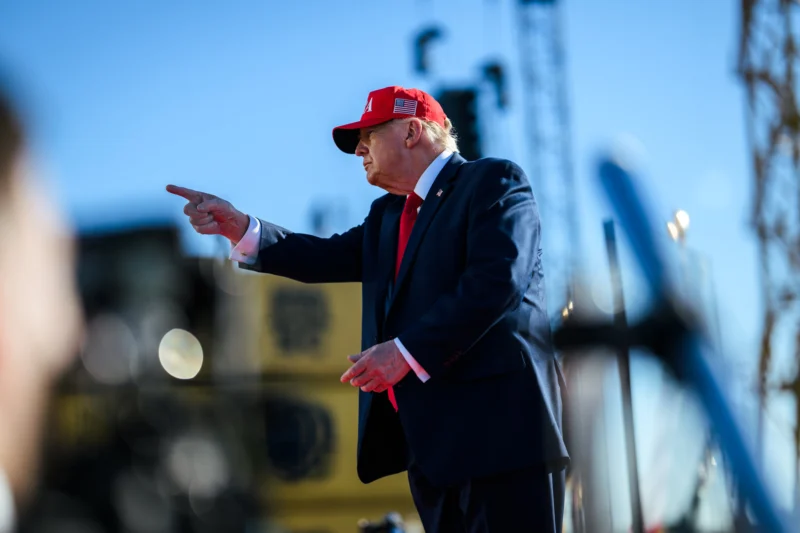
Poilievre’s campaign had been slow to respond to Trump’s imposition of tariffs, which allowed the Liberals to shift the narrative away from a disastrous lost decade under Justin Trudeau to portraying Trump as a serious threat to the country’s sovereignty. Poilievre’s rhetoric towards Trump was restrained, yet Canadians became so preoccupied with his annexation threats that his pragmatic messaging could not penetrate the collective anxiety that swept over the nation. Had Poilievre confronted Trump’s rhetoric more directly, it is possible he could have neutralized the Liberal advantage.
Poilievre had frequently referred to Canada as a broken country, arguing that Liberal mismanagement of the economy had created economic difficulties long before Trump’s arrival. In response, the Liberals cherry-picked statistics, telling the public everything was great, and then accused him of creating division. The Liberals ran advertisements juxtaposing Poilievre stating that “everything is broken” and Trump making a similar claim in the US. If Canada were a publicly traded stock, it would be significantly undervalued and ripe for a takeover. Its economic weakness has caught the attention of Trump, who, on election day, again expressed interest in making Canada the 51st state.
A pre-election report issued by Policy Horizons had painted a bleak picture. The report states that by 2040, most Canadians may find themselves stuck in the socioeconomic conditions in which they were born, facing downward mobility. The only way to get ahead will be through inheritance and society will increasingly resemble an aristocracy, the report cautioned. Carney has acknowledged some of the country’s problems and that is why he went ahead and stole the Conservatives’ best ideas from getting rid of the carbon tax, cutting taxes, and reining in immigration, proving that Poilievre was right all along.
As the race had tightened, one would have expected that conservative Premier Doug Ford of Ontario, the country’s largest province, would support Poilievre or at least not meddle in the election. His campaign manager Kory Teneycke—who recently engineered Ford’s provincial victory by spending $2 billion of tax money to court Ontario voters and sending Ford to Washington D.C to meet with US political backbenchers to appear as if he is the prime minister—lambasted Poilievre’s campaign strategy: “Blowing a 25-point lead and being like 10 points down is campaign malpractice at the highest level,” he said. Machiavellian politics of betrayal were perfectly timed to disrupt Poilievre’s momentum just as Carney’s appeal was fading.
After the election, Conservative Jamil Jivani tore into Ford: “He has taken the provincial Conservative Party and turned it into something hollow, unprincipled, something that doesn’t solve problems,” he stated. Ford remains a crafty politician who often comes across as a used car salesman. He is ambitious and aspires to lead the federal Conservative Party. He also has strong connections within the Liberal government that make it easier to extract hundreds of millions more in transfer payments to a highly indebted province.
The country’s state-subsidized media had never been friendly to Poilievre’s populism. They treat him as a mini-Trump, encircling him with commentary that he must change his views to meet the narrative of progressive politics, otherwise he can’t win. Poilievre fought back by not allowing journalists on his campaign bus and refused to conduct interviews. As the campaign got underway, the country’s largest publication, the Globe & Mail, published a review of a book titled “Ripper,” which describes Poilievre as “the nastiest leader of a majority party in this country’s history.”
The review amounted to character assassination of the highest order and did little to win over any of the paper’s Liberal readers. Meanwhile, Carney pledged an additional $150 million in funding to the state broadcaster, the CBC. No one in mainstream media questioned how the CBC could receive millions during a campaign and still claim to be objective.
In hindsight, the decision not to engage the media proved to be a strategic mistake. Poilievre is articulate and engaging and could have used more authentic coverage, and speaking to journalists would have expanded his audience. Few Canadians are aware that his wife arrived in Canada as a refugee from Venezuela, and that they are parents to a daughter with special needs. Allowing the media into his personal life would have revealed the human side of his personality.
Poilievre had managed to hold the Liberals to a minority government, increasing seats won, garnering 41 percent of the popular vote, and establishing the Conservatives as the party for working people. However, losing his seat makes him a vulnerable politician, and his enemies are sharpening their knives. The Conservative party is ruthless with its leaders who lose an election and has gotten rid of its last two leaders without hesitation. Poilievre will need to survive a leadership review and run in a by-election to get back in the House of Commons.
If not for the Trump effect, Poilievre might be prime minister today. But politics rarely turns on a single cause. A month later, his campaign serves as both a cautionary tale and a case study in missed opportunities. Whether he regains his seat—and the trust of his party—remains to be seen. But his blend of populism and policy remains potent. Carney will attempt to persuade members of the opposition parties to cross the aisle to gain the majority he needs. Carney plans to rely on significantly increased deficit spending to support an economy facing structural decline and to maintain stability within a fragile confederation.