AI Can Untap Trillions in Economic Potential—If It’s Allowed To
Government bureaucrats, labor unions, and business interests are already squelching this revolutionary technology.
May 18, 2025

News Article
Government bureaucrats, labor unions, and business interests are already squelching this revolutionary technology.
I was recently at an AI tech talk, and during the Q&A session, I noticed water leaking through one of the door seals. It was a rainy night, and the drip seemed to mock the digital dreams being discussed onstage. As speakers described how AI would reshape the online world, I raised my hand and asked: What will AI do to change the physical world—namely buildings? A coder behind me with a construction background declared that it could revolutionize every stage of the building process—if allowed. The problem, he explained, is that there are protectionist interests across the industry—architects, engineers, lawyers, inspectors—who will likely form resistance guilds, requiring that critical building functions still have a human seal of approval. In other words, “AI is coming for your job” doesn’t sound so clever when it’s your job.
This resistance will be a bottleneck in the AI rollout, which otherwise should be huge. One study found that AI advances could boost GDP worldwide by $13 trillion. But like all groundbreaking technologies, it will be delayed and diluted by entrenched interests. This already happens.
Self-Driving Cars
Perhaps the best known example is self-driving cars. Autonomous driving technology can already outperform human drivers in controlled settings. This development is an unqualified good—in the U.S., car crashes are among the top causes of death. Safer roads mean lower insurance costs. Autonomous driving would increase independence for the elderly and disabled. And it has the potential to reduce congestion, freeing up countless hours for productivity and leisure alike. It can also benefit mass transit: automated buses would allow providers to scale up service hours and frequency at lower cost and without contending with labor shortages.
At this point, the biggest reason to be skeptical of an autonomous driving future isn’t the technology, but the entrenched interests who stamp it out.
Ever since self-driving started to look possible, lobbyists and unions in the taxi and trucking businesses have fought it. In 2024, the California Public Utilities Commission paused Waymo’s expansion beyond test sites in San Francisco and Los Angeles for four months for “staff review.” The Teamsters have called for legislation requiring self-driving cars to carry a human driver at all times.
The reason is obvious: they fear mass job loss. Some 3.5 million Americans are employed as truck drivers, and Uber alone has over 5 million drivers worldwide. A lot of hardship would come from all these layoffs.
But focusing only on this “seen” cost, to invoke the dichotomy first posed by economist Frederic Bastiat, ignores the unseen cost of prohibiting self-driving cars. Every day this obstruction continues is a day that thousands of car crashes wound or kill people.
Shipping and Logistics
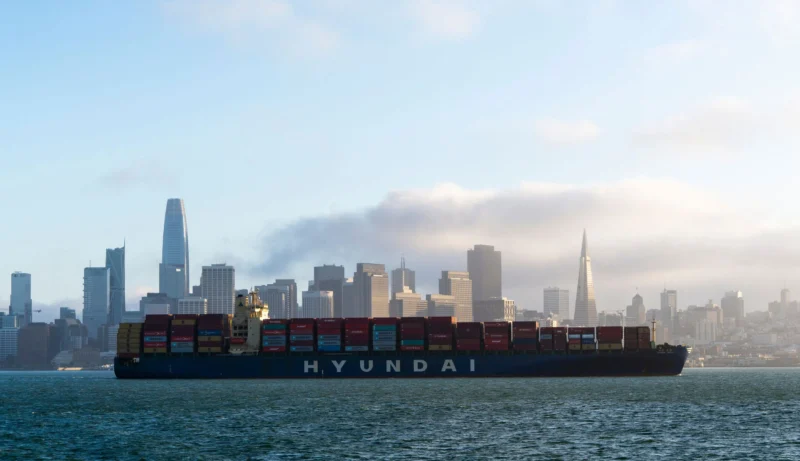
A similar battle is playing out at ports and warehouses. The Covid-era shipping delays, while triggered by that crisis, were worsened by longstanding inefficiency in logistics systems, such as shorter work hours that are often demanded by unions. These are the bottlenecks that automation can resolve, and it does exactly that around ports worldwide. Rotterdam, Europe’s busiest port, is automated and 3x’d its capacity. Automated cranes are commonplace at Chinese shipping terminals, and several even use self-driving technology.
But the powerful labor unions at U.S. ports oppose this, prompting semi-frequent strikes.
“Automation does two things,” asserted Harold Dagget, president of the International Longshoremen’s Association. “It makes the companies rich and the longshore workers unemployed.”
Urban Development
A less-discussed, but just as important, example is found in urban planning and zoning. Permit requirements stifle home construction, with municipal departments reviewing renderings and engineering specs, and ensuring rule compliance. AI can speed up this process.
The coder at the conference offered a precise example: AI can already calculate load-bearing strategies for buildings, determining where to place columns and beams. This is the structural skeleton required for any building permit and often takes engineering firms weeks to produce due to their work backlogs.
Engineering boards have every incentive to make sure it stays that way. They’ll argue it’s about safety, and to some extent, it is. AI generated schematics remain a maturing technology, and some level of human oversight may always be needed. But it’s also about keeping AI from undercutting a lucrative line of work.
*
Technological advance has caused economic change for centuries. But it hasn’t condemned masses to poverty and unemployment—quite the opposite.
The Luddites, who destroyed weaving machinery for fear of losing their livelihoods, did not win the day. The increase in efficiency grew the overall economy, creating new opportunities and jobs in higher value industries. One rebuttal is that the pace of AI development means we cannot guarantee this story will play out again. But the combo of protectionism and bureaucracy only makes big problems worse. The better answer is to make the economy less regulated, and AI can help with that by becoming accessible to all and thus lowering competitive barriers. An Uber driver today could own a self-driving car tomorrow, making passive income without having to share proceeds with a larger company.
A good future approach would be to take seriously what happens if and when livelihoods are disrupted. But it also needs to look at what we’ll lose if we block AI’s progress.
Cover image use authorized under the Creative Commons Attribution-ShareAlike 4.0 International license.