Abstract: Demographic trends imply that the social security system cannot be sustained without large tax increases or large cuts in benefits. In 9 charts, the causes of the crisis in social security are illustrated, the extent of the problem is explained, and some possible solutions are discussed.
-
Alexander T. Tabarrok
is Senior Fellow at the Independent Institute, Assistant Editor of The Independent Review, and Associate Professor of Economics at George Mason University.
Comments
Related Articles
Mandatory spending and surging debt interest drove federal outlays to record levels in fiscal year 2026.
California voters are being told that Proposition 40 is a one-time levy on...
Can government impose significant new obligations based on circumstances that existed...
A look at ten years of unprecedented national debt expansion.
The trade war with Canada is as electorally toxic as it is economically destructive.
The Trump approach would empower patients, free the marketplace, and encourage...
Proposition 40 is pitched as a one-time tax, but taxes that linger grow costlier as...
New federal laws aim to curb out-of-control boondoggles.
The seldom‑used budget tool has attracted attention on Capitol Hill.
Rising healthcare subsidies and interest payments are mounting.
The federal government is set to overspend by more than $2 trillion this year
No country in the world makes health care universally free, paid solely by their wealthiest taxpayers.
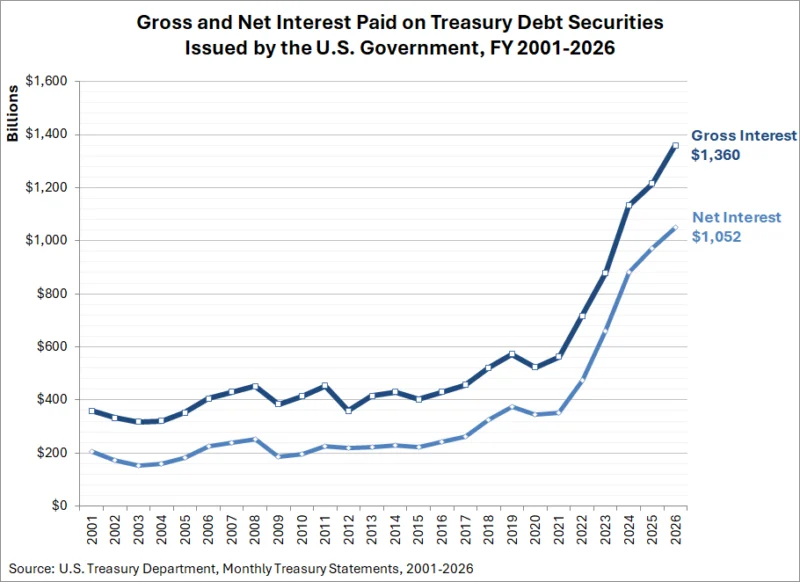
Trillions in deficits have pushed US national debt interest payments to record highs.
Examining California’s Proposed Billionaire Wealth Tax
Aligning politicians' financial incentives with ordinary Americans requires bolder solutions than term...
This isn’t just a matter of partisan scorekeeping. It’s a troubling sign of where our...
The U.S. government’s total public debt outstanding has officially surpassed $40 trillion. It was a...
Reuters columnist Jamie McGeever recently raised an alarm that the chances of governments anywhere...